Warm Introduction Conversion Rates vs Cold Outreach in Venture
Warm intros from trusted sources convert at 4x the rate of cold outreach in venture.

The Spectup case is useful precisely because it controls for almost everything. A SaaS founder, $200,000 in ARR, 15 percent monthly MRR growth. Same company, same deck, same metrics across two sequential campaigns.
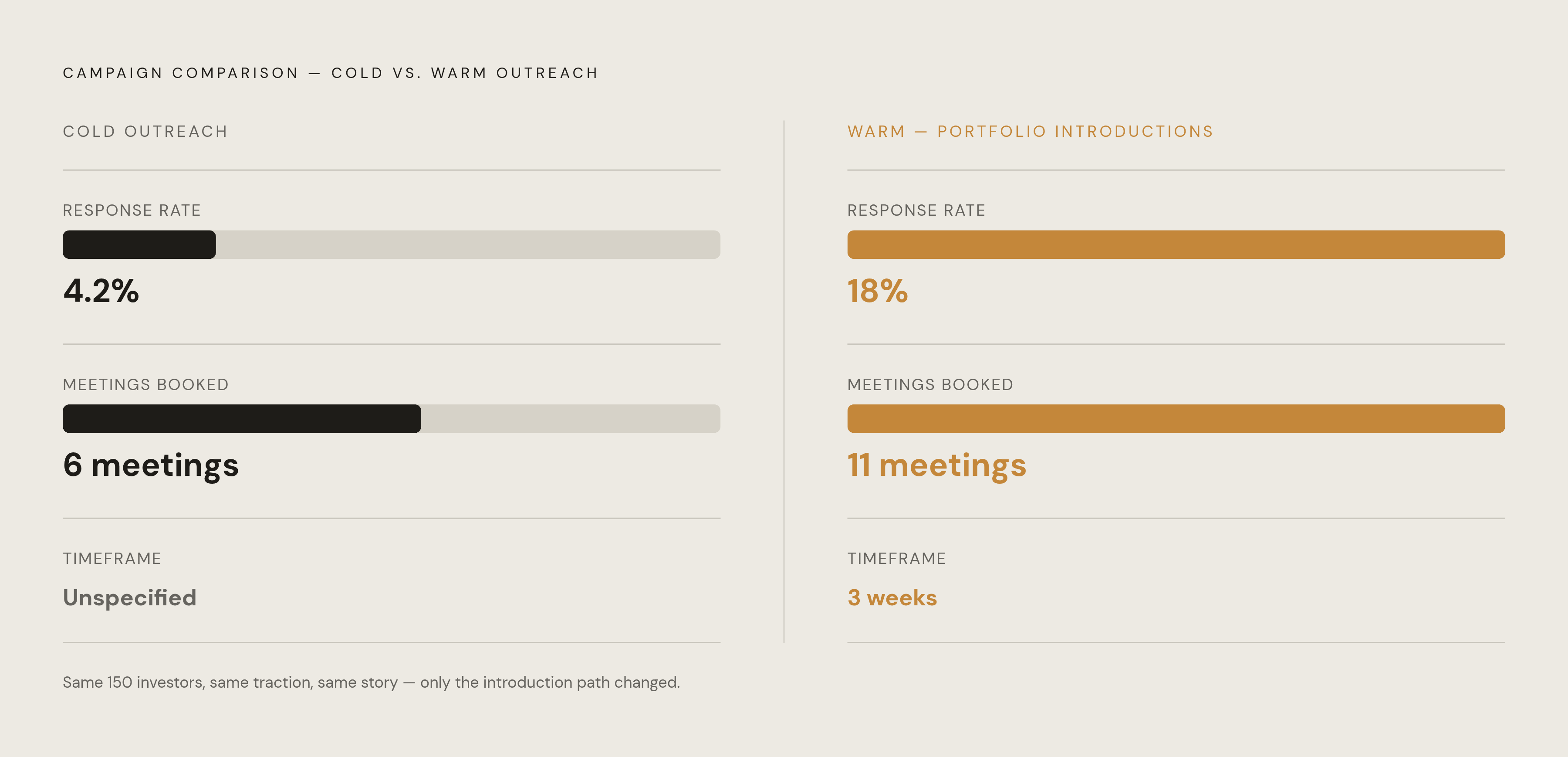
The cold campaign went to 150 institutional investors and produced a 4.2 percent response rate and six meetings. Eight weeks later, introductions sourced from portfolio founders at the same target firms produced an 18 percent response rate and 11 meetings in three weeks. Traction unchanged. Story unchanged. The only variable was the path in.
But what if the narrative itself were the real differentiator? What makes this instructive rather than merely illustrative is the arithmetic. The difference between a 5 percent and a 15 percent conversion rate, targeting the same investor list, is 3 meetings versus 9 over the same fundraising window. That is not a marginal edge. More meetings produce more feedback loops, faster iteration on pitch and positioning, and a higher probability of reaching an investor whose thesis actually fits the company.
Founders who have spent months refining their narrative tend to treat that narrative as the primary variable. The fundamentals set a floor. The introduction path determines whether anyone encounters those fundamentals at all.
How trust transfer works and why investors respond to it differently than to a cold pitch
A warm introduction is not an endorsement of the company. It is an endorsement of the founder's worthiness of attention, which is a different claim and a considerably lower bar to clear.
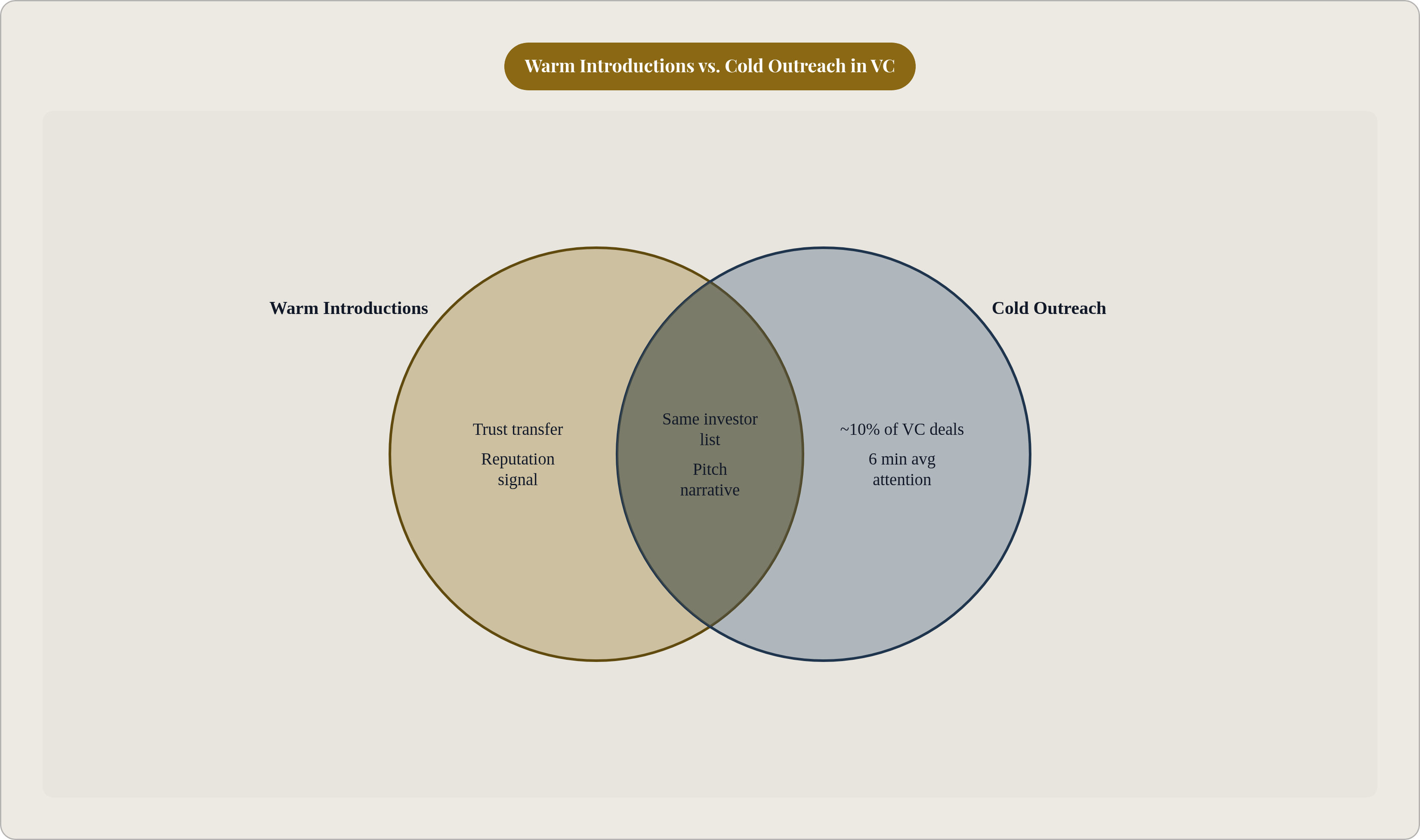
When a trusted contact makes an introduction, they put their reputation on the line. The investor's implicit read is not "this is a good company." It is "this person would not waste my time." That read happens in roughly 20 seconds and frequently leads directly to a 30-minute call. A cold deck, by contrast, commands roughly six minutes of attention on average, most of which is spent on a credibility question the warm introduction already answered before anyone opened the email.
With a warm introduction, the call becomes about fit, not legitimacy. The founder skips an entire phase of the investor's evaluation process.
It is also worth considering what signal quality actually compounds here. A cold email is undifferentiated: anyone can send one, and anyone does. A warm introduction requires a relationship to already exist on both sides, which is itself a filter. No amount of cold email optimization closes that gap, because the gap is not about the email. Trust is not a copywriting problem.
Where venture deals actually originate, according to the research on how VCs make decisions
Gompers, Gornall, Kaplan, and Strebulaev surveyed 885 VCs at 681 firms in research published in the Journal of Financial Economics in 2020. VCs reported spending an average of 22 hours per week on networking and deal sourcing out of a 55-hour workweek. Team quality ranked above product and technology as the primary investment selection criterion. If VCs are primarily investing in people, signals about people carry disproportionate weight, and an introduction from a trusted source is precisely that kind of signal.
Across that dataset and related work, roughly 58 percent of VC deals originate through professional networks, co-investor referrals, or portfolio-company introductions. Approximately 10 percent trace to unsolicited cold inbound. A Harvard Business Review analysis of nearly 900 VCs found that over 70 percent of all deals trace back to a firm's existing network. At the firm level, Robles Ventures has reported that 88 percent of its deals are sourced through network referrals.
These are not marginal differences in channel performance. Cold email is a fallback, and most practitioners already know this, even if they keep sending.
Why not all warm introductions carry equal weight
The mistake founders make once they accept the value of warm introductions is treating them as a uniform category. Securing a lukewarm LinkedIn connection into an investor's inbox and wondering why nothing happened is a pattern I have watched play out repeatedly, and the frustration is usually sincere. The founders are not wrong that they got a warm intro; they are wrong about what that intro was worth.
The strongest signal comes from existing investors in the company. Capital is already at stake; reputation is already committed. Portfolio founders at the target investor's firm represent the next tier: VCs maintain ongoing relationships with their portfolio founders and implicitly weight their judgment about other operators. Mutual connections, advisors, accelerator contacts, and shared operators occupy a middle range, where effectiveness depends heavily on the depth of the introducer's actual relationship with the investor, not simply their ability to send an email.
There are edge cases where cold outreach generates results. Emerging fund managers and solo GPs respond at 5 to 15 percent because they are actively building deal flow and have not yet developed the density of warm inbound that established firms receive. Exceptional traction, the kind that is unusual and self-evident, can break through because the signal quality comes from the metrics themselves. But these are exceptions, and treating them as a general strategy tends to produce disappointment that is genuinely hard to diagnose.
One might argue that a tepid introduction is better than no introduction at all — but that raises an important question: can a weak referral actively set a founder back? A tepid introduction from someone with a weak relationship to the target investor can occasionally damage a founder's credibility in ways that leave no visible trace. Effort should scale with introducer quality, not introducer availability.
The network visibility problem most founders and investors don't realize they have
Most founders have access to more than 200 warm paths through second- and third-degree connections they have never mapped. The constraint is almost never reach. It is visibility into the network they already possess.
This applies symmetrically to investors. The strongest path to any target founder or co-investor is very often already inside the firm's existing network. The constraint is not relationships; it is the ability to surface them on demand, with enough context to route the right introduction to the right partner.
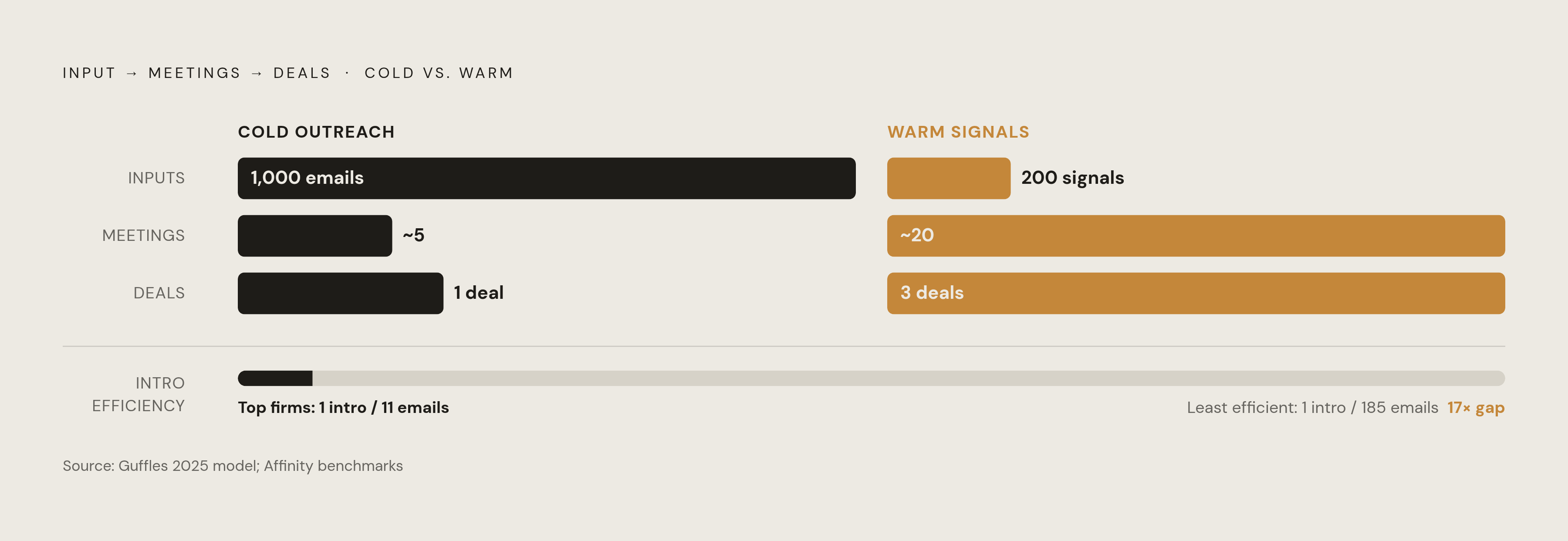
Guffles' 2025 modeling puts the arithmetic plainly: 1,000 cold emails yield approximately 5 meetings and 1 deal; 200 warm engagement signals yield approximately 20 meetings and 3 deals at the same deal value. The ROI gap is not about volume. It is about converting latent network connections into active introductions.
Affinity's benchmark data reinforces this: top-performing firms made 16 percent more introductions year-over-year in 2024 and consistently made 28 percent or more introductions per quarter than average firms throughout the year. The leaders are systematically activating their networks, not operating from better ones. That distinction matters more than it might initially appear, because it means the advantage is not structural, it is operational.
How relationship data gets fragmented inside firms and why that destroys the warm intro advantage
The typical firm's relationship infrastructure is a patchwork: spreadsheets, a CRM built for B2B sales, a portfolio monitoring tool, and a shared inbox that nobody fully trusts. None of them talk to each other. The partners who hold the most valuable relationship context are expected to log every meeting and email manually. Within months, the data goes stale. Within a year, most of it is functionally useless.
Manual data entry is, per interviews across hundreds of firms, the single biggest reason VC teams abandon their CRM. Not complexity. Not cost. The expectation that the people who generate the most valuable relationship data will also be the ones to record it is an institutional design failure that most firms have quietly accepted as normal.
The gap between what a CRM can tell you and what you actually need to know is wider than it looks from a distance. It can tell you every meeting ever logged. It cannot tell you who on the team actually knows the CFO at a target company, how frequently they communicate, or whether the relationship is warmer today than it was three years ago.
Affinity's Invisible Edge report, drawing on two years of data from 291 private equity firms, found that the most efficient firms generate one introduction per 11 emails sent; the least efficient require 185 emails for the same result, a 17-fold gap. Fifty-one percent of PE firms saw introduction output decline 46 percent from 2024 to 2025, even as they increased email volume by 20 percent.
There is also a compounding problem that rarely surfaces in post-mortems. When a partner leaves, their relationship context leaves with them, because it was never captured anywhere usable. The firm does not lose the contact record; it loses the understanding of how strong the relationship actually was, who specifically it was with at the target firm, and what the full history of the interaction looked like. The relationship existed. The institutional knowledge of it does not.
What relationship intelligence tools do differently from a traditional CRM
Relationship intelligence, as a practice, is the systematic mapping, scoring, and querying of professional relationships across a firm's network. It is not logging contact records.
A traditional CRM depends on active manual entry. Relationship intelligence platforms capture passively: communication patterns, meeting frequency, shared work history, recency, all analyzed without anyone filling in a field. The output is a queryable map of who knows whom and how well, rather than a list of companies in a pipeline.
Connection strength scoring draws on email communication frequency and recency, calendar patterns, shared work history duration, seniority proximity, and mutual connections. When a partner meets a founder at a conference, the interaction logs automatically, the company is enriched with available funding and headcount data, and the deal enters the pipeline scored. A 30-second conversation becomes a data-rich starting point without a single manual step.
LP networks are broadly underutilized here. Most funds treat LPs as capital sources. Mapping LP connections reveals deal sourcing and co-investment paths that most funds have never activated, simply because no one has made those paths visible.
The VC software market sat at $0.93 billion in 2025 and is growing at 11.4 percent annually, per available market analyses. New fund creation dropped to 538 funds in 2024, the lowest in over a decade, compressing the universe of viable capital allocators. In that environment, relationship efficiency is no longer an operational preference; it is a competitive necessity.
Where AI fits into relationship-driven dealmaking without replacing the relationship
Eighty-five percent of private capital dealmakers now use AI to automate daily tasks, per Affinity's survey of nearly 300 dealmakers, up from 76 percent the prior year. Eighty-two percent are using AI specifically for deal sourcing research.
What AI is actually doing in practice: automating relationship data capture so records stay current without manual entry, surfacing warm paths through second- and third-degree connections on demand, drafting outreach in the sender's voice as a recommendation rather than an autonomous action, and compressing screening timelines from days to hours. Industry analyses suggest AI-driven sourcing lets firms review three to five times more qualified opportunities than traditional approaches permit.
But how does this affect our original promise that relationships are the irreplaceable core of dealmaking? What AI is not doing is making investment decisions, and the industry appears to be actively recalibrating toward that position. The Data-Driven VC Landscape Report of 2024 found that only 13 percent of firms rely on AI for investment decision-making, down from 40 percent the prior year. That reversal is worth noting. Intel Capital COO Jennifer Ard has stated it plainly: "We will not have AI make investment decisions because so much of it is about relationships. But AI can streamline tasks like legal documentation, helping us focus on people and strategy."
Notable Capital offers a useful operational illustration: a two-person BD team manages more than 500 introductions annually using AI-powered workflows. Scale without proportional headcount is the operational promise. But AI should draft and recommend; the professional controls every send. In high-trust environments, autonomy over relationship actions is non-negotiable. AI amplifies the warm intro strategy. It does not substitute for it.
What founders and investors should take from the conversion gap and act on
The conversion gap is a structural feature of how venture capital operates, rooted in how VCs allocate attention and process trust signals. Understanding it changes what work looks like before a raise begins, not during it.
For founders, the fundraising constraint is rarely the quality of the company. It is the quality of the path to the investor. Mapping second- and third-degree connections before launching a raise is not optional preparation; it is the primary preparation. Introducer quality should drive effort allocation more than introducer availability. The Spectup case is the clearest available evidence of what is at stake when the path in changes and everything else stays constant.
For investors and BD operators, the firm's network is very likely larger and warmer than the firm can currently see. The 17-fold efficiency gap between top and bottom firms in Affinity's PE dataset is not explained by relationship quality. It is explained by the ability to activate and route those relationships. The leaders are not doing something categorically different; they are executing the same strategy with better visibility into what their network already contains.
Cold outreach is declining. Warm paths are becoming more competitive to activate as more founders understand the same conversion data and pursue the same introduction sources. The firms and founders who build relationship visibility now will not be doing something novel. They will simply be doing it before the people who figure this out a year too late.