Second-Degree Connection Paths to Off-Market Deals
Your network's blind spots cost you deals faster than competitors can move.
Most investment teams treat warm introductions as a politeness upgrade on cold outreach: same destination, warmer reception. That framing misses what is actually happening.
A Harvard Business School survey of nearly 900 institutional venture capitalists found that roughly 58% of deals originated through professional networks, investor referrals, or portfolio company introductions. Unsolicited inbound pitches accounted for just 10%. That gap is not social preference. It is information transfer.
When someone makes a warm introduction, they are not opening a door. They are embedding a prior judgment: this is worth your time, and my credibility is attached to that claim. The deal has already been filtered once, and the recipient knows it. Which is why conversion rates look the way they do: 8 to 15% on warm introductions versus 3 to 5% on cold contact. Across a six-month sourcing cycle, working from the same target list, that differential compounds into roughly three times the meetings.
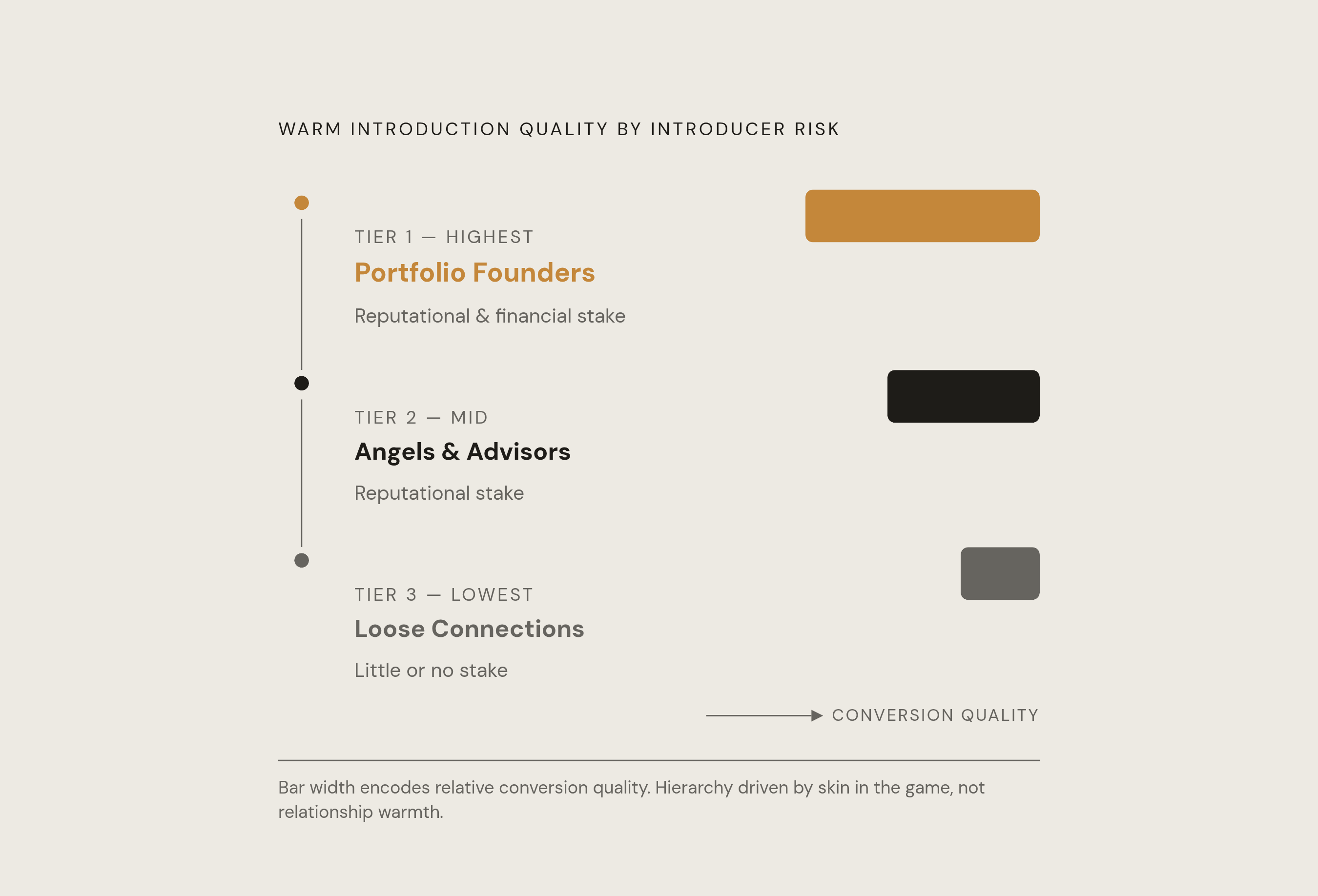
Not all warm paths carry equal weight. Introductions from existing portfolio founders convert at the highest rates because the introducer has real skin in the game, reputationally and sometimes financially. Angels and advisors sit in a middle range. Loose connections sit at the bottom, precisely because neither reputation nor capital is meaningfully at stake for the introducer. The hierarchy is a function of what the introducer is actually risking.
This creates an efficiency problem for firms that substitute volume for path quality. The documented spread between weakest and strongest performers on outreach-to-introduction efficiency runs approximately 17x. The bottleneck is not the number of names in a CRM. It is the quality of the path to those names, which depends on which second-degree connections a firm can actually see and mobilize.
Why Second-Degree Connections Are the Structural Home of Proprietary Deal Flow
Here is where the sociology becomes load-bearing, and where a lot of sourcing strategy quietly goes wrong.
Mark Granovetter's 1973 paper "The Strength of Weak Ties," published in the American Journal of Sociology and now among the most cited works in social science, established something most networkers intuitively resist: new, non-redundant information travels through weak ties, not strong ones. The logic is structural. Strong-tie networks share the same information because they share the same circles. Close colleagues and first-degree contacts have already seen the same opportunities, heard the same news, spoken with the same founders. Weak-tie bridges, the second- and third-degree acquaintances who connect to entirely different clusters, are where non-redundant information actually lives.
Apply this to deal sourcing and the implication is uncomfortable for anyone who spends most of their networking time deepening existing relationships. The deals your first-degree network knows about are already visible to competitors who share those same close contacts. Proprietary flow lives where your network reaches places theirs does not. Second-degree connections sit in exactly that zone: close enough to reach through a trusted intermediary, far enough out that the information has not yet been commoditized inside your immediate circle.
The small-world research tradition, running from Milgram's chain-letter experiments forward, suggests that the actual social distance between any two people is shorter than intuition implies. The path from a given partner at a mid-market PE firm to a founder in a non-obvious geography or vertical probably exists somewhere inside the firm's collective network. Most firms cannot see it.
This reframing matters because sourcing conversations too often center on who you know. The more consequential question is whether you can see the connections you already have.
What It Takes to Activate a Second-Degree Path Before a Competitor Does
Knowing that second-degree paths exist and being able to activate them quickly are different capabilities. Firms conflate them constantly, and it costs them.
Consistently proprietary deal flow tends to belong to firms that started the relationship before any process was conceivable. An owner contacted three years ago may not sell until now, but the first call goes to whoever maintained that relationship. Continuity, once established, is structurally difficult for a late-arriving competitor to overcome regardless of offer price. Sergio Monsalve, Founding Partner of Roble Ventures, has noted that 88% of his firm's deals came through either a network tip or a direct referral. That is not an exceptional outcome; it is the operating model, built on years of maintained contact.
Depth matters more than breadth. Alexander Ross, GP at Illuminate Financial, has described his definition of success in strategic relationships as reaching 10 to 15 very senior change agents within large counterpart organizations. Not hundreds of contacts. The right nodes, cultivated with real continuity.
Timing creates its own category of advantage. For earlier-stage companies, the window between when a founder is identifiable and when they appear in conventional databases or conference circuits can span weeks or months. Getting in before that window closes is not luck; it requires having the right warm path already mapped and ready to activate.
Path activation, in practice, requires four things: knowing which of your contacts has a real relationship with the target, not merely a LinkedIn connection; understanding the quality of that relationship in terms of recency, frequency, and context; identifying the introducer whose endorsement carries actual weight with this particular founder, because those hierarchies are person-specific; and framing the ask specifically enough that the introducer can act without doing significant additional work themselves. The VCs who spend an average of 22 hours per week on networking and sourcing, per the HBS survey, are not inefficient. They are compensating manually for systems that cannot surface what they need.
How Siloed Relationship Data Inside Firms Destroys Second-Degree Visibility
The structural failure at most firms is not that the relationships do not exist. It is that no single person can see the whole map.
A partner knows their own contacts. An associate knows theirs. A recently hired vice president brought relationships from a prior firm. None of them can see across the others' networks in any coherent way. I have been in rooms where one partner had a dormant relationship with a founder's former board member, another had a current relationship with that founder's attorney, neither knew the other's connection existed, and a cold email went out anyway. This happened at firms that would describe themselves as relationship-driven, firms where individual partners could reconstruct the history of every deal they sourced but had no idea what the rest of the team was sitting on. The breakdown is not cultural. It is structural.
Salesforce's 2024 Connectivity Benchmark Report found that 80% of IT leaders report data silos are hindering their digital transformation efforts. The private equity version of that problem is relationship data trapped in individual inboxes, calendars, and personal networks, never surfaced as a firm-level asset. IDC Market Research estimates that companies lose between 20 and 30% of annual revenue to inefficiencies caused by data silos. The relationship-intelligence equivalent is harder to quantify, but the mechanism holds: missed paths produce missed timing, which produces missed deals.
The personnel dimension compounds this considerably. When institutional knowledge lives in individuals rather than systems, it leaves when they do. An associate who spent three years maintaining warm contact with a founder, tracking the business, staying close on the firm's behalf: when that person accepts another offer, the relationship history walks out with them. The next hire starts from nothing, which is a peculiar way to manage what is, at bottom, a relationship business.
Manual-entry CRM systems do not solve this; they displace it. Associates spend a meaningful portion of their working time managing CRM data rather than deploying it, and when a partner needs context before a critical meeting, the system yields scattered notes rather than a coherent relationship history. The data is technically present and operationally useless. Some industry data suggests that a substantial share of PE firms saw their introduction output decline from 2024 to 2025 even as they increased outreach volume. That is the signature of a structural problem being misdiagnosed as an effort problem.
What a Firm Needs to Systematically See and Activate Second-Degree Paths
Start with the map itself. A complete, current picture of who at the firm knows whom, built from actual interaction history across every team member: emails sent and received, meetings taken, calendar events, follow-up cadences. Not self-reported contacts, which are incomplete by definition. Not CRM entries, which are perpetually behind. Interaction history, because interaction is the only reliable proxy for relationship quality.
Relationship scoring must account for recency and frequency together. A contact recorded three years ago with no subsequent activity is not the same asset as one cultivated last month, and a system that cannot distinguish between them will surface the wrong path at the wrong moment, which is operationally equivalent to surfacing no path at all.
For any given target, the output should not be a list of everyone tangentially connected. It should be a ranked recommendation: the shortest warm path with the highest-quality intermediary, scored against relationship strength and introducer credibility relative to this specific target. The specificity matters because a generic list of connected names puts the analytical burden back on the person who needed the system to do the work.
Context has to survive across time and across personnel changes. When a partner passed on a deal two years ago, the reasoning behind that decision needs to be accessible the next time the firm encounters the same company or founder, without anyone reconstructing it from a frantic email chain the night before a meeting.
There is also the drafting problem, which tends to get overlooked. Once the right path is identified and the right introducer is clear, the ask itself becomes the bottleneck. A vague request burdens the introducer and reduces the probability they act. A specific, well-framed request, written in the professional's own voice, makes action easy. That drafting layer is where AI assistance earns its place: not sending autonomously, but reducing the friction between knowing who to ask and making the ask cleanly.
One constraint is non-negotiable. Personal relationship context must remain private even as institutional relationship signals become collectively visible. A team member sharing network visibility is not the same as exposing individual conversation history. Any system that collapses that distinction will find no adoption in high-trust, high-stakes environments, and rightly so.
Each interaction captured, each introduction tracked, each path activated makes the next one more accessible. The firm's relationship graph becomes a durable asset rather than a collection of individual contact lists that resets with every departure and every hire. Most firms are currently leaving that compounding on the table.