Mapping Relationship Paths to a Target Investor or Acquirer
Trust strength matters more than connection speed when reaching target investors or acquirers.

A relationship path is a chain of people. That part is obvious. What gets missed is that each link has to carry enough trust and context to make the next introduction credible, and identifying the weakest link is almost never as simple as a LinkedIn mutual-connection view suggests.
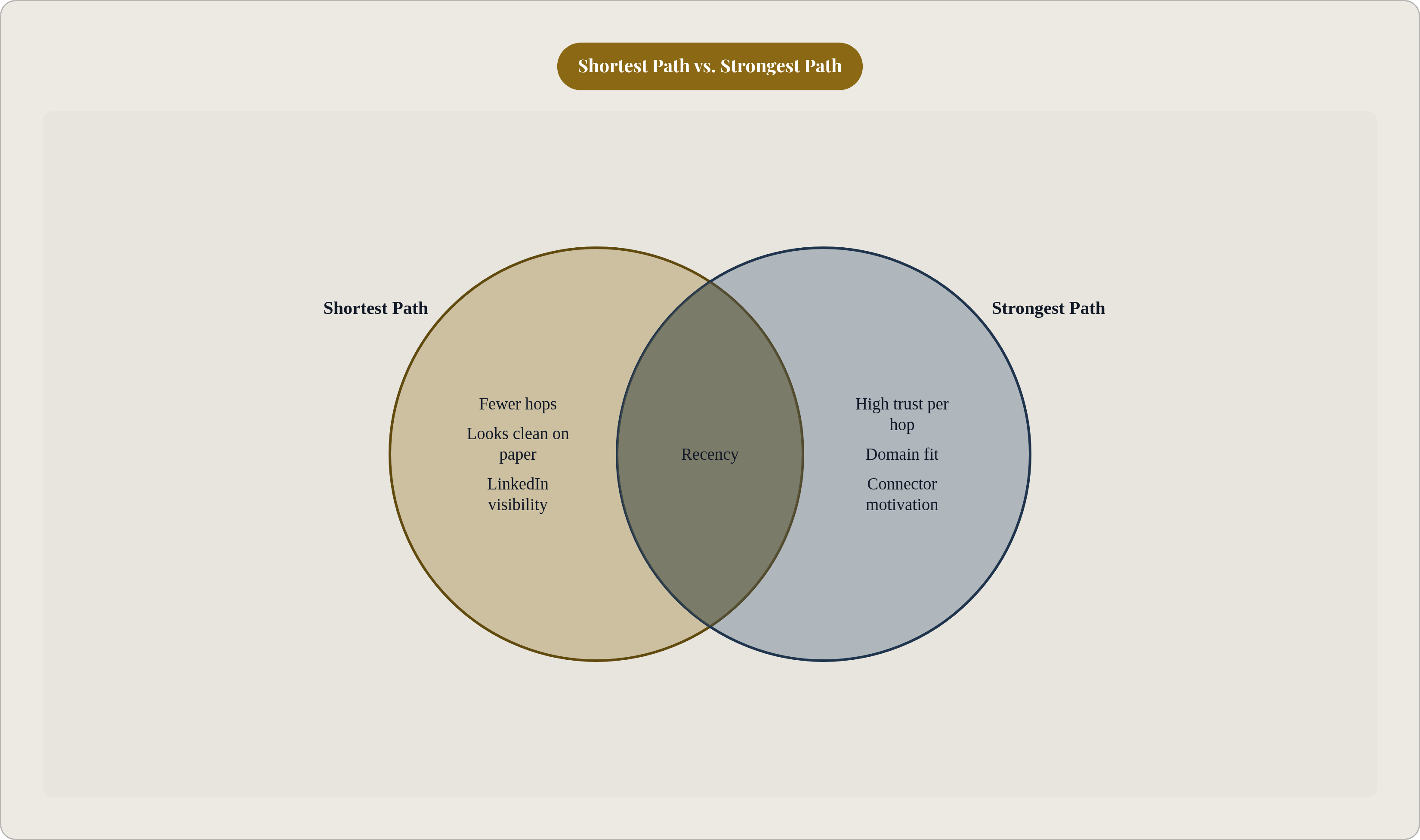
Shortest path and strongest path are not the same thing. This distinction sounds elementary until you watch sophisticated professionals conflate the two in practice, which happens more often than anyone in this industry would care to admit. A three-hop route through a former colleague who has worked closely with a target GP for years will beat a single-hop route through someone who accepted a LinkedIn request five years ago and hasn't replied to an email since. The shorter path may carry no trust whatsoever, and yet it gets activated first because it looks cleaner on paper.
Path quality turns on specific variables, none of which are proxies for one another. Recency: when did the connector last interact with the target in a meaningful way, not a LinkedIn like, but a conversation with actual substance? Context overlap: does the connector's credibility extend to the domain of this introduction, or are you asking a consumer investor to vouch for you to a deep-tech acquirer? Relationship depth, which you can approximate through email frequency, shared projects, and meeting history, matters differently than raw tenure of acquaintance. A contact sitting in someone's address book is not a relationship. And connector motivation, which may matter most of all: does this person have a real reason to advocate, or are you asking them to forward a message dressed up as a referral?
There is a counterintuitive finding from the Journal of Financial Economics worth sitting with here. Acquirers whose directors shared a second-degree board connection with target directors generated higher returns than those with first-degree connections. First-degree connections gave acquirers a bargaining advantage through private information; second-degree connections produced greater value creation. The mechanism differs depending on path type, which means different strategic goals require different path architectures, and the strongest path is not reliably the most direct one.
The task, then, is not to find any path to the target. It is to find the path with the highest trust signal per hop, which requires actually measuring trust rather than assuming it correlates with proximity.
Auditing the Relationship Graph You Already Own
Most professionals systematically underestimate their own network. Not because it is weak, but because it is scattered across systems that don't communicate with each other, and human memory is a poor substitute for a queryable record.
The richest signal of relationship depth sits in email threads: frequency, reciprocity, tone, the willingness to ask and answer difficult questions. That data is almost entirely locked inside individual inboxes. Calendar history tells you which relationships have had real-world substance, but it is rarely captured anywhere permanent. LinkedIn shows you that a connection exists and tells you almost nothing about its strength. Some of the warmest paths trace back to a text thread or a Slack conversation, forms of communication that rarely surface anywhere the broader firm can access.
Forrester Consulting found that a significant majority of knowledge workers report their teams are siloed, spending roughly 12 hours a week manually gathering data as a result. In a deal-driven firm, those hours are not an efficiency problem. They are a competitive disadvantage that compounds quietly until you notice you've lost something you didn't know you were losing.
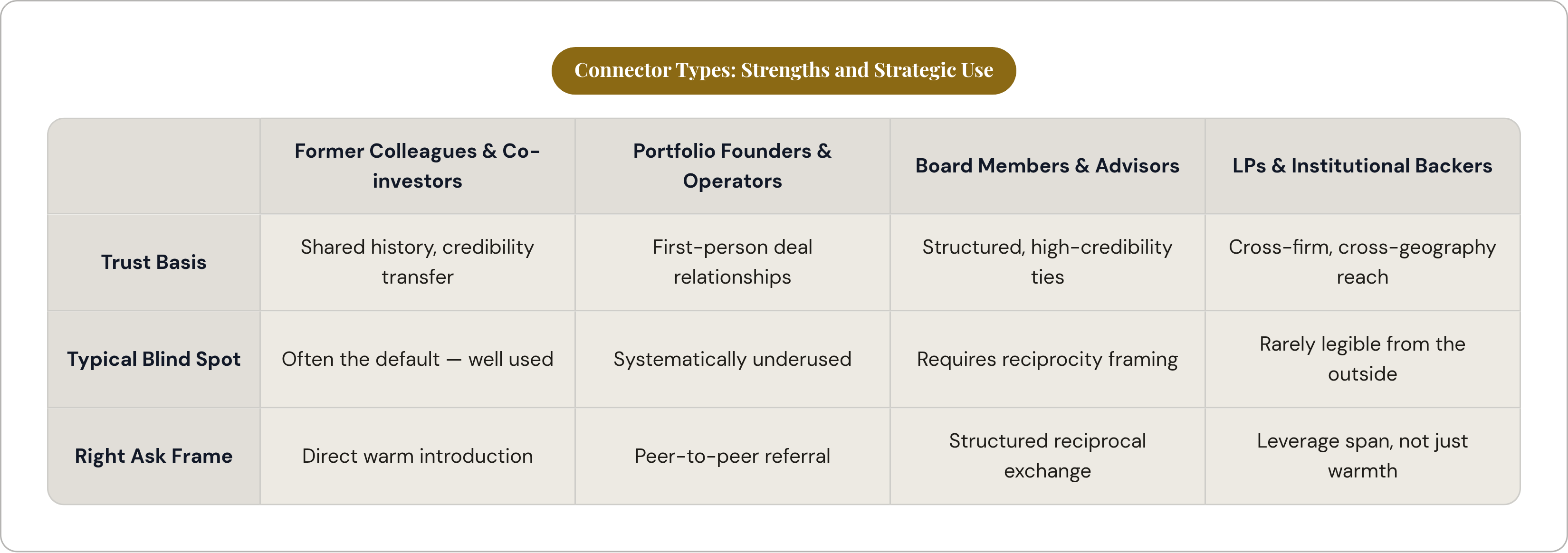
The audit is not about building a complete contact list. It is about mapping your strongest connectors by relationship type and domain relevance, which requires being clear about distinctions that are easy to blur when you're moving quickly. Former colleagues and co-investors tend to carry the highest baseline trust, because shared history creates credibility transfer that a professional introduction alone cannot replicate. Portfolio founders and operators are systematically underused; they often have first-person relationships with the investment team you're trying to reach, built through pitch processes or portfolio events that aren't visible from the outside. Board members and advisors hold structured, high-credibility relationships but require reciprocity framing rather than a cold ask for a favor. Limited partners and institutional backers are the most overlooked category; their relationships frequently span firms and geographies in ways that simply aren't legible from the outside.
One structural fragility deserves plain acknowledgment: when relationships live only in individual memory and personal inboxes, they leave when the person leaves. The departing-partner problem is not hypothetical at most firms. It is routine, and it is only partially preventable.
Tracing Second- and Third-Degree Paths from Your Network to the Target
Start with the target and work backward. Identify who at the target firm, or on its deal team or board, matters most for this specific conversation. For investors, the general partner with the relevant thesis is the right node, not a principal who lacks check-writing authority on deals of your profile. For acquirers, the corporate development lead, a relevant business unit head, or the CEO in smaller transactions; investor relations is not the right entry point.
Mapping the second-degree layer means identifying who in your first-degree network has a documented, active relationship with that specific person. The signals to look for: shared board memberships, prior co-investments, advisory roles, employment overlap. LinkedIn's mutual connection view gives you a starting point, nothing more. It surfaces existence, not strength.
When no clean second-degree path exists, the third-degree layer requires a different approach. Rather than searching for who you know who knows the target, identify which strong first-degree contacts are likely to know and speak regularly to people in the target's orbit. Two structural mechanisms are worth building explicitly. Board reciprocity, where portfolio company board members introduce executives across their boards, produces a consistent volume of introductions when it is operationalized on a regular cadence; treated as an ad-hoc favor, it produces little. Co-investor networks are chronically underutilized; the firm that co-invested in your last round has direct relationships with your target's investment team in most cases, relationships built through shared market exposure that firms rarely map against their own target lists.
Affinity's Invisible Edge report, covering 291 PE firms over two years, found that the most efficient firms generate one introduction for every 11 emails sent; the least efficient need 185 emails for the same result. A 17x gap, rooted in path quality rather than volume. That finding reframes path-tracing precision from a refinement exercise into something closer to a foundational competency. The difference between a functioning introduction engine and expensive noise is not effort; it is where that effort is directed.
Rank candidate paths by the connector's relationship strength to the target multiplied by their willingness to advocate, rather than by how convenient the ask is for you. Those two things are rarely the same.
Evaluating Which Path to Activate and How to Select the Right Connector
Having multiple paths to the same target is the right problem to have. Choosing the wrong one wastes relational capital and can foreclose the better paths behind it, which is a subtler and more durable kind of damage than a failed cold outreach.
Recency of the connector-to-target relationship is the first filter; a warm connection that went cold two years ago carries less weight than it appears on a contact list. Domain fit is the second; a connector whose credibility sits in consumer investing introduces friction rather than credibility when the conversation is about a deep-tech acquisition. The connector's current standing with the target is the third, and the most frequently overlooked: a board connection in a strained or distant relationship can transmit the wrong signal before you've said a word. Finally, connector bandwidth and incentive: is there a natural reason for this person to make this introduction now, or are you asking them to spend social capital with no frame that makes the ask sensible for them?
A 2025 British Journal of Management study found that social ties between acquirers' directors and their advisors are positively related to acquirers' gains, with effects more pronounced for inexperienced acquirers and targets in opaque industries. The mechanism is private information transmitted through trusted relationships in situations where public signals are insufficient. That is what the right connector actually carries: not warmth as an abstract social quality, but signal quality under conditions of real uncertainty.
The forwardable email principle follows from this. The connector is not a messenger; they are a co-author of the first impression. The ask you give them must be specific enough to endorse in their own voice, brief enough not to burden them, and clearly framed around why this introduction makes sense coming specifically from them. If you cannot articulate that last part cleanly, the path is probably not as strong as it appears.
When no strong path exists, the straightforward answer is to say so rather than manufacture a weak one. Founders who build relationships with five or more investors at least a year before raising close rounds significantly faster; the data makes the case for path-building as a pre-fundraise discipline rather than a last-minute improvisation.
Structuring the Ask So the Introduction Lands with the Intended Weight
The connector's job is to transfer trust, not transmit information. Everything about how you structure the ask should make that transfer easier, not more effortful.
A high-quality introduction request contains specific elements: a one-paragraph context note written in the connector's voice, explaining why this introduction makes sense coming specifically from them; a single, clear ask, a 20-minute call rather than a pitch meeting; and a sentence the connector can quote or adapt directly, which reduces their friction and preserves their voice. No attachment, no deck. Attachments signal that you are optimizing for volume, which is exactly the wrong signal to send through a warm path.
Commsor found that warm introductions book in one to two touches, compared to three or more for cold outreach, with a substantial majority closing faster than cold-sourced opportunities. The efficiency gain exists because trust transfer is complete before the first meeting. There is no trust-building to do in the room; the connector already did it.
Timing matters more than people expect. Introductions made in the context of an existing touchpoint, a board meeting, a portfolio update, a shared industry event, land with meaningfully less friction than standalone requests. The connector's relationship with the target already has a rhythm; fitting your ask into that rhythm respects both parties' time and makes the ask feel like a natural extension rather than an imposition. This is a small thing that fails constantly, because the person making the introduction request is usually focused on their own timeline rather than the connector's.
After the introduction is made, close the loop quickly. Signal back to the connector: what happened, what was useful, what comes next. This preserves the connector's reputation with the target, which they have now implicitly staked on you, and it keeps the path open for future use. A connector who introduces you into silence will not introduce you again.
Why This Process Fails When Relationship Data Stays Siloed Inside Individual Inboxes
A single dealmaker executing this process manually is tractable. A firm of ten doing it without shared visibility is operating with structural blind spots that compound quietly until they surface as missed deals or embarrassing redundancies.
The failure modes are specific. Two partners pursuing the same target through different connectors, neither aware of the other, can appear disorganized to a target receiving conflicting signals. The strongest connection to that target sits in a junior associate's inbox, invisible to the partners making the decision. A warm path that went dormant is treated as live because no one tracked the relationship's decay over time. A departing partner takes the firm's highest-trust relationships out the door because they existed only in personal memory and personal email. None of these are exotic edge cases; they are the ordinary cost of not treating relationship data as a collective asset.
WBR Insights found that a majority of financial institution leaders acknowledge data silos as a significant barrier to competitive advantage. The deeper problem is not inefficiency. It is that firms are losing proprietary deal flow to competitors who have the same network but can actually see it and act on it as a collective resource.
Max Eagle, Head of Data at WiL, has described the challenge in operational terms: "The biggest challenge to hit us when we started was not having a single source of truth." That is an operational problem before it is a technology problem, and firms that reach for a tool before diagnosing the structural cause tend to replicate the same silo in a different format.
Path-mapping as a firm capability requires relationship data to be collectively visible without being individually exposed. The privacy tension that creates is real, and it is the central design constraint the next category of tools has to navigate.
What Relationship Intelligence Tools Actually Do, and Where They Fit in This Process
Relationship intelligence platforms are not CRM replacements. They are a layer that makes the network visible and queryable across a team, which is a different function. The reason CRM implementations fail in most deal-driven firms is manual data entry; people don't do it consistently, and the record decays. Relationship intelligence tools address this by ingesting email, calendar, and messaging signals automatically, deriving relationship strength from engagement patterns rather than fields someone remembered to fill out.
The core capabilities map directly onto the steps in this piece. Automatic relationship capture addresses the visibility problem: the network that exists in individual inboxes becomes queryable across the firm. Relationship strength scoring replaces gut feel with a consistent signal derived from frequency, recency, and reciprocity. Warm path identification surfaces the highest-trust route from anyone on the team to any given target, treating the firm's collective network as a single graph rather than a collection of separate address books. Outreach drafting generates introduction requests in the user's own voice, reducing friction without removing the judgment about whether and when to send.
The key platforms have distinct orientations. Affinity identifies who on a team has the strongest connection to any given contact through email and calendar analysis. Rings AI assigns relationship strength scores across a firm's collective network and produces a visual graph of connection quality. Centralize, which raised $19 million led by NEA, focuses on enterprise sales teams navigating complex buying committees, surfacing introduction paths through executive, investor, and advisor networks. RelSci and BoardEx, now part of Altrata, offer proprietary research on board members and executives, best suited for investment banking and wealth management contexts where board-level connection mapping is the primary use case.
Affinity's data suggests that algorithms surfacing the warmest introduction path can increase the probability of winning a deal by up to 25%, and that warm introductions close deals measurably faster than cold-sourced opportunities. AI usage for investment decisions more than doubled year-over-year in a recent Affinity Predictions report, from 13% to 28%, with nearly half of firms having consolidated to a small number of core data platforms.
The privacy constraint shaping all of this is non-negotiable, and firms that treat it as an engineering problem rather than a governance problem will keep hitting the same wall. A partner's personal context with a contact, the texture of the relationship, its history, its sensitivities, cannot become firm-visible without consent. The firm-level signal and the individual-level context require different access controls; any platform that conflates the two will face adoption failure, because the people with the most valuable relationship capital will simply decline to participate. This is where most implementations quietly break down, not at the technology layer but at the human one.
Turning Path-Mapping from a One-Time Exercise into a Standing Firm Capability
Everything described here works as a one-time exercise. It only compounds when it becomes a discipline, and the gap between those two states is where most firms stall. The one-time version surfaces a few useful connections and then fossilizes because no one owns the maintenance.
Four structural habits institutionalize it. A relationship audit on a regular cadence: a quarterly review of which target relationships have gone dormant, which connectors have become more or less relevant, and which new targets should appear on the map. Without this cadence, the map becomes stale and the exercise has to restart from scratch each time it is needed, which largely defeats the purpose of building it.
Treating the co-investor network as a structured asset rather than an ad-hoc resource. Most firms have more warm paths than they realize through firms they've co-invested with; those paths are rarely mapped or maintained systematically. Cross-referencing co-investor networks against a target list takes a fraction of the time of building those paths from scratch, and yet it almost never happens as standard practice.
Onboarding relationship history as part of standard firm process. When a new partner or principal joins, their network should enter the firm's visibility layer immediately, not gradually, not only when it becomes relevant to a specific deal. The departing-partner problem is only partially addressable after the fact. The onboarding-partner opportunity is fully addressable and consistently underused.
Closing the loop as a firm norm rather than an individual courtesy. When an introduction produces a result, that result should be visible to the firm. The connector's contribution should be acknowledged and recorded; the path that worked should inform how similar paths are identified and activated in the future.
The compounding is real but slow, and firms that expect it to arrive in the first quarter tend to abandon the practice before it matures. In the early months, the process surfaces a few connections no one knew about and rescues one path that would have gone cold. By the second year, the picture looks different: a coherent view of the firm's relationship equity, the connectors who produce introductions consistently, the paths that convert, the targets that have been warming long enough to be ready. That is a different kind of organization. The advantage it holds has less to do with who its partners know than with what the firm can actually see.