Natural Language Querying of a Professional Network
How firms can query their scattered relationship data to find warm introductions faster.
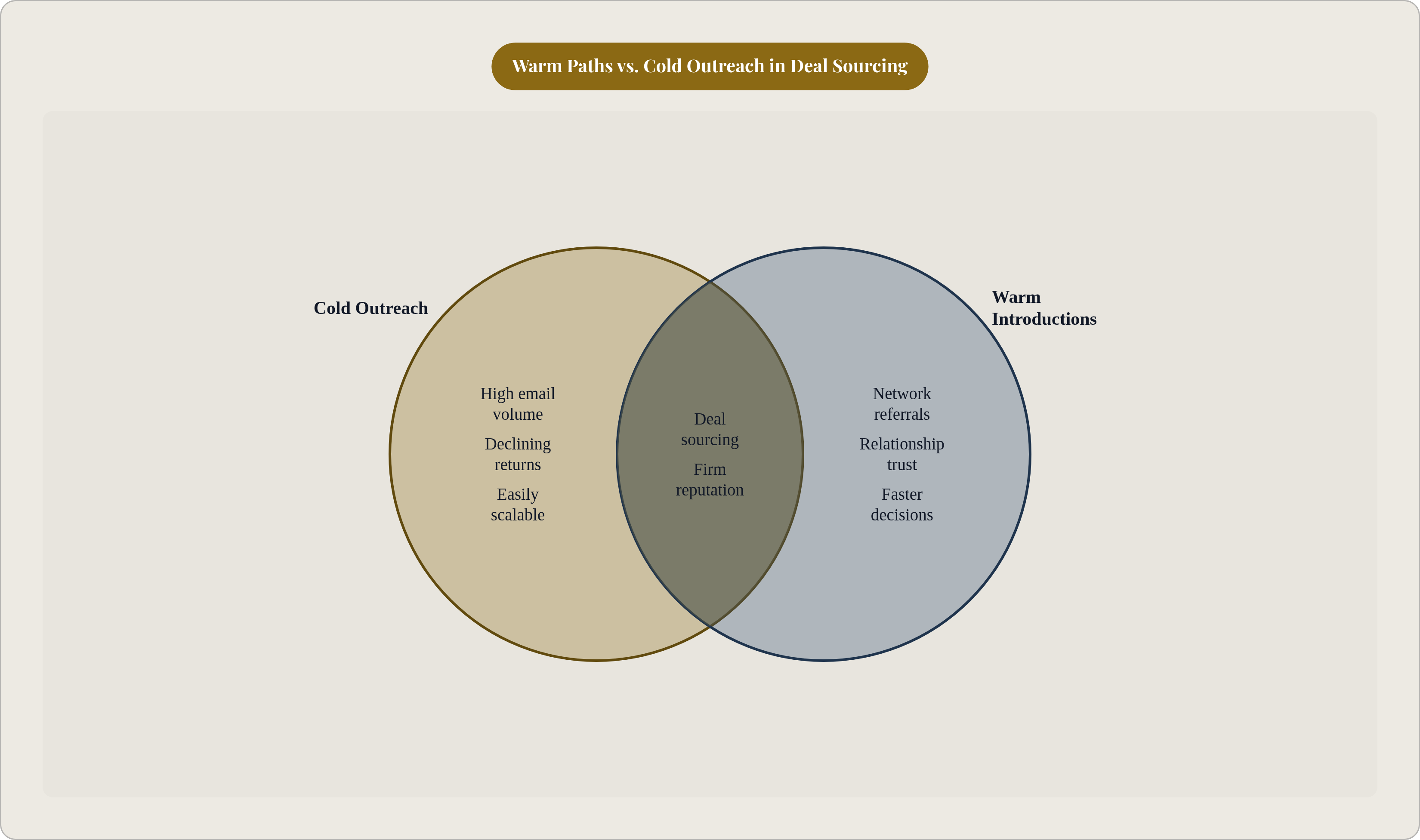
Warm introductions beat cold outreach by a wider margin than most people guess, and the real number lands closer to twenty times than two. Affinity's Invisible Edge report tracked 291 private equity firms over two years and found the most efficient ones generate one introduction for every 11 emails sent. The least efficient need 185 emails for that same single introduction. Run the math and you get a 17x spread between firms doing, on paper, identical work.
Introduction output is also getting worse across the board. In that same study, 51% of PE firms saw introduction output drop 46% between 2024 and 2025, even while email volume climbed 20%. More outreach, fewer introductions coming out the other end; the instinct when warm paths dry up is to fire off more cold email, but that instinct runs backward. Typing faster was never going to fix a problem that had nothing to do with typing speed in the first place.
Deal origin data backs this up from a different angle entirely. Research across large samples of venture capitalists consistently finds that the majority of deals trace back to a firm's existing network rather than outbound sourcing. Sergio Monsalve, Founding Partner at Roble Ventures, put a sharper number on it: "For the vast majority of our deals, we either get tipped off to the deal or directly referred by our network." That's close to the industry norm, and it tells you exactly where the leverage sits, inside the web of relationships a firm already has.
Stanley Milgram's six-degrees research is over half a century old at this point, and professional networks have only compressed further since. LinkedIn makes the compression literal on every profile: first, second, third connection, spelled out, no guessing required, most useful targets sitting within a surprisingly small number of hops of any given operator today. A path to almost anyone worth reaching probably already exists somewhere in a firm's collective network. Finding it fast enough for it to still matter, though, is a different problem, and it's the one the rest of this piece sits with.
Where relationship data actually lives (and why it can't be queried today)
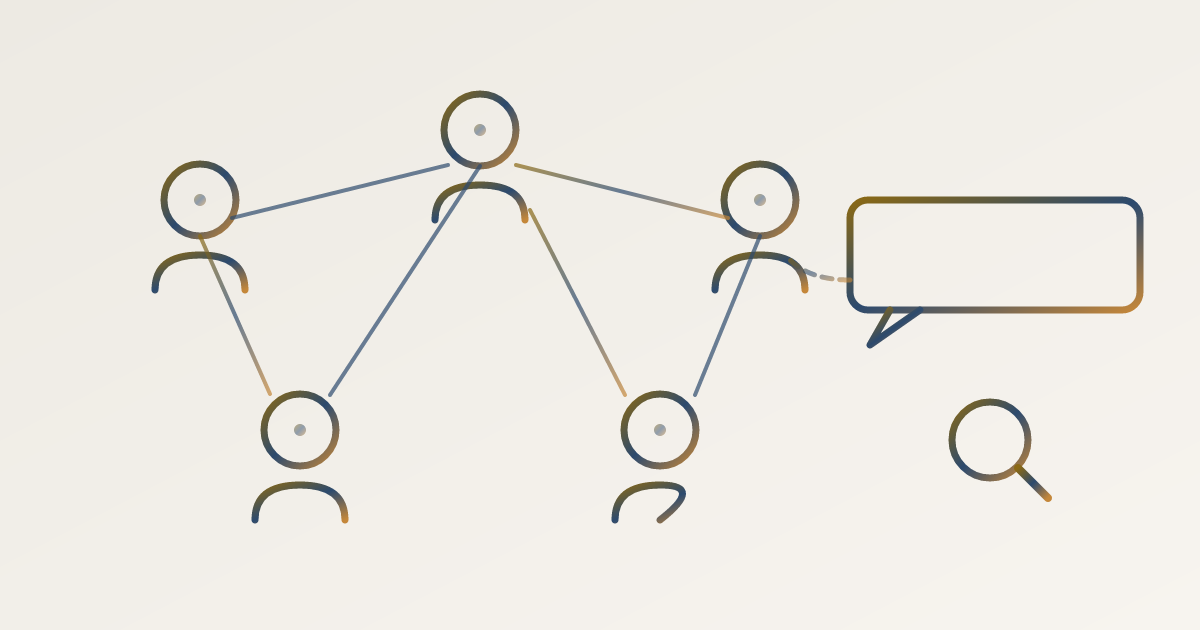
A firm's relationship graph is real. It's also scattered across systems that never learned to talk to each other: email threads, calendar invites, LinkedIn connections, CRM fields, Slack messages, deal memos buried three folders deep in a shared drive nobody can find fast enough. Each system captures a slice, and each slice is biased toward whatever that tool happens to log well. No dashboard has the whole picture, because nothing was ever built to assemble it in the first place.
The CRM was supposed to solve this. In practice it logs whatever a human remembered to type, and that often diverges sharply from what actually happened. Industry research consistently finds that a large share of organizations report their CRM data is incomplete or inaccurate. A tool that depends on someone typing up a conversation after a twelve-hour day of having conversations goes stale exactly when it's needed most. None of this is a knock on the people doing the typing. It's just what happens when data entry has to compete with everything else on a calendar.
Things get worse at the firm level, because the knowledge doesn't live with the institution. It lives with individuals, full stop. A partner leaves and the relationship graph walks out the door with them, with no record it was ever there to begin with. Max Eagle, Head of Data at WiL, put it plainly: "The biggest challenge to hit us when we started was not having a single source of truth." Fixing that took more than a new subscription; it meant rebuilding the plumbing so relationship data could stay current and shared across the firm instead of trapped in one inbox.
This runs deeper than a maturity problem. It's structural. Cross-industry research has consistently found that only a fraction of enterprise applications are actually integrated with one another, on average. These tools got built as separate products, sold separately, adopted at different times by different teams for different reasons. Integration was never on the table. The firm ends up sitting on real relationship value with no way to see it whole, because the connections exist but nothing sits above the fragments to make them legible.
What natural language querying is and how it works against relationship data
Natural language querying means typing or saying a question the way you'd ask a colleague across the desk, and getting a structured, sourced answer back. No SQL, no dropdown filters, no need to know which table a field lives in. Business intelligence tools already do a version of this; ask "what caused revenue to drop last month?" and get a chart pointing at the answer. Point that same idea at a relationship graph instead of a sales dashboard, and the question turns into something like "who do we know at Stripe who can open a path to their VP of Partnerships?" What comes back is ranked and sourced, with context attached, rather than a bare list of names someone has to interpret on their own.
Underneath, this runs on natural language processing, machine learning, and something called a semantic layer, the piece of infrastructure that translates what a person means into the shape of the underlying data and turns that into a query the system can actually run. That layer does more work than its name suggests, especially once relationship data enters the picture.
So why is this harder than a normal database query? Because "who knows someone well" isn't a filter you set the way you'd filter by deal stage or industry. Warmth is fuzzy by nature and depends on context nobody wrote down anywhere. The semantic layer has to reason about proximity, meaning how recently two people actually interacted; warmth, meaning how substantive those interactions were, not just how many there were; and path, meaning whether the connection runs direct or one hop removed. None of that sits in a clean column waiting to be pulled. It has to be inferred from a pattern of activity scattered across systems that were never designed to talk to each other.
The output matters as much as the input, maybe more. A flat list of names under time pressure is close to useless. A ranked answer, one that says this path first, this one second, here's roughly why, is what actually gets used when a decision has to happen today and not next week. As of 2026, major CRM platforms handle simple natural language queries reasonably well, but the complex, multi-condition, analytical questions, exactly the kind relationship intelligence runs on, still trip most of them up. The interface shift is real. The products built on top of it are still catching up to what that shift makes possible.
What operators can actually ask (and what they get back)
Three kinds of operators ask three different flavors of question, and the differences say something about how wide "relationship intelligence" actually has to stretch to be useful at all.
An investor sourcing a deal wants to know who in the network has worked with a founder before, and how recently, or who at a target company is warm enough to open a cap table conversation. A founder chasing a warm path wants to know which of their investors knows someone at a target OEM, ideally at VP level or higher. A BD operator mapping coverage wants to know which relationships inside the firm sit closest to companies in a given vertical that nobody has approached yet. The jobs differ, the urgency differs, but the underlying need is the same: turn "who do we know" from a guess into an answer with a source attached.
A genuinely useful response looks less like a contact list and more like a ranked set of paths, each carrying the connection's identity, how recently the relationship was active, how substantive the past interaction actually was, and often a suggested way to make the ask. What used to eat half a day, asking around the office, cross-referencing LinkedIn, scrolling back through old email threads trying to remember a name, collapses down to something closer to seconds.
Intel Capital's COO said something worth sitting with: "We will never have AI make investment decisions because so much of it is about the relationships." That instinct draws the line exactly where it belongs. The decision to invest, to partner, to hire, stays human, because it runs on judgment no query can replace. The reconnaissance before that decision, the digging through six disconnected systems to figure out who actually knows whom, is where compression earns its keep.
One design principle follows from this pretty directly: the system drafts and recommends, it never sends anything on its own, and the professional stays in the loop on every outreach. Rolo, built on that model, connects email, calendar, LinkedIn, and messaging into one queryable relationship graph, surfaces ranked warm paths, and drafts outreach in the user's own voice, without sending on its own and without exposing the private content behind the recommendation.
How NLQ changes the speed and quality of relationship-driven decisions at the firm level
Something compounds once this exists at the firm level instead of trapped in one person's head. Everyone can query everyone else's relationship graph, and the firm's effective network grows larger than any single person's contact list ever was on its own. Affinity's benchmark data shows top-performing firms grew introductions 16% year-over-year in 2024. The gap between firms that systematize this and firms that don't is already showing, and it's widening.
The downstream numbers back this up further. Affinity's research found investors who tap into relationship intelligence increase deal flow by 25%, while saving over 200 hours a year that would otherwise go into manual contact entry and data cleanup. That's real time handed back to the parts of the job that actually need a human brain running the show, not a spreadsheet.
Timing sharpens the stakes here quite a bit. Per Affinity's 2026 Predictions Report, 50% of investors now name sourcing new deals as their top priority, at the exact moment per Affinity's 2026 Predictions Report, the active investor count has dropped by nearly half from its 2021 peak. Fewer investors chasing scarcer deal flow means more competition per opportunity than there used to be, plain and simple.
A warm path to a target often already sits somewhere inside a firm, in a junior associate's old college roommate, or a portfolio company CEO's board member, and nobody thinks to go looking, because there's no obvious reason they would. A queryable layer over that knowledge doesn't exist at most firms yet, so it just sits there doing nothing. Firms that can query across their full relationship graph respond faster and pitch better-calibrated introductions; firms that can't are paying a tax on speed for every sourcing decision they make, whether they notice the bill or not. None of this replaces relationship judgment. It just removes the reconnaissance delay that judgment has always had to sit behind.
Why privacy and permissioned architecture are non-negotiable in this context
There's a real tension sitting in the middle of all this. Making a firm's collective relationship intelligence useful means aggregating signals that are personally sensitive by nature: who emailed whom, how often they met, how warm those conversations actually ran. That's not throwaway metadata. It's close to the most private layer of someone's professional life, and treating it casually is how trust gets burned fast and doesn't come back easy.
But here's a distinction that resolves most of the tension. Institutional signals, meaning the fact that someone at the firm has a connection to a given target, can be pooled and made useful without much controversy. Personal context, meaning the actual content of what was said, has to stay locked down. Those are two different categories of information, and a system worth trusting enforces that line architecturally, not as a clause buried three pages into a terms-of-service page nobody actually reads.
The pattern that handles this well flips the usual instinct: bring the AI to the data instead of moving the data to the AI. The relationship graph gets queried in place rather than pooled into some central store everyone can touch. This approach, often built through data mesh or data fabric architecture, has gained broad adoption among data leaders as a way to make distributed data usable without centralizing it.
Role-based access and row-level security aren't features to brag about in regulated industries. They're the minimum bar for getting in the door at all. Financial services, law, and investment management sit under GDPR, CCPA, and the EU AI Act as it takes shape, and any tool ingesting email, calendar, and CRM data across a firm has to show real audit trails and access controls to survive procurement. The people who need this kind of intelligence most, investors, founders, BD operators, run businesses where trust is the actual product on the shelf. A tool that leaks context or smudges the privacy line destroys more value than any speed gain could create. Rolo's approach keeps relationship data private and permissioned even as it becomes usable across a whole team; the system surfaces the warm path without exposing what was actually said to produce it.
What it means to have always had the right connections but never the visibility to use them in time
Here's the point underneath all the infrastructure talk: the value was never in acquiring more connections. It sits in finally being able to act on the ones already there, quietly, sitting in a system nobody thought to query.
The strongest path to almost any target has probably lived somewhere inside a firm's existing network for years, maybe longer. The real question isn't who you know. It's whether you can find it fast enough to matter, before the window closes or a competitor stumbles onto the same path a day ahead of you. Visibility, not reach, has been running the show the entire time; reach was just easier to measure, so it got most of the attention.
What changes in practice is almost mundane once it's actually working. The person who asks "who do we know at this company?" gets a ranked, sourced answer in seconds, instead of burning an afternoon triangulating across LinkedIn tabs, old threads, and a Slack message to a colleague who might remember something useful. The decision gets made while the door is still open. Multiply that across a whole firm, and the professional network stops being a passive asset built up over a career and rarely examined as a whole. It starts behaving like an active layer of intelligence that pays off whenever someone thinks to ask it something.
Does this all sound a little too clean, maybe the kind of pitch you'd expect from someone selling software? Fair, test it against your own week instead of taking the claim on faith. How many times did you already know someone who could have made an introduction, and just didn't think to check? That's the actual gap worth closing, apart from any abstract talk of "AI-powered networking."
Picture the difference between a filing cabinet and a colleague who happened to read every email, sit in every meeting, remember every introduction anyone ever made. That colleague was never going to make the call for you; that part stays yours, and probably should. Still, they also weren't going to make you wait three hours just to remember who you should be calling in the first place. For firms willing to build toward that, "I know someone, I just can't remember who" stops being an excuse anyone gets to lean on.