Evaluating AI Relationship Intelligence Tools for Enterprise Procurement
How to buy relationship intelligence software without leaking deal data or wasting money.
Evaluating relationship intelligence software for enterprise procurement is not the same exercise as evaluating a CRM or a sales engagement platform, and treating it that way is where most firms go wrong. The stakes are structural: these tools ingest the firm's most sensitive relational assets, including who knows whom, how warm those ties actually are, and the communication history behind every partner-level relationship. Get the procurement framework wrong here, and the failure mode isn't wasted license spend; it's leaked deal context or relationship data that quietly trains someone else's model. This piece lays out that framework, section by section, in the order the decisions actually need to happen.
What relationship intelligence software actually does — and what it doesn't do
Relationship intelligence is the automated capture and analysis of interaction signals, meaning email, calendar events, meeting frequency, and messaging activity, to build a picture of who knows whom, how well, and how recently. That's a different question than what a CRM answers. A CRM tells you every meeting your team has logged. Relationship intelligence tells you which person on your team actually has a live connection to the CFO at your top target account, and how strong that connection is right now, not eighteen months ago.
It's also worth drawing the line against contact enrichment tools like ZoomInfo or Harmonic. Those platforms add firmographic and biographical detail about a person: title, company, tenure, funding history. Relationship intelligence doesn't care about any of that in isolation; it scores the actual relational proximity between your team and that person, which is what warm-path finders like Rolo or Affinity are built to surface. Enrichment tells you who someone is. Relationship intelligence tells you whether you can credibly reach them.
A mature tool in this category produces a few specific outputs. First, a firm-wide relationship graph, meaning every person the firm collectively knows, ranked by recency and depth of interaction. Second, warm path surfacing: given a target, the tool identifies who on the team has the strongest and most recent connection, and whether that person can make a credible introduction. Third, relationship health scoring, which flags decay (no contact in six months, say) against active engagement. Fourth, outreach drafting, which suggests language in the sender's own voice but never sends autonomously.
That last point matters more than it sounds. What the tool should never do is send messages on a user's behalf, expose one person's private email context to a colleague without permission, or train a shared model on relationship data without explicit consent. Those aren't feature gaps; they're the difference between a tool that respects the sensitivity of what it's touching and one that doesn't.
An analysis of nearly 900 venture capital firms found that a substantial majority of deals originate from the firm's existing network, not from cold outbound. That's the entire premise behind this category. Relationship intelligence exists to make an already-latent asset visible and usable. It is not a replacement for outbound volume, and any vendor that pitches it as such is selling the wrong thing.
The signal quality problem: why relationship data degrades fast and what that means for procurement
Here's the part procurement teams consistently underweight. Relationship data has a shelf life, and most static databases don't account for it. A connection that was genuinely warm eighteen months ago, with zero contact since, might still show up scored as "strong" in a tool that doesn't recalculate for recency. In practice, that connection is cold. Acting on it wastes a partner's credibility and burns the very introduction you were trying to protect.
Affinity's Invisible Edge report, which analyzed private equity firms over a two-year window, found an enormous gap between the most and least efficient firms at converting network activity into actual introductions. Why does that gap exist? Largely because low-quality or stale relationship signals send teams down paths that look warm on paper and aren't. The tool told them "strong connection," and the connection had gone dormant six months earlier.
So what should procurement actually ask a vendor before signing anything? A few things, and they're not cosmetic:
How often is relationship strength recalculated: on every new email or calendar event, or on some batch schedule that runs overnight or weekly? What signals actually feed the score: is it just email volume, or does it weight reply rate, sentiment, meeting recurrence, and recency? Can the model tell the difference between a one-way newsletter subscription and an actual two-way conversation? And when a relationship goes quiet, does the score decay automatically, or does it sit frozen at whatever peak it hit a year ago?
For firmographic layers that sit alongside the relationship graph, such as tracking executive moves at target companies, refresh cadence matters just as much. Weekly refresh cycles are workable for deal-critical intelligence. Quarterly refresh is too slow for most investment use cases, full stop.
None of this shows up in a vendor's marketing deck. Signal quality methodology has to be requested directly, and it should be tested in a sandbox against real firm data before any contract gets signed. A vendor that can't produce documentation on how it calculates relationship strength is telling you something, even if they don't mean to.
Integration depth: the difference between a bolt-on and a firm-wide relationship layer
A relationship intelligence tool is only as good as the data feeding it. A tool that reads Salesforce records and nothing else will miss most of what actually constitutes a relationship, because that lives in email threads, calendar invites, LinkedIn messages, and Slack channels, not in CRM fields someone remembered to update.
Think about the scale difference here. One partner's inbox is a personal contact list. The entire firm's email and calendar history, aggregated and cross-referenced, is a relationship graph. The institutional value doesn't scale linearly with data breadth; it compounds.
It helps to think about integrations in tiers. Tier one, the baseline, is bidirectional sync with major CRMs like Salesforce or HubSpot, read access to Gmail or Outlook, and calendar ingestion. Tier two, where things get meaningful, adds LinkedIn relationship data, messaging platforms like Slack or Teams, and meeting transcripts. Tier three, the differentiating layer, connects to internal deal management systems, data rooms, or LP portals, and offers API access for custom workflows.
Enterprise data environments are fragmented almost everywhere you look, and research on this consistently shows that silos slow growth and blunt responsiveness across large organizations. A relationship intelligence tool that can't bridge those silos doesn't solve the problem; it becomes another silo, just a more expensive one.
Watch for what might be called integration theater: a vendor listing forty-plus integrations when the actual value depends on two or three deep, bidirectional connections. Ask which integrations are native versus Zapier-mediated, and which ones carry full relationship signal versus bare contact metadata. There's a real difference between a tool that ingests full email thread context and one that just pulls a name and a timestamp.
The clearest stress test for integration depth: what happens when a partner or senior rep leaves the firm? Does their relationship history stay in the system, or does it walk out the door with them? A tool that hasn't solved this at the integration layer, meaning the data lives in the platform and not in someone's personal inbox, cannot actually protect institutional relationship equity. This is the exact problem the next section digs into.
Data privacy architecture: the criterion that eliminates most vendors before the demo
This is the section that should come before feature comparisons, not after, because it eliminates candidates faster than anything else on the list.
Here's the tension at the center of this category: the tool needs deep access to sensitive communication data, meaning email content, meeting participant lists, messaging threads, in order to produce anything useful. That same access creates a concentrated data risk that most enterprise security teams will flag the moment they see the data flow diagram, assuming the vendor can produce one.
Research into enterprise AI security has found that a substantial share of organizations have already experienced some form of AI-related data exposure, and most of those incidents trace back to weak input controls or unclear data handling policies, not sophisticated external attacks. Research on AI-related breaches adds a sharper detail: nearly all organizations that experienced such an incident lacked AI-specific access controls. That finding lands directly on tools built to ingest communication data at scale.
So what actually separates a defensible architecture from a risky one? A handful of specific questions do most of the work. Is one person's private email context isolated from the collective relationship graph, or does ingesting an inbox make those private conversations searchable by anyone else at the firm? Does the vendor train its model on customer data, and if so, is there any risk that relationship signals from your firm surface in another client's outputs? Where is data actually processed and stored: on-premise, in a dedicated cloud tenant, or in a multi-tenant environment shared across customers? And can the firm set granular permissions, so a junior analyst can't see a partner's LP communication history just because the relationship graph is nominally shared?
SOC 2 Type II certification is the floor here, not a differentiator. It confirms that security controls actually function over time across five areas: security, availability, processing integrity, confidentiality, and privacy. A vendor without it shouldn't make it past the first screening call. Beyond that, procurement should verify GDPR and CCPA compliance documentation, whether Customer-Managed Encryption Keys are available, data residency options for globally distributed teams, and how granular the role-based access controls actually get.
Industry analysis worth sitting with projects that a significant share of AI-related data breaches expected through 2027 will likely trace back to careless cross-border use of generative AI tools. Any investment team spread across multiple jurisdictions using a relationship intelligence platform is directly exposed to that risk, and it's worth asking a vendor point-blank how they handle data residency across borders.
One might argue this is excessive diligence for what looks, on the surface, like a productivity tool. It isn't. Any vendor that clears initial screening should be able to produce a complete data flow diagram on request. Most vendors that built the product before they built the security architecture cannot do this, and that gap alone is disqualifying.
How the leading vendors are positioned and where each makes trade-offs
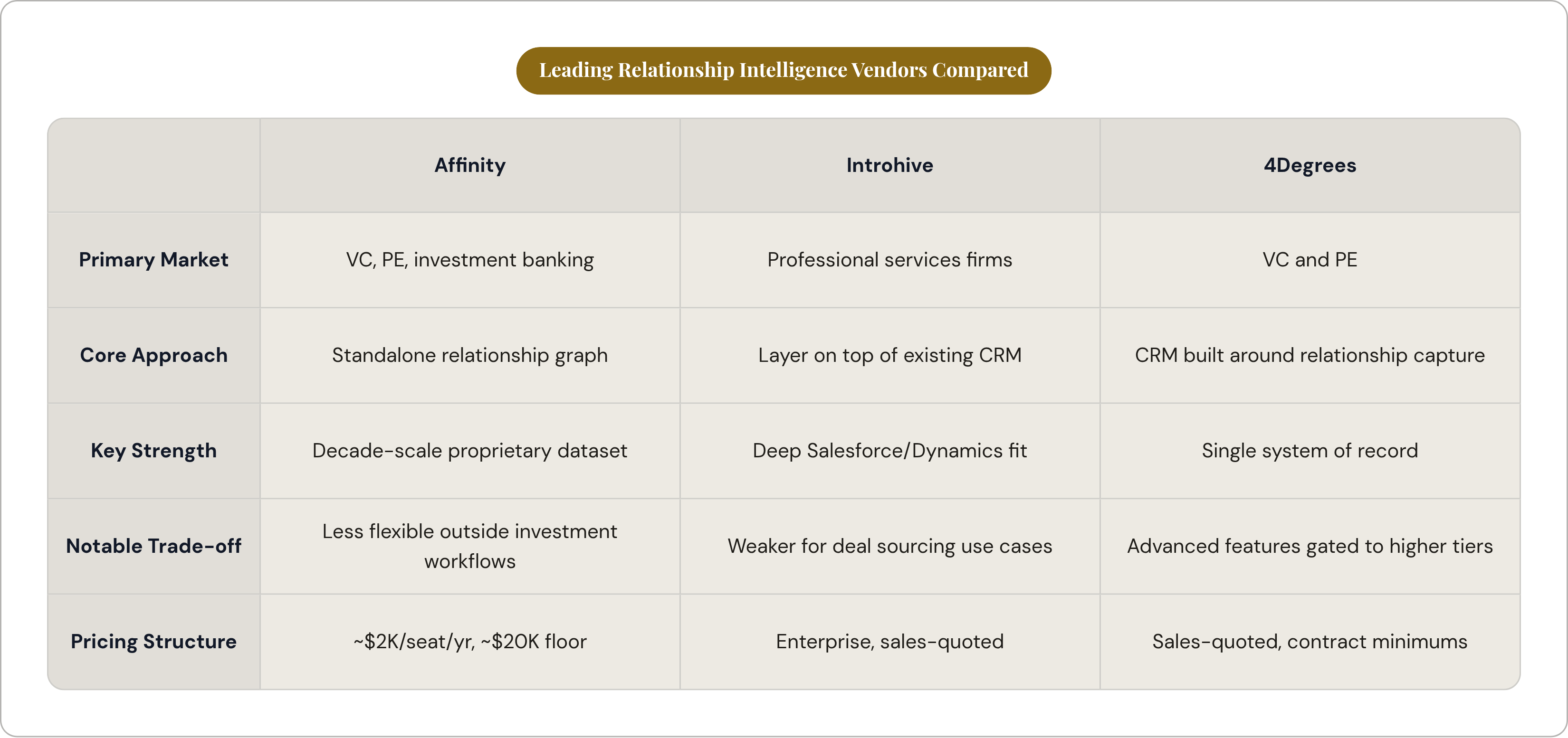
The category has a handful of established players, each with a distinct trade-off worth naming plainly.
Affinity is the default choice in venture capital and is expanding into private equity, real estate, and investment banking. Its relationship graph draws on more than a decade of compounding data across thousands of firms, which makes it one of the largest proprietary datasets in the category. It integrates natively with Salesforce, Outlook, and Chrome, and pulls from a wide range of third-party sources for contextual enrichment. Pricing starts around $2,000 per seat per year with a floor near $20,000, which positions it squarely as an institutional purchase rather than a team-level tool. The trade-off: its deep fit for VC and PE workflows can mean less flexibility for enterprise teams with different deal structures or compliance needs.
Introhive takes a different approach, built for professional services firms operating at enterprise scale. It layers relationship intelligence on top of an existing CRM rather than replacing it, which suits firms that already have Salesforce or Dynamics embedded and want intelligence added, not a rip-and-replace migration. Its core market is law firms, accounting firms, and consulting practices managing firm-wide relationship graphs for cross-selling and key account management. Introhive shipped an AI-powered intelligence suite in late 2025, and firms evaluating it should test how mature those newer capabilities actually are against the core relationship capture functionality, which has a longer track record. The trade-off is specialization in the other direction: strong for professional services, less tailored to investment workflows that need deal sourcing baked in.
4Degrees positions itself as a full CRM built around automated relationship capture, used heavily across VC and PE. It's designed to be the system of record rather than a bolt-on, which matters for firms that don't want to run a separate relationship intelligence layer alongside their existing CRM. Advanced features, including AI notetaking and SSO, are gated to higher pricing tiers, and reviewers have flagged this as a meaningful cost addition for larger teams. Pricing is sales-quoted with contract minimums, so it's worth running the full total contract cost against alternatives rather than assuming it lands cheaper than Affinity by default.
Beyond the three, there's a newer cohort worth naming: tools like Folk, Dex, and Articuler, which target a different part of the market and should be evaluated carefully against enterprise security requirements. These are generally better suited to individual operators or small teams than to firm-wide enterprise deployment, and should be measured against SOC 2 Type II and data residency requirements before being seriously considered for anything beyond a pilot. Clay deserves a separate note: it's better understood as a data enrichment and outreach automation platform than a relationship intelligence tool in the sense this piece has defined it. Different category, different evaluation criteria entirely.
The institutional knowledge risk that procurement teams systematically underestimate
Every firm eventually runs into this scenario. A senior partner, a key business development lead, or a managing director leaves, and with them goes an LP relationship, a founder connection, or a multi-year account history that existed only in their personal inbox. Nobody else at the firm had visibility into it. It's gone.
That's not a personnel failure. It's a structural failure in how the firm chose to store its relationship equity in the first place, and no offboarding checklist fixes a problem that was architectural from day one. IDC market research has found that companies lose a substantial share of annual revenue to inefficiencies caused by data silos, and relationship data silos are among the costliest, precisely because the loss stays invisible until a deal falls through or a warm introduction turns out to be cold.
There's a compounding effect worth sitting with here. When relationship data lives in silos, the firm becomes dependent on whichever individuals happen to hold the most institutional context. Those people become the default bridge for every relationship request that comes in, they get overloaded, they burn out faster than anyone accounts for, and when they eventually leave, the resulting damage is often worse than if no system had existed at all. The dependency itself becomes the risk.
Procurement teams that frame relationship intelligence purely as a sales productivity purchase are undervaluing what it actually does. The business case should also account for relationship continuity, succession planning, and firm-wide visibility into where the network has coverage gaps. Properly implemented, the tool means a new partner walking in on day one can see the firm's existing history with any LP or founder immediately, rather than inheriting a blank slate and rebuilding trust from zero. That's not a nice-to-have. That's the entire point of treating relationships as an institutional asset instead of a personal one.
Building the internal evaluation process: who should be in the room and what they should be testing
Gartner's research on enterprise buying has tracked a steady increase in the number of stakeholders involved in a single purchasing decision over the past decade, and relationship intelligence procurement is subject to exactly that dynamic. Getting internal alignment before the first vendor call isn't optional here; it's the difference between an evaluation that surfaces real risk and one that rubber-stamps whatever the sales demo showed.
The evaluation committee needs at least four distinct perspectives in the room, and they're not interchangeable. Security and legal need to evaluate data handling practices, SOC 2 Type II documentation, GDPR and CCPA compliance, the vendor's data flow diagram, and what happens to firm data if the contract ends. IT and infrastructure need to assess integration depth, API access, authentication methods like SSO and SAML, and compatibility with the existing security stack. The power users, meaning the investors, BD operators, or partnership leads who will actually use the signals day to day, bring a different lens entirely: their tolerance for friction is low, and if the tool doesn't surface something genuinely useful within the first two weeks, adoption collapses regardless of how good the architecture is on paper. Finance and procurement round it out, looking at total contract value, minimum seat counts, pricing for features gated to higher tiers, and how clean the exit terms actually are.
The sandbox evaluation matters more than any of this, and it has to run on real firm data, not the vendor's polished demo environment. Signal quality only becomes visible once the tool is processing your firm's actual email and calendar history against your actual target account list; a demo built on sample data will look clean no matter how the underlying model performs.
One concrete test worth running: name three target accounts where the firm currently has no CRM record at all, and see whether the tool can surface a warm path to any of them using email and calendar data alone. If it can't find a single connection across three real targets, that tells you more about the tool's actual signal quality than any spec sheet will. That raises the real question every evaluation should end on: does this tool make relationship equity visible across the firm, or does it just make one person's inbox slightly easier to search? The answer determines whether the purchase protects the firm long after the person who championed it has moved on.