AI Contact Enrichment for Venture and PE Deal Teams
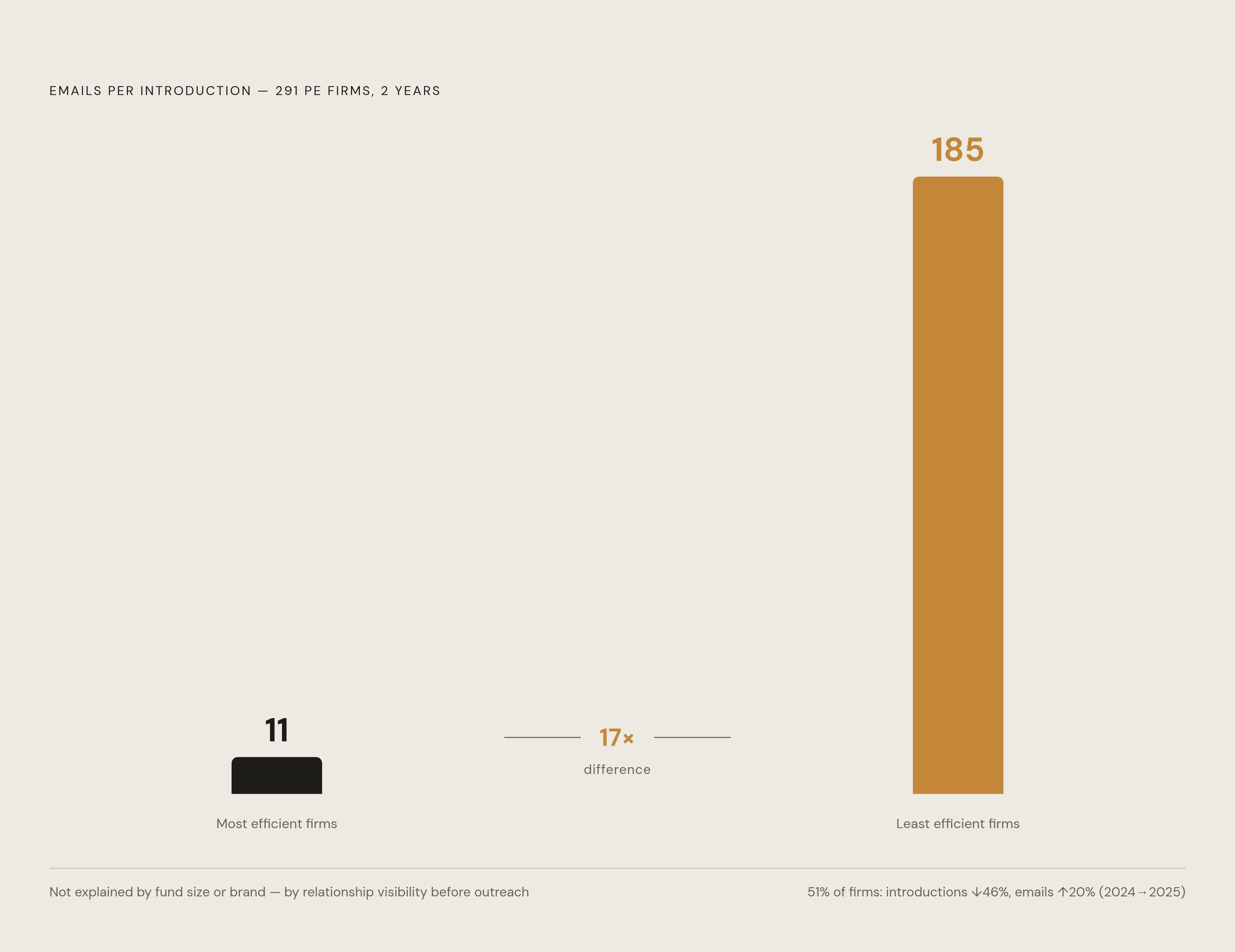
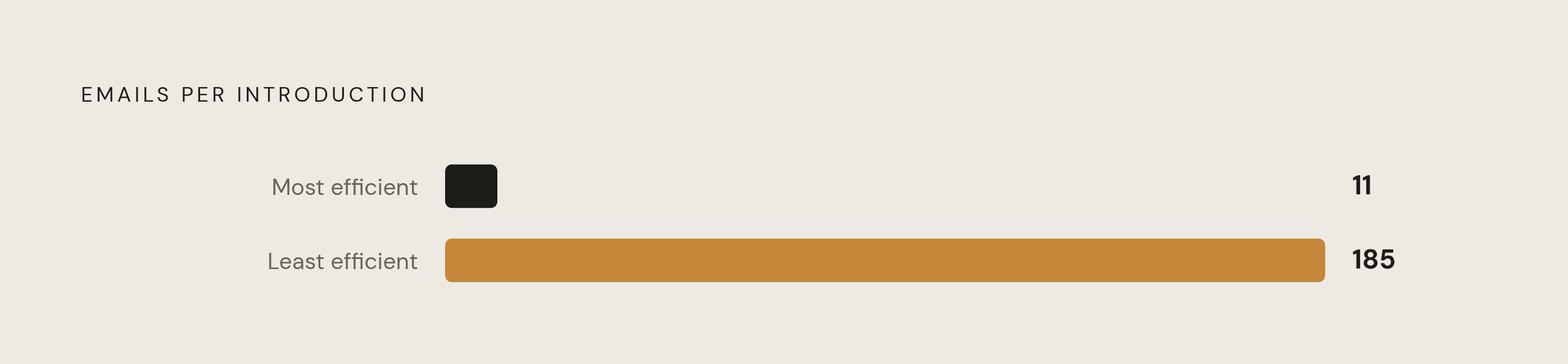
Most efficient PE firms need eleven emails per introduction; the least efficient need 185.
AI contact enrichment for venture and PE deal teams gets sold as a data completeness problem. Pull the right fields, verify the email, tag the firmographics, ship it. But the actual value sits somewhere else: whether your system can tell you who at the firm already knows the founder, how warm that relationship still is, and whether a credible introduction is sitting there, unused, in the firm's own history.
What contact enrichment has traditionally meant, and why that definition is too narrow for deal teams
Traditional enrichment does one job well. Take a name or an email, return a fuller record: verified contact info, LinkedIn profile, company size, funding stage, industry tags, sometimes board composition, all pulled from third-party databases and bolted onto whatever the CRM already had. The assumption baked into that workflow is that a complete record is a useful one, that knowing a founder's title and current employer gives you something to act on.
That record won't tell you whether anyone at your firm has actually spoken to that person. It won't tell you if the relationship was a real conversation or a LinkedIn follow from a conference three years back that went nowhere. And it says nothing about which path through your firm's network produces the warmest possible introduction, which is, for most deal teams, the only question that actually matters.
That gap barely registers in consumer SaaS sales, where the target list runs into the tens of thousands and the goal is volume plus personalization at scale. A clean record across ten thousand contacts is genuinely useful there. Venture and PE work a much smaller universe, and relationships are the access mechanism, not a nice-to-have layered on top of access. One warm path to a single founder beats a thousand clean records with no path attached. Most of the enrichment tooling deal teams use today got built for sales workflows and imported wholesale into private markets, and somewhere along the way nobody stopped to ask whether "do we have data on this contact" was even the right question. A better question: do we have a relationship with this contact, and can we prove it.
The empirical case for warm paths, and why most firms can't see the ones they already have
Harvard Business Review's analysis of nearly 900 VCs found that over 70% of all deals originate from a firm's existing network. Warm paths are, functionally, the sourcing strategy for most firms, whether or not the firm has organized itself to reflect that fact.
Affinity's Invisible Edge report, which tracked 291 PE firms over two years, puts a number on what happens when a firm can't see its own network. The most efficient firms generate one introduction for every 11 emails sent. The least efficient need 185 for the same result. Seventeen times the effort for the same outcome, and fund size or brand name doesn't explain it. What explains it is whether the firm knows, before it starts sending emails, which of its own people already has a real relationship with the target.
Here's the part that should worry anyone who assumes more outreach fixes the problem: 51% of PE firms in that same report saw introduction output decline 46% from 2024 to 2025, even while email volume rose 20%. Sending more without knowing your warmest path doesn't just fail to help. It makes the ratio worse. Volume without relationship intelligence just produces more noise per unit of signal, and I've watched teams mistake the noise for progress because the activity dashboard looks busy.
Why does this keep happening at firms full of smart, well-connected people? Because the relationship data sits siloed in a way that's almost structural. A partner's genuine connection to a founder lives in that partner's personal inbox and calendar, not in any system the rest of the team can query. When that partner leaves, the relationship leaves with them. Nobody inherits it, because nobody else ever knew it existed in a form they could act on. Layer on the usual fragmentation, GPs tracking opportunities in one system, investor relations managing LP contact in a second, portfolio monitoring living in a spreadsheet someone updates when they remember, and you get an institution that's individually well-connected and collectively blind.
McKinsey's Global Private Markets Report for 2025 makes a point worth sitting with: the firms winning deals aren't necessarily the ones with the largest funds. They're spotting opportunities earliest and holding stronger LP relationships through consistent operational discipline. The bottleneck for most deal teams was never a scarcity of data on companies. It's the invisibility of relationships the firm already has.
How AI changes what enrichment can actually surface
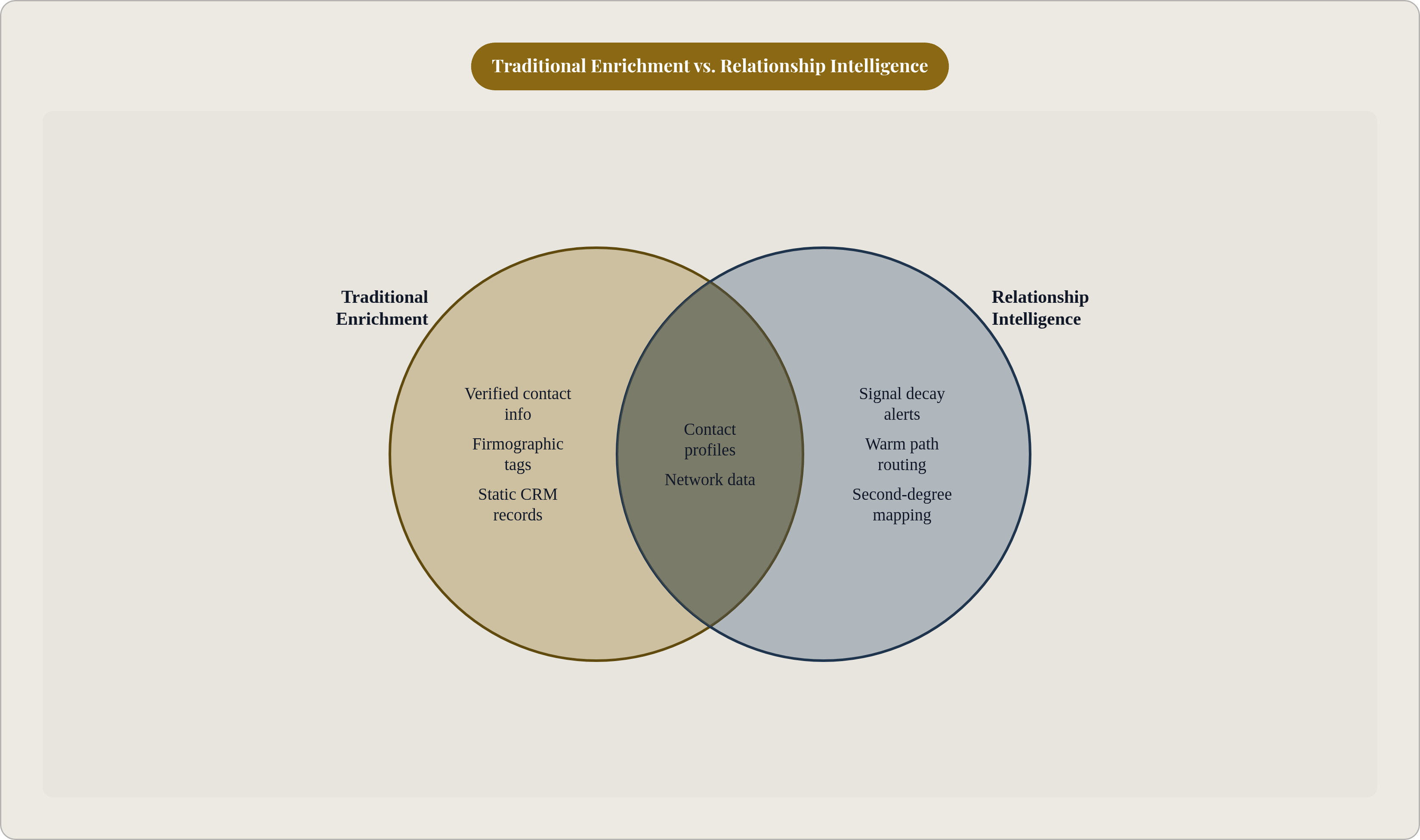
The leading relationship intelligence platforms infer connections from email, calendar, and work history data instead of waiting for someone to type a note into a CRM field. That shift, from manual entry to inference, is what turns a contact database into something you can actually query for relationship strength.
What surfaces from that, that a static record never could? Communication recency and frequency, for one: the gap between a connection gone quiet for two years and one with three email exchanges this month. Shared history, for another: co-investors on a prior deal, two people who sat on the same board call, mutual references buried in old correspondence nobody remembered to flag. It traces second- and third-degree paths too, the kind nobody checks by hand. Partner A doesn't know the founder directly, but eighteen months ago she introduced the founder's former co-worker to Partner B, and that connection is still sitting there, unused. It can also flag signal decay, the moment a once-warm relationship has cooled enough that it needs re-engagement before anyone tries to use it for an intro.
There's a portfolio-level version of this that's genuinely underrated. Every portfolio company brings its own founders, executives, customers, and co-investors into the firm's orbit. Combine those relationships across a portfolio of twenty or thirty companies and the effect isn't additive. It's multiplicative. The resulting network is probably the single largest relationship asset most investment firms own, and also the one they use least, which is a strange thing to sit with once you notice it.
On the sourcing side, tools like Harmonic, which indexes more than 30 million companies and tracks founder movement and hiring signals, show what's possible when AI works against live signal instead of a static record. It can surface pre-seed and stealth-stage startups before they've announced anything. On the institutional side, EQT's Motherbrain, launched back in 2016, remains the reference case. It combines external market data with the firm's own internal records and contributions from investment teams across the organization, so the firm's accumulated relationship history becomes an input to sourcing instead of a byproduct of it.
The architectural distinction underneath all of this matters more than any single feature, honestly more than most vendors want to admit. AI layered on top of a CRM three people update sporadically produces enriched records, full stop. AI operating on live, continuously updated relationship data produces something closer to actionable signal. Those aren't the same product, even when the marketing language sounds identical on the landing page.
Where relationship-signal enrichment changes deal team behavior in practice
The question changes first. Instead of "who is this founder," a partner starts asking "who on our team has the strongest relationship with this founder right now." Small shift in phrasing, completely different workflow underneath it.
Introduction routing is where this shows up most concretely. There's a real gap between a cold ask routed through a technically-real but practically-dead connection and a credible intro sent by whoever holds genuine, current relationship equity. Warm introductions convert at 15 to 25%, well above cold outreach, and companies with strong referral motions close deals 69% faster. Sergio Monsalve, Founding Partner of Roble Ventures, put it plainly: for 88% of their deals, the firm is either tipped off by its network or referred directly into the deal. For Roble, the intro path carries the deal process from end to end.
The same relationship graph that helps a firm find deals also helps its portfolio companies find customers and hires. Warm connections to a potential enterprise buyer, a key executive hire, or a co-investor all run through the same underlying network, and each new introduction feeds back into it, making the next one easier to surface. LP relationship management benefits too, in a quieter way. Knowing which LP spoke with which portfolio founder, and when, and about what, provides continuity more than surveillance. It's the difference between a relationship that survives a fund cycle and one that goes dark between raises because nobody was tracking it.
The productivity numbers are worth sitting with rather than skimming past. MassMutual Ventures surfaced tens of thousands of contacts and organizations within 60 days of adopting a relationship intelligence platform, and the team now triages opportunities several times faster than before. Alpha Venture Partners reports doubling deal flow, two years running, after adopting a comparable platform. What changes is when in the process that data becomes usable, more than the volume of data teams can access. Enrichment stops being prep work that happens before the real job starts, and becomes the layer deciding which conversations happen at all.
Why the data privacy architecture underneath enrichment is not a compliance checkbox
Relationship data carries a kind of sensitivity a firmographic record never does. A partner's email history with a founder might reveal a live deal process, competitive tension with another fund, or a board dynamic nobody involved wants broadcast to the rest of the firm. The real architectural question is whose relationship context becomes visible to whom, under what conditions, and who made that call. That's a permissioning question more than a security certification, and firms that treat it as the latter tend to find out the difference the hard way.
Individual relationship context has to stay private even as institutional relationship signal, meaning who the firm collectively knows and at what degree of closeness, becomes queryable across the organization. Those two things sound similar and require genuinely different design choices. Conflating them is where a lot of enrichment tools go wrong.
Think about what's actually getting combined here: privileged financial data from private deal documents, public third-party data, and communication history, all tied into one knowledge layer. That combination belongs to the firm in a way nothing else in the tech stack does. No competitor can replicate it by licensing a database, and no new hire can rebuild it from scratch, because it's built from years of accumulated, proprietary interaction. That's exactly why it needs real protection: the asset only holds value if it stays exclusive.
There's a trust problem hiding underneath the privacy problem too. If team members suspect that logging a relationship might expose sensitive context to people who shouldn't see it, they'll just stop logging it. The graph goes incomplete, quietly, and an incomplete relationship graph produces worse signal than no graph at all. It creates false confidence that the firm checked for a warm path when it actually didn't, which might be worse than never checking in the first place.
Permissioned architecture should be the baseline expectation when evaluating any enrichment platform, not a line item to compare on a spec sheet. The real test is how a system handles the edge cases: a partner who leaves and takes nothing but also loses nothing the firm needs; a relationship spanning two competing portfolio companies; an LP who also happens to be a potential acquirer of something in the portfolio. About 64% of investors now use AI to speed up company research, and the firms moving fastest on enrichment are, not coincidentally, the ones most exposed if they get the permissioning model wrong. Speed without sound trust architecture underneath it erodes the very thing that makes warm introductions work in the first place.
What separates deal teams that operationalize relationship enrichment from those that treat it as a feature
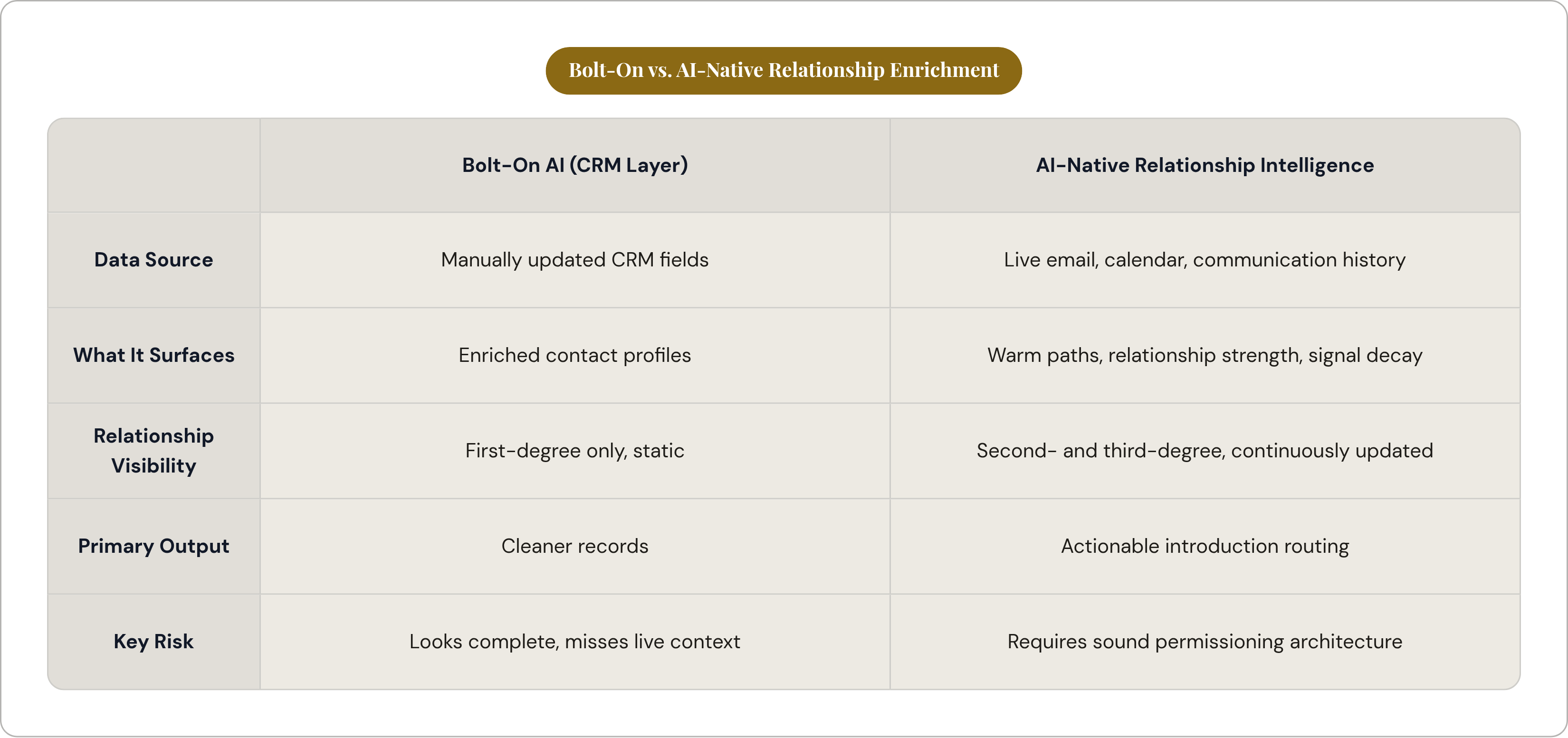
There's a real gap between an LLM wrapped around a stale CRM and an architecture where relationship signal updates continuously from live communication data. That distinction, bolt-on versus AI-native, might be the single most important thing a deal team evaluates when shopping for enrichment tools, and it's easy to miss because both approaches can produce a nearly identical interface on the demo call.
A handful of platforms built specifically for private markets relationship intelligence take a different approach than general sales-enrichment tools. Affinity auto-captures email and calendar activity across a firm and scores relationship strength from it; the 17x efficiency gap cited earlier comes from Affinity's own benchmark work across those 291 PE firms. 4Degrees focuses on relationship scoring and introduction routing built specifically for VC and PE workflows, organizing deal flow around network connections rather than generic pipeline stages. Rolo takes a different angle: it connects the systems where professional relationships actually live, email, calendar, LinkedIn, messaging, and turns that scattered history into a queryable graph. It surfaces warm paths, ranks connections by relevance and recency, and can draft outreach in the user's own voice, without acting autonomously or exposing private context to people who shouldn't see it. It's built on the assumption that a single introduction can shape a fund's entire vintage. That's a fairly high-stakes design constraint, and it shows in how conservatively the tool handles visibility.
What separates the firms that get value from this from the ones that don't isn't really the platform choice. It's the habits built around it: treating every portfolio relationship as a network asset instead of just an investment to monitor, routing introductions to whoever has the genuinely strongest relationship instead of whoever holds the most senior title, using signal decay as a trigger to re-engage a contact before an intro is needed instead of scrambling after the fact, setting permissioning norms before rollout so the privacy model stays consistent across the firm rather than getting improvised deal by deal.
TELUS Global Ventures saw a substantial improvement in data completeness after adopting a relationship intelligence platform. Completeness sounds like a hygiene metric, but it's the foundation everything else sits on: fewer missed connections, more accurate relationship scores, sourcing decisions that are reliable instead of lucky. Firms that treat enrichment as a feature use it to tidy up CRM records before a quarterly review. Firms that have actually operationalized it use it to answer "who do we know" before every outreach decision, and that difference shows up in deal flow numbers long before it shows up in how clean the database looks.
How to audit whether your firm's enrichment is producing relationship signal or just filling fields
Here's a fair test: can anyone on your team name, in under two minutes and without asking around, who has the warmest relationship with a specific founder you're targeting right now? If the honest answer involves digging through an old email thread, pinging a partner on Slack, or guessing based on seniority, your enrichment layer is producing records rather than signal.
A few checks get at this from different angles. What happens to relationship context when a senior associate leaves tomorrow? How much of it walks out the door, and how fast does the rest go invisible to everyone else? Can the team actually surface second-degree paths through portfolio founders, LPs, or co-investors for a company on the active sourcing list, or does the search dead-end at first-degree connections because nobody built the tooling to go further? And are the relationship scores in your current system pulling from live communication data, or from the last time someone remembered to update a CRM field, which, if we're honest, was probably a while ago?
When evaluating platforms, a few questions cut through the marketing fast. Does it capture communication signals automatically, or does someone have to keep it current by hand? Does it surface actual paths and introductions, or profiles and firmographics dressed up with an AI label? Does it draw a real line between individual relationship context and institutional relationship signal, or flatten the two together in a way that will eventually make someone uncomfortable? And does it plug into the systems where relationships genuinely live, email, calendar, LinkedIn, rather than just the CRM where they're theoretically supposed to be logged?
The window here is closing faster than most firms realize. With 94% of dealmakers planning to fold AI into their workflows in some form, the ones who get the enrichment layer right first end up holding a relationship graph nobody else can copy, built from years of proprietary communication history rather than a database any competitor could license off the shelf. The goal, in the end, is a firm that can answer who it knows, how well, and what the fastest warm path looks like, for any target, at any moment, without anyone having to stop and ask around.