AI Meeting Preparation Briefs for Investor and Founder Calls
Most tools miss the introduction and relationship history that actually predict call outcomes.

Open one of these tools before a founder or investor call and you get the same package almost every time: company overview, funding history, product description, team background, a few news mentions, maybe a competitor list. Fine, as far as it goes. It's also something anyone with a browser and thirty spare minutes could put together themselves. So what you actually end up with is parity between two prepared people, not an edge for either one. The result is often just a re-read of the deck with extra steps.
A handful of tools push further, including warm-path finders like Rolo that surface introduction context from a firm's existing network data. Brief My Meeting pulls context from a user's inbox and calendar ahead of a meeting, which nudges toward relationship awareness instead of pure company lookup. Granola takes a different angle, capturing meeting notes without a bot sitting on the call, and that matters more than people give it credit for in an industry built on trust. Both are real steps forward. Both still orbit the meeting itself rather than the relationship the meeting lives inside of.
Almost everywhere in this category, tools summarize one call, or what's publicly known about one company. They rarely stitch together what's happened across a relationship over six calls, six months, six years. That's the stuff that actually changes how you open a conversation: how this investor knows this founder, who made the introduction, what got said last time, what concern got raised twice and never got resolved.
Why the introduction and the relationship history are the most predictive inputs to a call
Warm introductions beat cold outreach at every stage of the funnel, and the gap isn't marginal. We're talking an order-of-magnitude difference in conversion between a warm intro and a cold email landing in someone's inbox. That alone tells you where the real signal lives, and it isn't in the deck.
Introduction quality varies a lot. An intro from a portfolio founder carries far more weight than one from a loose LinkedIn connection, so the source of the introduction is itself information, shaping the call before either person says a word. There's also the double opt-in norm governing most warm intros: a well-structured introduction already implies both sides agreed to the meeting. Knowing who brokered it, and how they framed it, tells you a lot about how the other party is likely to show up.
If an investor knows a founder came through a trusted co-investor instead of a cold pitch, the tone of the call shifts before anyone opens their mouth. Skepticism drops. The conversation starts from a different baseline entirely. Run the logic the other way: a founder who knows which partner made the introduction, what that partner's relationship is to the actual decision-maker, and whether there's portfolio overlap, already holds more useful information than any tweak to slide four of the deck ever will. The introduction is a compressed signal about trust, shared network, and what the other side already believes about you before you've walked in the room.
What a genuinely useful AI prep brief contains, layer by layer
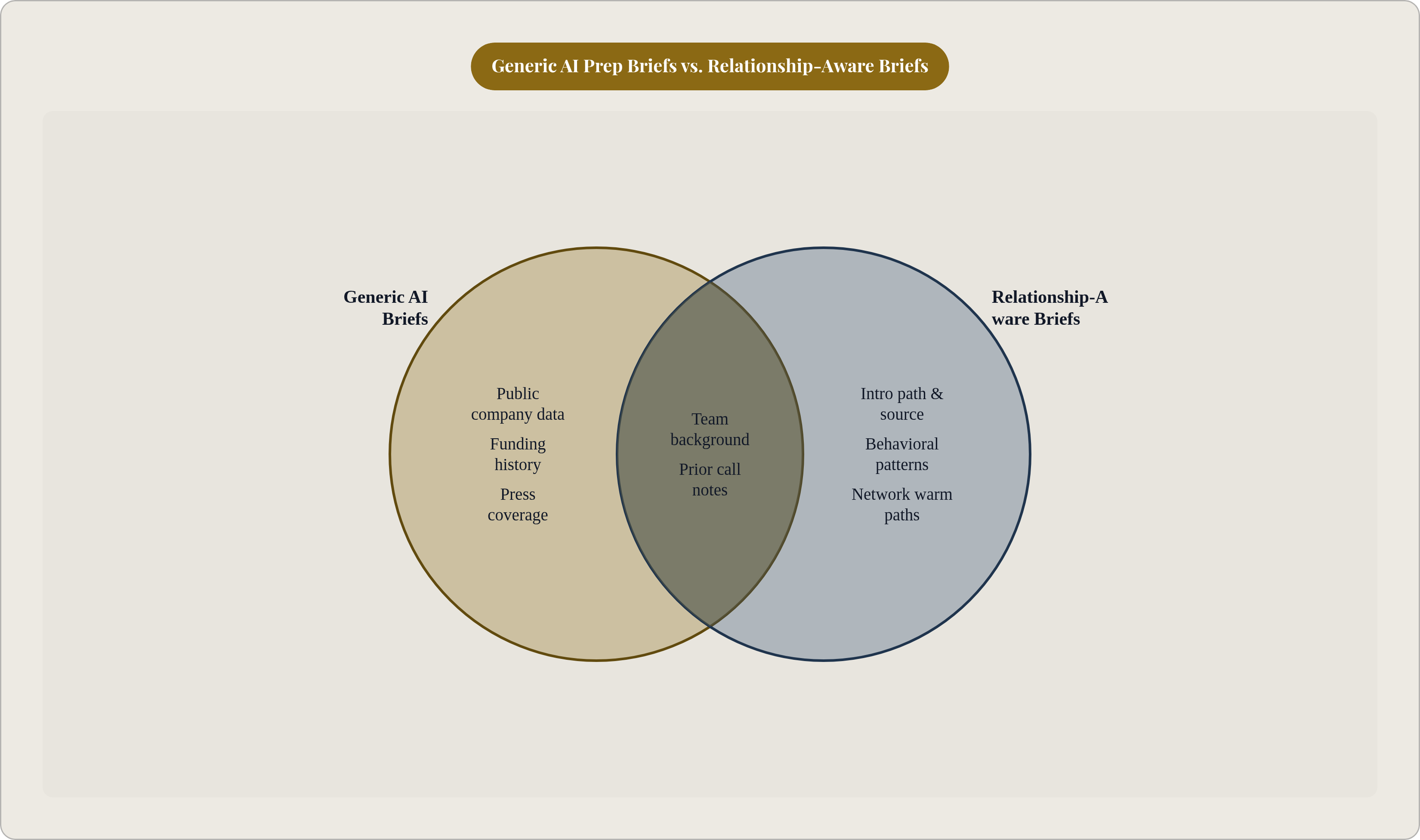
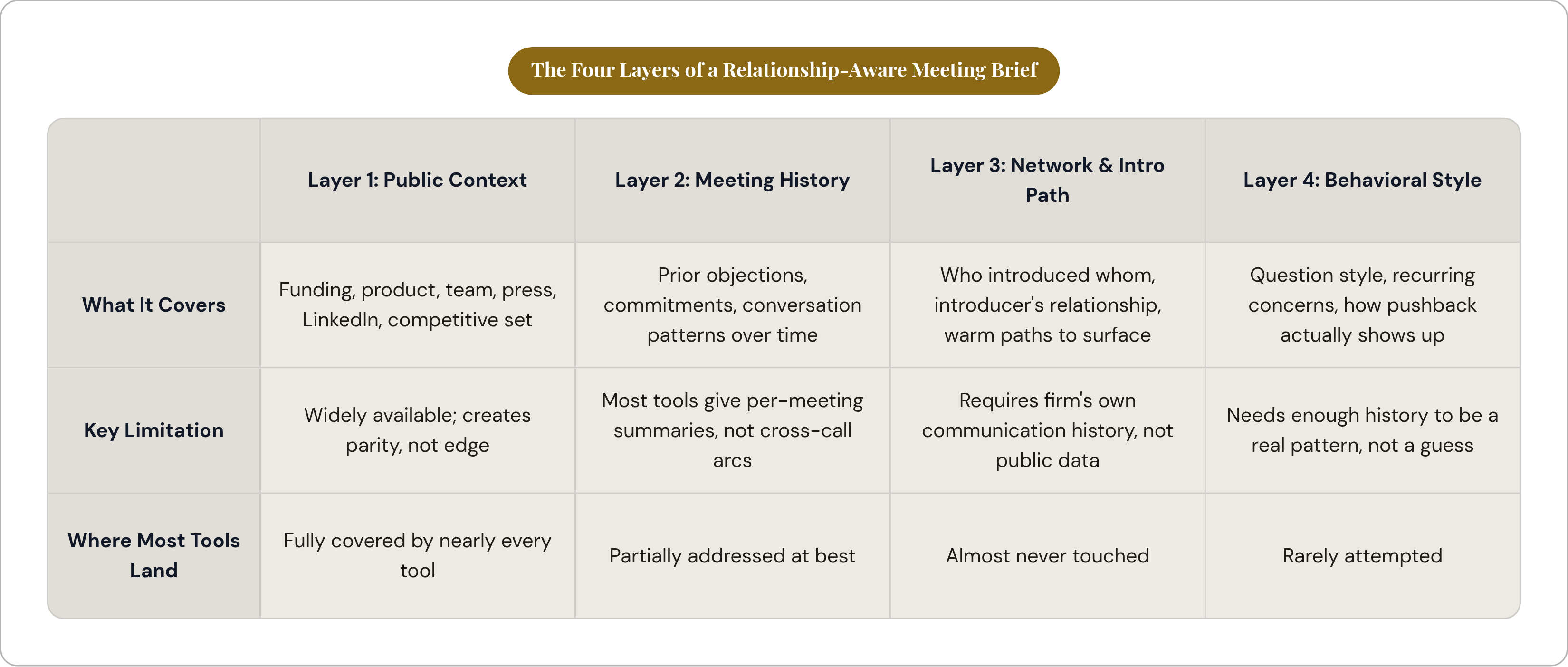
Start with the baseline, since it still matters even though it's no longer enough on its own. Call it layer one: public company and person context, recent funding events, product updates, team changes, press coverage, LinkedIn activity, published writing, conference talks, the competitive set. Necessary, but limited. Most tools stop right here and call it done.
Layer two is meeting history and prior conversation signals. What did this person or their firm actually say last call? What objection came up that nobody circled back on? Did either side commit to something, and did it happen? Maybe it's a pricing concern from Q3 that never got revisited, or a hiring freeze mentioned once in passing last month. Individually these are small facts. Strung together across an arc, they're the pattern that actually informs a good decision, and most tools hand you per-meeting summaries instead of anything spanning the relationship.
Layer three: the introduction path and network context. Who introduced the two parties, what's that introducer's relationship to each side, does the firm have other touchpoints with this founder's investors or advisors or team. This layer also surfaces warm paths a participant might not know exist, a colleague who already knows the lead investor, a portfolio founder who's worked with this exact team before. Almost no generic AI tool touches this, because it needs access to a firm's actual communication history, not public data scraped off the internet.
Layer four is behavioral and engagement style. Does this person front-load the questions in a meeting, or hold them until the end? Challenge assumptions out loud, or sit quiet and push back later? What do they keep circling back to across conversations, which tends to be a far more honest signal of what they actually care about than anything they'd tell you directly. A brief that flags that this founder gets defensive about burn rate, or that this partner always probes unit economics first, changes how you calibrate delivery, not just what you bring into the room.
Four layers, and I'll admit the fourth one is the hardest to build well. Behavioral pattern requires enough history to actually be a pattern and not a guess dressed up as one.
The institutional memory problem that makes most briefs incomplete
The context that would make a brief genuinely useful usually already exists somewhere inside the firm. It's in a partner's memory, in a colleague's email thread from eight months back, in a call summary nobody ever linked to the CRM record. The information sits there, invisible from wherever you happen to be standing when you need it. That's the frustrating part: it's misplaced, not missing.
Partner and associate turnover makes this impossible to ignore. Someone leaves the firm, and years of accumulated context on portfolio companies and prospective founders leaves with them. Whoever inherits those relationships starts from zero on history that took years to build. Warning signs in founder conversations scatter the same way, spread across multiple calls instead of concentrated anywhere useful. A concern raised briefly in one meeting, echoed in a different form six months later, only reads as a pattern if someone can query the full record, not just happen to remember it came up once before.
Manual logging sits underneath all of this, and it's the quiet culprit. The people holding the most valuable context, the partners, are also the people with the least time and the least incentive to sit down and type it into a CRM field after a long day of calls. Within months, any CRM-based record of a relationship goes stale, and a firm's institutional memory erodes without anyone quite noticing. Nobody catches it until they need something and it isn't there, which tends to happen about fifteen minutes before a call.
Why relationship data stays siloed even when firms invest in tools
So why doesn't better tooling just fix this? Traditional CRMs were built for transactional sales funnels: pipeline stages, call notes, a linear path from lead to close. Venture dealmaking loops back on itself; it's relationship-driven, and forcing a general-purpose sales CRM into that shape usually takes heavy customization and consulting work just to get it functioning at all. Adoption stays low anyway, because even after all that work it still doesn't match how investment teams operate day to day.
What most firms end up with is a patchwork: a CRM nobody fully trusts, a shared inbox with no real structure, spreadsheets tracking deals, a separate tool or two for portfolio monitoring. None of it talks to any of the rest. The gap between what firms pay for and what they actually manage to capture remains a persistent challenge despite growing tool adoption.
The silo reflects a design gap as much as a technology gap. Tools built around contact records and activity logs were never built to answer the question that actually matters: what do we, collectively, across everyone at the firm who's ever touched this relationship, actually know? Carta's work unifying front-office deal teams with back-office fund data solves one version of that problem. Affinity's relationship intelligence layer solves a different piece of it. Between raw communication history and a usable meeting brief, there's still a gap most platforms leave wide open, and it's the gap that matters most.
What it looks like when relationship context is surfaced before a call
Picture an investor prepping for a second meeting with a founder. The generic brief hands over a company overview, recent press, deck highlights, a comp set, the usual. A relationship-aware brief adds something different: the intro came through a portfolio founder who specifically vouched for this team's technical depth, the first call surfaced a CAC concern nobody ever followed up on, a colleague at the firm had a separate conversation with the co-founder three months back about something unrelated, and the lead partner has actually met the CTO before through a mutual board seat.
Walk into that second meeting with all of that in hand, and you know exactly which thread to pick back up, who else at the firm has context worth sharing beforehand, and roughly what the founder is watching for based on how the last call ended.
Now flip it around. A founder prepping for a first meeting with a new partner at a firm. Generic brief: the partner's portfolio, their stated thesis, whatever they posted on LinkedIn last week. Relationship-aware brief: the introduction came through a shared network contact, the partner has publicly stated views on what they look for in a deal, and an advisor on the founder's own team has a prior working relationship with someone inside that firm.
That founder opens on terms that matter to this specific person, leads with a connection that already exists instead of manufacturing rapport cold, and doesn't burn the first ten minutes establishing credibility a warm path had already built before the meeting got scheduled.
What's consistent across both versions is that the volume of information barely changes. What changes is which pieces of it are actually usable before the first sentence gets spoken.
The trust and privacy constraints that shape how relationship intelligence can work
None of this works if it costs someone their privacy, and that tradeoff deserves a straight answer rather than a hand-wave. The data that makes a relationship-aware brief useful, email threads, calendar history, message context, is also some of the most sensitive material a professional handles all day. A system that takes one partner's private conversation and exposes it to the whole firm becomes a liability fast, and firms treat it exactly like one.
The real architectural question is how to surface institutional-level signal without exposing the individual content underneath it, and the two are genuinely separable. A firm knowing "we have three touchpoints with this founder across two different partners" is nowhere near the same thing as every person at the firm reading the actual content of those three threads. Permissioned access and aggregated signal can sit side by side; one doesn't require the other.
Enterprise AI security in this corner of the industry is as much a compliance question as a technical one. Professionals working in high-trust environments, and their legal teams right behind them, ask about data residency and access controls, and whether a tool can send or act on its own, before they ask about a single feature on the roadmap. The standard that holds up in practice: the tool drafts and surfaces, and stops there, short of sending or acting independently. The person stays in control of every piece of outreach that comes out of a brief's suggestions.
A few products are trying to solve this specific slice of the problem, connecting communication history into a relationship memory layer you can query, built to surface warm paths while keeping private threads unexposed and outreach under manual control. Whether any given architecture holds up at scale across a fifty-person fund is a separate question from whether the idea itself is right. The idea is right: the firm gets collective visibility into what it already knows, and the individual keeps control of their own conversations.
How to evaluate whether your current prep process is actually using the relationship layer
Here's a fairly simple test. Think back over your last ten investor or founder calls, and ask whether your prep actually answered a short set of questions. Who introduced the two of you, and what's that person's relationship to each side? What got said across the last three touchpoints with this person or their firm? Does anyone else at your firm already have a relationship with this person or their close network? Is there an open concern from an earlier conversation that never got resolved?
If your honest answer to most of that is "I had to dig for it," or worse, "I had no idea," then what you've built leans almost entirely on public research and barely touches relationship intelligence at all.
The firms that consistently win on introductions and deal conversion see their own network clearly enough to use it with precision instead of guessing at it, which shows up as sharper-targeted outreach rather than simply more of it. The right prep process pulls from wherever the relationship history actually lives, whether that's email threads, calendar records, or conversation history reflecting what genuinely happened between two people over time, rather than a CRM that's three months stale and getting staler.
Relationship context works best as a foundational layer to a meeting brief, not an afterthought bolted on at the end. It's the layer that decides whether the brief changes how the call actually goes, or just gives you something to read on the train ride over.