Network Decay and Why Warm Connections Go Cold
Cognitive limits, not neglect, explain why professional networks decay over time.
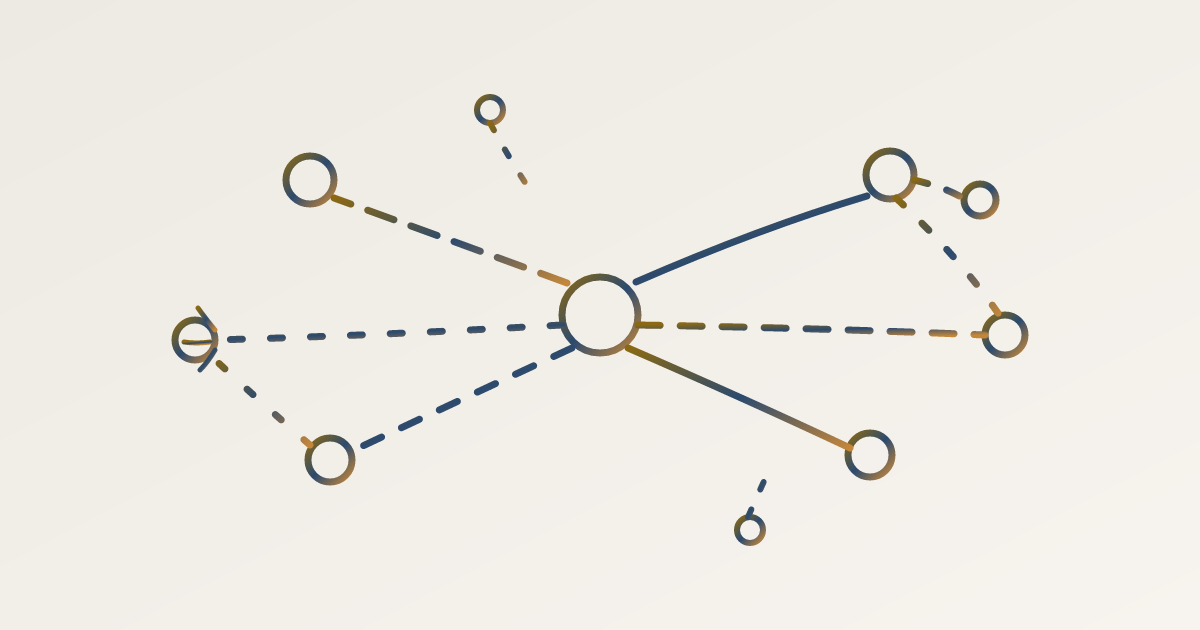
Relationships don't expire on a schedule anyone announces. They thin quietly, like a path through grass that stops being walked. By the time most professionals notice the erosion, they're already standing at a door they assumed was still open, discovering the warmth has left without sending notice.
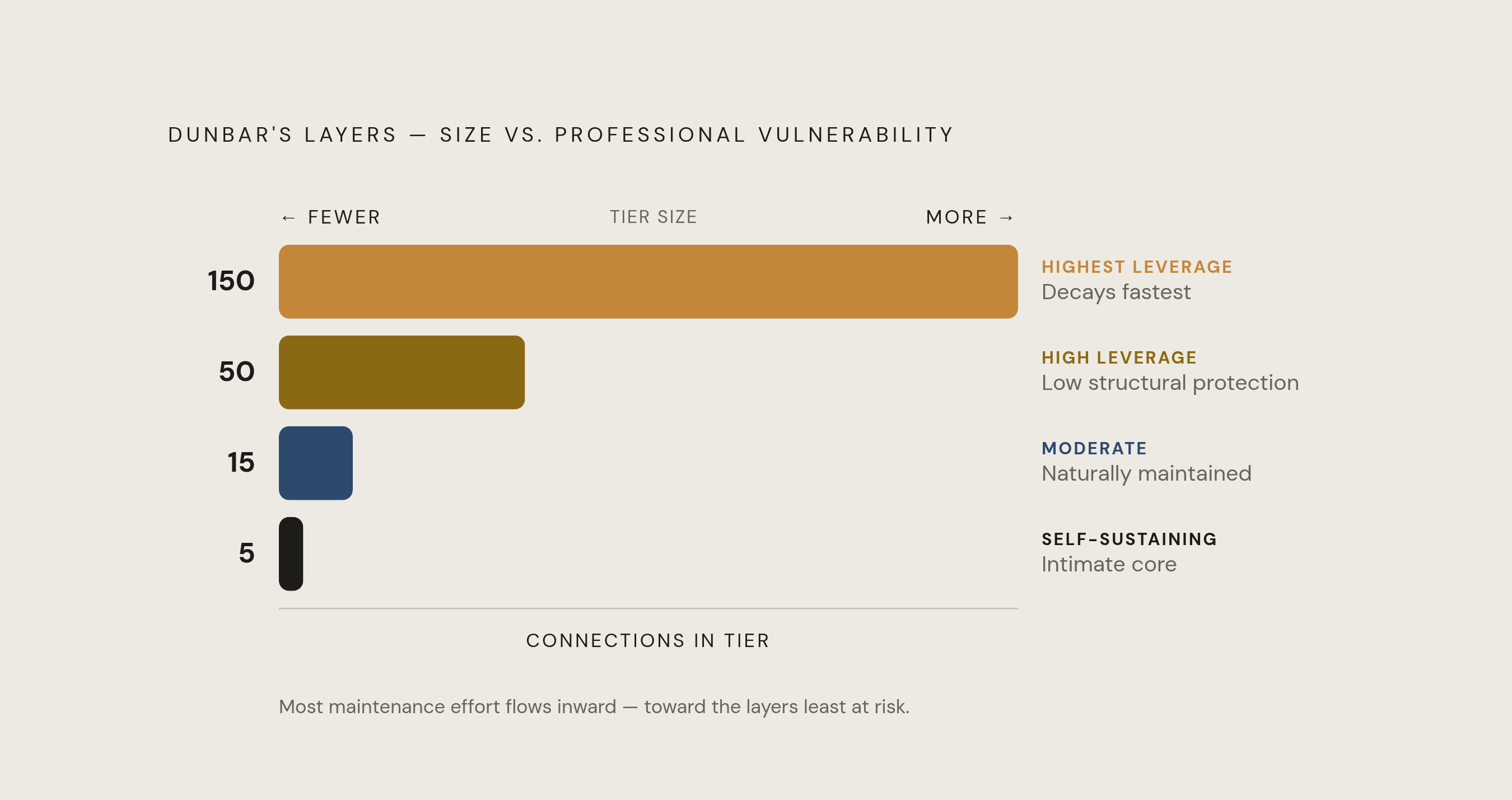
I've spent enough years building, losing, and occasionally recovering professional relationships to know that the failure mode isn't laziness or ingratitude. It's something more structural, and more forgiving in its explanation: cognitive architecture. The work of Robin Dunbar, whose original research appeared in 1992 and whose conclusions were validated through a 30-year review published in 2025, suggests that human social capacity is not a matter of effort or character. It is a matter of limits. Roughly five intimate connections. Fifteen close friends. Fifty good acquaintances. About 150 total meaningful relationships. These aren't aesthetic categories; they're load-bearing tiers, each one requiring a different investment of cognitive and emotional energy to sustain.
The implication that took me the longest to internalize is this: the outermost rings, the 50 and 150, carry the highest professional leverage and the lowest structural protection. They are the most vulnerable precisely because they are the most cognitively expensive to maintain intentionally. That tension is the engine behind most of what professionals experience as network decay.
What Actually Causes a Warm Connection to Go Cold
Decay is not passive. It is an active reallocation of finite cognitive resources toward whoever is present. The brain doesn't so much forget the peripheral colleague as it reassigns bandwidth to the people currently in the room, on the calendar, in the inbox.
But what if the real danger isn't forgetting someone entirely — but believing you haven't? What makes this insidious is the lag. The colleague you saw every week for three years feels close even after months of silence. Your internal model of that relationship reflects its peak, not its current state. You believe you have a warm path; what you actually have is a warm memory.
The asymmetry makes it worse. The person who drifted away experiences continuity. The person who was drifted away from experiences absence. These are two fundamentally different subjective realities, and they diverge without any explicit rupture to signal that a rupture has occurred.
Research conducted during the pandemic period illustrated the mechanism in stark relief. As social contact contracted, people's outermost relational rings shrank considerably while their innermost circles strengthened. The cognitive resources freed by reduced peripheral contact flowed inward, not outward. The 50 and 150 tiers contracted consistently and predictably, because those relationships require the most intentional effort to sustain and offer the least structural reinforcement.
Structural reinforcement matters. Burt's network research found that ties embedded in dense, shared third-party networks decay significantly more slowly, with a z-score of −8.1 at P <.001. A mutual colleague, a shared board seat, a co-investor relationship: these act as passive bracing. Remove the shared context, and the decay accelerates, not because anyone made a choice to withdraw, but because the architecture that was holding the relationship in place is gone.
The False Sense of Closeness That Outlasts Real Warmth
The subjective feeling of a relationship persists long after its actual warmth has faded. This is distinct from forgetting someone. It is actively believing that a relationship is warmer than it is, and it is one of the more professionally costly cognitive distortions I've encountered.
Several mechanisms feed the illusion simultaneously. Memories of past closeness are vivid and feel recent even when they aren't; the brain does not timestamp emotional memory with the precision of a calendar. Social media and LinkedIn activity create a sense of ambient presence: you see someone post, you notice their promotion, you register their name in passing. Dunbar's 2016 research published in the Proceedings of the Royal Society found that online social platforms do not increase functional network size beyond approximately 150. Visibility, in other words, is not relationship maintenance. It mimics it well enough to deceive.
The practical consequence is the moment I have watched cost people the most: the professional who reaches out expecting a familiar reception and encounters something closer to a stranger's distance. They assumed a warm path existed. They operated on the model of the relationship as it was, not as it is. The path had decayed, but their confidence in it had not.
Why Dormant Ties Hold More Value Than Most Professionals Realize
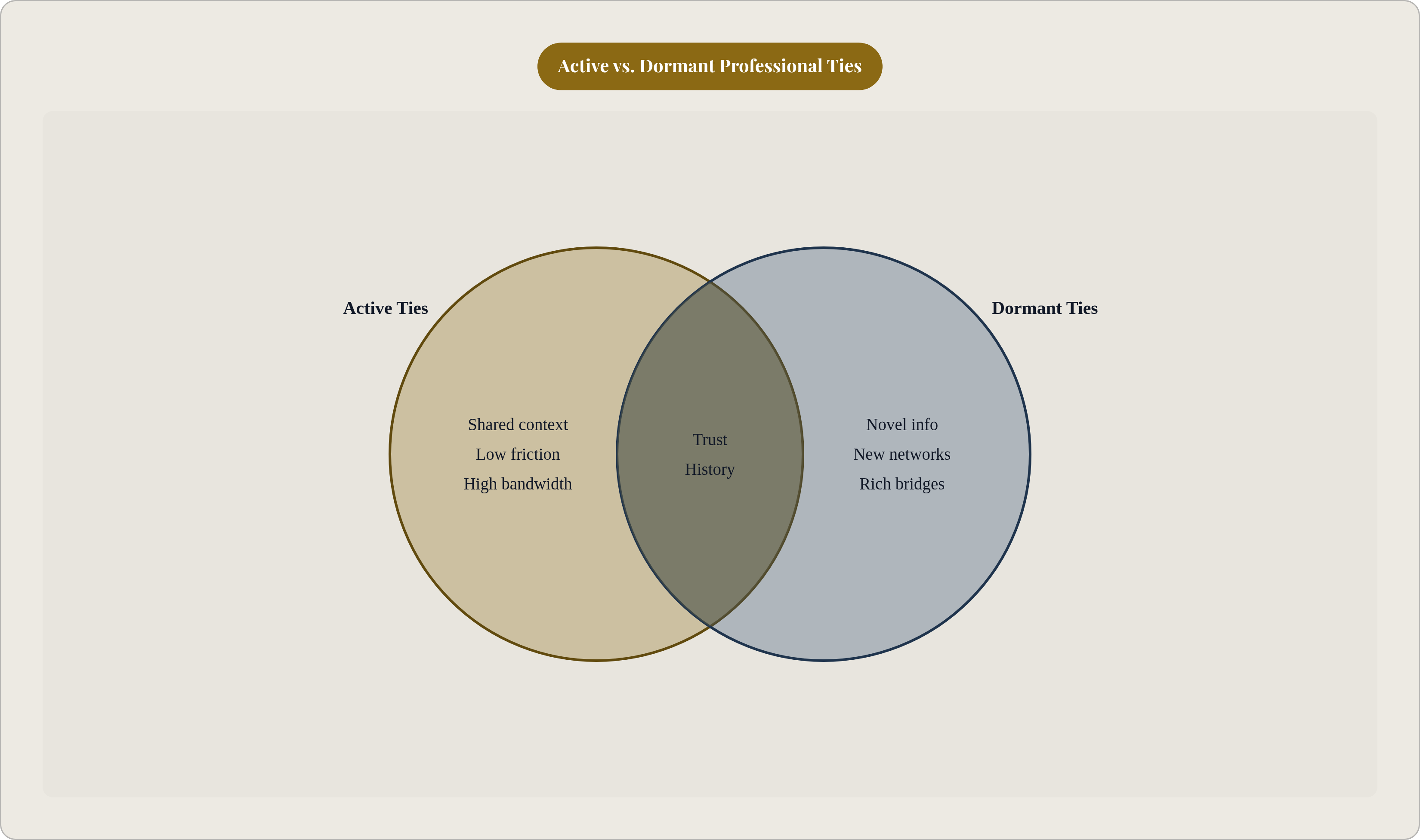
A dormant tie is not a failed relationship. It is a former colleague, mentor, or contact with whom genuine relationship history was built and then allowed to go quiet for six months or more. The distinction matters because dormant ties are not simply degraded versions of active ones; they are a qualitatively different asset.
The gap is productive in one specific respect. During the silence, the other person has been building entirely new knowledge bases, networks, and contexts that your current active relationships cannot access. A Levin, Walter, and Murnighan study published in Organization Science in 2011 found that executives who consulted dormant contacts received more valuable problem-solving assistance, more novel information, and better referrals than when they turned to currently active contacts. The explanation is straightforward: active contacts are embedded in the same information environment you're already in. Dormant contacts have diverged. They are bridges to worlds you've lost visibility into.
Granovetter's weak-tie theory extends this framework: the most valuable professional opportunities, jobs, deals, introductions, flow through bridging relationships, not tight clusters. The very distance that makes a dormant tie feel awkward to reactivate is what makes it informationally rich.
It is also worth considering the compounding loss. A decayed network isn't simply a lost asset; it's a loss that grows with time. Every year of dormancy widens the gap between what that tie could offer and what your already-active network provides. The diminishing returns are real and they accelerate.
The Contact Frequency Thresholds That Determine Which Tier a Relationship Holds
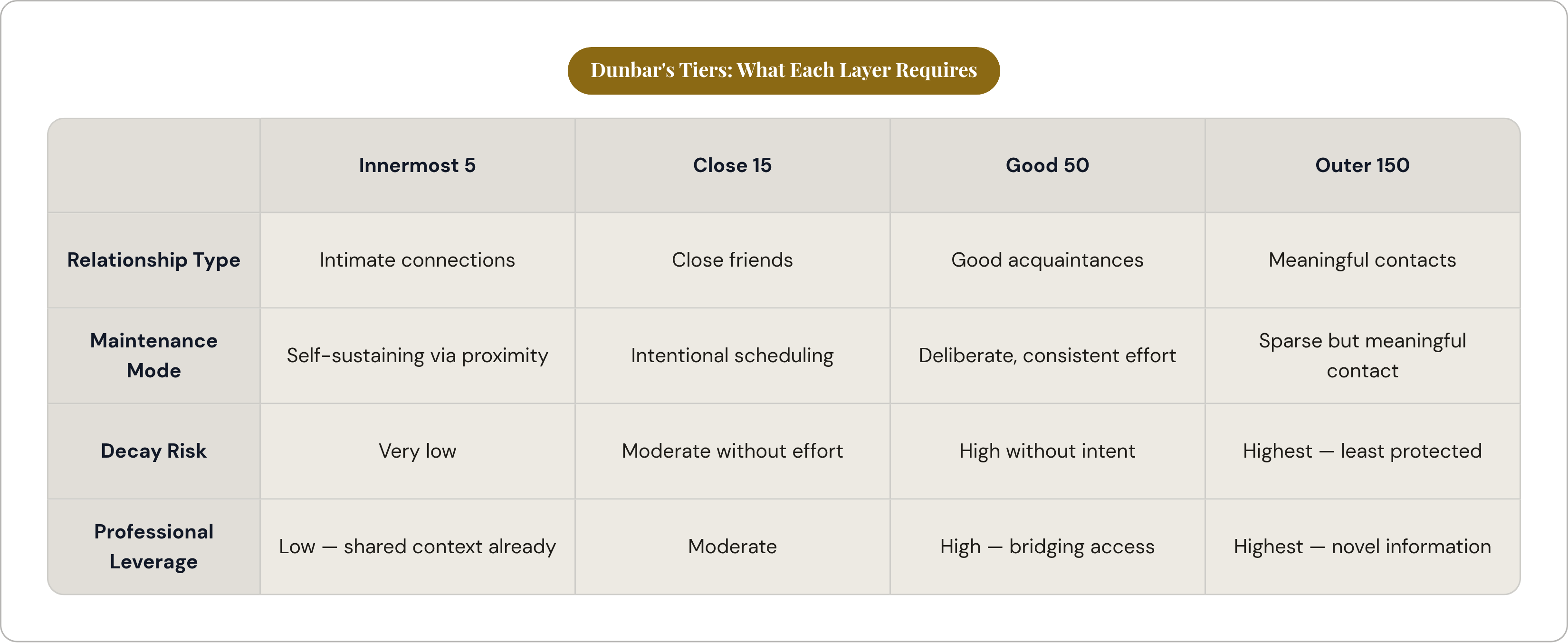
Each layer in Dunbar's framework carries an implied contact-frequency floor. Drop below it consistently, and the relationship migrates outward to the next ring. It doesn't announce the migration. It simply arrives there.
The innermost five are largely self-sustaining; life keeps them active through shared context, proximity, and the natural urgency of intimate relationships. The fifteen and fifty layers are different. They require intentional scheduling. They don't stay warm through ambient daily contact alone, and they will drift without deliberate investment.
The outermost rings, approaching 150, can be maintained with surprisingly sparse contact, but only if that contact is meaningful and consistent enough to signal continued mutual relevance. A single substantive conversation carries more maintenance value than five passive observations of someone's LinkedIn activity.
Burt's structural research introduces a useful variable here. Ties embedded in shared third-party networks decay more slowly; a mutual connection or shared organizational context acts as passive maintenance infrastructure, reducing the burden on direct contact alone. Gender also factors into maintenance modality. Burt's network research found that for women, contact frequency was the primary factor preventing relational decline; for men, shared activities mattered more. The goal is the same; the currency differs.
The practical utility of this framework is precision. Knowing which tier a relationship occupies tells you how much effort is required to hold it there, and critically, when a relationship has already migrated outward without your noticing.
How Professional Transitions Accelerate Decay in Ways People Don't Anticipate
A new job, a new city, a new fund, a new role: each transition radically redistributes who remains present and who quietly drops out of regular contact. This is not unique to any particular industry, but it is especially acute in professional contexts where shared physical space and organizational rhythm do much of the relational maintenance work.
Network research on transitions over an 18-month period shows that friendship quality declines without intentional effort in ways that family bonds typically do not. Professional networks behave more like friendships than family in this respect: proximity and shared context are load-bearing, and transitions remove both simultaneously.
The compounding effect is where the real damage accumulates. A single transition can push dozens of peripheral ties toward dormancy at once, while the cognitive load of the new environment fills whatever bandwidth might have been used to maintain them. The crisis is quiet and distributed; no single relationship feels like it's dying, but many are slowing toward dormancy in parallel.
There is an additional complexity specific to professionals who move through multiple roles over time. A colleague who was a founder when you met may now be an LP, a board member, or an advisor in an entirely different domain. Each role transition creates invisible new context, new networks, new priorities, none of which a static contact record captures. The person you knew and the person they are now are related but not identical. Treating them as continuous, without updating your model of the relationship, is a version of the false-closeness problem applied to professional identity.
Most professionals don't notice the erosion until they need to activate a path and discover the warmth has already gone.
What a Decayed Network Looks Like at the Firm Level, Not Just the Individual Level
Individual decay compounds when relationship data lives in scattered inboxes, personal calendars, and individual memory rather than shared systems. A firm's collective network is almost always warmer than any single person inside the firm can see, but that warmth is institutionally invisible.
The warm path to a target contact often exists somewhere inside the organization. A junior analyst had a working relationship with a founder years ago. A partner sat on a board with a potential LP. A colleague from a previous firm has a direct relationship with someone who is now unreachable cold. None of this surfaces unless someone knows to ask.
When a team member leaves, retires, or transitions to a new role, their relationship history leaves with them. Years of trust, built across dozens of touchpoints, evaporate from institutional view. In venture capital and private equity specifically, where deal flow is sourced through networks and introductions carry substantial weight, this is not an abstract problem. The most efficient firms have learned to systematize relationship maintenance and surface shared network visibility before they resort to cold outreach.
The institutional version of the false-closeness problem is this: the firm believes it has relationships it can no longer reliably activate. The connections are real; the warmth has decayed; and no one inside the firm can easily distinguish between the two. This is a visibility problem, not a reach problem. The firm is not missing connections. It is missing the ability to see which connections are still warm.
Why Catching Decay Early Is Cheaper Than Trying to Reverse It
Levin et al.'s research confirms that dormant ties can still deliver high-value assistance. Reactivation is possible. But it carries friction that maintenance would have avoided entirely.
The reactivation cost is real: awkwardness, warmth to rebuild, asymmetric expectations about where the relationship currently stands. The person reaching out is operating on the model of the old relationship. The person being reached out to is responding from wherever the relationship actually is. Closing that gap costs time, effort, and a degree of vulnerability that many professionals underestimate until they're in the middle of it.
The maintenance cost, by comparison, is modest. A consistent, meaningful investment of attention at the right frequency for the relationship's tier. This is not a demand for constant communication; it is a demand for calibrated communication, timed to the tier.
The asymmetry compounds over time in a way that should concern anyone who depends on their network for professional opportunity. A tie left dormant for two years is substantially harder to reactivate than one left dormant for six months. The window is real, and it closes gradually enough that most people miss it.
AI-assisted relationship tracking has entered this conversation as a practical tool, and the application is defensible in principle: flagging relationships approaching decay thresholds, surfacing contacts that haven't received meaningful engagement in a relevant period, recommending reconnection before the window closes. The value is not in replacing judgment but in extending cognitive capacity beyond what any individual can reliably track across a professional network of meaningful size.
The framing that holds, and the one I keep returning to after years of watching both careful and careless relationship management play out, is this: decay is predictable and patterned, which means it is also interruptible. The thresholds are knowable. The tiers have structure. The clock on a gap that is becoming costly can be read, if you know what to look for.
Protecting the relationships that matter most is not a matter of being more gregarious or more diligent in some vague, exhausting sense. It is a matter of precision: knowing which tier a relationship occupies, what contact frequency holds it there, and when the gap between where the relationship is and where you believe it to be has grown wide enough to cost you something.