Relationship Graph Architecture for Venture Firms
Venture firms are mapping their networks to identify the strongest connectors for each deal.
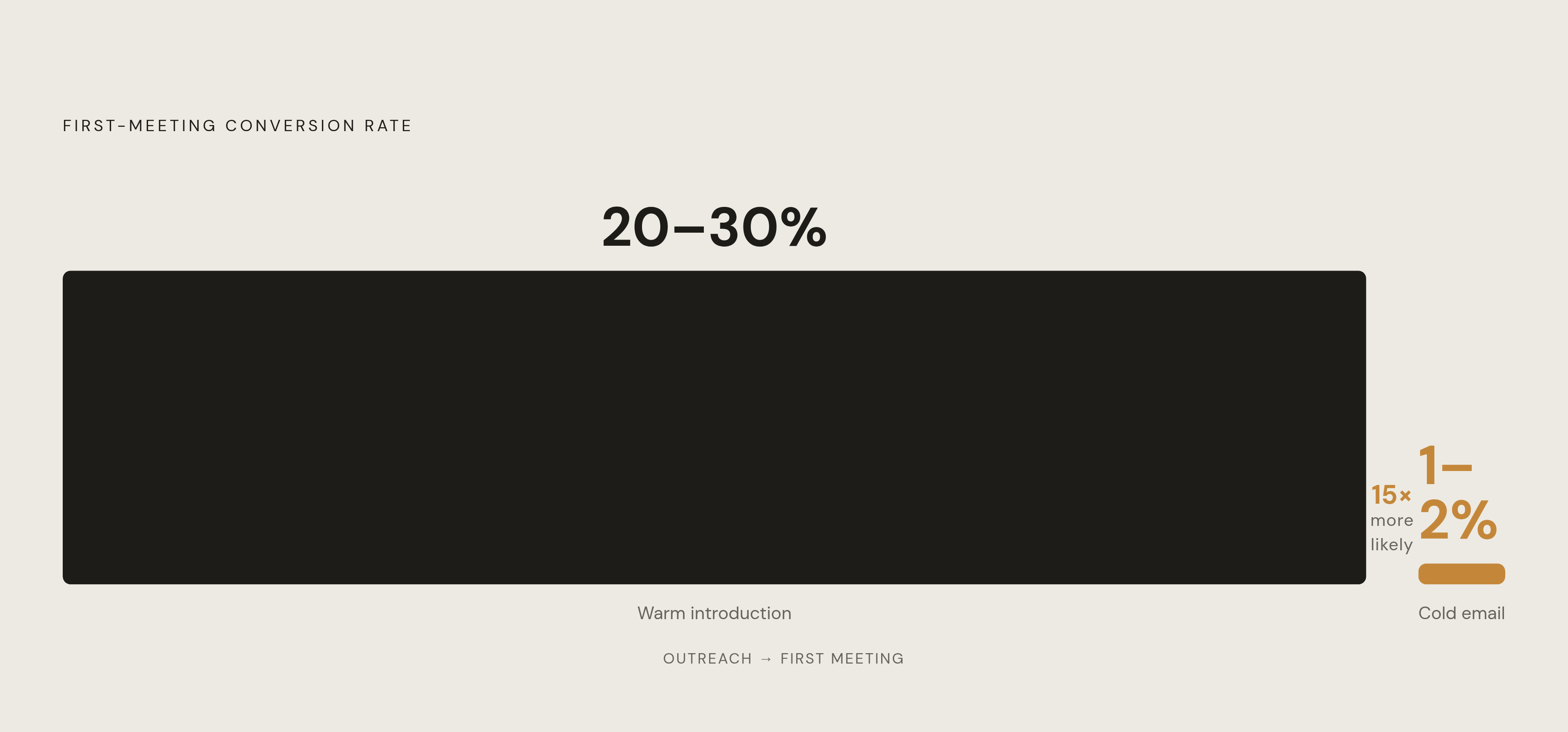
Start with the number: warm introductions convert to a first meeting at 20 to 30 percent. Cold emails convert at 1 to 2 percent. That is not a difference in outreach efficiency. It is a different category of outcome.
The structural reason is not mysterious, though it gets obscured by how casually the term "warm" gets thrown around. Investors see hundreds of pitches each month and spend under three minutes on a typical first-pass review. A warm introduction does not improve the pitch deck. It exits the queue entirely. The investor's attention is given before the materials arrive, because someone they trust has already performed the first layer of filtering on their behalf. The deck is the same deck. The context around it is completely different.
A Harvard Business School survey of nearly 900 institutional venture capitalists found that roughly 58% of deals originate through professional networks, referrals, or portfolio company introductions; only around 10% come from unsolicited inbound. These proportions have held with remarkable stability even as platforms for cold outreach have multiplied. VCs spend an average of 22 hours per week on networking and sourcing, out of a roughly 55-hour workweek. That allocation looks inefficient until you accept what the data says about where quality deal flow actually originates.
Here is where most conversations about warm introductions go sideways: "warm" is a spectrum, not a binary state. The connector's credibility is what actually drives conversion, and the range is wide. An introduction from a portfolio founder, someone whose reputation is partially staked on the quality of what they send your way, carries the highest conversion weight. Introductions from angel investors or experienced operators perform meaningfully but not as strongly, because the implicit underwriting is less complete. A weak-tie introduction from someone a partner barely knows transfers almost no trust; it can convert no better than a sharp cold email from a stranger. Most people treat all warm introductions as interchangeable. They are not, and conflating them produces bad sourcing decisions.
There is a legitimate critique embedded in all of this, and I want to sit with it rather than dispatch it efficiently. Practitioners including Del Johnson have argued that the warm introduction as a gatekeeping mechanism systematically excludes founders who lack existing network access, concentrating deal flow among those already proximate to capital. That critique is accurate, and it does not have a clean resolution. The narrower question here is whether making network visibility more deliberate and systematic helps or worsens the problem. My tentative view is that a more legible map at least allows a firm to see the full scope of its relationships, including the less obvious ones, rather than defaulting reflexively to whoever is top-of-mind for the partner in the room that day. Whether that is sufficient remains uncertain.
The calibration data from Clear Current Capital is instructive: over 40% of their deal flow originated from warm relationships, 34% from proactive outreach, and 25% from cold inbound. Even a disciplined, relationship-driven fund maintains meaningful proactive and inbound channels. The warm path is dominant, not exclusive.
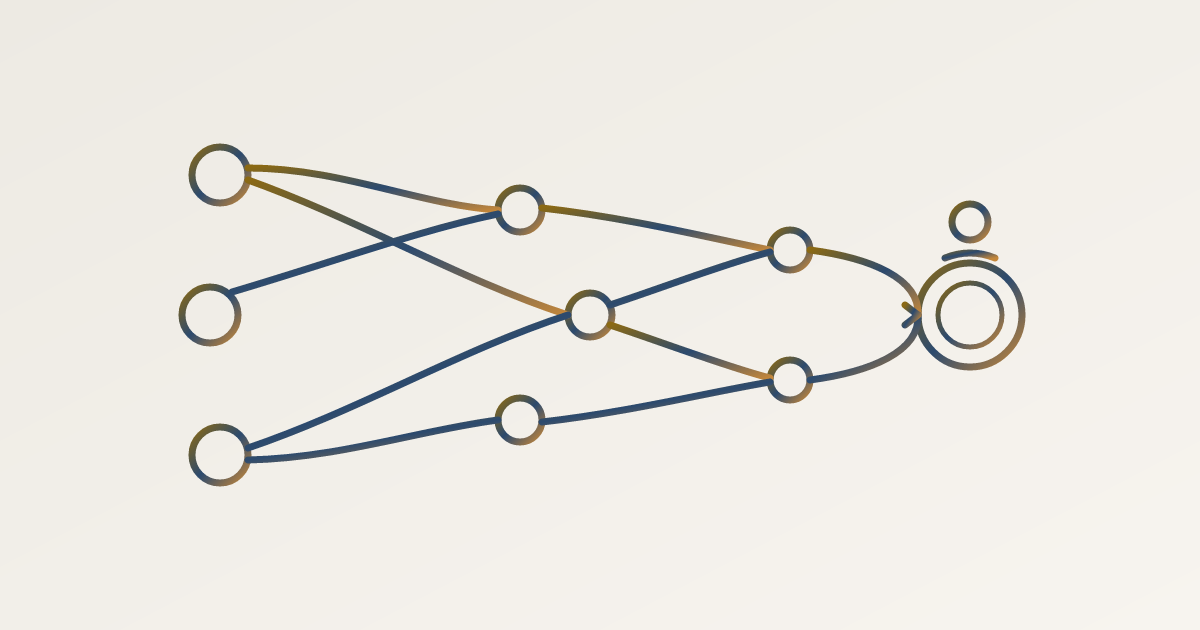
If warm paths are this powerful, and the connector's credibility is the variable that actually determines conversion weight, the core operational problem becomes visibility: which connections does a firm actually have, and who is best positioned to make each introduction?
What a Relationship Graph Is and How It Differs from a CRM
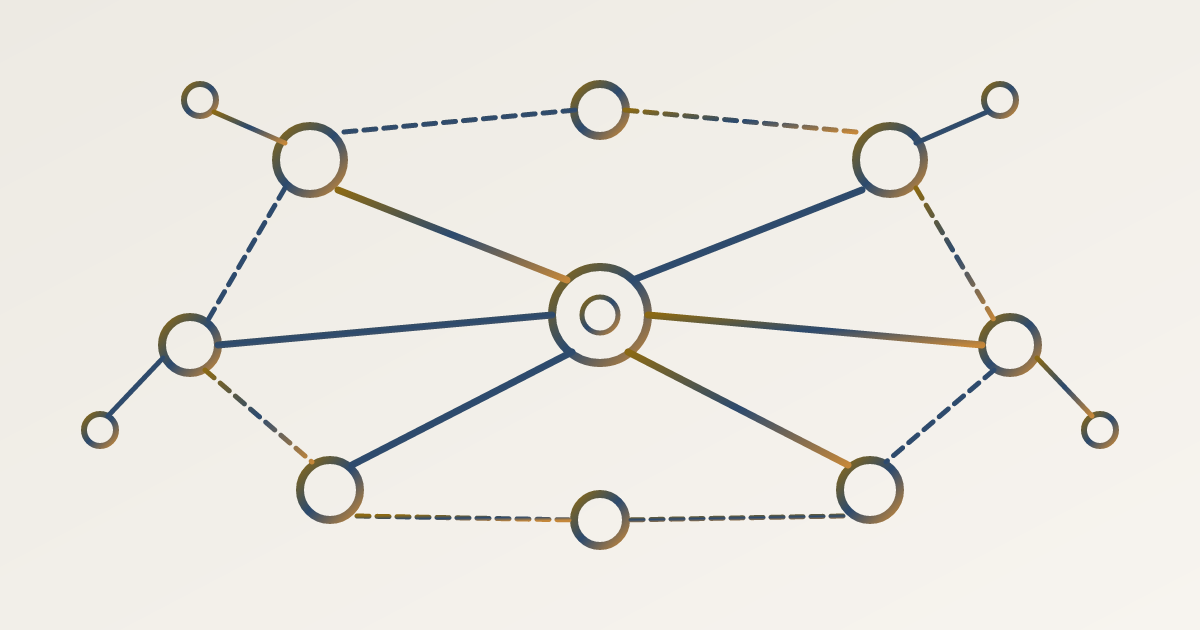
A relationship graph is a structured, queryable map of who knows whom across a firm's entire network, weighted by connection strength, recency, and relevance. Not a contact list with better UX. A topology, something you traverse and interrogate rather than scroll through.
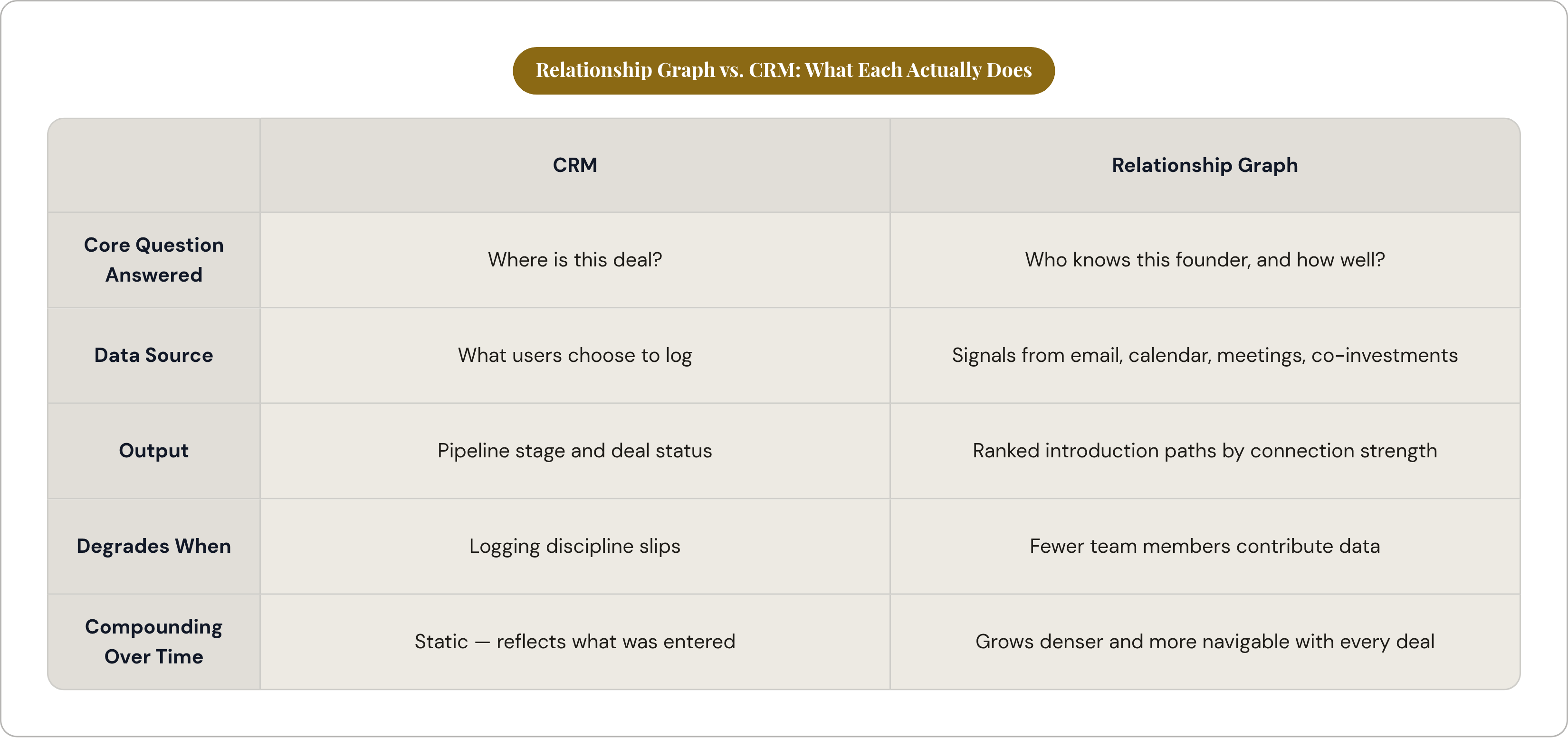
The sharpest definition comes through contrast with the tool most firms already use. A CRM tracks deal stages and pipeline status; it captures what a user decides to log. It answers the question: where is this deal? A relationship graph is built from signals that already exist in the systems where professional relationships actually live, email cadence, meeting frequency, shared work history, co-investment patterns. It answers a different question: who in this firm is connected to this founder, and how strong is that connection right now?
The architectural components worth naming plainly: nodes are the entities in the graph, founders, LPs, co-investors, operators, advisors, companies. Edges are the relationships between them, weighted by signal strength rather than a binary connected-or-not designation. Signal inputs are the data streams the graph ingests, email threads, calendar meetings, LinkedIn connections, messaging history. The scoring layer is where raw signals become ranked intelligence, distinguishing a live, active relationship from one that was warm three years ago and has since gone cold.
That queryable quality is what makes this operationally different from anything a CRM provides. A partner surfaces the warmest path to a target founder in seconds, ranked by who has the strongest recent signal and is therefore best positioned to make an introduction credibly. The alternative is shouting across an open-plan office and hoping the right person happens to be at their desk.
One structural caveat that cannot be soft-pedaled: relationship intelligence is only as good as the data feeding it. A graph connected to one partner's email reflects a fraction of the fund's actual network. A graph built from the firm's full relationship surface, partners, associates, operating partners, and relevant LPs, is something categorically different. The gap between those two versions is not a matter of degree; it is a matter of whether the architecture is capable of doing what it promises.
How a Relationship Graph Operates Inside a Venture Firm's Workflow
The most immediate application is deal sourcing path-finding. Before anyone picks up a phone or composes an introductory email, the graph surfaces which person at the firm has the warmest existing path to a target founder. The question "does anyone know this person?" becomes a ranked answer retrieved in seconds rather than a Slack thread that may or may not surface the right person before the moment has passed.
LP networks represent a sourcing channel that most firms have never systematically touched, which, when you think about it, is a strange thing to leave on the table. A fund's LP base, family offices, corporate executives, institutional investors, often carries deep industry relationships entirely invisible to the deal team because no one has ever mapped them. The raw material already exists in the cap table. The relationship graph makes those paths legible.
Co-investor intelligence adds another operational layer. Tracking relationship strength with other firms across deals reveals which co-investors consistently add value in specific contexts and, more tactically, which partners within those firms to call first when a competitive process is moving fast. That knowledge currently lives in individual memory. When the person holding it leaves, it leaves with them.
Timing signals compound the graph's utility. Tools in this category generate alerts when a contact changes roles, makes a key hire, or surfaces in news connected to recent transactions. Engagement at a moment of transition is qualitatively different from cold reconnection six months later, when the window has closed and you are explaining why you did not reach out sooner.
The structural value of second- and third-degree path-finding is where the architecture earns its most compelling use case. The portfolio founder who went to college with the target founder's CTO. The LP who sits on the same nonprofit board as a key operator. These paths exist in the fund's network; they are simply invisible without the map to show them.
Once the right path is identified, the graph's context layer enables outreach drafted with specific shared history in mind. The human sends, decides, and controls every communication. The tool surfaces context; the professional exercises judgment. That division matters both ethically and practically, because the trust the graph is designed to activate lives in the human relationship, not the software.
Harmonic, valued at approximately $1.45 billion in 2025, illustrates the broader sourcing intelligence category: identifying early-stage signals including key hires, domain registrations, and founder departures from established companies, giving investors a window before a deal becomes competitive. The relationship graph and the signal intelligence layer are complementary. One tells you who to reach out to; the other tells you when.
Why Siloed Network Data Is the Default State and What It Costs a Firm
Most firms have lived inside this architecture long enough that it no longer reads as a structural problem. It is worth describing plainly. Email lives in individual inboxes. Calendar data lives in individual calendars. The CRM is partially filled in by whoever remembered to log things. Deal notes live in someone's document workspace. LinkedIn connections are locked to individual accounts. No single map of the firm's actual relationship surface exists anywhere. This is treated as normal. It is not, and the fact that it feels normal is precisely what makes the cost so hard to see.
Research from 4Degrees on VC deal sourcing infrastructure found that most VC teams still rely on spreadsheets and basic contact management software, requiring significant manual data entry and keeping relationship information siloed with individual team members. The operational consequence is not just friction. It is invisible opportunity cost, which is the hardest kind to act on because it never shows up as a line item.
The key-person risk embedded in this architecture is the most acute long-term cost. When systems do not integrate, institutional knowledge concentrates with whichever person informally bridges the gaps: the partner who knows everyone, the associate who remembers every introduction, the executive who tracks co-investor relationships in a personal spreadsheet. When that person leaves, the firm does not lose a contact list. It loses the navigational layer that made the contact list usable. What remains is a set of names with no connective tissue.
One practitioner account of the transition captures the distinction plainly: "All our data is now centralized in Affinity, so information is never siloed with a single team member and we all understand the relationships among the entire team's business network." Relationship knowledge becoming a firm asset rather than a personal one is a meaningful organizational shift, not merely a software upgrade.
The scale of data silo costs across industries provides useful directional context. Salesforce's 2024 Connectivity Benchmark Report found that 80% of IT leaders report data silos are hindering digital transformation; IDC estimates that companies lose 20 to 30% of revenue annually to inefficiencies caused by fragmented data. In venture, the cost does not show up in a revenue line. It shows up in the warm path that never gets surfaced, the introduction that never gets made, the deal that goes to a competitor because the right person did not know the right connection existed.
The front-office and back-office split in VC software has historically compounded the problem. Deal teams, investor relations, and fund finance have operated from separate systems built for separate purposes. Firms that treat consolidation as a purely technical challenge tend to solve the wrong thing; the organizational dimension, who owns what data and who has access, is frequently where the actual friction lives, and technical tooling cannot resolve an organizational question.
How Relationship Graphs Compound Sourcing Advantage over Time
The compounding mechanism is what separates relationship graph architecture from a software subscription that delivers consistent but static utility. This is the part of the argument I find most interesting, and also the part where the logic is easiest to accept in theory and hardest to act on in practice.
Every deal closed adds a node and deepens an edge. Every co-investor relationship developed across multiple transactions strengthens a connection that makes the next competitive process easier to navigate. Every LP introduction made and logged creates a path that was not previously visible. A firm with a relationship graph gets better at sourcing as it ages. A firm without one resets partially every time a senior person leaves or a deal closes without being systematically captured.
Foundation Capital GPs Jaya Gupta and Ashu Garg articulated the underlying thesis in December 2025, describing what they called the context graph: consumer platforms built trillion-dollar businesses by compounding behavioral traces over two decades; the enterprise equivalent, compounding decision traces and relationship signals into institutional intelligence, represents a larger opportunity precisely because the signals are more structurally significant. Applied to venture, the fund with multiple years of relationship signals encoded in a queryable graph sees deals, paths, and introductions that a fund starting from scratch simply cannot see. The graph becomes a durable structural asset.
The competitive implication for firms that delay is not neutral. Deal flow is already concentrating: 20 VCs captured 60% of capital raised in 2024. The gap between firms with systematic relationship visibility and those operating from individual memory and partially filled CRMs is not a stable equilibrium. It widens as connected firms accumulate more relationship data and disconnected ones continue losing context when people leave.
Network effects within the firm add another dimension. The more team members, operating partners, and LPs whose relationship data feeds the graph, the more complete the map. Each new participant reveals previously invisible second-degree paths. The graph does not simply grow; it becomes more navigable as it grows. That navigability, the increasing density of legible paths through the network, is what makes the compounding logic coherent rather than merely aspirational.
What a Well-Architected Relationship Graph Requires to Be Trustworthy at the Firm Level
A relationship graph that partners will not connect their email to is a graph with no data. This is not a change management problem solvable with training sessions. It is an architectural problem that has to be resolved before the system is deployed, because senior professionals will ask privacy questions before they participate, and they are right to.
The core design tension is between two legitimate institutional needs that pull against each other. Relationship signals must be collectively visible across the firm: which partner has the strongest path to a target, which LP has a relevant industry relationship, which associate has met a particular founder's CTO. But relationship context must remain private and permissioned to the individual: the content of emails, personal correspondence, the texture of a relationship the individual has not chosen to share institutionally. These two requirements are not inherently in conflict if the architecture enforces the separation deliberately. They become a serious problem when the system treats all relationship data as institutionally accessible by default, which is the easier thing to build and the wrong thing.
What "collectively visible" means in practice: the graph surfaces connection strength and path quality without exposing message content. What "private" means: message content, personal correspondence, and relationship context the individual has not explicitly shared remain with them. The distinction sounds simple. Building systems that honor it reliably requires deliberate architectural choices at every layer.
Granola, which raised $43 million at a $250 million valuation in 2025, offers an instructive design reference. Its no-bot, no-cloud-audio approach to meeting notes was not a differentiator layered on top of a functional product; privacy-first design was the prerequisite for adoption in confidential deal discussions. The same logic applies to relationship graph architecture. Privacy is the condition under which the tool gets used at all, not a feature to consider after the core functionality is built.
The compliance dimension extends this further. In environments where investor-founder conversations, LP communications, and co-investor deal discussions carry legal and fiduciary weight, who can see what is not purely a technical question. It is a governance question, and it should be answered explicitly before any data is connected, not negotiated under pressure during rollout.
One principle follows from all of this: AI should draft and recommend, not act autonomously. The professional must control every outreach decision and every communication sent. In venture, where reputation is slow to build and fast to damage, autonomy without explicit permission is not a feature worth the risk.
What Firms That Want This Infrastructure Should Actually Think About Building
The starting point is not a software evaluation. It is a data audit. The graph is only as useful as the signals feeding it, so the first question is concrete: where does the firm's relationship data currently live? Which email systems, calendars, messaging tools, deal note repositories, and LinkedIn accounts hold the relationship signals that would constitute the graph's raw material? How much of that data is practically inaccessible, locked in individual accounts with no integration path? Those answers shape every subsequent decision more than any vendor feature comparison, and most firms discover during this audit that the silo problem is considerably worse than they assumed.
Defining the scope of participation is the second structural decision, and it has to happen before any tool is configured. A graph connected to one partner's email is a sophisticated personal contact manager. The value that justifies the infrastructure investment emerges when associates, operating partners, the platform team, and relevant LPs contribute relationship signals. The sequencing to get there is a tactical question, but the destination should be established at the start, because systems built for one inbox rarely expand naturally into firm-wide infrastructure. They calcify around their initial constraints.
The permissioning and privacy model must be resolved and communicated before anyone is asked to connect their inbox. The specific answers to what is visible to whom, and what stays private, must be explicit and documented. This is not a detail to finalize during rollout.
Treating the graph as a firm asset rather than a product subscription shapes both the build decision and the vendor relationship. The relationship data accumulated over years of deals, introductions, and LP conversations is institutional capital. A system in which that data effectively belongs to a vendor or becomes inaccessible when a subscription lapses is a contact database with a rental agreement, not infrastructure.
For firms starting from a blank sheet, the practical sequencing: audit where relationship data lives and how much is currently inaccessible; identify the highest-value use case to build around first, which for most firms is deal sourcing path-finding because the return is visible quickly; establish the permissioning model before connecting any data sources; expand coverage over time, because adding more participants makes earlier data more valuable rather than redundant.
The question underlying all of this is how to systematize early access in a market where access is the competitive moat. In a market where 20 firms captured 60% of capital in 2024, where warm introductions convert at fifteen times the rate of cold emails, the answer has less to do with effort than with architecture: whether the firm's relationship data is scattered across individual inboxes depreciating silently, or encoded in a graph that compounds with every deal, every introduction, and every year of operation.