Board Member and Advisor Networks as Sourcing Assets
Board connections compound in value and surface off-market deals most competitors never see.
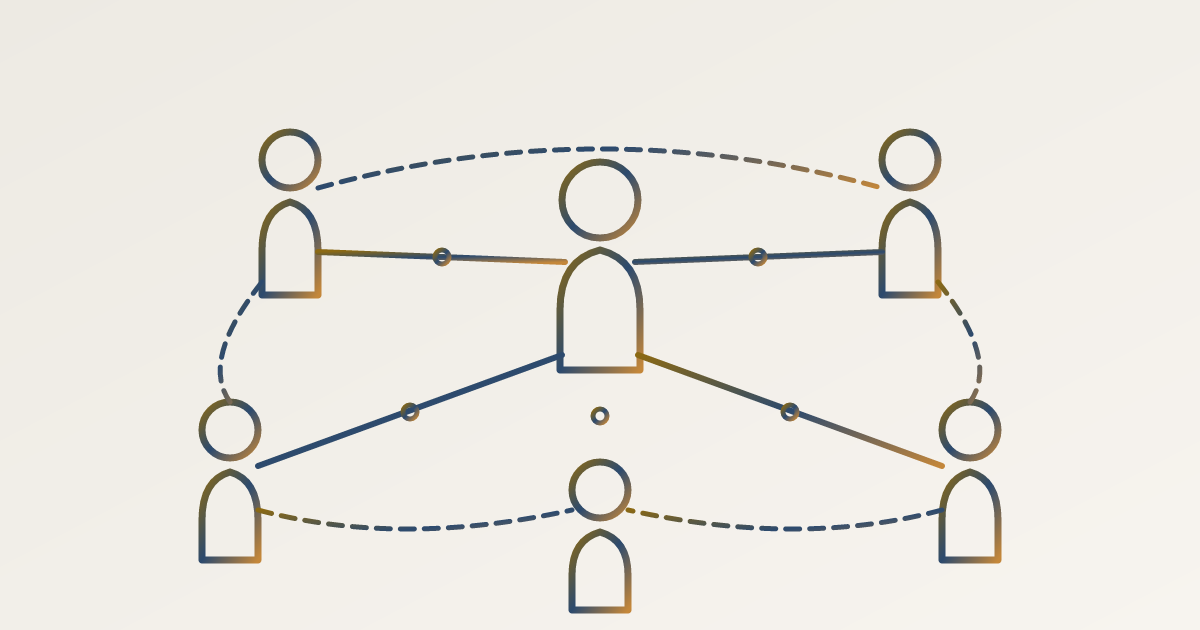
A board member is not simply a contact. They hold a position, and that position grants simultaneous visibility into multiple companies, capital networks, and decision-making circles that no individual professional relationship can replicate. That spanning quality is the whole point.
Three structural properties separate this layer from ordinary professional relationships, and they compound. Board members are inherently multi-company by design: a director at one firm is often an investor, advisor, or fiduciary at several others, so every relationship with them is a relationship with a web. The trust carried by that connection is structural rather than social. Fiduciary and advisory obligations create repeated, high-context interactions over months and years, not the one-off conference contact that never gets revisited. And endorsement from that layer lands differently. The target already knows the board member as a credible, invested party with real skin in the game. A warm introduction from a director is categorically different from one from a LinkedIn connection who sat on a panel three years ago.
Advisory boards typically span five to nine members, small enough to preserve genuine relationships but large enough to cover meaningfully different sectors and geographies. Worth distinguishing advisors from consultants here. Advisors hold equity; their financial outcome is tied to the firm's long-term success rather than the completion of a discrete engagement. A consultant leaves when the project ends. An advisor stays because departure is expensive.
The compounding logic is what most firms miss. Unlike a database subscription or a broker relationship, advisor relationships appreciate in value as trust deepens. Practitioners who have built effective sourcing networks from this layer describe a consistent pattern: identify a focused set of key advisors, operators, and industry connectors in a target sector, invest consistently in those relationships, sustain one substantive warm conversation per week across that set. Compounded over two years, the result is a referral network that surfaces off-market opportunities most firms rarely encounter. Most firms never realize this because they treat these connections as goodwill rather than infrastructure, which means nobody is formally responsible for maintaining them.
What the M&A Research Shows About Board Connections and Deal Outcomes
The empirical foundation here is more rigorous than most practitioners realize, and the findings resist easy summarization.
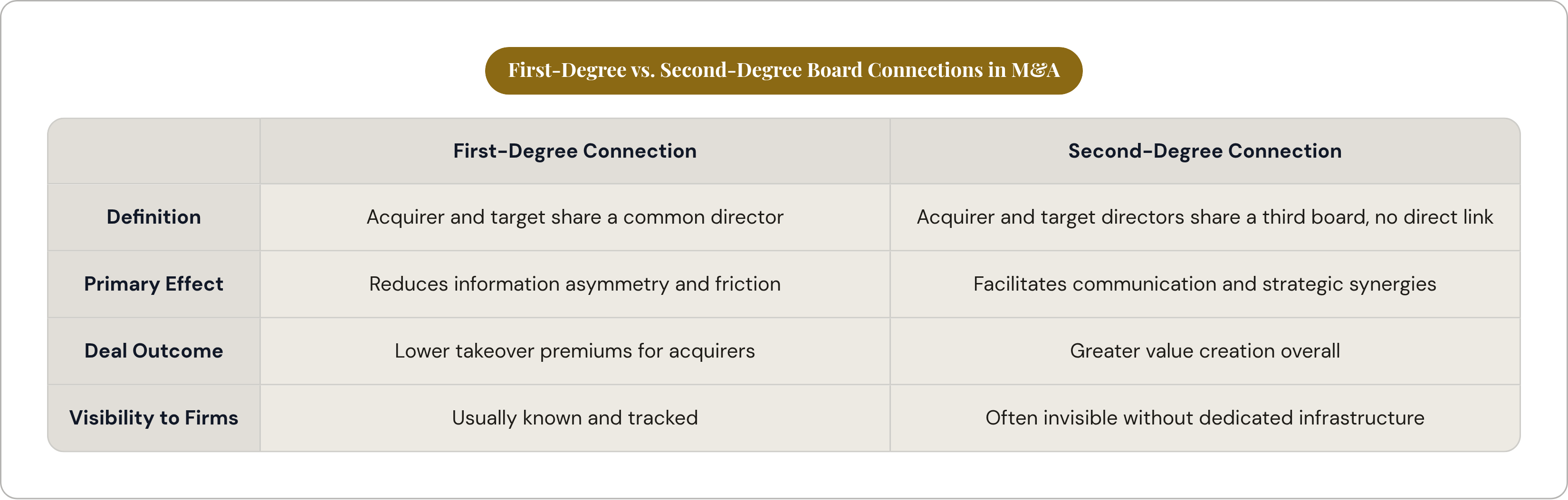
Cai and Sevilir's 2012 study, published in the Journal of Financial Economics, analyzed M&A transactions between firms with existing board connections and found that first-degree connections, situations where an acquirer and target share a common director, are associated with lower takeover premiums for acquirers. Shared directorship reduces information asymmetry and friction in price negotiation in measurable ways. Fewer surprises, smoother process, better terms.
The more counterintuitive finding concerns second-degree connections, where an acquirer director and a target director both serve on the same third board without any direct link between the two firms. These connections are associated with greater value creation. Shared network adjacency facilitates better communication and more strategic synergies even when no direct tie exists. A relationship the firm may not even know it has can still drive measurably better deal outcomes. Most sourcing conversations never reach this claim, which is part of why it matters.
More recent research extends the logic to execution. Barbopoulos and colleagues, writing in the British Journal of Management in 2025, found that personal connections based on prior employment, educational, or social overlaps between top executives, board members, and financial advisors affect M&A completion rates. Deals where bidder managers share past work-related connections with their advisors are more likely to close. Board-level connections do not simply open a door; they demonstrably alter the economics and completion probability of transactions.
Both bodies of research leave one question unresolved, and it is the question that actually matters operationally. They describe connections that existed and were ultimately used. They say nothing about the connections that existed and were never surfaced, never activated, never known. That gap is where the real problem lives, and no academic dataset captures it cleanly because invisible paths leave no record.
How Second- and Third-Degree Paths Through Board Networks Reach Deals Firms Can't See Otherwise
The off-market thesis is not hard to articulate: proprietary deal flow comes from relationship-based sourcing that surfaces opportunities before they are formally marketed, removing competitive auction pressure and improving both terms and value creation potential. The harder question is how to actually reach those opportunities. Most firms run out of road here.
Traditional sourcing channels are structurally insufficient. Broker-led auctions are crowded and drive up prices by design. Commercial databases have significant gaps, especially for smaller private and family-owned businesses; there are more than 200 million private companies globally, and no database captures them with anything approaching completeness or recency.
Second-degree board connections represent a specific, underexploited channel. A firm's advisor sits on a board alongside an executive at a company the firm has encountered. That shared board membership is an introduction waiting to happen, sitting inside the firm's own network, invisible without the infrastructure to surface it. Third-degree paths extend this further: the founder of a portfolio company knows the CFO of an adjacent business through a shared early investor, and that path exists inside the firm's extended network but requires cross-referencing relationships that no individual professional can hold in their head simultaneously. M&A practitioners typically begin sourcing from the most obvious potential buyers or targets, and as transactions increasingly cross markets, geographies, and sectors, confining sourcing to direct networks leaves entire pools of opportunity permanently invisible.
The market environment sharpens this urgency. Affinity's research found that 50% of investors now cite new deal sourcing as their top priority, with 46% identifying competition as the biggest factor impacting deal flow, up from 42% the prior year. The number of unique active investors dropped by nearly 50% from its 2021 peak. New fund creation fell to its lowest level in over a decade, while hundreds of billions in dry powder sit concentrated among top-tier firms chasing a narrow set of visible opportunities.
Firms that can systematically reach into second- and third-degree board connections are not simply more efficient in that environment. They are competing in a different pool entirely.
Why Most Firms Cannot See the Board Network Assets They Already Hold
Most firms are not relationship-poor. They are visibility-poor. The connections exist; they are scattered across individual systems and memories rather than aggregated into anything queryable or shared.
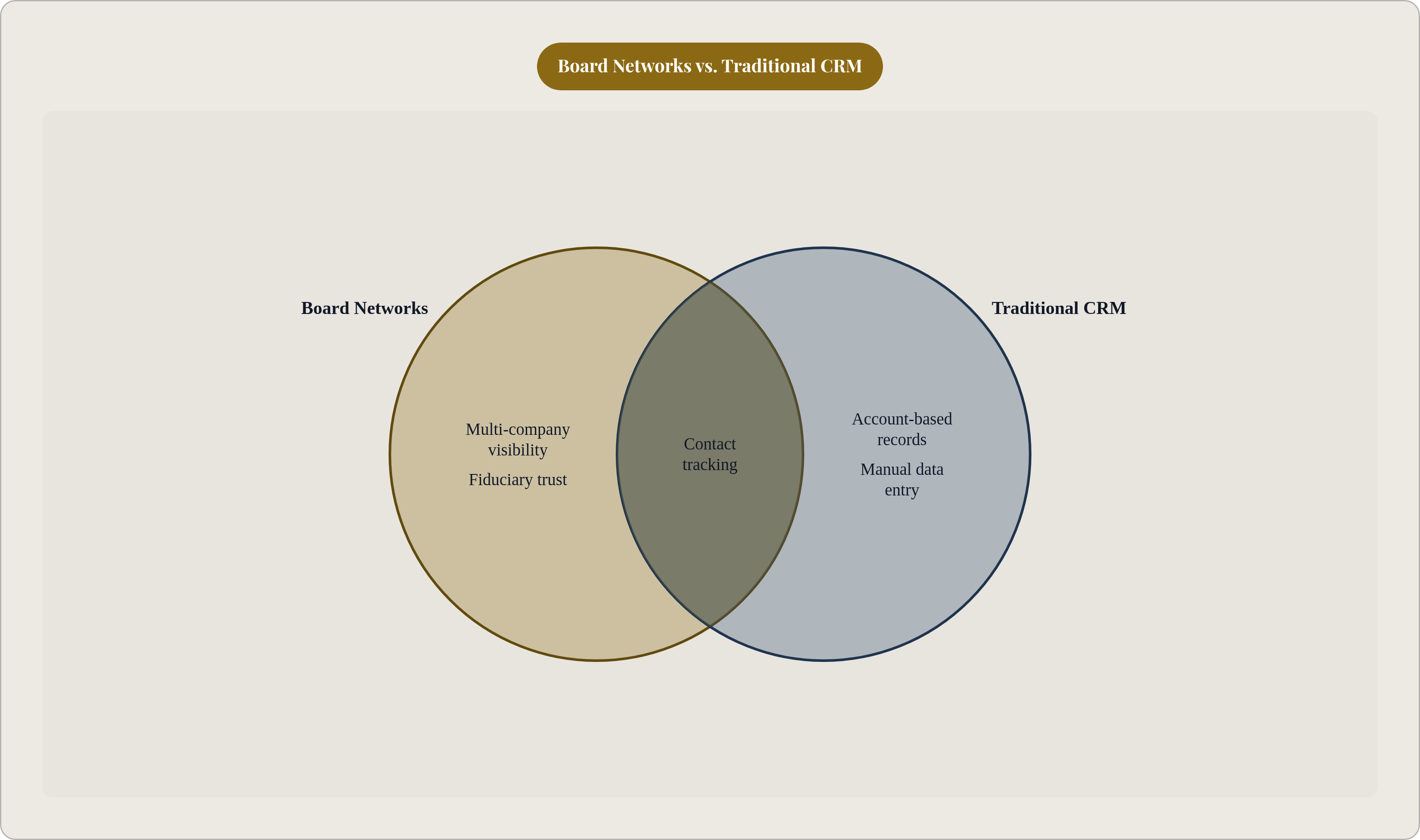
Relationship data lives in individual email inboxes, personal LinkedIn connections, calendar histories, deal memos, and the recollection of whoever happened to take a particular meeting three years ago. Traditional CRMs organize contacts by account or company, not by the web of personal connections across an org chart. A partner may have a warm path to a target board member through two intermediaries, but the CRM cannot surface that path because it was never designed to map one.
Relationship data also decays continuously. Contacts leave firms, change roles, join new boards. CRMs built on manually entered records become less accurate from the moment they are updated, with no automated correction mechanism. The knowledge-departure problem compounds this: when a senior professional leaves a firm, years of touchpoints, personal history, and informal trust leave with them. What remains in the system is a contact list, not a relationship record.
Affinity's research found that 76% of investors rely on at least four data sources when evaluating prospects. That fragmentation is a symptom of how much relationship context is being lost between systems.
The silo problem is structural, not behavioral. It is not that professionals are careless about their networks; no system was ever designed to aggregate relationship signals across a firm and make them queryable as a shared institutional asset. The result: firms routinely pursue cold or lukewarm paths to targets while a warm path through a board connection sits dormant in a colleague's email history, unknown to anyone who could use it.
What Relationship Intelligence Actually Does to Make Board Networks Queryable
Relationship intelligence, as a category, refers to tools that collect and analyze data from the communication systems where professional relationships already live, then convert that dispersed history into a queryable relationship layer. The category is still maturing, and precision about what it actually does matters.
The infrastructure operates in layers. Automated data collection captures what practitioners sometimes call "relationship exhaust": who talked to whom, when, how often, and in what context, without requiring manual logging. Analytics then apply relationship strength scoring, recency weighting, and network graph mapping to identify who inside the firm has the warmest path to any given target. The actionable layer surfaces that specific path and enables the next step, whether an introduction request, a reengagement, or a contextual outreach draft.
For board network sourcing specifically, relationship intelligence identifies who in the firm's extended network sits on multiple boards, advises growing startups, or occupies a position one step removed from major decision-makers. These influence hubs are hardest to spot from any single vantage point because they require seeing across the entire firm's relationship graph simultaneously. When three startups share the same early advisors or board members, that is a signal worth knowing. When executives move between companies and reconvene, that is a pattern worth tracking.
The underlying architecture is what makes this possible. Graph databases map the connections between entities rather than storing contacts in flat tables, making it possible to query paths rather than records. The question "who in our network is closest to this founder?" cannot be answered by a traditional CRM, which was designed to find records, not trace paths. A graph-based relationship layer can answer it. These are different tools in a meaningful sense.
Affinity's data shows that AI usage for investment decisions more than doubled year-over-year, from 13% to 28%, and that nearly two-thirds of investors now use AI to accelerate company research. Pear VC tracks more than 120,000 people through Affinity, which illustrates what firm-wide relationship intelligence looks like at scale: institutional memory that does not depend on any single person remembering a conversation.
Rolo, built by Alpha Watch, connects email, calendar, LinkedIn, and messaging into a firm-wide relationship graph, surfaces warm paths to targets ranked by relevance and recency, and drafts outreach in the user's voice without sending anything autonomously or exposing private relationship context across the team. That design constraint matters. Board-level introductions derive their value from human trust, and a tool that acts without permission undermines the very asset it is meant to use.
The Efficiency Gap Between Firms That Systematize Board Network Activation and Those That Don't
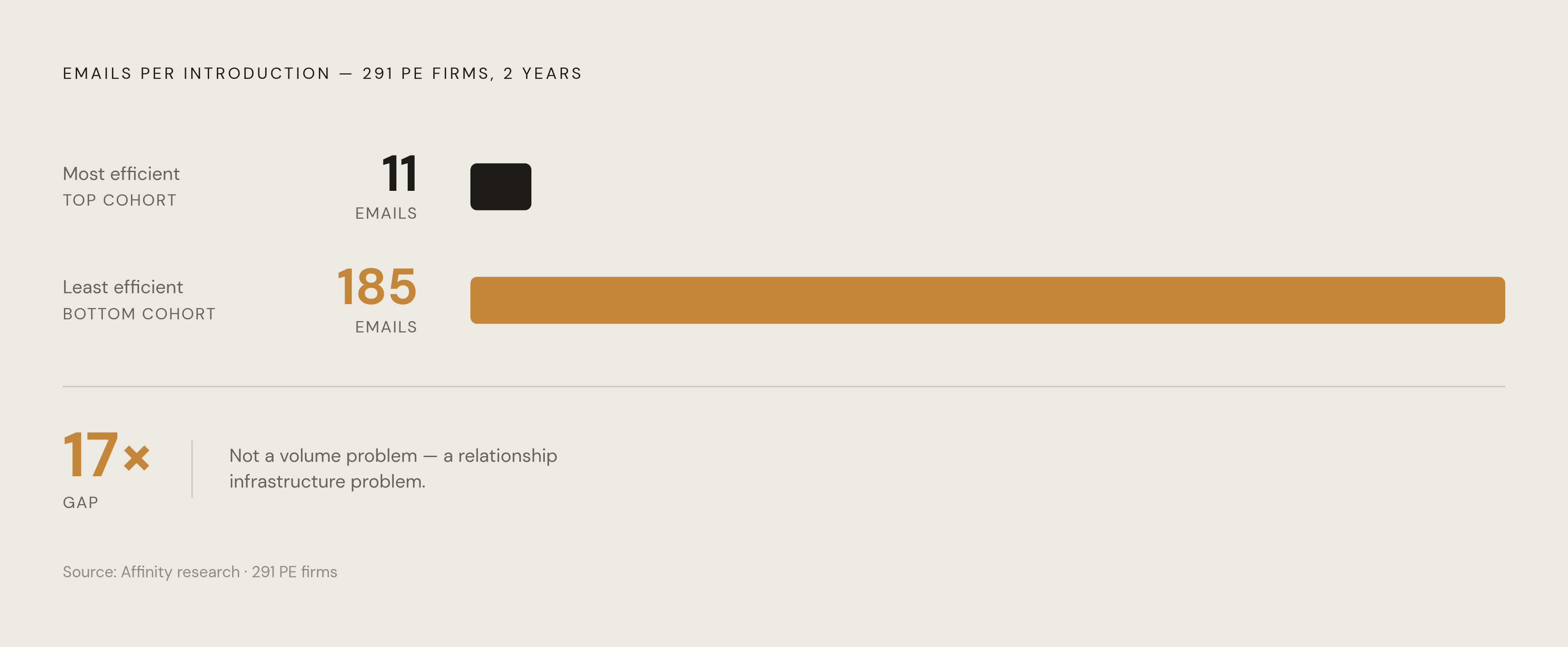
Affinity's research on 291 PE firms over a two-year period produced a finding worth sitting with. The most efficient firms generate one introduction for every 11 emails sent. The least efficient need 185 emails for the same result. A 17-fold gap in outreach-to-introduction efficiency, and it is not primarily explained by market conditions or deal availability.
The gap is widening. Over the same period, more than half of PE firms saw their introduction output decline substantially even as they increased email volume. More activity, fewer results. Cold and semi-warm outreach is losing effectiveness as inboxes saturate, while relationship-mediated introductions remain high-conversion. Firms without relationship infrastructure are working harder to achieve less.
The productivity case for systematizing this layer is concrete. Automating relationship and contact data capture saves measurable hours of manual data entry per employee per year. Speedinvest, after investing in relationship infrastructure, increased its coverage of future Series A European company rounds by more than 30%, a direct outcome of having better data on which portfolio companies and investors were connected to which opportunities. Earlybird Ventures' Andre Retterath described the before/after plainly: a relationship intelligence platform gives "a way better view of our network and of who we know; and what, when, why we know these people."
There is also a compounding dynamic here that rarely gets discussed. Firms that systematize early accumulate relationship data that becomes more valuable over time as the network deepens and the graph grows denser. Firms that do not are rebuilding institutional knowledge from scratch every time a senior professional departs, starting over with information that should never have been allowed to walk out the door. The distance between the two groups is not narrowing; it is structural, and it widens with each hiring cycle.
How to Treat a Board and Advisor Network as Structured Sourcing Infrastructure Rather Than Goodwill
Treating board and advisor relationships as infrastructure is conceptually simple and organizationally hard. Someone has to be formally responsible for them, which means naming that responsibility explicitly, not leaving it as a vague expectation distributed across the partnership.
Most firms, when they audit carefully, underestimate what is already there. Mapping the existing network before attempting to expand it is the logical first step: who on the team has existing relationships with board members and advisors at companies in the target sector, and where does that data actually live? The answer is usually more distributed than anyone expects, and more valuable than anyone is currently treating it.
Building a firm-wide relationship graph from that audit requires connecting the systems where relationship history already exists, including email, calendar, LinkedIn, and messaging. From that foundation, second-degree connections become visible. Which board members in the network also sit on boards of companies the firm cares about? Which advisors recur across multiple portfolio-adjacent companies and therefore represent high-leverage introduction nodes? These are answerable questions. Most firms simply never ask them in a form that a system can respond to.
Systematic relationship cultivation follows a consistent practitioner standard: identify a focused set of key advisors, operators, and connectors in a target sector, and invest in those relationships consistently over time. One substantive warm conversation per week, sustained over years, builds the kind of referral network that surfaces off-market opportunities most firms rarely encounter. Tracking relationship health matters as much as tracking contact frequency, which means not just when the last conversation occurred, but whether the relationship is deepening, stalling, or going cold.
AI belongs in this workflow at the drafting and surfacing stage, not the execution stage. The appropriate role is to identify the warm path and draft an introduction request in the professional's voice, while the human decides whether to send it. Autonomous outreach would undermine precisely the trust that makes board-level introductions valuable in the first place.
Privacy and permissioning are not optional considerations. Board-level relationship context is highly sensitive; a director's private conversations about a company cannot be treated as firm-wide shared data without clear consent and architecture that enforces it. The design distinction between personal relationship context, which stays private to the individual, and institutional relationship signals, which become visible across the team when permissioned, is both a compliance requirement and a trust requirement. Rolo operates within exactly these constraints, keeping private relationship context private while surfacing the warmest paths to any given target.
The board and advisor relationships that could drive proprietary deal flow already exist inside most firms. They are invisible because they are fragmented across inboxes and memories and systems that were never designed to surface them. Whether that changes is an organizational question more than a technology one: whether a firm decides those relationships constitute an asset worth maintaining, or leaves them as a byproduct of doing business that no one is formally responsible for.