Using Calendar and Email Data to Score Connection Strength
Behavioral data from email and calendar reveals relationship strength that CRM records miss.

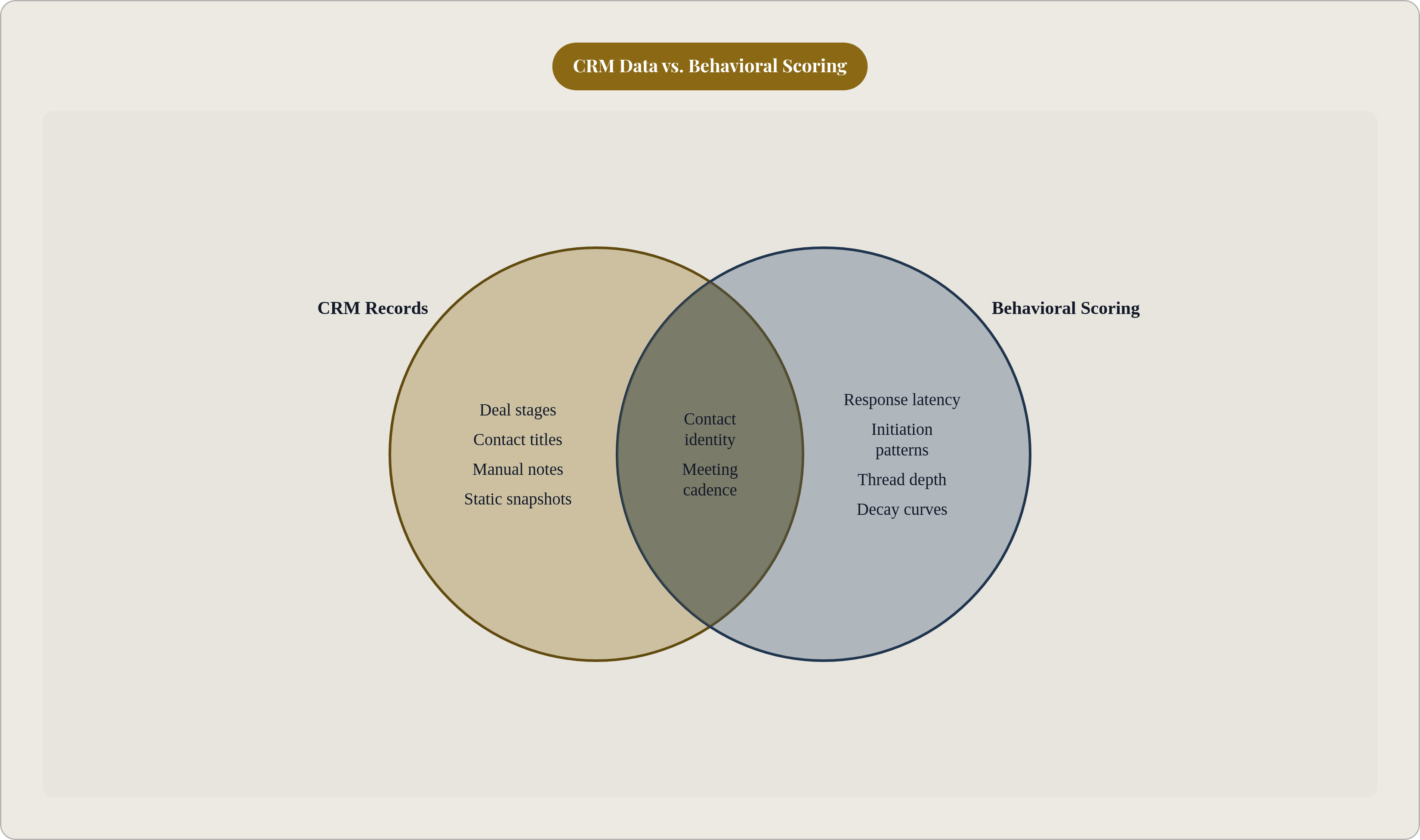
A CRM is a logging system. It records what someone decided to record, at the moment they decided to record it, in the format they chose. That is not a flaw in the software; it is a structural constraint of the medium. The interactions that actually determine whether a professional relationship is warm rarely get logged: the quick reply on a Friday afternoon, the meeting accepted within minutes, the email thread that ran twelve exchanges deep because the other party kept re-engaging. These moments define relationship health, and they exist nowhere in a CRM.
The data that does get entered reflects decisions, not behavior. A contact rated "strong" may reflect a deal that closed three years ago. That contact may have changed roles twice, moved to a new firm, or simply drifted out of regular communication, and none of that decay will appear in the record unless someone manually updated it. Research on data quality in enterprise systems consistently shows that contact records degrade significantly over time, particularly when update responsibility is distributed across a team rather than owned by a single function. Most teams cannot maintain that discipline, not because they are careless, but because manual logging cannot keep pace with the volume and texture of daily communication.
What a CRM entry typically contains: a name, a title, a company, a deal stage, perhaps a note from a call logged weeks after it happened. What it misses is the entire behavioral layer. Who has been consistently reaching out to this contact for the past six months? Have response times lengthened over that period? Is there a colleague who never entered this contact's name into any system but has been exchanging regular, substantive correspondence with them for months? The gap between what a CRM captures and what actually determines relationship health is not correctable by better discipline. The structure of the tool creates the gap.
How the Scoring Logic Translates Raw Signals into a Relationship Strength Estimate
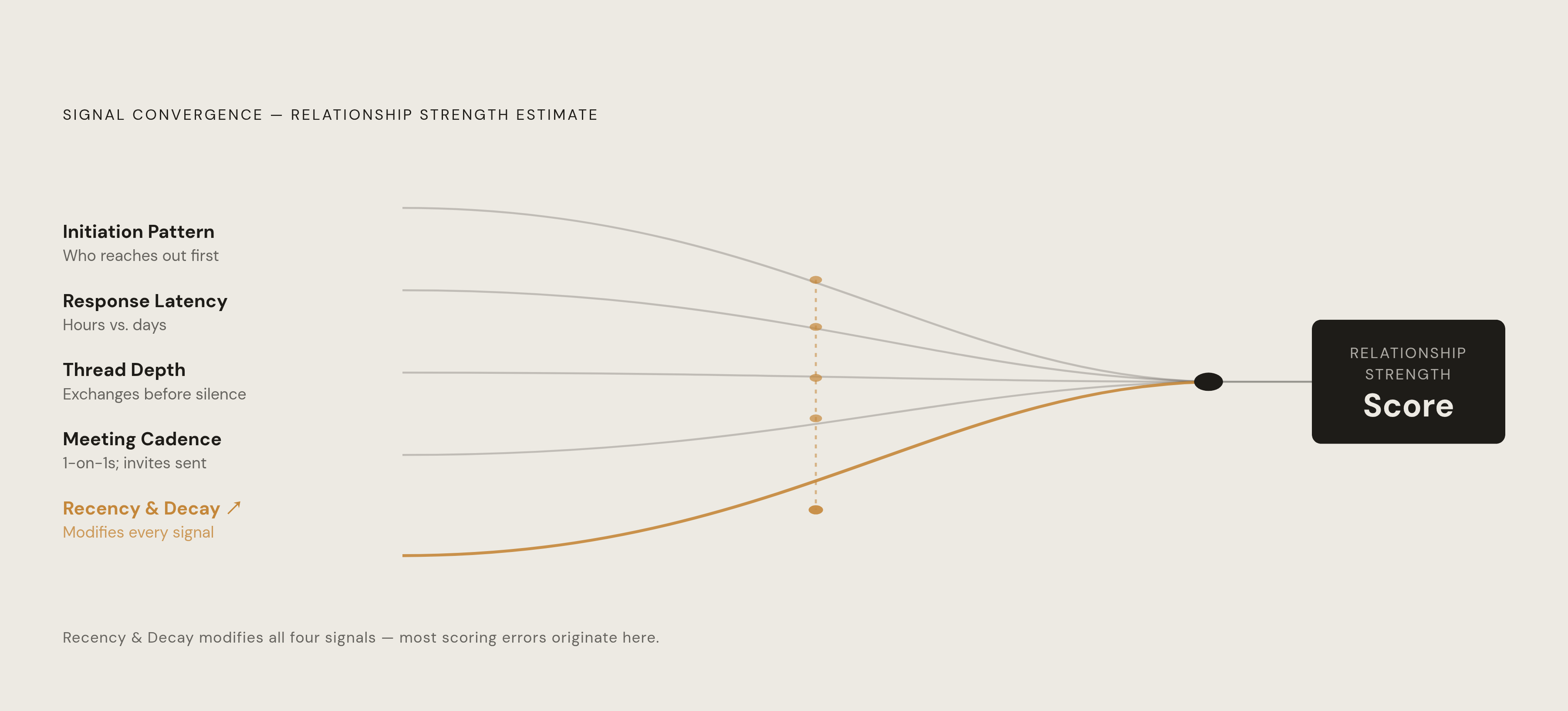
No individual signal is sufficient. A single meeting tells you almost nothing. A single email thread tells you marginally more. What produces a meaningful relationship strength estimate is the combination of signals across multiple dimensions, weighted against each other and interpreted in the context of recency and decay.
The core signal categories are: initiation pattern, response latency, thread depth, meeting cadence, and recency. Initiation pattern captures who reaches out first, and how consistently. Reciprocity is a strong amplifier; a relationship where both parties initiate contact regularly scores far higher than one where all the initiative flows in one direction, because one-directional contact tells you more about persistence than about mutual investment. Response latency captures how quickly each party replies, and whether that speed is symmetric. Short, symmetric latency, both parties responding within hours rather than days, is a reliable indicator of active engagement. Thread depth captures how many exchanges a conversation generates before it goes quiet; a thread that runs many replies deep suggests the other party is genuinely engaged. Meeting cadence adds a dimension that email alone cannot provide. A recurring one-on-one is categorically different from a large group call where two people happen to share the invite; an invitation extended rather than merely received is a stronger signal of investment.
Recency and decay interact with all of the above, and this is where I have seen scoring frameworks go wrong most often. A high-frequency relationship that went completely quiet three months ago is a fundamentally different asset from a lower-frequency but consistently maintained one. Decay curves matter as much as peak activity, because what the system is trying to predict is how a contact is likely to respond now, not during a peak engagement period that has since passed. Platforms like Affinity and Introhive have built commercial scoring systems on variants of this logic, which at minimum establishes that the methodology is operable at firm scale, not merely theoretical.
The output is a probabilistic estimate, not a guarantee. The score tells you how the relationship has behaved. That is the best available predictor of how the contact is likely to respond to future outreach, and it is a better predictor than memory.
What Single-Threaded Relationships Reveal When the Data Is Mapped Firm-Wide
The real value in behavioral scoring emerges not at the individual level but at the firm level. When relationship scores are aggregated across a team rather than confined to individual inboxes, the structural picture of the firm's external network becomes visible for the first time. What that picture typically reveals is a concentration problem.
Many accounts, particularly important ones, are single-threaded: only one person inside the firm has a scored, meaningful relationship with the external contact or company. That concentration is risk the firm may not know it is carrying. If that one person leaves, changes roles, or is simply unavailable when the relationship needs to be activated, there is no warm path in. Research on account health consistently shows that multi-threaded relationships are substantially more durable than single-threaded ones, and that single-threaded accounts carry meaningfully higher rates of churn and disengagement.
The inverse insight is equally valuable and, in my experience, less commonly discussed. When communication data is aggregated across a team, colleagues who were never recognized as relationship owners become visible. A junior team member, an analyst, a managing director whose correspondence with a particular target was never surfaced, may hold the warmest current path to a company the firm has been trying to reach through colder channels. Firms are routinely sitting on warm paths that remain invisible because the signal is trapped in individual inboxes.
The scoring layer does not expose private messages to surface this. It surfaces the structural fact that a strong relationship exists and identifies who holds it. For investors and BD operators, this shifts the sourcing question from "who do we know?" to "who in this firm has the strongest current path to this target?" Those are different questions, and only the second one is answerable from behavioral data.
How Connection Strength Scores Change How Professionals Decide to Reach Out
Without scored data, outreach decisions default to memory and intuition. Professionals reach out to contacts they remember, which is not the same as contacts with whom they currently have a warm relationship. Memory is a lagging indicator; the behavioral record is current. That gap is larger than most people expect.
A strength score changes the decision architecture in several concrete ways. It reveals when a relationship has cooled, creating the opportunity for re-engagement before the moment of need rather than at it. It surfaces colleagues with stronger current paths to a target. It distinguishes between contacts who will respond quickly and those where outreach is unlikely to land, allowing professionals to sequence efforts by actual probability of response.
Timing becomes legible in a way it is not when you are operating from memory. A contact whose communication cadence has recently increased is in an active period; that is a better moment to reach out than after weeks of silence. Data from sourcing research consistently shows that warm introductions outperform direct cold outreach by wide margins on both response rate and deal velocity, and that advantage compounds when the warm path is current rather than historical. For deal-driven teams, investors, founders pursuing partnerships, BD operators working a target list, a scored warm path is a distinct competitive advantage, not merely a preference for comfort. It reflects a measurable difference in conversion probability.
Alpha Watch's Rolo applies this signal-weighting logic in practice, combining initiation patterns, response latency, meeting cadence, and recency into a relationship strength estimate without requiring manual CRM upkeep and without accessing underlying message content. That tradeoff, signal without content, is worth understanding before evaluating any system in this category.
Where the Signal Has Limits and What It Cannot Tell You
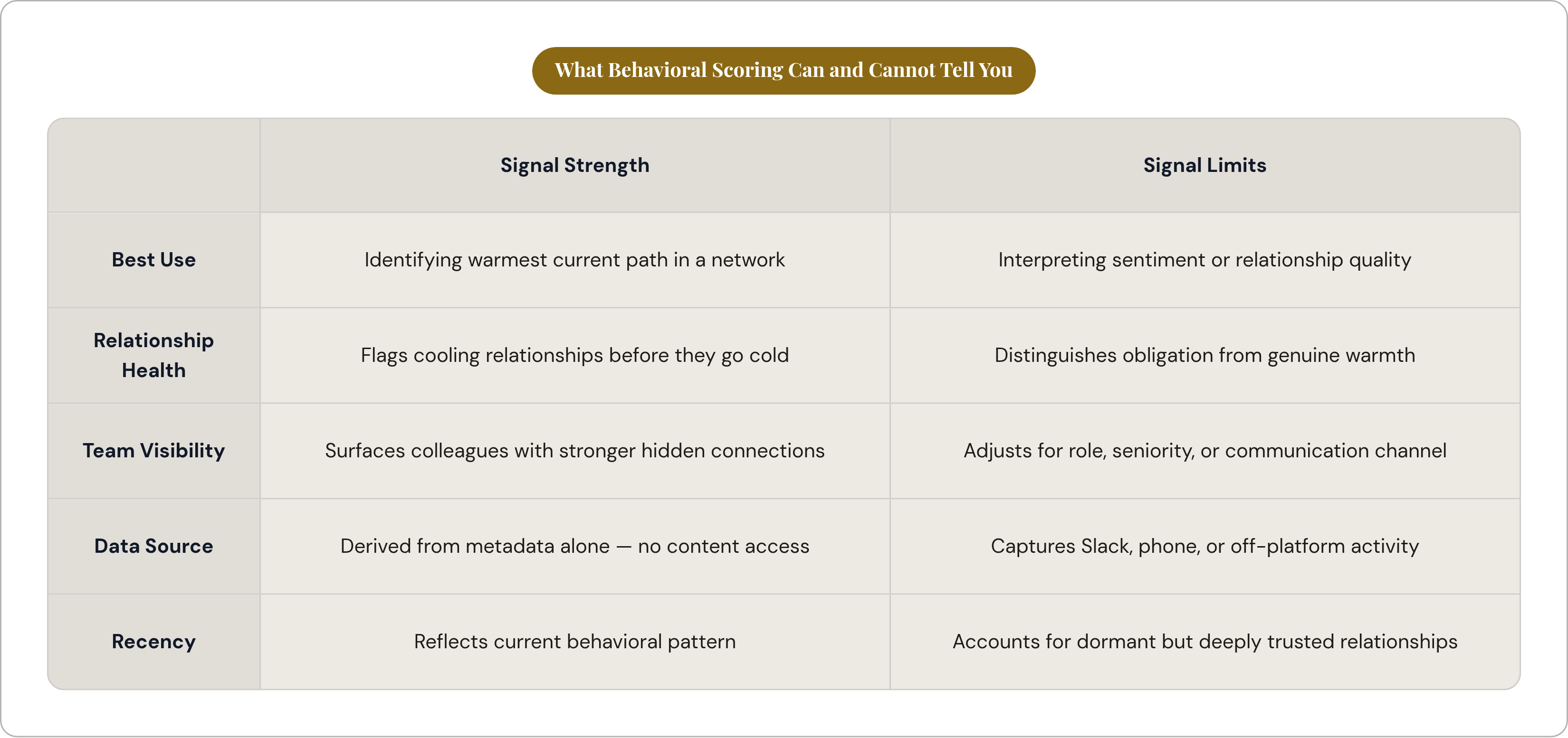
Behavioral scoring measures the history and pattern of communication. It does not measure sentiment, interpersonal quality, or whether the other party actually values the relationship. These are not minor omissions.
High frequency can reflect obligation rather than warmth. A vendor relationship with heavy email traffic may score strongly while the underlying dynamic is adversarial. A legal dispute generates significant communication volume; that volume is not evidence of a healthy relationship by any useful definition. Scoring systems that treat frequency as a direct proxy for warmth will misread these cases, and that misread can be consequential.
Response latency is context-dependent in ways aggregate scoring tends to miss. A slow response from a senior executive is not the same signal as a slow response from a peer; the former reflects schedule and volume constraints, not disinterest. Systems that do not adjust for role and seniority can produce misleading outputs. Calendar data is also richer for some professionals than others. A founder whose relationship activity runs primarily through Slack or phone calls reads differently than one whose correspondence is primarily email, and a scoring system calibrated to email and calendar alone will underweight the former's actual network activity.
Recency bias is a genuine risk. A strong long-term relationship that has been dormant for a quarter because both parties are occupied may score below a recent high-frequency exchange that is actually superficial. The score reflects behavior, not history of trust or depth of prior collaboration.
What the signal does well: identifying the best available warm path within a network, flagging relationships at risk of cooling before they actually go cold, surfacing colleagues with stronger connections to a target. What it requires: professional judgment to interpret the score in context. The score narrows the field and ranks options. The professional decides what the signal means. A system that surfaces signal and defers to human judgment is more trustworthy, and ultimately more useful, than one that acts autonomously on behavioral data.
Putting the Signal to Work Without Compromising Privacy
The capability that makes behavioral scoring powerful is precisely what makes it sensitive. If a system can determine that a colleague has a strong relationship with a target based on their email and calendar activity, the immediate question is: what else can it see?
The architecture matters more than the capability. The critical distinction is between a system that reads message content and one that analyzes only communication metadata. Structural signals, frequency, recency, initiation pattern, response latency, thread depth, are all derivable from metadata alone. The content of the messages is not required to score the relationship, and a well-designed system does not access it.
This is both a privacy argument and a trust argument. Professionals will share communication data with a firm-wide system only if they believe the system cannot expose private context to colleagues or misuse it in ways they did not intend. Systems that cannot make that guarantee credibly will not be adopted in high-trust environments, regardless of their analytical power. This is not hypothetical; it has constrained deployment of relationship intelligence tools across exactly the industries where the signal would be most valuable, financial services, legal, professional services, the places where a warm path matters most and where compliance requirements are strictest.
Permissioned access design is the practical solution: individuals control what they contribute to a shared relationship graph, and the system surfaces the existence of a warm path without exposing the private exchange that generated it. Data residency requirements, access controls, and retention policies are baseline conditions for deployment in regulated industries. A system that cannot meet those conditions simply does not get deployed.
The practical question is not whether to open your inbox to your firm. It is whether a system can separate the signal from the content, surface the structural fact of a warm relationship, and leave the private context of that relationship exactly where it belongs. That is the design constraint worth pressure-testing before committing to any platform in this category.