Relationship Depth Signals That Predict Introduction Quality
Three signals—recency, frequency, and reciprocity—reveal which relationships can actually deliver.

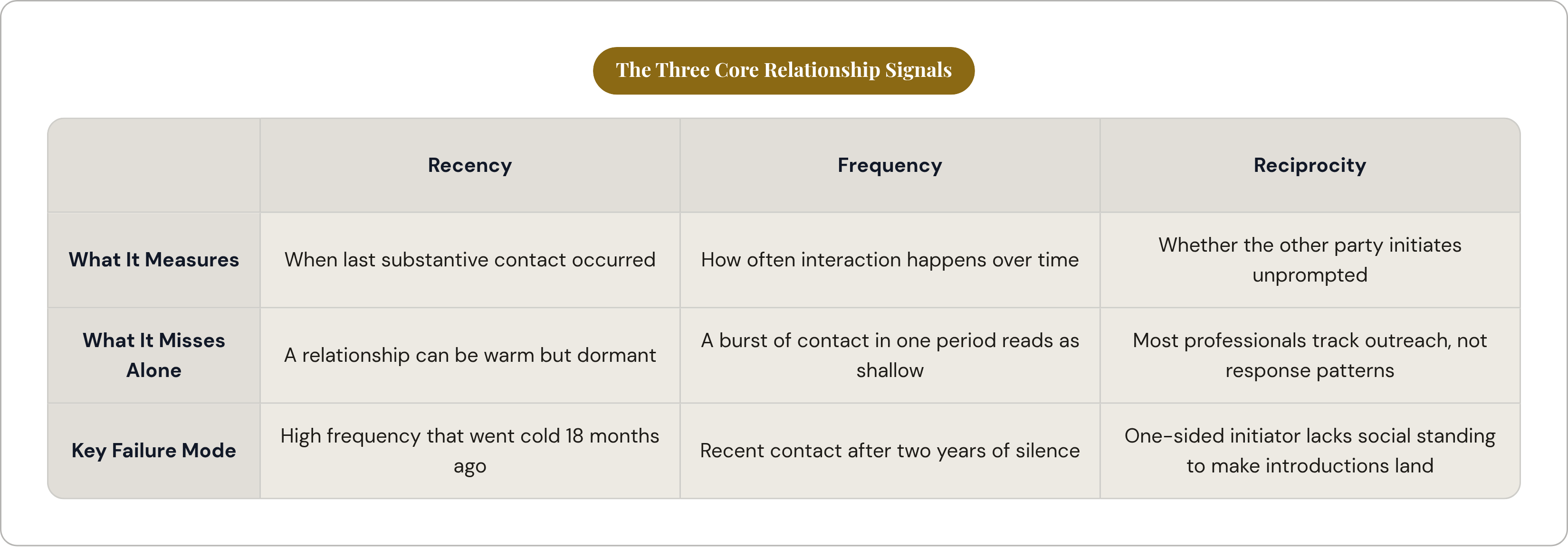
The framework that keeps surfacing across relationship intelligence systems and serious practitioners involves three variables: recency, frequency, and reciprocity. Each matters on its own. Together, they get you closer to a complete picture, though not all the way there.
Recency asks when meaningful contact last occurred. Not any contact, but substantive exchange. A relationship can be long, warm, and entirely dormant. Frequency asks how often interaction happens across a sustained period, not compressed into a single project or conference sprint. A relationship can be recently active and still shallow if every exchange happened inside one intense month and nothing since.
Neither signal alone tells you much. A high-frequency relationship that went cold eighteen months ago is warm in no practical sense. A recent exchange that was the first in two years is not frequent. You need both, read together, before the picture clarifies at all.
Reciprocity is the most underweighted of the three, and I've watched smart people miss it repeatedly. Most professionals have a reasonable read on how often they've reached out to a given contact. Far fewer track whether that contact ever initiates unprompted. Unprompted contact is the cleaner signal: it suggests the other party has invested in the relationship outside any transactional need. One-sided relationships, where one person is consistently the initiator, rarely transfer social capital reliably. The introducer may want to help; they simply may not have the standing to make it land.
Here is a concrete way to see this. A colleague who exchanged substantive communication with a target throughout the prior quarter scores higher on all three dimensions than someone who shared a conference panel with that person two years ago. Both may sincerely describe the relationship as warm. Only one of them can make an introduction that carries weight.
These signals capture interaction patterns. They say nothing about shared context, mutual obligation, or what two people have actually been through together. That requires a different kind of reading.
Qualitative Signals That the Quantitative Layer Misses
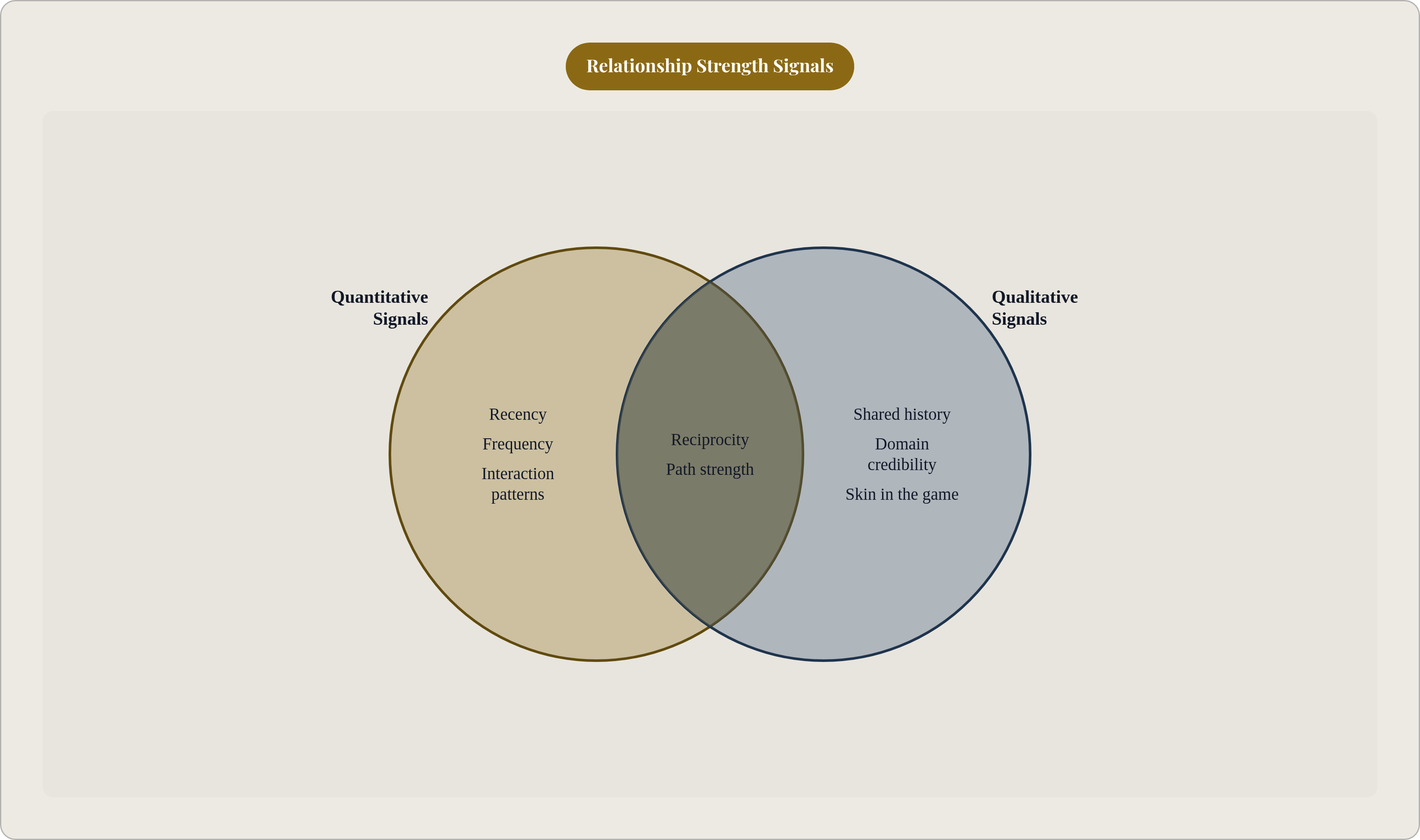
Shared history is a distinct signal, and frequency metrics cannot capture it. Two people who co-invested on a deal, worked through a genuine crisis at the same firm, or went through a formative professional moment together carry residual trust that interaction patterns cannot reproduce. The texture of the relationship is different. Endorsements within it carry implicit accountability that a relationship built on periodic lunches simply does not.
The nature of the ask relative to the relationship type matters in a way professionals consistently underestimate. A relationship built around co-investment may not transfer cleanly to a product or partnership introduction. An introducer trusted as a capital allocator may carry little weight vouching for a software vendor. Credibility in one domain is not automatically credibility in another. The question is not whether the introducer has a relationship; it is whether that relationship is the right kind for this particular ask. I've seen otherwise well-positioned introductions fall flat for exactly this reason, and the failure is rarely diagnosed correctly after the fact.
Mutual network overlap functions as a second-order signal worth paying attention to. When the introducer and the target share multiple connections, the social stakes of a hollow endorsement rise. The introducer's reputation is not just with the target but with a broader ecosystem of people who know both of them. That accountability tends to make endorsements more considered.
The introducer's standing with this specific target also requires examination, separate from their general reputation. A well-regarded investor or executive will have uneven relationships across a large firm. Their introduction to one partner may be strong while their introduction to another person in the same organization carries little weight. Assuming that a strong general reputation produces uniformly strong specific relationships is one of the harder routing errors to catch before the fact.
Job changes create an inflection point that gets insufficient attention. When a contact moves to a new role, they retain goodwill with former colleagues but lose operational proximity. The relationship is warm in affect and thinner in active context. Someone who changed roles in the past year is worth routing through carefully; their strongest paths may now run somewhere different than they did before.
The gap between quantitative interaction signals and qualitative context often explains exactly why an apparently strong path produces a weak introduction. The two layers are complements, not substitutes.
How to Map Relationship Depth Across a Firm's Entire Network Before Routing a Request
The visibility problem almost always precedes the routing problem. Most professionals can assess the depth of their own relationships with reasonable accuracy. What they cannot do is simultaneously assess relationship strength across every colleague's network to every potential target. The warm path may exist, held by someone two floors away or in a different office entirely, and neither party knows to connect.
Affinity's Invisible Edge report, covering 291 private equity firms over two years, found that the most efficient firms generate one introduction for every eleven emails sent, while the least efficient require close to 185 emails for the same result. A gap of that magnitude is not primarily a network size problem. It is a routing and visibility problem. The less efficient firms are not lacking connections in any meaningful sense; they are failing to identify and use the highest-quality paths through the connections they already have.
Systematic mapping inverts the typical approach. Instead of starting with who you know and working forward, it starts with the target and works backward through the firm's collective network, ranking colleagues by relationship strength to that specific person rather than by whether any connection exists at all.
Before routing any request, a decay check is warranted. Relationships erode without maintenance, and that cooling tends to become visible only when an introduction falls flat. Verifying that the path is still live before relying on it is not excessive caution; it is basic due diligence.
The institutional data silo is where this breaks down at most firms. Relationship context is trapped in individual inboxes and calendars. The colleague who holds the strongest relationship with a given target may not know they are the right person to ask, because no one has mapped it. IDC Market Research data suggests companies lose a meaningful fraction of annual revenue to inefficiencies caused by data silos; in firms where relationships are the primary productive asset, the fraction attributable to misrouted or invisible introductions is likely disproportionate, though the honest answer is that most firms have never measured it.
What Degrades Introduction Quality Even When Relationship Depth Is Real
Relationship depth is a necessary condition for a strong introduction, not a sufficient one. The handoff design determines whether that depth is preserved or lost in translation.
Generic framing is the most common failure mode. An introducer who does not know what to say about you cannot convey the relationship's depth. The recipient receives an introduction that could have been written by anyone, and the social capital that was supposed to transfer does not, because there is nothing specific enough to carry it. I've seen this happen with introductions made by people who cared and had standing. The framing failed them.
The difference between a double opt-in introduction and a blind forward is more significant than it appears. When an introducer checks with the recipient before making the connection, the recipient experiences that consideration as a credibility signal in itself; the introducer signals standing by virtue of having a relationship worth respecting. A blind forward implies the opposite. Experienced recipients can usually tell, and they adjust their response accordingly.
Timing relative to the introducer's relationship cycle rarely surfaces in how firms think about routing. Asking someone to make an introduction when their relationship with the target is at a low point, after a disagreement, a period of silence, or a professional disappointment, depletes rather than draws on relationship capital. The introduction lands at exactly the moment the introducer is least positioned to carry it.
Skin in the game is a separate variable. An introduction where the introducer has something at stake, whether reputation, a shared deal, or an ongoing working relationship, carries different weight than one where they lose nothing if it goes poorly. Recipients sense the difference, even if they couldn't always articulate why.
Overuse of a strong path erodes it over time. Repeatedly routing requests through the same high-relationship connector is a kind of tragedy of the commons: the target begins to see that connector as a referral machine rather than a trusted peer, and the value of each successive introduction diminishes. The strongest paths require the most deliberate protection, which means rationing them.
Why Firms That Read These Signals Systematically Outperform Those That Rely on Intuition Alone
Intuition scales to one person. A senior professional with decades of pattern-matching can make reasonable routing decisions within their own network. That ability cannot be distributed across a team of thirty or a hundred people making independent decisions about where to route requests, each drawing only on their own visibility. This is where the gap between individuals who are good at relationships and firms that are good at relationships tends to open up.
Consider the compounding dynamic. Firms that consistently route introductions through the highest-quality paths build a track record of high-signal introductions. Future requests arrive with a reputational tailwind; recipients have learned that an introduction from this firm carries real weight. That track record is itself an asset, and it accrues only to firms that are protecting it deliberately.
Affinity's 2024 benchmark data illustrates the divergence clearly. Top-performing private equity firms made 16% more introductions year-over-year, while more than half of firms saw introduction output decline significantly over the same period despite increasing outbound email volume. More emails, fewer introductions: that combination is the signature of a volume strategy applied to a signal-quality problem.
The Harvard Business Review's analysis of nearly 900 venture capital firms found that more than 70% of deals originate from existing networks. Systematic relationship mapping is how firms ensure they are drawing on those networks rather than leaving large portions of them dormant. The warm path already exists in most cases; the problem is that no one can see it.
Institutional memory is where the failure mode becomes irreversible. When relationship context lives with individual employees rather than with the firm, every departure is a relationship loss. Warm paths disappear or must be rebuilt from scratch, and firms rarely know it until they try to route a request and find the path is gone. Research on organizational performance consistently finds that companies drawing on both internal and external relationships outperform those that do not, particularly on revenue attainment; the mechanism runs largely through the quality and continuity of introductions.
How AI Surfaces Relationship Depth Signals That Humans Would Otherwise Miss or Misread
The manual ceiling on relationship assessment is real and hits quickly. A professional can hold an accurate model of their own relationships. They cannot simultaneously model the relationship strength of every colleague to every potential target in anything close to real time. The firm-wide mapping problem is, at its core, a data processing problem, and it's worth being direct that most humans solve it by not solving it at all: they route through whoever comes to mind first.
What AI reads that humans do not systematically track is the metadata layer: email and calendar activity across the entire organization, synthesized into a ranked relationship graph reflecting recency, frequency, and reciprocity without requiring anyone to self-report or maintain a CRM record. The signals that professionals know they should be tracking but rarely do consistently are exactly the signals automated processing handles well.
The scale at which this becomes material is significant. Affinity's data shows that General Catalyst made over 8.6 million API calls to their relationship intelligence system in a single month in 2024, across 94 active users. At that interaction volume, no manual process surfaces relationship strength signals in time to act on them. The analysis a senior professional might do intuitively for their own network gets extended, imperfectly but meaningfully, across the entire firm's contact graph.
The right frame here is augmentation, not automation. The system surfaces who holds the strongest path to a target; the professional decides whether and how to ask. As Intel Capital COO Jennifer Ard has framed it, AI handles the data processing while humans handle the relationship judgment. The introduction itself is not automated. What changes is the quality of information available before the human makes the call.
Job-change alerts are a specific, underappreciated AI-enabled signal. When a contact moves to a new organization, a properly configured system flags it immediately rather than leaving the transition invisible for months. A warm path into a new institution that would otherwise take a year to recognize represents real opportunity cost, and catching it early is a tractable data processing task.
The qualitative layer remains a human domain. Shared history, domain-relevant credibility, skin in the game, the nature of the ask relative to the relationship type: these still require interpretation that no current system performs reliably. AI narrows the field to the most promising paths. Human judgment makes the final call about which path is actually the right one.
The Privacy Constraint That Determines Whether Firms Will Actually Use Relationship Data This Way
The most valuable relationship signals live in private communications. Email threads, calendar context, message history: these are exactly what relationship intelligence systems need to read, and exactly what investment professionals are most protective of. The utility of aggregating relationship metadata at the firm level and the legitimate caution about doing so are not in tension through misunderstanding. Both concerns are valid, and anyone who dismisses either one quickly probably hasn't sat through a serious LP conversation about data governance.
In financial services, the confidentiality stakes are not abstract. An investment professional's communications contain term sheet discussions, LP updates, founder negotiations, and sensitive counterparty context. The relationship metadata is inseparable from the deal context. Exposing either to the wrong internal audience creates legal, regulatory, and reputational exposure simultaneously.
The 2025 State of AI Security report found that 62% of enterprises have experienced AI-related data exposure incidents, most attributable to inadequate input controls. In an industry where confidentiality is both a legal obligation and a competitive necessity, that statistic demands specificity rather than general reassurance. The question is whether the risk is real; the answer is yes, and the follow-on question is whether the architecture of a given system manages it adequately.
The permissioning distinction that makes collective relationship intelligence usable runs along a fairly clear line. Individual relationship context stays private. A professional's email content is not surfaced to colleagues. What is shared is the existence and relative strength of a connection, not the substance that established it. The firm sees that a particular person has a strong relationship with a particular target; it does not see why, or what was said, or what deal context surrounds it. Whether that distinction holds in practice depends entirely on the architecture of the system in question, not on the vendor's assurances about it.
The regulatory environment is tightening the stakes. DORA came into effect for financial services entities in January 2025; U.S. state-level privacy frameworks are accelerating. Firms evaluating relationship intelligence platforms need to assess compliance posture as a prerequisite, not a post-procurement consideration.
The first question to ask any vendor is not about feature functionality. It is about data architecture: where does the data go, who can see what, and what feeds model training. Adoption collapses if the people whose communications are being read do not trust the system reading them. That trust is architectural before it is cultural.
A Practical Approach to Reading and Routing Introductions Before the Next Ask
Before any introduction request is made, three questions deserve careful answers.
First: how recently and how frequently has the potential introducer had substantive contact with this specific target? The question is whether the relationship is live, active, and reciprocal in any meaningful sense, not merely whether they are connected or know each other. If it is not, the introduction will feel thin to the recipient regardless of the introducer's sincerity.
Second: does the introducer's credibility map onto the type of ask? A financial relationship built around co-investment may not translate into a trusted referral for a technology partnership. Skipping this question is how strong relationships produce weak introductions, and the failure mode is invisible until the recipient doesn't respond.
Third: is the path still warm, or does it need to be rekindled first? The highest-quality path that has cooled is often worth a direct investment in rewarming before the ask. A brief engagement, a piece of relevant context shared, a conversation that is not about the ask: these can rebuild enough proximity to make the subsequent introduction land properly. Routing around a cooled high-quality path in favor of a weaker live one is usually the wrong trade, though it feels safer in the moment.
The firm-level version of this exercise adds a prior step: before concluding that no strong warm path exists, map the target backward through the organization's collective network. The path exists somewhere inside most firms with meaningful networks. The problem is almost always visibility, not absence.
What you give the introducer is the final piece. Enough context for them to write something specific: what you are working on, why this introduction is relevant now, what you are actually asking for, and what they can say about why it is worth the target's time. A strong introduction, poorly equipped, is a missed opportunity. The relationship capital was there; the framing failed to deploy it.
The binary of warm versus cold is a useful shorthand until the moment it costs you a deal. The full range is worth learning to read.