How Institutional Investors Source Proprietary Deal Flow
Top PE firms source deals through relationship networks, not data subscriptions.

Sutton Place Strategies puts the median private equity firm at roughly 18% coverage of relevant deal flow in its target markets. Most firms, if you ask them, believe their number is closer to 50. That gap is not an abstraction. It is where capital gets misallocated, year after year, without anyone in the room naming it clearly.
What makes this stranger is that firms keep adding data sources. Over half of private capital firms now pull from more than four different providers simultaneously, and the coverage gap persists anyway. At some point that pattern stops being a data problem and starts being something else. Most firms are drawing from the same vendors, developing converging theses, and arriving at the same processes. Another subscription does not solve that. It accelerates the convergence.
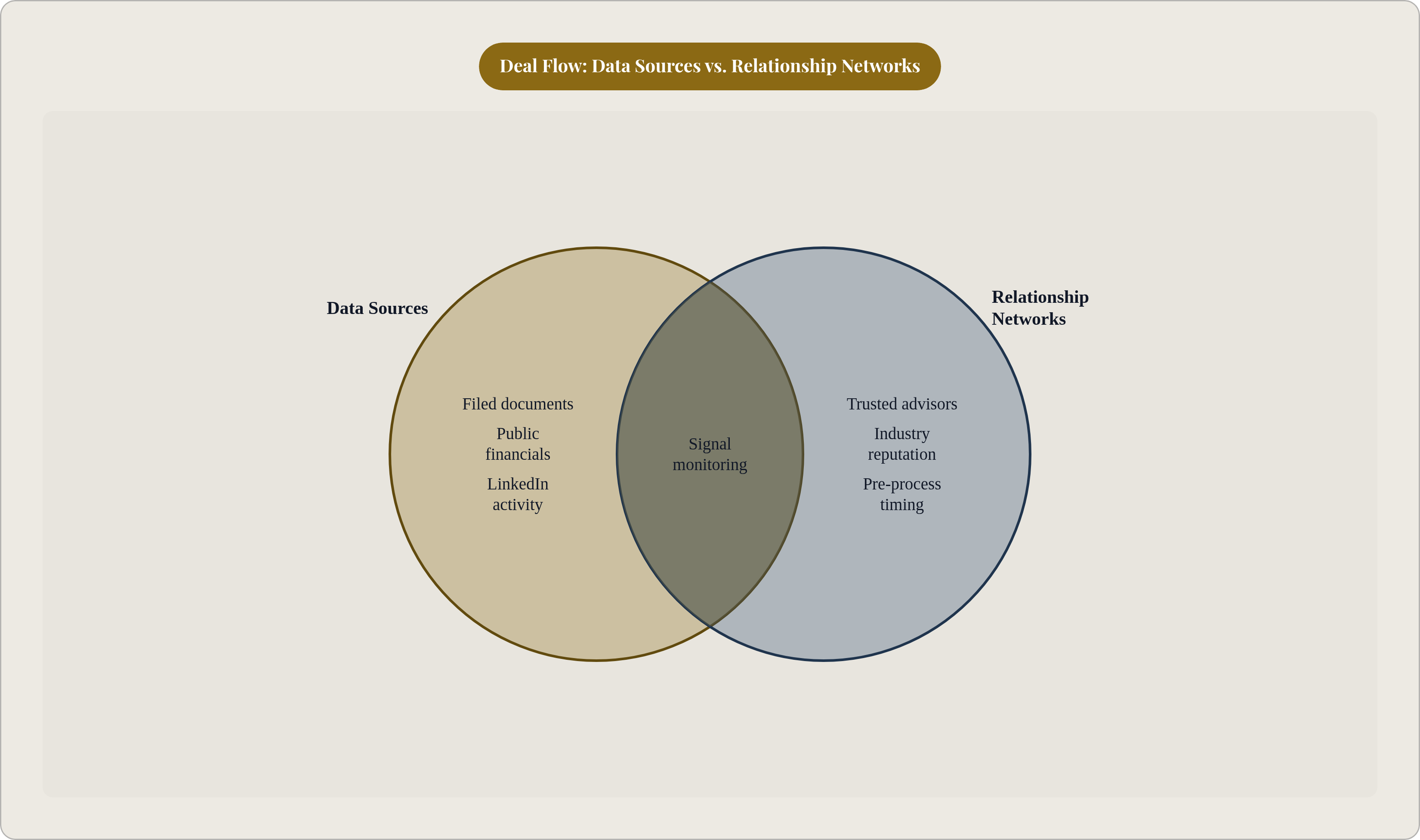
The deeper issue is what data sources are actually capable of capturing: companies that have left legible digital signals. Filed documents, press releases, public financials, LinkedIn hiring activity. What they cannot reach is the founder-owned manufacturing business that has never retained a banker, does not file publicly, and is not, in any formal sense, for sale. The owner might be 62, thinking intermittently about what comes next, running a business doing $8 million in EBITDA with zero institutional coverage. That company is not invisible because the research tools are inadequate. It is invisible because no one in its orbit has introduced it to the right buyer yet.
That missing 80% is not distressed businesses or marginal ones. It is companies whose owners have not decided to sell, have not engaged an intermediary, and will not until someone they trust raises the question in a context that feels safe. That is a relationship problem. Firms solving it have built a different kind of infrastructure than the ones adding subscriptions, and the infrastructure looks almost nothing like what most people mean when they say "deal sourcing."
Where top-performing firms actually find their best deals
A Harvard Business Review analysis of nearly 900 venture capital investors found that more than 70% of all deals originate from within a firm's existing network. Not inbound volume, not databases, not banker introductions. That figure gets dismissed sometimes as a VC-specific dynamic, but the underlying mechanism applies broadly: a warm introduction carries pre-vetting. The referring party provides context and credibility that no outreach sequence can replicate. It compresses the trust-building timeline in ways that matter enormously when a founder has three or four options in front of them.
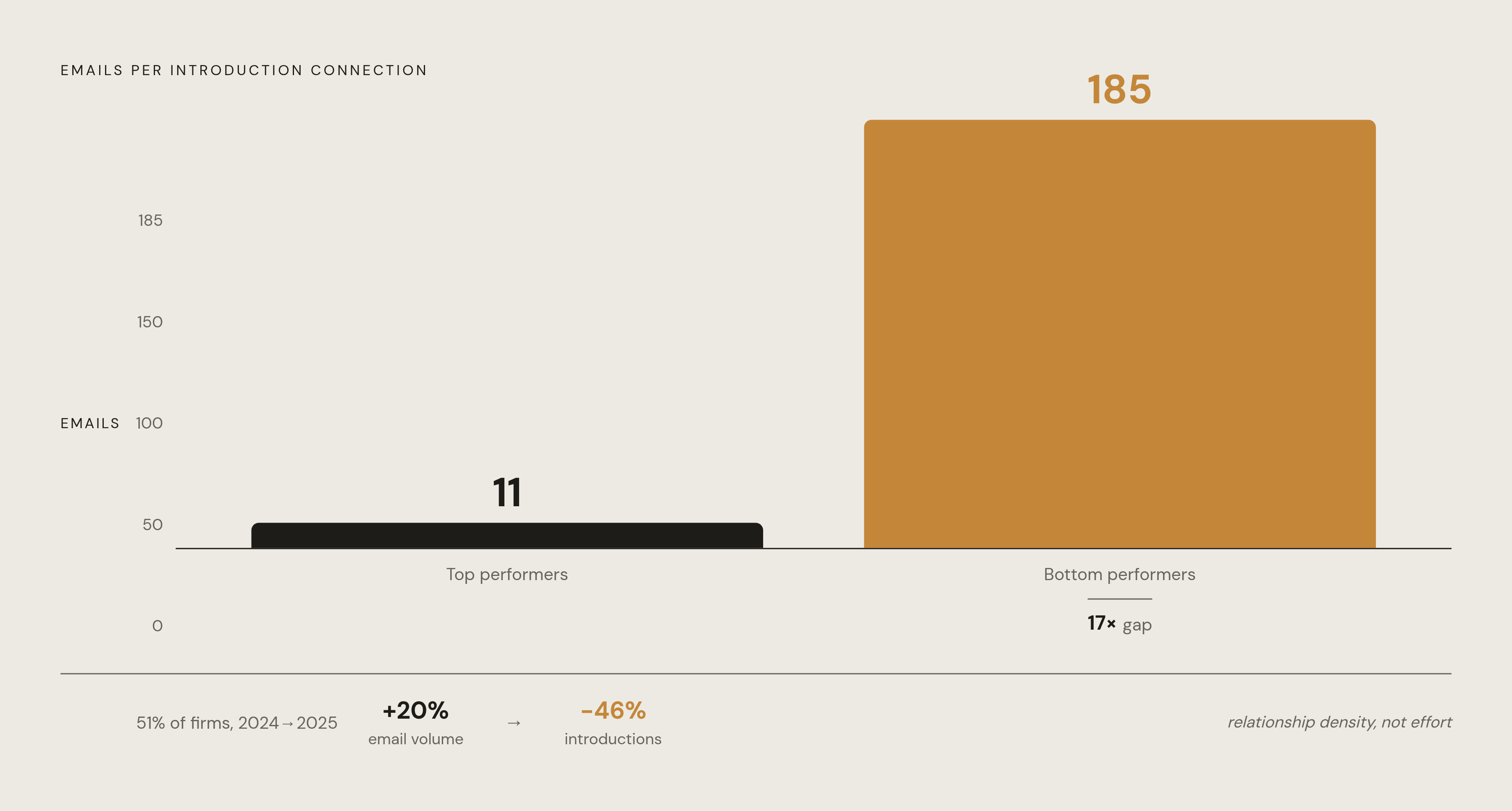
The efficiency gap here is large enough to warrant some scrutiny. Affinity's research shows the most efficient private equity firms generate one introduction connection per 11 outreach emails. The least efficient require roughly 185 emails for the same result. That 17x spread has almost nothing to do with email quality. It reflects relationship density and the caliber of the network being activated. The same data showed that 51% of PE firms saw their introduction output decline 46% from 2024 to 2025, even as they increased email volume by 20%. More activity, worse results. At some point you have to ask what the activity was actually measuring.
Add-ons deserve separate examination, because they distort how firms talk about proprietary deal flow. In 2024, add-ons accounted for approximately 74% of all private equity deals, per Harvard Law School's corporate governance review. Add-ons are often less competitive because the platform already holds a commercial relationship with the target and has proprietary operating insight. When a GP claims strong off-market flow, they are frequently describing a concentrated add-on program. That is a defensible and often valuable capability, but it is not the same as a repeatable method for sourcing new platforms off-market. LPs paying for that distinction should be making it clearly.
Building relationships before there is a transaction to discuss
The firms that source consistently tend to treat the 12 to 24 months before any transaction timeline exists as the actual work. Sourcing is an off-cycle discipline, not a response function. That sounds obvious. Almost nobody does it with any structural consistency.
The anatomy of why it matters is concrete. A founder-owned business doing several million in EBITDA has almost certainly never worked with an investment banker. The owner has a local accountant, a regional lending relationship, maybe a few peers in a trade association. The GP who has spent three years attending the same industry conferences, who has earned a reputation as a buyer that does not retrade, who has maintained consistent contact with that accountant over time: that GP occupies a completely different position than the one receiving the same opportunity through a formal process six months later. One is already known. The other is a bidder.
Reputation at this market level compounds quietly. Sellers choose buyers partly on perceived trustworthiness, and referral networks carry reputation signals that no outreach sequence manufactures. The accountant who recommends a GP to an owner client is putting their own credibility on the table. They will do it repeatedly only for a firm they have watched behave well, across more than one situation, over real time. One good close is not enough. The referral relationship is built on pattern, not transaction.
The logic runs in both directions. Founders approaching institutional investors who begin those relationships 6 to 12 months before needing capital allow investors to watch them in motion: shipping, missing targets, recovering. By the time a round opens, the investor has witnessed the traction story rather than received it as a pitch. In both contexts, the relationship that ends up mattering was started before it was needed. Most firms have no structural mechanism for maintaining relationships that carry no immediate commercial signal, which is precisely why sustaining this discipline proves so difficult across fund cycles.
The intermediary and expert networks that feed proprietary pipelines
At the lower middle market, the relevant trusted advisors are an owner's accountant, their regional lender, and their industry lawyer. These are the people a business owner consults before they consult any investor. The PE firm with cultivated relationships among those advisors sees the opportunity when the owner starts asking questions, not after a process is formally launched. That timing difference determines whether you are having a proprietary conversation or paying an auction entry fee.
Industry conferences matter, but not primarily as networking events in the conventional sense. They are long-duration reputation-building venues. The GP who shows up consistently, speaks on panels, and becomes known by operators in a given sector is creating a referral surface that compounds across years. The GP who attends once, collects business cards, and follows up with a generic email sequence is building something far less durable, and probably senses it while it is happening.
Scout networks and senior operating partners with genuine sector relationships extend a firm's reach into markets the investment team cannot cover directly. Prior co-investors surface deal flow from adjacent geographies and sectors. LP relationships at sophisticated family offices and endowments surface opportunities before they are broadly marketed, because those LPs are embedded in the same ownership networks as the companies being sourced. None of this is novel in concept. The question is which firms actually sustain it past the first fund.
Expert networks serve a related but distinct function: rapid access to industry insight and early mapping of a sector's key players before any specific target is identified. The shared characteristic across all these channels is that none of them are transactional at the moment of use. The relationship has to be earned before the ask. Firms that approach intermediary networks transactionally tend to burn them, usually without fully understanding why the referrals stopped coming. That dynamic is slow, quiet, and difficult to reverse.
How institutional relationship data gets siloed and what that costs
The structural problem in most firms is visible once you start looking. GPs track deal opportunities in one system. Investor relations manages LP relationships in another. Portfolio monitoring lives in spreadsheets that belong to whoever built them. There is no unified view of who the firm knows, when it last had meaningful contact, or how warm a given relationship actually is at any given moment.
Founder relationships often exist only in a single partner's inbox. When that partner leaves, the relationship history goes with them. Declined deals live in email threads, internal memos, and the memories of analysts who are now in MBA programs. When a similar business surfaces 18 months later, the firm frequently starts from scratch without realizing it has already seen a version of this. I have watched this happen more than once at firms that would describe their institutional knowledge as a competitive advantage.
The compounding cost is rarely calculated. A firm that consistently captures the reasoning behind declined deals, over time, builds a working model of what quality looks like in a given sector: what strong businesses share, what red flags appear before they surface in headline numbers. Most firms build nothing of the kind. The knowledge dissolves with each personnel transition, and the firm pays for it again in the next process, usually without connecting the two events.
The LP relationship dimension carries similar weight. In a fundraising environment where LPs have more options and more data than in prior cycles, the firms winning repeat commitments are those whose IR teams demonstrate an active, living relationship rather than reassemble one from scattered notes before a quarterly meeting. Closing this gap does not require more headcount. It requires making the network the firm already possesses visible to the people who need to use it.
What it looks like when firms treat their network as a queryable asset
Relationship intelligence platforms connect email, calendar, and communication history and turn that record into a mapped, searchable picture of who knows whom, when contact last happened, and how the relationship has developed over time. The practical shift is in the question the firm can ask: not "do we know anyone at this company?" but "who in our firm has the warmest path, and what does the history actually show?" That question becomes answerable in seconds rather than requiring a manual sweep of individual inboxes.
The sourcing research on warm versus cold introductions is consistent: routing through the warmest available path, rather than the most convenient one, meaningfully improves the probability of winning a deal. Across hundreds of interactions, that compounding effect is real, even when no single introduction looks decisive in isolation.
Signal monitoring adds a proactive dimension. Tracking revenue trajectory, headcount changes, and leadership transitions as indicators of a company's readiness means those signals can reach a firm before a banker does, provided the monitoring infrastructure is already in place. Relationship intelligence tools can also recover substantial time through automated data capture and contact enrichment. The value is in surfacing context for a human to act on. The professional controls every outreach; the tool makes the judgment better-informed, not unnecessary.
There is a privacy constraint that has to be addressed here. Relationship data becomes collectively useful across a team only if individual contacts trust that their private context stays private. That is not a feature to evaluate late in the procurement process. It is the precondition for the whole system functioning, and it deserves more weight in the evaluation than it typically receives.
Why the security and governance architecture around relationship data is not optional
Investment firms handle confidential deal information, proprietary sourcing intelligence, and sensitive LP communications simultaneously. A compliance failure in this context damages client trust and regulatory standing in ways that no product capability recovers. The 2025 State of AI Security report found that 62% of enterprises had experienced AI-related data exposure incidents, most stemming from inadequate input controls or unclear data handling policies. Organizations that implement AI with proper security frameworks experience substantially fewer breaches than those that treat security as a post-deployment concern. The architectural decision made at the start determines the outcome.
Zero-trust architecture, in this context, means every user, device, and AI system must verify identity before accessing relationship data, with permissions that adjust based on role and context. This matters particularly because it addresses the shadow AI problem: individual team members routing firm data through unauthorized tools because the official system is too slow or inconvenient. That failure mode is not hypothetical. It is common, and it is occurring at firms that believe they have the problem contained.
SOC 2 Type II, GDPR, and CCPA compliance are the floor, not a differentiator. Any firm evaluating relationship intelligence platforms should treat certification as the baseline check before examining any other capability. The governance questions that need answers before deployment include: who can see which relationships, under what conditions, and what happens to a contact's private context when it is shared across a team. These are architectural questions, not policy ones. They need to be resolved before a problem surfaces, not in response to one.
The contacts whose relationships the firm is mapping provided no consent to being data points. The only sustainable model is one where the system makes collective signals useful without exposing individual context, and where the people whose relationships are being tracked can trust that boundary holds.
What separates firms that consistently source off-market from those that occasionally do
The firms that source off-market with any consistency share a behavioral posture more than a specific method. They treat the network as something requiring ongoing cultivation, not a resource to activate when a mandate appears. That is a harder operational discipline than it sounds, and most firms do not sustain it past the first fund. The ones that do are usually not doing anything exotic. They are simply not stopping.
Time is the variable that cannot be manufactured inside a process. Relationships built 12 to 24 months before a transaction exists, intermediary networks maintained through genuine reciprocity, declined deal reasoning captured and retrievable: none of that is available on demand. It either exists because the firm has been building it continuously, or it does not exist. There is no shortcut that closes the gap once a timeline is already running.
The institutional memory dimension is less visible and probably more consequential. A firm that can retrieve why it passed on a company 18 months ago, and evaluate what has changed since, is conducting a form of due diligence that a firm starting from scratch cannot replicate under time pressure. That accumulated context is not glamorous work to build. It is also entirely unreplicable without the infrastructure to capture it as you go.
The coverage math remains unforgiving. The median firm sees roughly 18% of relevant deal flow in its markets. That gap is not closed by additional data subscriptions. It is closed, slowly and imperfectly, by being the firm that owners, accountants, and operators think to call before they call a banker. Most of the network required to get there already exists inside a firm's own email, calendar, and communication history. The problem is that it sits fragmented across individual inboxes, untagged, unshared, and unavailable to anyone making a sourcing decision in real time. The firms pulling ahead are not those with the largest contact databases. They are those who have made their existing relationships legible and maintainable across the team, while keeping individual context private enough that people trust the system with their relationships at all. Whether that combination is achievable at scale across a firm's full network is still an open question. The firms trying to answer it are at least asking the right one.