Ranking Introductions by Path Quality in Multi-Hop Networks
Weak ties outperform strong ones because they bridge separate clusters and carry novel information.
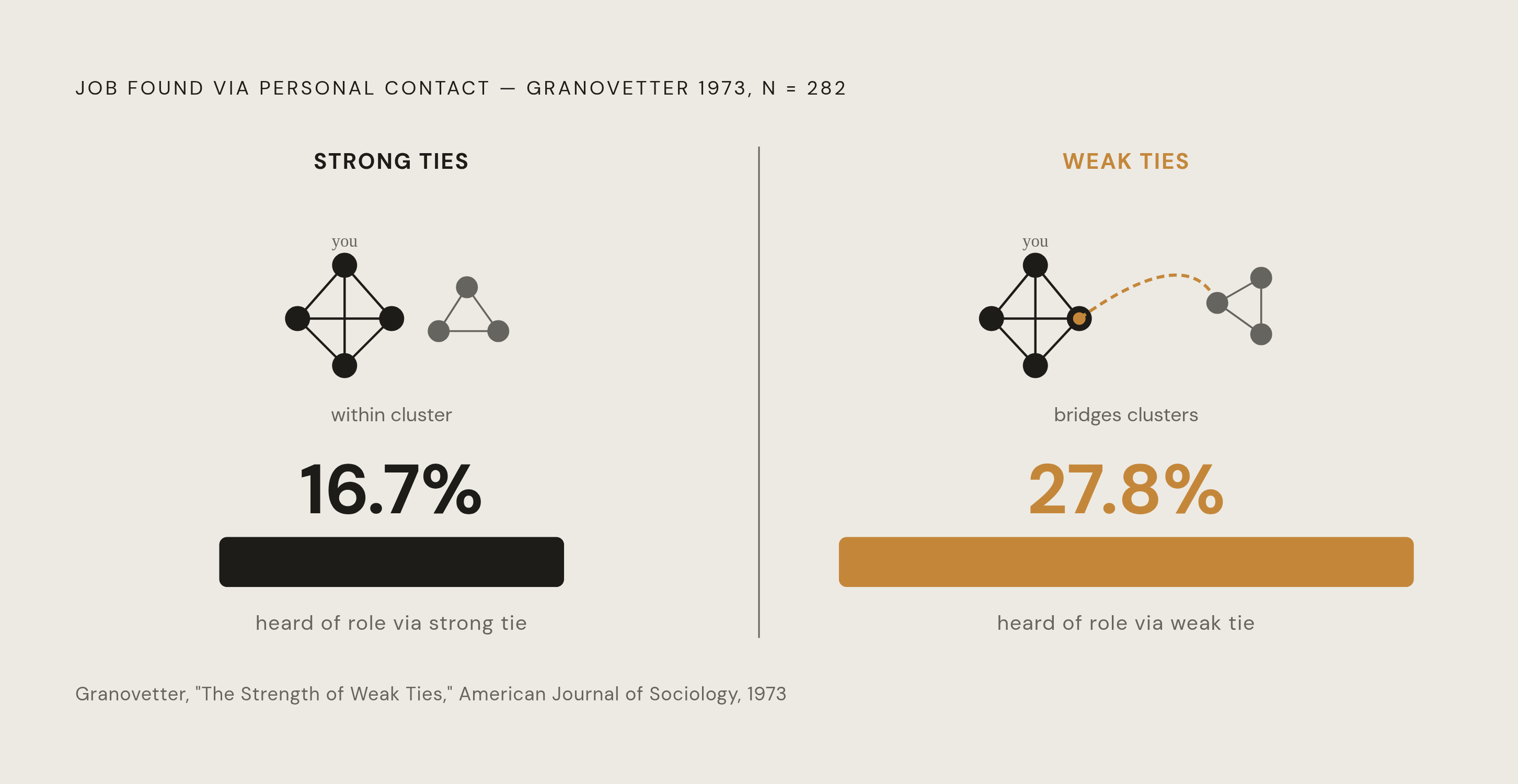
The foundational insight here belongs to Mark Granovetter. His 1973 paper "The Strength of Weak Ties" is approaching 70,000 citations, and its core finding still surprises people when they encounter it stated plainly. In a survey of 282 men who found employment through personal contacts, 27.8% heard of the role through weak ties, compared to only 16.7% through strong ones. Weak ties won not because they were more trustworthy but because they crossed cluster boundaries. Strong ties connect people who already know the same people. Loose acquaintances bridge separate social clusters and carry information that neither side already has.
Stanley Milgram's small-world experiment, which traced letters from distant strangers to a Manhattan stockbroker through an average of six intermediaries, provided early empirical confirmation that networks are shallower than they feel. You are rarely as far from any given target as the absence of a direct connection suggests.
The structural implication is that a multi-hop introduction crossing cluster boundaries carries different information than one staying inside a tight community. The bridge-crossing hop adds novelty; the within-cluster hop adds redundancy. But network structure only explains why paths vary. It does not tell you how to measure which path is actually better, and that is the more consequential question.
The Four Signals That Actually Determine Path Quality
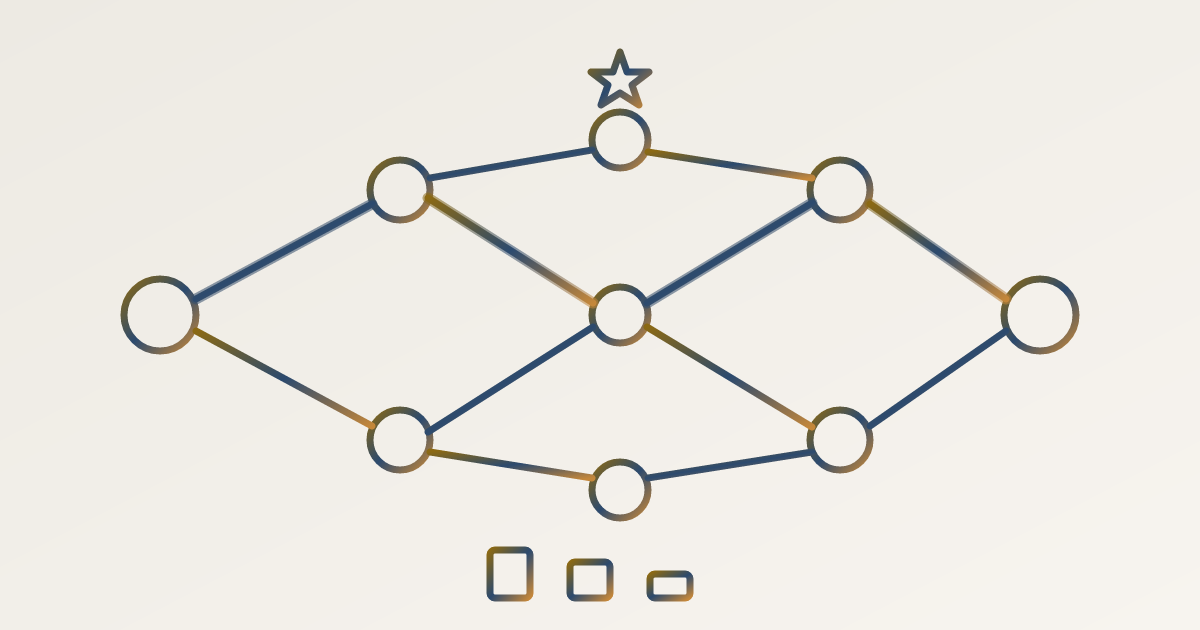
These four signals interact. A path that scores well on three but catastrophically on one can still fail.
Relationship strength is the most obvious signal and the most consistently misread. Professionals tend to conflate familiarity with strength, but the more reliable proxy is communication frequency and recency. Someone emailed weekly signals a meaningfully different relationship than someone contacted once two years ago. Calendar data adds texture that email frequency alone misses: regular one-on-ones indicate substantive professional proximity in ways that shared attendance at a large group event simply does not. Shared work history contributes latent trust even when recent communication has lapsed, though that latency depreciates faster than people assume. Routing a request through a former colleague you haven't spoken to in three years is drawing on an account you may have inadvertently closed.
Recency operates somewhat independently of strength. A relationship that was once strong but has gone dormant carries less transferable credibility than a moderately strong tie that was active last month. An intermediary asking a favor from a relationship they haven't maintained is spending from a balance they haven't checked. The final hop is where this most often goes wrong.
Intermediary credibility is context-dependent in ways that resist generalization. The relevant question is not whether the intermediary is generally respected but whether they have standing in the target's specific domain. The same person may be high-credibility for a technical hire and low-credibility for a fundraising introduction. Being introduced by someone the target barely respects is, in many contexts, worse than a slightly longer path through someone the target actually trusts.
Hop count is the weakest standalone signal. Two strong, recent, credible hops outperform five weak or stale ones. Beyond three or four hops, even technically strong ties tend to produce an introduction so diluted that the target has little context for why it arrived.
What these signals share is that they are rarely available in full. Professionals routinely work with partial information, routing by instinct rather than systematic assessment. That gap is where most introduction value disappears.
How Trust Degrades, and Occasionally Amplifies, as It Moves Through a Chain
The default across multi-hop paths is degradation. Each hop requires the intermediary to vouch for someone they may know less well than the requester assumes. When intermediaries pass a request along without active investment, the introduction arrives without the credibility transfer that makes warm paths valuable in the first place. The target receives a name and a chain, not a recommendation.
The amplification case is less intuitive but real. A well-chosen weak-tie hop can raise an introduction's quality if that intermediary has credible standing with the target and a concrete reason to advocate. This is Granovetter's bridge-crossing insight applied to trust rather than information: the hop adds something the target didn't already have.
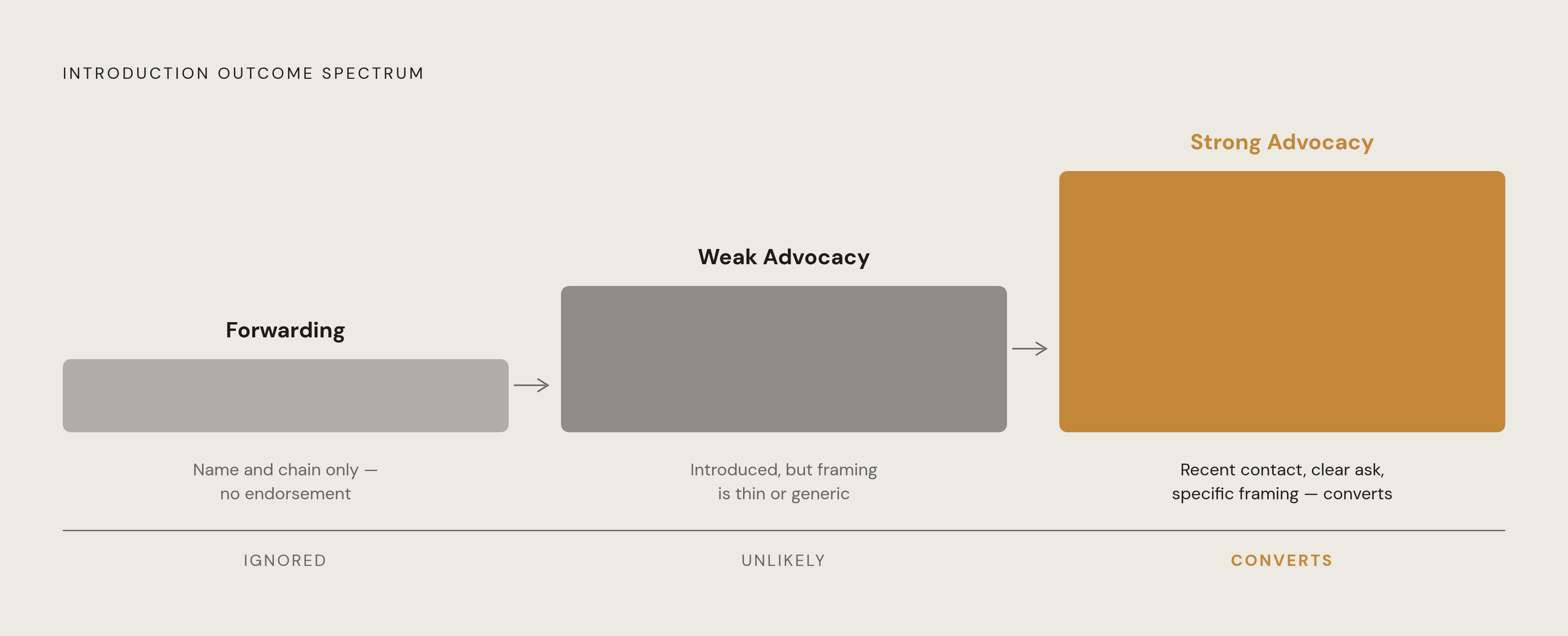
What separates these outcomes is whether each intermediary actively advocates or simply forwards. Forwarding is what happens when an ask travels too far from the intermediary's core relationship with the target; they pass it along without personal investment. Weak advocacy is what happens when the intermediary makes the introduction but lacks enough context to frame why it matters. Strong advocacy is what happens when the intermediary has recent, substantive contact with the target, understands the context of the ask, and frames the introduction with specificity. That version converts.
A path ranking that scores only connection strength misses whether each intermediary will actually advocate. Structurally identical paths produce radically different outcomes depending on that variable.
Why the Relationship Data That Would Reveal the Best Path Is Usually Invisible
The practical problem is that a firm's actual relationship graph is not visible to anyone but the person holding it. Industry research consistently finds that fewer than 5% of partners in law and advisory firms actively use CRM, and roughly 70% of top-client relationships exist only in individual inboxes. The same structural blindness appears in venture capital: spreadsheets track contacts, CRMs track deal stages, but the informal relationships that precede deals go unrecorded. Harvard Business School research finds that nearly 70% of VC deals originate from connections in the investor's network, which means network visibility is a deal-sourcing variable, not a productivity convenience.
The silo problem compounds this. When relationship data lives in individual inboxes, a colleague sitting three desks away may have a direct, active connection to the target and there is no way to know it. The best path may already exist inside the firm. When employees leave, institutional relationship memory leaves with them.
Even a professional who understands these four signals has no practical way to apply them without some systematic view of which connections are strong, recent, and credible across the team's full network. The framework is only as useful as the data it runs on, and for most firms that data is scattered across personal inboxes and aging spreadsheets.
How Relationship Intelligence Tools Reconstruct the Path-Quality Signals Firms Can't See Manually
The tools that address this problem share a common mechanism: passive inference from communication metadata rather than manual logging. Email frequency and recency infer relationship strength without reading content. Calendar interactions, specifically meeting frequency and the distinction between one-on-one and group settings, add signal about the depth of professional proximity. Work history overlap contributes latent trust signals even where recent communication is absent.
What this produces is a queryable relationship graph capable of answering the exact question path-quality ranking requires: who in our network has the strongest active relationship with this target?
The performance data is instructive. Per Affinity data, firms using relationship intelligence source and close deals 25% faster, and investors using these tools report a 25% increase in deal flow while saving more than 200 hours annually on contact data entry. MassMutual Ventures surfaced 67,000 contacts and 43,000 organizations within 60 days of implementation; managing partner Eric Emmons noted the platform helped his team discover and triage investment opportunities up to five times faster.
Rolo connects email, calendar, LinkedIn, and messaging apps into a single queryable relationship layer, surfacing warm paths ranked by relevance and recency, and drafting outreach in the user's voice. It does not act autonomously or expose private context, a design constraint that matters for reasons the next section addresses.
One caveat: the quality of path ranking depends entirely on the quality of the underlying signal capture. A graph built on stale or incomplete data reproduces the same blind spots as a manual CRM. Passive, continuous ingestion matters more than periodic data imports.
The Privacy Constraint That Shapes How Path-Quality Signals Can Be Shared Across a Team
The most valuable path-quality signals are also the most sensitive. Who talked to whom, how recently: sharing that carelessly destroys the trust that makes the network valuable in the first place.
This tension resolves through a permissioned architecture. A colleague can learn that their partner has a strong recent connection to a target without reading their emails. Surfacing the path is not the same as surfacing the private context behind it. Per DATAVERSITY's 2024 Trends in Data Management survey, 68% of organizations cite data silos as their top concern, up 7% from the prior year; per Salesforce's 2024 Connectivity Benchmark Report, 80% of IT leaders report that silos are hindering digital transformation. The answer to silos is not unrestricted data sharing. Permissioned visibility is the solution.
For investors, founders, and operators managing confidential deal contexts, the privacy architecture is not a feature. It is a precondition for adoption. A relationship intelligence tool that leaks private context will not be used, and a network whose participants don't trust the infrastructure eventually stops functioning as one.
There is also a practical judgment call here. AI should draft and recommend. It should not send autonomously. The professional must remain in control of every outreach decision, particularly in multi-hop contexts where a misjudged ask can damage the intermediary's relationship with the target in ways that take years to repair. That is not a hypothetical concern. It is the kind of thing you only need to experience once to take seriously.
How to Apply Path-Quality Ranking Before Sending an Introduction Request
The shortest path to a target is rarely the best one. Finding the best path requires mapping every viable route across the team's full network and then scoring each against the four signals: how active and substantive is each connection along the path, when did each pair last have meaningful contact, does each intermediary have standing in the target's specific domain, and is each additional hop adding trust-transfer value or diluting it.
A high-scoring path is only valuable if the intermediary will actively advocate. That means framing the ask with enough specificity that the intermediary can vouch in concrete terms. The difference between "can you introduce me to X?" and "here is exactly why this conversation would be useful to X, and here is a draft you can send in your own words" is the difference between a forward and an endorsement.
Giving the intermediary a well-framed draft reduces friction and raises the quality of the actual outreach. Specificity, brevity, and relevance to the target's context determine whether an intermediary feels good about sending the message. Nearly 49% of dealmakers now use AI tools nearly every day, per Sourcescrub survey data, which suggests the profession is moving toward more systematic workflow, if not yet systematic path judgment. The professionals building path-quality assessment into that workflow will extract more from networks they already have. The ones still routing by instinct are likely unaware of what they're missing.