CRM Adoption Failure Patterns in Investment Firms
Firms lose deal sourcing advantage when CRM systems rot from poor adoption and partner resistance.

CRM adoption in investment firms fails worse than the software industry average, and vendor choice barely explains why. Roughly 70% of CRM deployments across all industries miss their stated goals, but private equity and venture capital manage to make failure look even more embarrassing than that: senior partners won't log a single call, associates quietly build their own shadow spreadsheets in Google Sheets, and within a few months the expensive new system turns into a ghost town nobody opens before a meeting. I've watched this happen at firms with genuinely good software and firms with mediocre software, which is the first clue that the tool was never really the issue. This piece looks at why the pattern repeats no matter how polished the platform gets, and what a handful of firms actually did to break it.
What CRM adoption actually requires from the people who matter least to the workflow
Ask anyone who's run a rollout what killed it, and adoption comes up before integration bugs, before vendor mismatch, before nearly everything else on the list. Manual data entry is the obstacle users name most often, and at an investment firm that burden lands hardest on the people whose time costs the most and whose relationships are worth the most: the partners.
That's a backwards incentive if you sit with it for more than a second. The people generating the highest-value relationship data, the founder met at a dinner, the operator known since 2011, are the least likely to sit down afterward and type any of it into a form field. A partner sourcing a deal at a conference isn't carrying a laptop. He's got a drink in one hand and a phone in the other, and asking him to reconstruct that exchange the next morning is asking him to work against how relationship-driven work actually happens.
A meaningful share of CRM users switch vendors purely because the tool wasn't user-friendly enough. Firms read that as a software problem, so they re-platform, sign a new contract, run the whole rollout again. But the new tool still asks a human to feed the machine, memory first, form field second, so it rots the same way the old one did. Switching vendors doesn't change who has to do the typing.
There's a quieter, second-order problem sitting underneath that one. When associates pick up the logging slack instead of partners, they end up documenting relationships that were never theirs to begin with. An associate typing up her boss's contact with a target company's CFO produces a secondhand, incomplete record, one the partner didn't write and doesn't fully trust. Data nobody trusts doesn't get used. It just sits there, technically present and functionally invisible.
The five failure patterns that show up across virtually every investment firm CRM rollout
Look across enough failed rollouts and the same handful of patterns keep surfacing, more or less regardless of firm size or which vendor got picked.
The cold start problem comes first. A brand-new CRM is empty on day one, and empty systems offer nothing back, so nobody logs anything, which keeps the system empty. The value needs adoption to already exist; adoption needs the value to be felt first. It's a closed loop, and most firms never find the lever that pries it open.
Then there's the senior exemption. Nobody's going to make a managing partner log his calls, and within a few weeks an unspoken rule sets in: this tool is for associates and analysts, not for the people actually making decisions. Once that signal takes hold, the data that matters most, what senior people actually know, never makes it into the system at all.
Relationship data decay sets in even where adoption starts out decent. People change jobs, firms, phone numbers, and email addresses faster than anyone updates the records tracking them. A system that looked accurate at launch looks stale a year later, and when a partner leaves the firm entirely, his relationship history walks out the door with him. His sense of who trusts whom, his whole network map: gone, with no institutional record left behind. Manual systems have no answer for that kind of exit.
Compliance theater is its own loop. Leadership mandates logging, adoption spikes for a quarter, then quietly slides back down. The CRM becomes a box to check before quarterly review rather than something anyone opens before a meeting, and associates figure out exactly how much to enter to pass review. Not a field more.
And sometimes it's just the wrong category of tool. A lot of firms pick a CRM because it's the market leader, the safe brand name, not because it fits how deals actually move. Most CRMs enforce a straight pipeline: lead, qualified, proposal, close. Investment relationships don't run on that clock. A deal can take a year or two to develop, gated by trust and timing rather than any stage-gate process, and cramming that into a sales funnel model is like fitting a river into a pipe.
None of these five happen in isolation, either. A cold start pushes partners toward the exemption, which speeds up decay, which produces theater, and all of it plays out inside a tool that was never built for this kind of work to begin with.
What investment firms are actually losing while the CRM sits empty
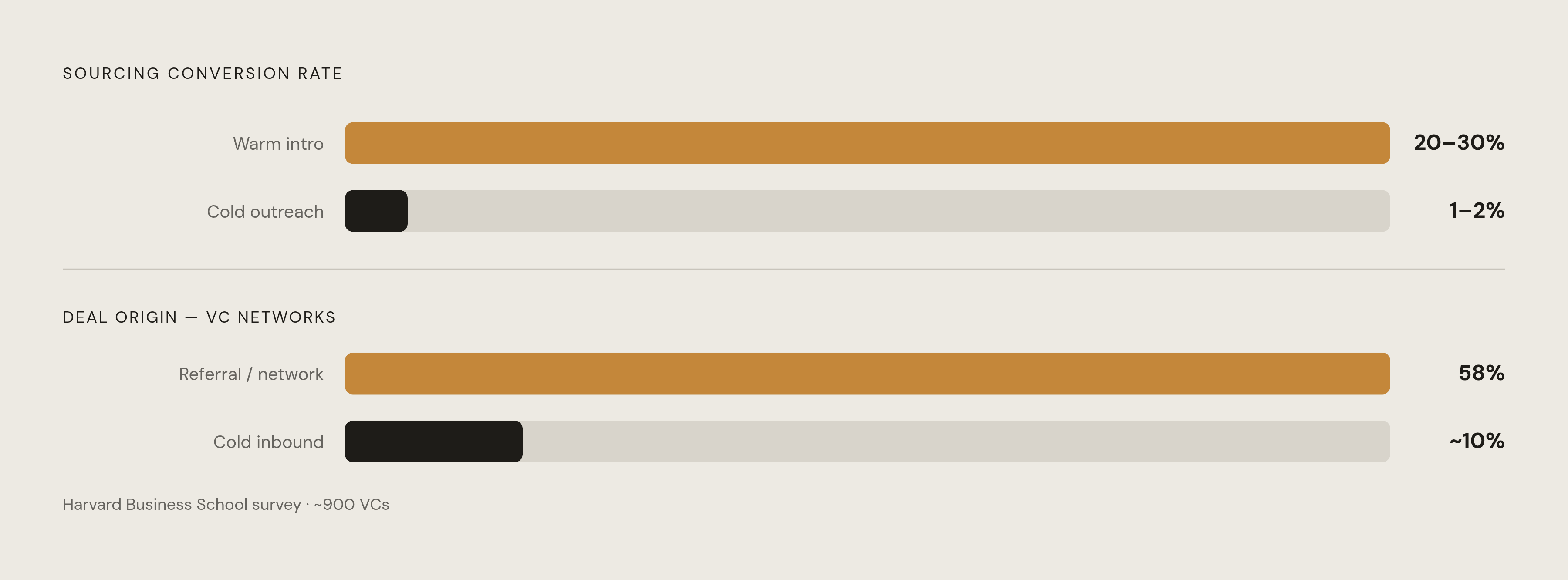
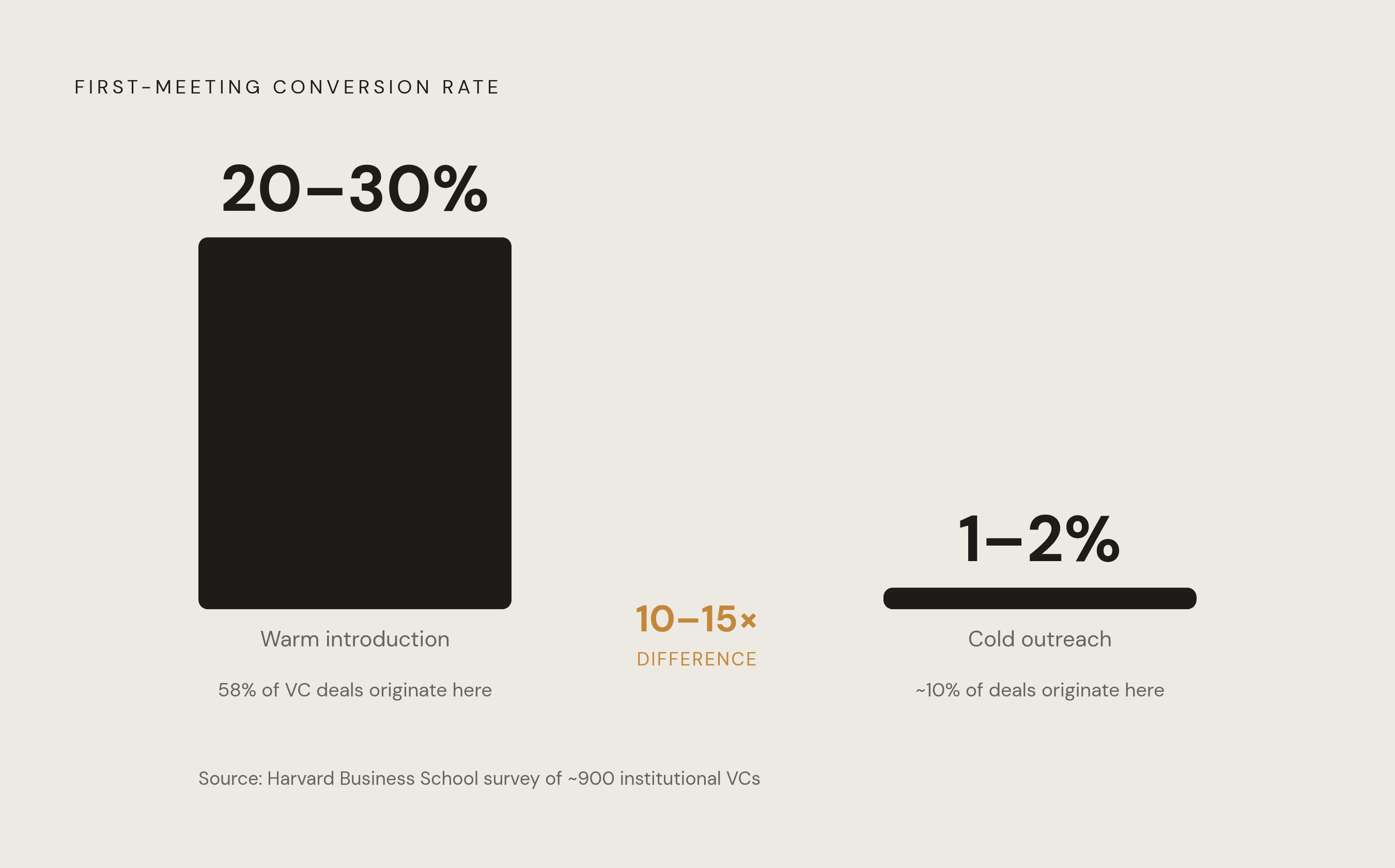
Here's what should worry a managing partner more than the software line item ever will. Warm introductions convert to a first meeting somewhere in the range of 20 to 30% of the time, while cold outreach converts at maybe 1 to 2%. That gap isn't small, and it changes what "sourcing" even means at a firm.
Why does the gap exist at all? A warm introduction carries borrowed credibility, so the recipient skips the filtering question, is this worth my time, and goes straight to evaluating the opportunity itself. Cold outreach never gets that pass. DocSend's research on pitch review behavior shows the average investor spends under three minutes on a first pass through a deck that arrives cold, competing against dozens of other cold emails hitting the same inbox that same week. A warm intro from a portfolio founder walks into a different room entirely, competing against the last couple meetings that person took, not the whole inbox.
That difference shows up in where deals actually come from. A majority of VC deals, something in the neighborhood of 58%, originate through professional networks, co-investor referrals, or portfolio introductions, while cold inbound accounts for closer to 10%, according to a Harvard Business School survey of nearly 900 institutional venture capitalists. Affinity's analysis of 291 PE firms puts a number on how wide the efficiency gap gets at ground level: the most efficient firms generate one warm introduction for every 11 emails sent, and the least efficient need 185 emails for that same single introduction. Same job, same basic tools, a 17x spread in execution. Sit with that for a second, because it means the gap between firms isn't really about effort.
And the trend line is going the wrong way. Across the firms in that study, over half saw introduction output drop by nearly half from 2024 to 2025, even as email volume climbed 20% over the same stretch. Firms are sending more outreach to compensate for weak relationship intelligence, which makes the underlying problem worse. More cold email just adds noise on top of a visibility problem it can't fix.
What's actually lost while the CRM sits half-used isn't reach. Most firms already hold warm paths into their priority targets somewhere inside partners' existing networks. The asset was there all along. Just invisible.
How network and relationship data silos compound the adoption failure
Even at firms with partial CRM use, relationship data doesn't live in one place. It's scattered across four or five systems at once: individual inboxes, personal LinkedIn connections, calendar histories, messaging threads, and, most fragile of all, whatever a partner happens to remember that week. No single person at the firm, not even the most senior one, holds a complete picture of who the firm collectively knows.
Take the junior analyst assigned to research a target company. Good chance she has no idea a managing director at her own firm once co-invested alongside the CFO of that target's biggest customer. The connection is real, it's usable, and it's completely invisible to the person doing the sourcing work, because it lives in someone else's inbox or someone else's memory.
This isn't unique to investment firms, but it bites harder here. DATAVERSITY's 2024 Trends in Data Management survey found 68% of organizations name data silos as their top data-related concern, up 7 points from the year before. For most companies that's a governance headache to fix eventually. For an investment firm, it's a sourcing problem with a direct line to deal flow.
The clearest case is the departing partner. Without a system that captures relationship context at the firm level instead of the individual level, every partner exit doubles as a small data-destruction event: interaction history gone, connection strength gone, years of network mapping gone with him. Smaller and mid-sized firms carry this risk disproportionately, since one founding partner's personal network is often the primary sourcing engine for the whole shop. That network stays invisible to junior staff on a normal Tuesday and becomes fully inaccessible the moment that partner is traveling, on leave, or gone for good.
Here's a finding worth sitting with, because it cuts against the obvious assumption: firms with larger combined networks sometimes underperform firms with smaller, better-mapped ones. Raw size matters less than whether the firm can actually see what it already has.
What the firms that broke the pattern actually did differently
The firms that got past this removed the manual entry step entirely. Rather than running a better training program or writing a stricter compliance memo, they took the burden away.
Munich Re Ventures reached 96% firm-wide adoption and saved more than 100 hours a year that used to go into manual data entry. Adoption climbed that high because the system pulled from channels the team was already using, instead of asking anyone to sit down and populate it by hand.
BDev hit 100% adoption across its investment team. Once relationship data surfaced on its own, the manual overhead that had existed to compensate for incomplete logging dropped away.
CAS Group cut 20 hours of training per new hire. When relationship history surfaces on its own instead of living in someone's head, a new associate inherits institutional context on day one instead of spending weeks piecing it together from old email threads and partners' fading memories.
What connects the three firms: each stopped treating the CRM as a logging tool people have to feed, and started treating relationship data as a byproduct of work that was already happening. Send an email, take a meeting, connect with someone on LinkedIn, and the firm's collective picture of who knows whom gets a little richer without the partner lifting a finger. That's the design principle separating tools that get used from the ones that quietly go empty.
What a relationship intelligence layer does that a traditional CRM cannot
A relationship intelligence layer sits underneath the tools where professional relationships already live, email, calendar, LinkedIn, messaging apps, and turns that scattered history into something the whole firm can query. That's a different job than a CRM does, and the distinction is worth being precise about rather than waved off as a rebrand.
The core difference is that it populates itself from behavior that's already happening, demanding nothing new from busy people. Adoption stops being a change-management project, because there's genuinely nothing for a partner to do differently than what he was already doing.
What it surfaces that a traditional CRM structurally cannot: warm paths into a target company through second- and third-degree connections the firm already has but nobody's mapped, connection strength scores that separate an active, trusted relationship from one that's technically still in someone's contacts but functionally dead, and recency signals showing which relationships are live right now versus gone cold over the past year. Add a network map spanning the whole firm, not just the slice one partner happens to remember on a given Tuesday, and the picture gets a lot more complete.
The sourcing math backs this up. Most founders already sit on more than 200 warm paths they don't even know they have, through investors, advisors, former colleagues, any of which could open a door if someone could actually see them. The intelligence layer surfaces relationships that already exist rather than asking anyone to build new ones from scratch.
Scale matters here too. A two-person business development team at Notable Capital manages more than 500 introductions a year using AI-assisted relationship workflows, a volume that would be close to impossible to sustain if every introduction required manual CRM upkeep just to identify and track.
One boundary needs stating plainly, though. AI in this setting should draft and recommend: who to contact, through which connection, with what context. A person still reviews and approves every outreach before it goes out, and in relationships where a firm's reputation and a partner's credibility are on the line, a human decision before every send is the whole point.
The trust and privacy constraints that any solution in this space has to meet
Partners who resist logging relationships into a CRM aren't being lazy about it. Their resistance is, in most cases, completely reasonable. Relationship context is sensitive, clients expect discretion, and a partner's network is often his single most valuable professional asset, built over a career, not something handed over to a shared database without a few hard questions first.
Any system built to give a firm visibility into its collective relationships has to sit with a real tension. How does it give the firm useful visibility without exposing the private substance of a relationship that belongs, in some sense, to the individual partner? The honest answer is that it should surface that a path exists, this person can reach that person, without necessarily exposing what was said, when, or why it mattered.
That makes permissioning an architectural question, not a feature bolted on after the fact. Which relationships are visible firm-wide, which stay personal to the partner, and who gets to draw that line: these decisions determine whether senior people trust the system enough to actually open it.
Enterprise relationship intelligence is, in that sense, as much a compliance and trust problem as it is a technology one. For any firm operating in a regulated market, the standard security certifications are table stakes, the baseline a system has to clear before the conversation about usefulness even starts.
So the real evaluation question isn't just what a system captures. It's what it refuses to surface, who can see what, and what happens to the firm's relationship data the day a partner walks out the door. Get that architecture right, and you end up with a relationship graph that compounds instead of decays: it survives partner turnover, gets more useful the longer it runs, and stays trustworthy enough that senior people actually check it before a meeting instead of trusting memory alone.