Relationship Capital Lost When Senior Professionals Leave a Firm
Firms lose years of hard-won client trust the moment senior professionals walk out the door.
The turnover cost formulas that circulate in HR literature and executive briefings are operationally sound, as far as they go. They capture recruiting fees, time-to-fill, onboarding expenditure, and the productivity deficit during a new hire's ramp period. Gallup has documented that replacement costs for senior leaders can reach multiples of annual salary when these factors are aggregated. That figure is already uncomfortable. It is also structurally incomplete.
None of the standard frameworks assign a dollar value to the warm paths a departing professional had cultivated, the co-investor relationships nurtured over a fund cycle, or the client trust earned through years of difficult conversations and hard-won outcomes. Relationship capital does not appear on a balance sheet, so it does not appear in the cost calculation. The accountants are not wrong; they are just measuring what they can see.
What makes this worse is the compounding effect. Replacement hiring takes months, and during that gap, warm relationships go cold faster than most firms expect the first time they experience it. The incoming hire may bring their own network, but they start at zero relationship equity in the role. Contacts who trusted the departing person may extend that trust to wherever that person lands next, not to the institution they left behind. In professional services, whether venture capital, private equity, management consulting, or law, the relationship often is the product. Losing it is closer to losing a revenue-generating capability than to losing institutional knowledge in any conventional sense.
Research on organizational knowledge loss has documented significant productivity costs tied to inefficient knowledge sharing in large firms. Relationship knowledge sits at the far end of that spectrum: no written form, no document repository, no version history. It is the least recoverable category of organizational knowledge, and most firms are not treating it that way.
How relationship capital becomes invisible inside a firm before anyone leaves
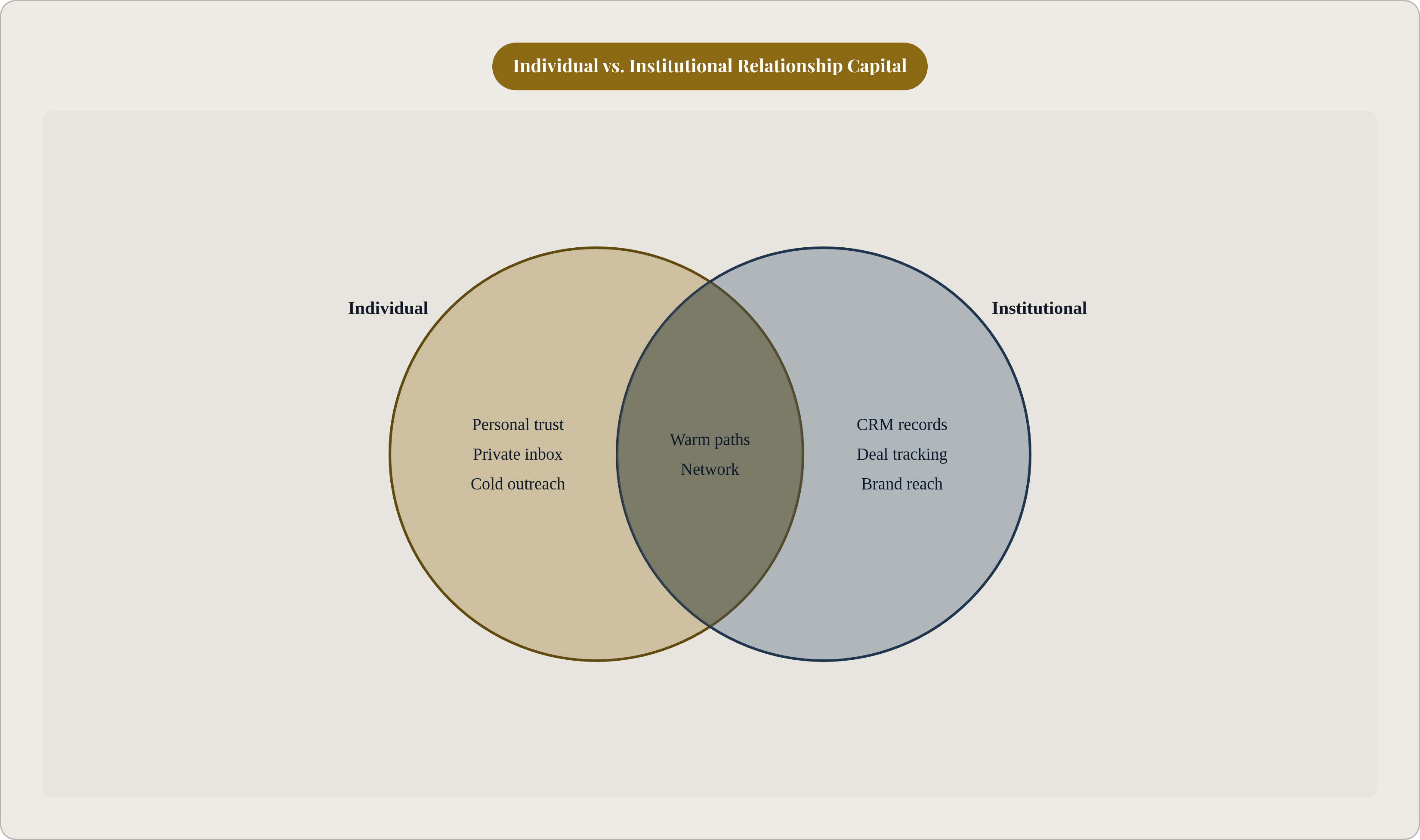
The visibility problem predates the departure by years. While a senior professional is still fully employed, their relationship capital is already stored somewhere the firm cannot access: the individual's inbox, calendar, phone, and memory. This is the default architecture of professional relationship management across nearly every industry, and it persists because it requires no deliberate maintenance.
Associates track deals in spreadsheets. Partners hold relationship context in their heads. No firm-level system can answer who carries the warmest path to a given target and why. The firm's collective network is almost certainly far larger than any one person can perceive, but it is stored in a way that makes it functionally private to each individual who built it.
Traditional CRM systems do not resolve this. They capture contacts, not relationship strength or recency, and they degrade almost immediately under deal pressure because manual data entry competes with every other claim on a professional's attention. A contact record with a name and an email address conveys nothing about who should make the outreach, on what basis, or with what framing.
MassMutual Ventures encountered this at institutional scale. Before deploying relationship intelligence tooling, years of email communications with tens of thousands of individuals across thousands of organizations existed inside the firm but were invisible as a collective asset. The relationships were real and extensive; the firm simply could not see them as a unified whole. Each relationship was navigable only to the individual who had built it. That is not a data problem in the conventional sense. It is an architecture problem.
The departure event does not create this invisibility. It simply removes the one person who could navigate through it.
What warm introductions are actually worth, and why that makes the loss concrete
A warm introduction is a trust transfer. The connector extends their reputation to bridge two parties, and that extension works precisely because the connector's credibility is genuine and personally earned. When the connector leaves the firm, the lending mechanism goes with them. A successor cannot replicate it, because trust of that quality is not delegable.
The conversion differential between warm introductions and cold outreach is large enough, in deal-intensive environments, that a single warm path can substitute for a substantial volume of cold attempts. This matters more as cold outreach deteriorates. Reply rates have declined year-on-year as AI-generated volume floods inboxes and email providers tighten sender requirements. The fallback option is structurally worsening, which raises the marginal value of every warm path a firm retains.
There is also a scalability constraint that makes each warm introduction more valuable than it appears in isolation. Even the most well-networked senior professional can generate only a handful of high-credibility introductions per month. This is a precision channel, not a volume channel.
Affinity's research on relationship-driven sourcing in private equity documents a meaningful efficiency gap between the most and least relationship-networked firms: those with stronger relationship capital require far fewer outreach attempts to generate a productive introduction than those without it. The most effective sourcing firms build relationships well in advance of any active transaction timeline. That long-cycle investment is precisely what is destroyed when the person who made it departs. The warm path is not just lost for the current deal; it is lost for every deal that contact might have touched over the next several years.
Why the departure moment is too late to start capturing relationship data
The standard organizational response to a senior departure includes offboarding checklists, transition meetings, and introductory emails to key contacts. These gestures are not worthless. They consistently fail, however, to recover the most valuable layer of what is being lost.
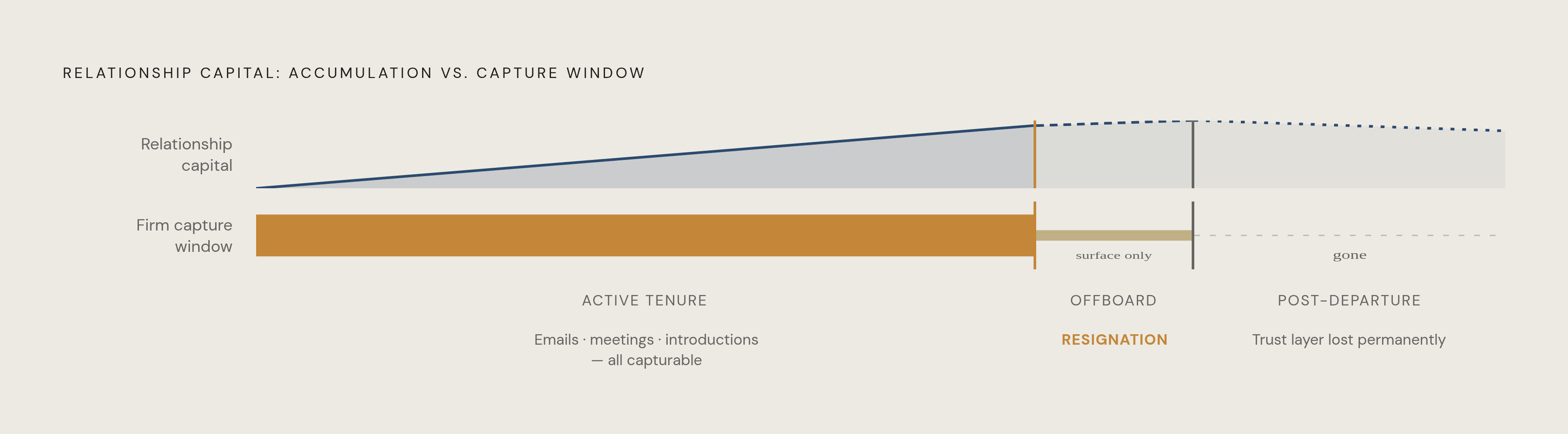
Relationship context cannot be extracted in a final week because it was built over years of interaction that left no firm-readable record. The departing professional has limited incentive and limited time to transfer context comprehensively. Even under ideal conditions, what gets transferred captures names and titles but not the trust layer: who defers to whom in a given conversation, what sensitivities remain from a prior process, what was said off the record that shaped the relationship's texture over time. None of that survives an offboarding memo.
There is a compounding data quality risk layered on top of this. Firms are increasingly deploying AI-driven tools on top of CRM data to inform sourcing and outreach decisions. If the underlying relationship data is thin, stale, or missing entire tenures of a senior professional's activity, the AI does not close the gap; it amplifies it, surfacing confident recommendations built on an incomplete foundation.
Jonathan Gross of Pemeco Consulting has framed this directly: effective relationship continuity requires tools that maintain existing relationships and identify successor paths when personnel changes occur. The infrastructure has to exist before the departure, not be assembled in response to it.
The window for capture is the full period of active employment. Relationship signals, emails exchanged, meetings held, introductions made, are generated continuously while a professional is active. That is when they can be captured. The window closes at resignation. Firms that treat relationship capital as the individual's personal asset will lose it at every departure. Firms that treat it as institutional infrastructure begin building retention capacity before any departure is anticipated, or anticipated correctly.
What a firm-level approach to relationship capital retention actually requires
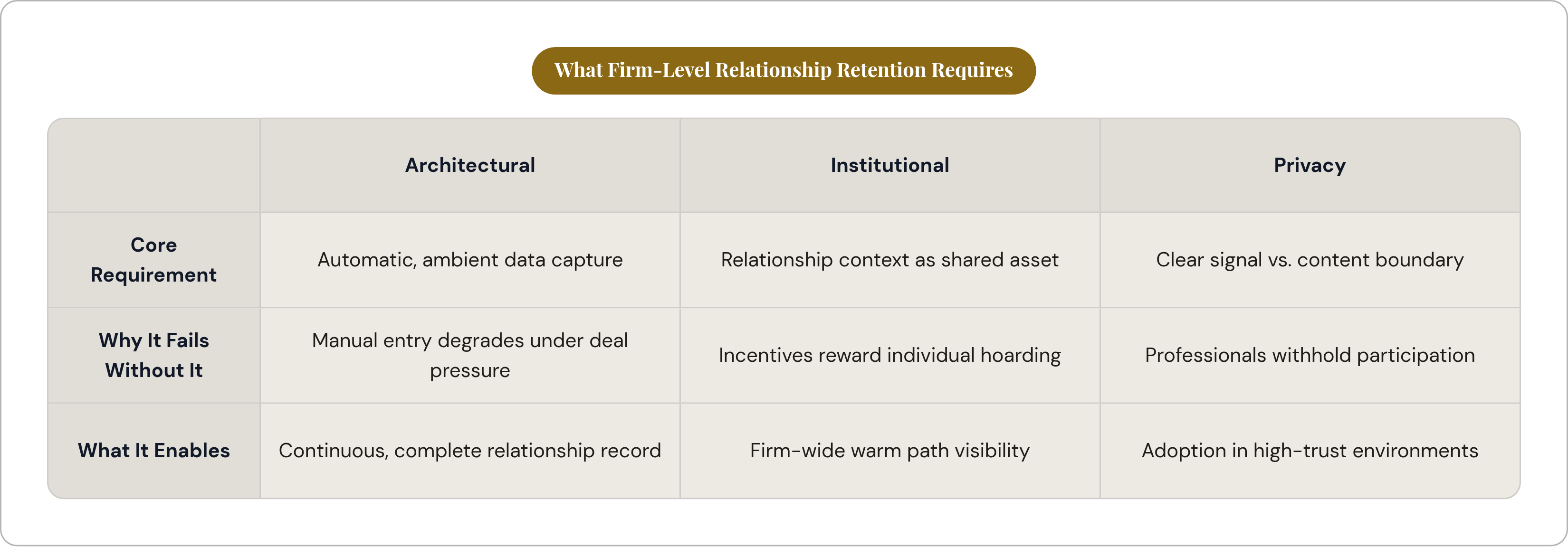
Most technology investments in this space stall not because the tools are inadequate but because the preconditions for adoption are wrong from the start.
The first precondition is architectural. Relationship data must be captured where it actually lives: in email threads, calendar meetings, and messaging exchanges. Waiting for professionals to log it manually into a separate system is a strategy for permanent data degradation. The capture has to be automatic and ambient, not volitional, because volitional systems fail under deal pressure every time.
The second is institutional. The firm must treat relationship context as a shared asset with explicit ownership, not as each professional's personal contact list that the firm benefits from only while that professional is present. This is a governance question as much as a technology question. Technology alone will not change behavior that incentive structures reward.
The third, and the one most firms underestimate, is privacy. Professionals will not participate in firm-level relationship systems if those systems expose private conversations or compromise the trust of their contacts. Any viable system must distinguish clearly between relationship signals, who knows whom, with what recency and interaction frequency, and private content, what was actually said in those exchanges. That distinction is the precondition for adoption in high-trust environments, not a design preference.
In practice, satisfying all three means a firm-wide relationship graph that surfaces warm paths across the entire team rather than only within each individual's visible connections; automatic interaction capture so the record does not depend on a professional's memory or discipline under deal pressure; successor identification that surfaces, when a senior professional departs, which colleagues carry the next-warmest relationships with the affected contacts; and outreach drafted in the individual's voice, held for human review and judgment before any contact is made.
Rolo, built by Alpha Watch, operates in this space. It connects email, calendar, LinkedIn, and messaging into a single queryable relationship memory layer, surfaces warm paths across a firm's collective network, and maintains a clear boundary between relationship signals and private content. In regulated industries, investment management, law, financial services, data governance requirements have to be satisfied from the outset, not retrofitted.
The cultural precondition cuts across all of this. Professionals who are compensated for hoarding relationships will continue to hoard them regardless of what infrastructure is deployed. The tools have to be paired with an institutional posture that treats relationship capital as a collective asset worth building and protecting, not a perk of individual tenure.
How firms that get this right source deals their competitors cannot see
The highest-returning transactions in private equity and venture capital are disproportionately sourced before they are visible to the broader market. Proprietary access is largely a function of relationship depth: who called whom first, and why the founder or seller took the call. That sourcing edge is not a function of brand alone; it is a function of a firm's ability to identify and traverse warm paths that competitors cannot.
The competitive context has sharpened. A record volume of undeployed capital is competing for a constrained supply of attractive transactions. Proprietary sourcing through relationship networks has moved from a competitive advantage to a practical necessity for mid-market and specialist funds. The firms that can reach a target before it runs a process, and reach it through a trusted intermediary rather than a cold inquiry, are playing a structurally different game from those still relying on inbound deal flow and cold outreach volume.
Most firms underestimate their reach because they can only see the first-degree connections each individual can name. A firm-level relationship graph reveals second- and third-degree paths through colleagues' networks that no individual professional could identify on their own. The firm's aggregate network is almost always substantially larger than the sum of what each professional perceives as their own.
Relationship continuity changes the compounding structure of that advantage. Relationships built over years by a departed professional remain navigable to the firm rather than being severed at resignation. Successor professionals can approach affected contacts with genuine context rather than a cold introduction. The firm's sourcing capacity becomes a function of its institutional network, not of which individuals happen to still be employed on a given day.
The firms that will compound this advantage over time are not necessarily those with the largest headcount or the most recognizable brand. They are the ones that have built the infrastructure to retain what their people build, so that no departure resets the clock.