Relationship Intelligence as a Layer on Top of Existing CRM
Relationship intelligence automates what your team already knows but can't find.
A CRM stores what happened: deal stages, contact fields, a timestamped log of activity. It says almost nothing about what those records mean, though; namely, who on a team has the strongest connection to a target, which path to that person is warm right now, and when to move on it. Relationship intelligence is the layer that sits on top of that archive and does the interpreting, reading signals already flowing through email, calendar, and messaging without asking anyone to log a thing. This piece walks through what that layer does, why the gap it fills is expensive to ignore, and where it earns its sharpest edge.
What the gap between logged data and actual relationship reality costs a firm
Most firms treat the CRM as if it were the relationship strategy itself. In practice, it functions more like a filing cabinet for whatever someone remembered to type in after the fact, while the actual relationships, the ones that determine whether a cold email gets ignored or a warm intro gets a reply within the hour, live somewhere else entirely: scattered across personal inboxes, individual calendars, and the memory of whoever happens to have worked that account the longest.
That distinction shows up constantly in practice. A warm path to a target account might exist inside the firm right now, sitting in a partner's inbox, invisible to three other people on the deal team about to cold-email the same company. A follow-up commitment gets made on a call, lives in one person's email thread, and never makes it into any system anyone else can query. A key relationship goes quiet for four months and nobody notices, because nothing was watching for the gap; the contact record just sat there, looking exactly as healthy on paper as it did when the relationship was thriving.
Gartner estimates that 70 to 80% of enterprise knowledge has never been written down in any retrievable form. Relationship context is arguably the most extreme version of that problem, since it's inherently interpersonal: nobody writes a memo documenting how well they know someone. They just know it, and that knowledge sits in one head until it gets acted on or forgotten. When that person leaves the firm, the network leaves with them. The CRM record stays put, contact still populated, deal history still intact, but the warmth behind it is gone, and nothing in the record itself tells you that.
Brian Smiga of Alpha Partners put it plainly: "the curated data that comes out of the brains of our peers is really really valuable, and we need to figure out how to capture that back into our CRM so the whole team can utilize it." He's right about the value. What he's describing, without quite naming it, is the exact mechanism relationship intelligence is built to provide: turning private, undocumented knowledge in someone's head into something the rest of the team can query.
Why the warm path outperforms cold outreach by a margin that makes the comparison almost unfair
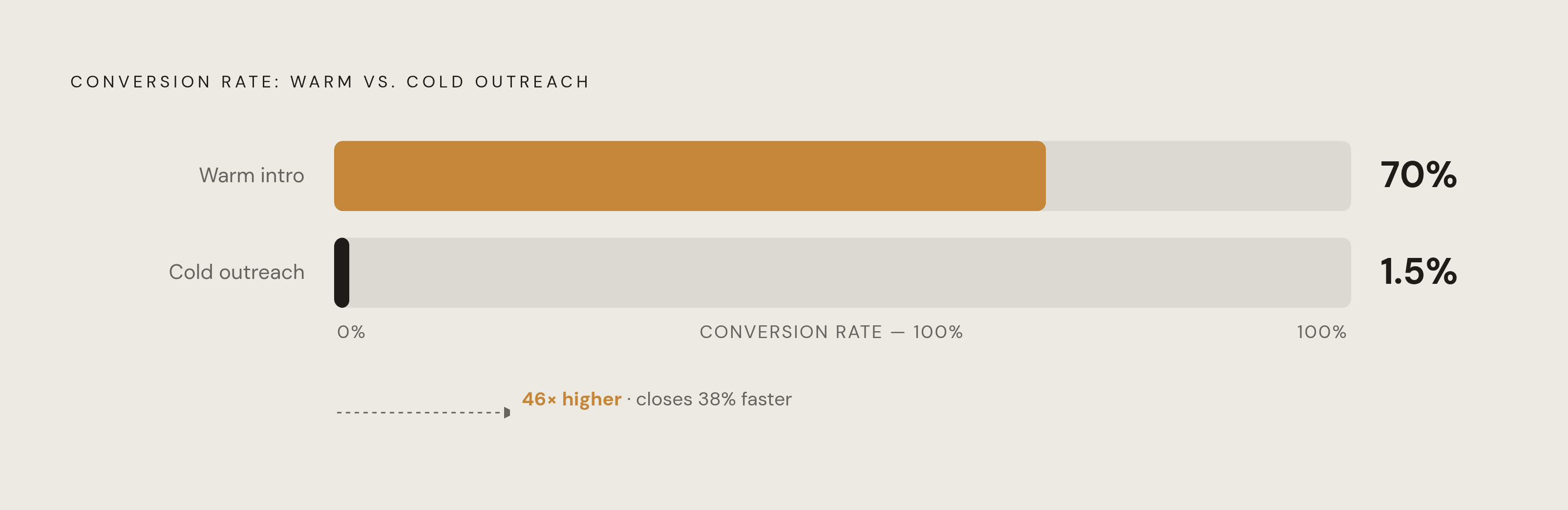
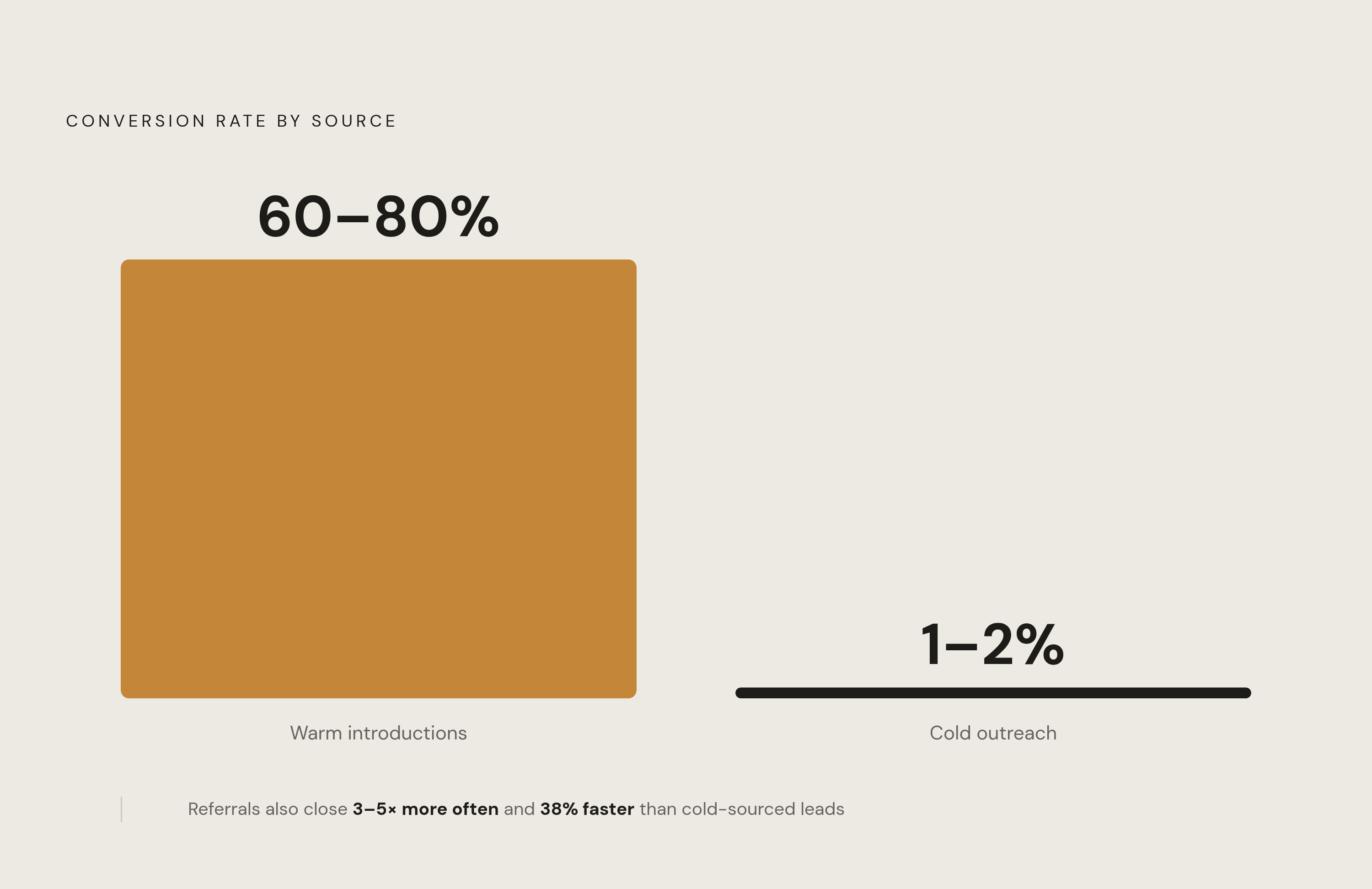
Warm introductions convert at somewhere around 60 to 80%. Cold outreach sits at roughly 1 to 2%. That's a structural difference in how trust gets established before the first real conversation even starts, and treating the two channels as interchangeable parts of the same funnel is where most go-to-market strategy goes wrong.
Warm referrals close 3 to 5 times more often than cold-sourced leads, and deals that start with a warm introduction close 38% faster than deals that don't. Harvard Business Review research found that 84% of B2B buyers begin their purchasing process with a referral, a figure that suggests the warm path functions as the default starting point for how most enterprise deals actually begin, with cold outreach as more of an exception than a core strategy.
The reason the warm path works this well comes down to trust: when a known third party makes the introduction, the trust-building work that normally eats up the first several conversations has already happened before anyone picks up the phone. The buyer arrives with a prior belief that this is worth their time, handed to them by someone they already trust. Wharton research found referred customers retain at a rate 37% higher than customers acquired cold, so the advantage doesn't stop at the close. It follows the customer through the entire relationship.
Bigger networks aren't the fix firms actually need here. Most firms, especially ones with more than a handful of people, already have some warm path to most of their target accounts sitting inside the collective connections of their team. The constraint has rarely been reach; it's visibility into that reach at the exact moment someone needs to act on it, and that's the specific gap relationship intelligence exists to close.
How relationship intelligence actually works as a layer on top of existing infrastructure
Relationship intelligence tools connect to the places professional relationships already live: email, calendar, LinkedIn, messaging platforms. They read the signals already flowing through those channels, passively, without a single manual entry from anyone on the team. That passive capture is the foundation everything else builds on, and it's also the detail that separates this category from another CRM field asking to be filled in.
From there, three things happen. Signal capture comes first: communication frequency, how recently two people last spoke, meeting cadence, response speed, the shape of the network across every touchpoint the firm has. Then AI-driven scoring turns those signals into relationship strength scores over time, enriched with verified contact and firmographic data, so the system has a working answer to who knows whom and how well. Then come the actionable outputs, and this is the part that actually changes behavior: warm introduction paths to a specific target, alerts when an important relationship is going quiet, draft outreach written in the sender's own voice and ready for review.
The CRM stays exactly where it is, doing exactly what it's always done: storing deal stages, contact fields, activity history. Relationship intelligence reads that data alongside live communication signals and produces reasoning the CRM was never built to generate on its own, functioning less as a new database and more as a queryable memory layer sitting on top of the ones already in place. Instead of a rep combing through contact records trying to remember who on the team might know someone at a target account, the firm's combined network becomes searchable by strength, by recency, by the actual path to whoever the target is.
The firm-wide piece is where this gets genuinely useful rather than just interesting. Relationship signals aggregate across the whole team, so a warm path sitting in one colleague's inbox becomes visible to whoever else needs it, without that second person ever seeing the actual content of the correspondence that revealed it. Critically, the system recommends and drafts; a person reviews every output and decides whether to act on it, since sending is never automated. That's not a minor caveat bolted on for compliance reasons. An unsanctioned outreach sent by an autonomous system can burn a relationship that took years to build, and no efficiency gain is worth that risk.
Where relationship intelligence has the sharpest edges: investors, founders, and BD operators
Deal sourcing in venture capital and private equity is a relationship problem before it's anything else. The question a partner asks is never whether the firm knows someone at a target company; it's who on the team has the strongest connection and how fast that connection can be activated. Rolo is built around exactly that query, surfacing warm introduction paths across a firm's collective network on demand. Affinity, one of the more established platforms in this category, added 71 new PE firms in the six months through June 2026, bringing its total past 330 PE firms globally. That's a category moving toward standard infrastructure across private capital, well past the early-adopter curve.
LP relationships extend this further. Limited partners aren't just sources of capital; they're relationship assets in their own right, and relationship intelligence can map LP connections to potential portfolio company customers, co-investors, and strategic introductions that would otherwise require someone to remember, unprompted, that an LP happens to know the right person. Firms like Social Capital and SignalFire built reputations on data-driven sourcing approaches. What RI tooling does is make that same rigor systematic across a whole team, instead of dependent on the memory of whichever partner happens to be in the room that day.
Founders face the same problem from the other side of the table. Starting the relationship with an investor six to twelve months before actually needing capital gives that investor time to watch a founder operate under normal conditions, before anyone's being asked to commit money. In 2024, 42% of closed venture funds ranged from $1 million to $10 million, which tells you how sprawling and fragmented the investor landscape actually is for someone raising a round. Warm paths to the right check-writers often decide whether a founder gets a meeting at all, and those paths are rarely obvious from the outside. A founder's co-founder, advisors, angels, and early employees collectively know a far wider set of investors than any single person on that list realizes; the challenge tends to be surfacing that combined network on demand rather than growing it further.
BD and enterprise operators hit the same wall from a slightly different angle. The right introduction to an OEM partner or an enterprise buyer usually already exists somewhere inside the firm. What's missing is a way to find it that doesn't involve a firm-wide email asking if anyone happens to know someone at a given company, and hoping someone remembers before the deal window closes. 4Degrees, built specifically for VC and PE workflows, maps and scores relationship strength directly from email and calendar data, which is a useful contrast to generic CRM enrichment features bolted on after the fact by vendors chasing the same buyer.
Rolo sits in this same territory, built for exactly these high-stakes, high-trust situations: the investor trying to source a deal, the founder who needs a warm path to a specific fund, the BD operator who knows an introduction exists somewhere but can't see where. It works as a firm-wide relationship graph without asking anyone to rip out and replace the CRM they already depend on.
The privacy architecture that makes firm-wide relationship data trustworthy rather than intrusive
Here's the tension sitting at the center of all of this: relationship intelligence gets more useful the more it aggregates signal across an entire firm, but the raw material it reads (email threads, calendar invites, private correspondence) is some of the most sensitive data any employee generates in a normal week. Solve for usefulness without also solving for trust, and the result is a tool nobody wants installed on their inbox, however good the underlying scoring is.
As agentic AI systems blur the line between what's personal and what's professional inside enterprise environments, the foundational question stops being about capability and becomes about control: who decides what the system can see, and who it's allowed to share that with. The answer that makes firm-wide relationship intelligence workable is a permissioned architecture, where individual relationship context stays private by default, while institutional signals, meaning who knows whom, how strong that connection is, how the network is shaped, become collectively useful without exposing the content behind any of it.
In practice that looks like this: a colleague can see that another person on the team has a strong connection to a given target company. That colleague cannot see the emails or calendar notes that produced that score. The system surfaces the existence and strength of the warm path; it does not surface the private conversation that revealed it. Every piece of outreach the system drafts gets reviewed and approved by a human before it goes anywhere, with no autonomous sending and no contact made without someone's explicit say.
Affinity's MCP, or Model Context Protocol, server is one working example: a permissioned layer that lets AI tools reason over firm-level relationship context while controlling precisely what's exposed and to whom. Security certifications alone don't differentiate much anymore; most enterprise buyers treat them as table stakes rather than a selling point. What actually separates one system from another is whether the permission model protects individual trust while still enabling collective visibility, and that's a design decision baked into the architecture, not a policy document sitting in a folder somewhere unread.
Regulated industries raise the stakes further rather than lower them. Law firms, the Big Four, investment banks: relationship data governance in these environments is a compliance requirement with real teeth, not a nice-to-have. Introhive's traction specifically in those verticals says something about where the category is heading: purpose-built relationship intelligence with auditable permissions has become table stakes rather than a differentiator. Rolo follows the same logic. Private context stays private, permissioned signals become firm-wide intelligence, and the architecture itself is the trust model rather than something bolted on beside it.
What adding a reasoning layer to existing CRM infrastructure actually looks like in practice
Most firms already have what they need to start. Existing CRM data, years of email history, calendars full of meetings nobody ever went back and analyzed: the raw material for relationship intelligence is almost certainly sitting there already, unused, simply because nobody has interpreted it yet.
What changes once that interpretation layer gets added is fairly concrete. Reps stop manually logging every interaction after the fact and start reviewing signals the system already surfaced on its own. Before any outreach goes out, the first question shifts from "what's this person's email address" to "who on the team already has the warmest path to them." Engagement gaps get flagged while there's still time to act, instead of showing up later as a postmortem explanation for why a deal went cold.
The CRM doesn't go anywhere in this picture. It stays the system of record for deal stages, contact fields, and history, exactly as it was before. Relationship intelligence reads from that record and writes interpreted signal back into it, which makes the CRM's existing data more useful alongside it. The AI-in-CRM market was valued at $8.09 billion in 2024 and is projected to reach $11.04 billion in 2025, a 36.5% compound annual growth rate. That's infrastructure investment accelerating in real time, not a trend firms can afford to watch from the sidelines for another budget cycle.
The tooling splits by use case fairly cleanly, and the split matters more than any single feature comparison. Affinity leans toward VC, PE, and investment banking, building its relationship graph from email and calendar data with particular strength in private capital workflows. Introhive targets professional services firms like law and the Big Four, built around permissioned relationship data with compliance-grade architecture suited to regulated environments. Common Room focuses on community and go-to-market teams, drawing relationship signal from public and community interaction data rather than private inboxes. Rolo is built for investors, founders, and operators who need a firm-wide relationship graph without ripping out the CRM they already run on: it passively captures signal across email, calendar, LinkedIn, and messaging, surfaces warm paths, drafts outreach in the user's own voice, and keeps the whole thing governed by a permissioned architecture that keeps private context private.
The question worth asking about any of these tools isn't how much data they can ingest. It's whether the system makes a firm's existing network visible enough to act on, or whether it becomes one more layer of data somebody has to manage on top of the CRM they already half-ignore. Firms sourcing the best deals, closing the most referrals, and holding onto the strongest networks over the next few years will likely be defined less by the size of their contact databases and more by how clearly they can see their own network in time to activate it, rather than a month after the moment has passed.