Automatic CRM Updates from Email and Calendar Activity
Captures relationship data from email and calendar to eliminate manual CRM entry work.
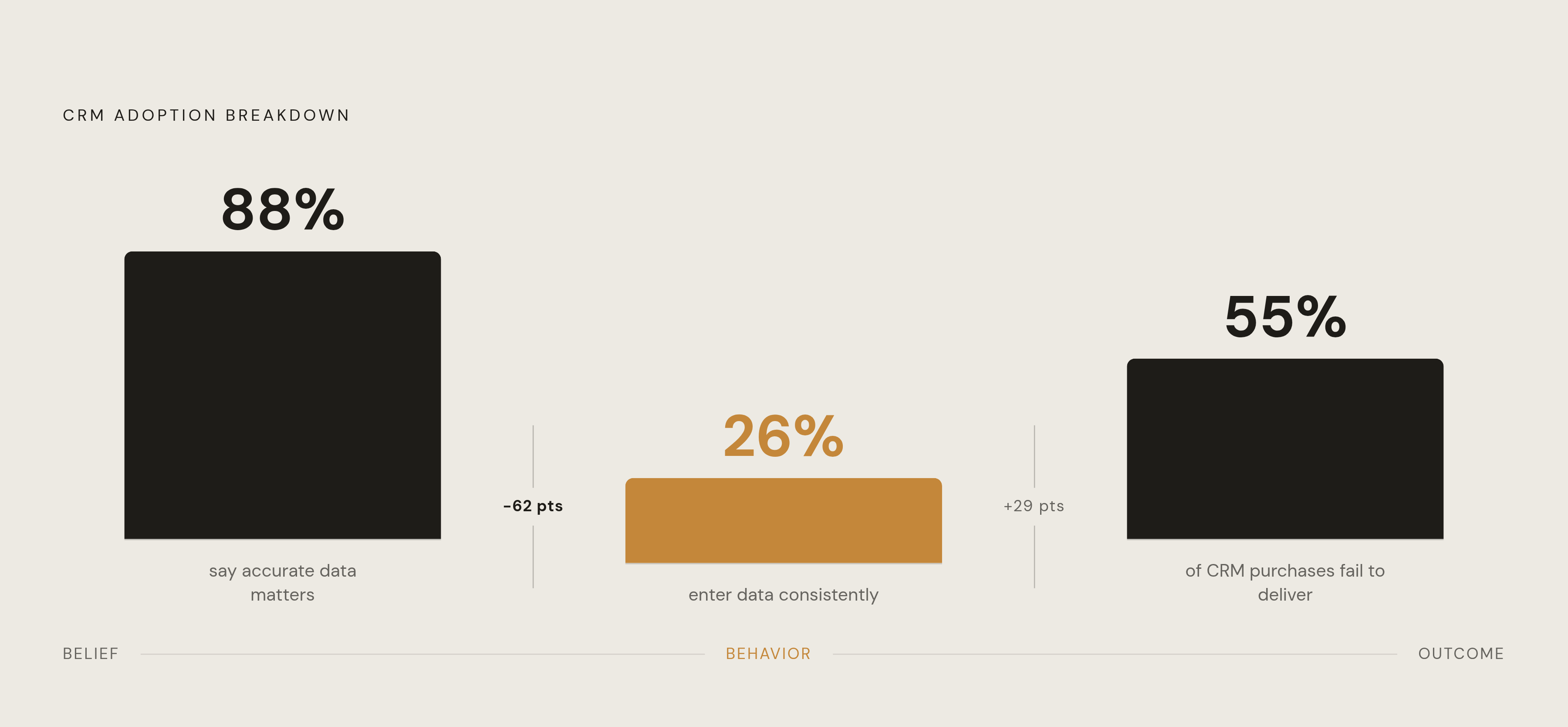
CRM systems fail because they ask busy people to type up things that already happened, and busy people, predictably, don't do it. Industry estimates put the failure rate somewhere between 30% and 70%, and a 2025 figure from Johnny Grow lands around 55% when "failure" means the system never delivered the business goal it was bought for. More than half of every CRM purchase is quietly not doing its job. That's the starting point for everything that follows, and honestly, it's the number that got me interested in this problem in the first place.
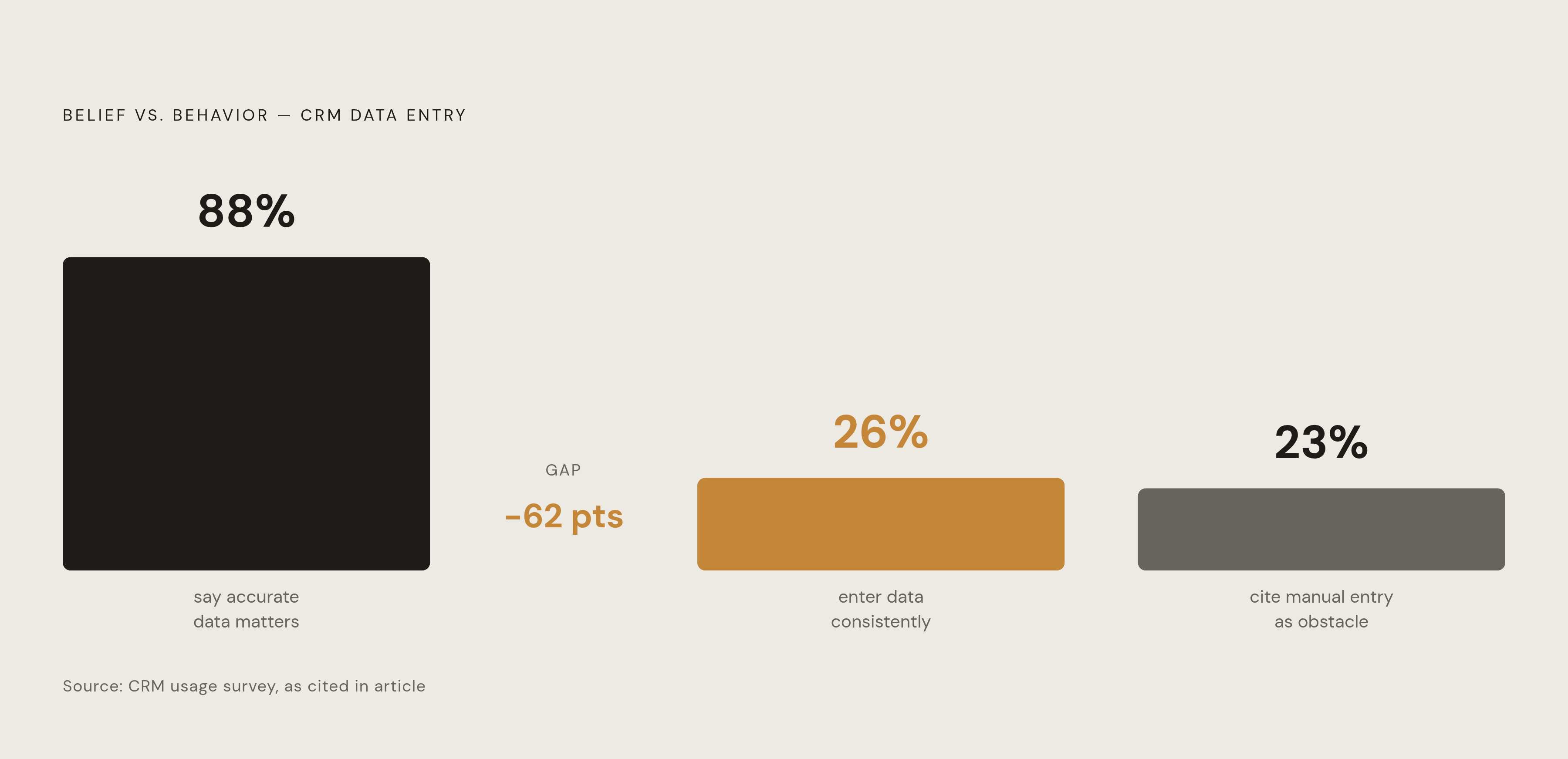
What does that failure look like from inside a firm? A deal is live, but the last logged touchpoint sits three months back; a colleague turns out to have had the real relationship with a prospect, and nobody else at the firm knew it until the deal was already in trouble; and a contact switches jobs and the record never catches up. Average CRM adoption sits around 26% across sectors, meaning roughly three out of four users aren't entering data consistently, even though 88% of sales professionals say accurate customer data matters to them and 23% name manual entry as a major obstacle. People say the data matters. Then they don't enter it. That gap is the whole story: a CRM asks professionals to do clerical work now for a payoff they may never personally see, and most people decline that trade most of the time.
This piece follows that failure through to its fix, roughly in the order it plays out in a real firm: the cost manual entry imposes on the people doing it, why email and calendar activity already hold what the CRM needs, how AI turns that activity into structured records, what becomes visible once a record stays current, what silent inboxes cost firms that never notice the leak, and what's worth checking when a vendor claims their tool updates itself.
The behavioral tax that manual entry places on every professional who touches a CRM
Call it what it is: a tax. Every meeting, every email, every call generates data a CRM needs, but capturing it takes a separate act. Stop what you're doing, open the record, type up something that already happened, for a reward that shows up later, if it shows up at all.
The tax compounds the way these things usually do. Skip one entry and it feels harmless, because in isolation it is. But skipping becomes habit, the record degrades, and once a professional stops trusting what's in the system, they stop checking it. Once they stop checking it, they have even less reason to keep it current. Forrester's 2025 data shows 47% of organizations naming data quality their top CRM challenge and 44% pointing to reliance on manual processes. Two numbers, one loop, caught at different points in its cycle.
Who pays this tax hardest? Investors tracking dozens of portfolio companies and live deals at once pay it, as do founders bouncing between fundraising calls and product meetings in the same afternoon, and BD operators running multi-stakeholder relationships across deal cycles that stretch for months. The higher the stakes of a relationship, the busier that professional tends to be, and the less likely they are to stop and log it properly. So the most important records in the system end up, structurally, the least likely to be current. Nobody decides to neglect the important accounts. It just falls out of the math of a busy week, quietly enough that nobody notices until the deal is already cold.
Top-performing sales organizations are 81% more likely to use their CRM consistently than average ones. Worth asking why. Consistent use tends to follow from visible payoff rather than willpower; when logging activity clearly leads somewhere, people keep doing it, and when it doesn't, no amount of management pressure closes the gap for long. The entry problem has the shape of a visibility problem, dressed up as a compliance one.
What email and calendar activity already contain, and why it is sufficient to keep a CRM current
Professionals generate a complete record of their work, just in the wrong place. Every fact a CRM wants already exists somewhere in an inbox or a calendar. The gap has always been visibility, not data generation.
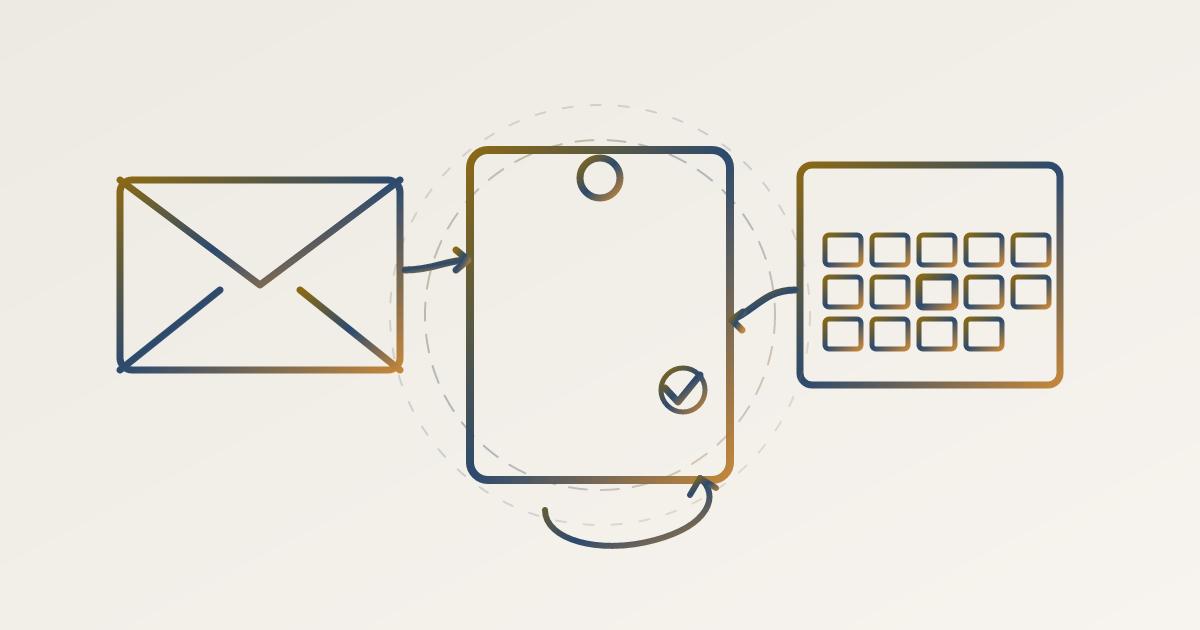
Take one email exchange. The signature block carries contact identity, including name, title, company, and sometimes a direct line; the timestamp tells you recency, when the last real exchange happened; the body carries deal-stage signal, what was asked for, what got promised, what's still open; and the CC line carries the network layer, who else is looped in, who introduced whom to whom.
A calendar event carries its own version of the same picture. Who showed up, which organizations they represent, whether it's a first meeting or a recurring slot, which works as a rough proxy for how deep the relationship runs. Scheduling patterns matter too: who chased whom for the meeting, how long the gap ran between the ask and the confirmation. None of that is decorative. It's signal, sitting there unread in a folder nobody opens twice.
Put it together and a full inbox plus a full calendar is already a timestamped, participant-tagged log of every relationship that matters to a professional's work. The CRM just can't see any of it. Relationship intelligence tools built around this kind of capture are reported to save dealmakers over 200 hours a year, and that number makes more sense once you notice those aren't new hours at all. They're hours previously spent re-typing something that had already happened, in an email, a week earlier, from memory, badly.
How AI reads email and calendar signals and turns them into structured CRM updates
How does a system get from a wall of email text to a clean CRM update? Three layers do the work, and they're worth naming instead of waving off as "AI."
Natural language processing reads the unstructured content of a message the way a person would, as ordinary language rather than data fields; named entity recognition then pulls structured facts out of that language, including names, company names, dates, phone numbers, and deal terms, the sort of thing you'd otherwise copy and paste by hand; and classification models sit on top and read intent, sorting a demo request from a follow-up nudge from a pricing negotiation from a plain check-in with no deal content at all. Each layer does a distinct job, and the system only becomes useful once all three work together, not in isolation.
What a well-built version does with those signals matters more than which models sit underneath it. It links the email or meeting to the right contact and company record, and creates one if none exists; it can update a deal stage or relationship status based on what someone actually said, going beyond the mere fact that contact happened at all; and when confidence in an inference is low, it flags the update for a human instead of writing it straight into the record.
That confidence check is where the real capability line sits. Summarizing an email into a CRM note is table stakes now; most tools manage some version of it. Writing to the record, actually shifting a deal stage because of what someone implied in a message, is the harder move, and the one worth paying for. Salesforce's Einstein Activity Capture offers one version of this: linking email and calendar activity to contact and lead records automatically. Native connectors from HubSpot and Salesforce tend to scope narrowly, often scanning just the first message in a thread, avoiding overwrites, requiring per-user setup that leaves a gap the moment one teammate skips configuration. Purpose-built relationship intelligence tools tend to go further, covering full threads, calendar events, and call activity, with uncertain updates routed for review instead of written quietly into a shared record.
That review step is structurally necessary. A system that auto-writes wrong information at scale can corrupt a CRM faster than years of manual neglect ever could, because neglect at least leaves a visible gap. A wrong entry looks exactly like a right one until somebody acts on it and finds out the hard way. I'd rather have a gap I know about than a lie I don't.
What a continuously updated CRM makes visible that a stale one cannot
Once the record actually stays current, what changes? Recency becomes visible for the first time. The system shows who's gone cold, who's mid-conversation, who just went quiet, without anyone reconstructing it from memory or digging through six months of old threads.
The most valuable question in dealmaking might be "does anyone at our firm already know this person?" Without current data, answering that means walking the floor and hoping someone remembers. With current data, the system just surfaces it. That matters because warm introductions routed through a mutual board member, investor, or advisor are reported to convert somewhere between 60% and 80%, a wide gap over cold outreach. But that only works if the firm can actually see which relationships in its own network are strong enough to carry the introduction in the first place.
Relationship strength becomes a usable input instead of a gut feeling. A quantifiable relationship score showing who at the firm has the strongest relationship with a given decision-maker is reported to help close deals up to 25% faster. That score is only as good as the data feeding it, though, and it's only calculable at all when the underlying communication history is current rather than three months stale.
There's a risk-visibility angle too. A relationship gone silent for 90 days is worth acting on, but without automated tracking that silence stays invisible until the deal it was quietly supporting falls apart on its own. And there's an institutional memory argument that outlasts any one person's tenure: when a colleague leaves the firm, the relationship history they built, every introduction made, every conversation held, stays in the record instead of walking out the door in their head.
How relationship data trapped in individual inboxes costs firms more than they account for
This is a visibility problem at the organizational level. Every professional's inbox is a relationship record the firm technically owns but functionally cannot read, because it lives inside one person's mail client and nowhere else.
IDC research estimates companies lose 20% to 30% of revenue annually to inefficiencies tied to data silos. For a mid-sized firm doing $10 million a year, that's $2 to $3 million left on the table, because nobody besides one inbox owner could ever see the relationships behind it. Sit with that figure for a second. It's not a rounding error.
That builds what you might call the human-translator problem. When systems don't talk to each other, the one person who happens to know a given relationship becomes a single point of failure for it: they get pulled into every conversation that touches it, they get overloaded, and eventually they burn out or leave, taking the history with them on the way out. Automation saves time here, sure, but the bigger win is removing a dependency that was never sustainable in the first place, by making the record systematic instead of personal.
The investor world makes this sharpest. Half of dealmakers named new deal sourcing their top priority in 2025, up from 30% the year before, and 68% expect deal volume to keep rising, meaning more targets and less time per opportunity to figure out who already knows whom. In that environment, the firm that can see its full collective relationship graph finds the warm path to a target faster than the firm where every partner still works out of a private inbox. Speed, in sourcing, often just means someone finally seeing what was already there.
None of this works if it comes at the cost of privacy, though. Making relationship data useful across a firm cannot mean exposing the private content of someone's conversations to their colleagues, and any vendor who glosses over that tradeoff hasn't thought hard enough about it. Permissioned architecture, where signals like recency and strength get shared but the actual message content stays private, is the design requirement that makes firm-wide intelligence safe to build at all.
What to look for when evaluating tools that promise automatic CRM updates
When a vendor says their tool updates your CRM automatically, check scope first. Does it read from the CRM and summarize, or does it actually write to it? Reading and summarizing is common now, and not particularly hard to build. Writing updated records based on inferred signals, the thing that actually removes the behavioral tax, is a different and much harder capability. Ask directly which one you're being sold, because the marketing language rarely draws that line for you.
Coverage gaps are where a lot of tools quietly fall apart. Does it process a full email thread or only the first message? Does it capture calendar events at all, or just emails? Does it work across the whole team by default, or only for the people who individually bothered to configure it? That last gap matters more than it sounds, because per-user setup recreates the exact problem manual entry had in the first place: one person forgets to turn it on, and the hole in the record reappears right where it always was.
Confidence handling separates tools worth trusting from tools that just relocate the problem somewhere less visible. A tool that writes every inference straight into the CRM trades one failure mode, missing data, for another, wrong data, and wrong data is arguably worse because it sits there looking legitimate. Look for systems built to route low-confidence updates to a human before anything lands in the record.
That matters even more in high-trust environments, where one bad update can misrepresent a relationship that took years to build. Gartner predicts 40% of enterprise applications will include task-specific AI agents by the end of 2026, and the better-designed ones still keep a person in the loop before anything consequential gets sent or written. Privacy architecture needs the same scrutiny: who can see whose relationship history, at what level of detail, and is personal conversation content kept separate even when signals like recency or strength get shared across a team? For regulated industries and firms built on trust, that's a compliance question before it's ever a technology one.
Was the tool built for this job specifically, or bolted onto something else? Native features inside HubSpot and Salesforce handle the narrow, general case well enough for teams with light needs. Purpose-built relationship intelligence tools, including Affinity for private capital and 4Degrees for investors and professional services, treat relationship data as the primary asset feeding a pipeline rather than a secondary input tacked onto a broader platform. Rolo takes a similar approach, connecting email, calendar, LinkedIn, and messaging into one relationship graph and surfacing warm paths without sending anything on its own or exposing private context to people who shouldn't see it. In a market where trust is the actual product being sold, that kind of restraint tends to matter more than any single feature on a spec sheet.