Portfolio Company Network Leverage for Follow-On Sourcing
Portfolio companies are a dormant sourcing engine most VCs haven't learned to systematize.
Venture capital has been a relationship business for a long time. That phrase gets repeated until it loses its texture, but what it actually describes is this: the firms generating the best deal flow are not necessarily the ones with the sharpest analysts or the most aggressive market maps. They are the ones who spent years building networks dense enough that a founder's first call, when they are finally ready to raise, goes to someone inside that network. The sourcing advantage is, at its core, a proximity advantage.
Most investment teams grasp this intuitively. What they understand less clearly is that they are already sitting on one of the most valuable proximity assets in the industry, and most of them are using it only by accident.
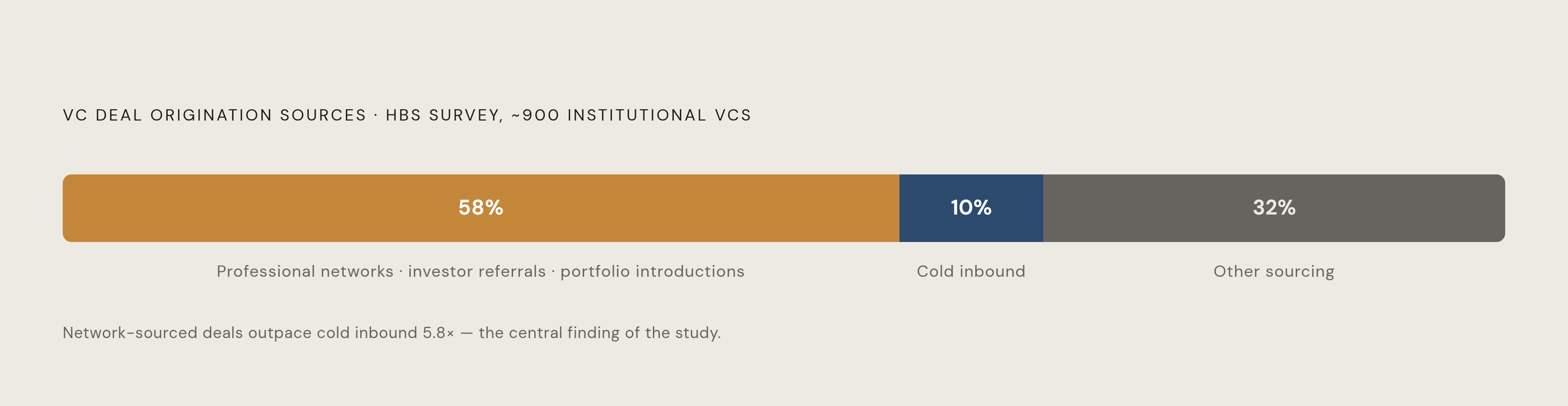
A Harvard Business School survey of nearly 900 institutional VCs found that roughly 58% of deals originate through professional networks, investor referrals, or portfolio company introductions. Unsolicited inbound accounts for approximately 10%. The overwhelming majority of venture deals do not get discovered through systematic market coverage; they move through existing social graphs.
The time investment that implies is substantial. VCs spend an average of 22 hours per week on networking and sourcing, out of a roughly 55-hour workweek. Nearly half the working week is, in functional terms, relationship maintenance. On the performance side, research by Hochberg, Ljungqvist, and Lu demonstrates that well-connected VC firms have measurably better fund performance, as proxied by IPO and acquisition exit rates. Bain's research on private equity reinforces the point: funds where more than half of closed deals originated from proprietary sourcing delivered a median IRR of 23%, compared to 16% for funds relying heavily on intermediaries.
Network position is a returns driver, not merely a sourcing convenience. The question that rarely gets pressed is which parts of the network a firm is actually mining, and which parts it has never learned to see clearly.
Why introductions from inside the portfolio carry the highest trust signal of any inbound channel
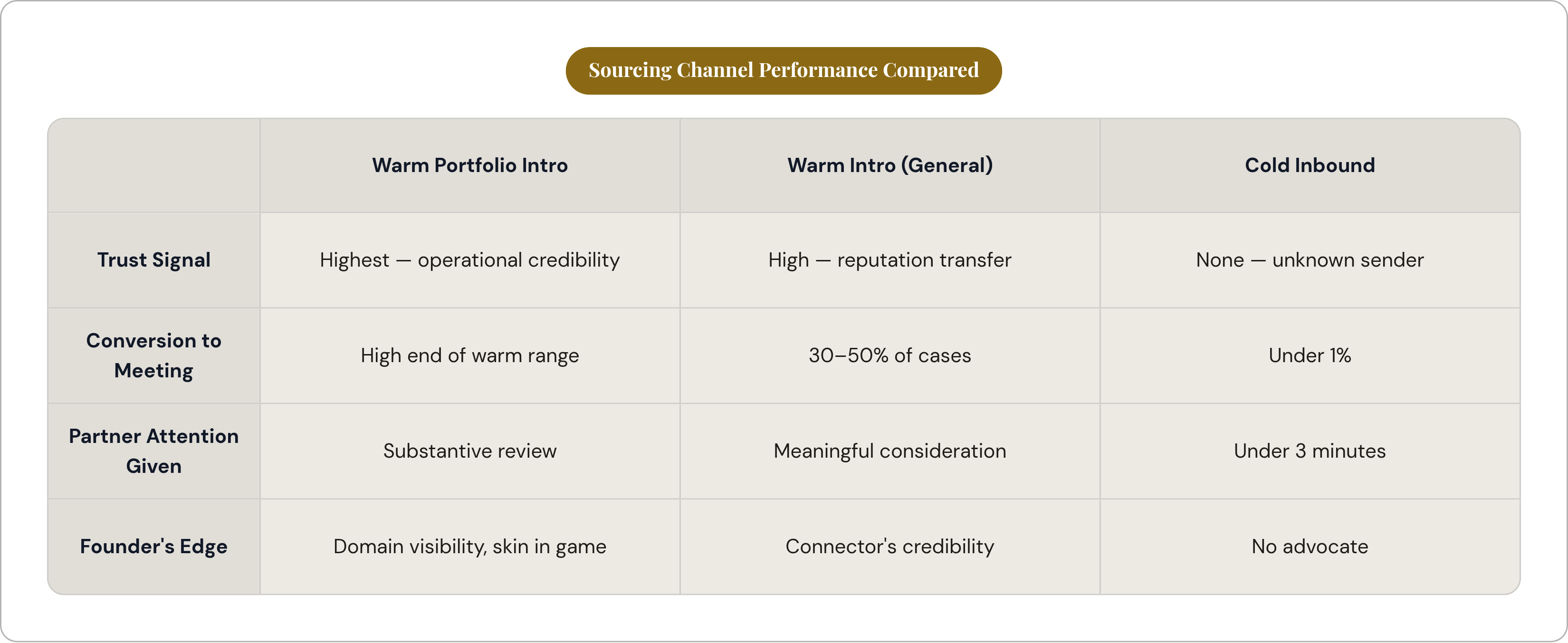
Warm introductions work because trust transfers. When someone with credibility vouches for an opportunity, they lend their reputation to the signal, compressing the cognitive distance between noise and serious consideration. But "warm" is a spectrum, and the connector's relationship depth is the variable that matters, not the format of the ask.
Conversion rates reflect this. A properly structured warm introduction leads to an actual conversation in roughly 30 to 50% of cases. Cold inbound at established VCs converts at less than 1%, and partners at established firms typically receive between 20 and 100 unsolicited pitches per day, spending under three minutes on first-pass review. The attention budget simply does not accommodate cold outreach at any meaningful rate.
Portfolio founder introductions sit at the high end of the trust spectrum for reasons that compound on each other. The founder has already survived the firm's diligence process, which is itself a credibility filter. Their judgment about other operators carries operational weight; they have real skin in the game on who builds the next generation of companies in their space. They also have domain-specific visibility the investor often lacks, seeing adjacent founders, early customers, and key hires long before those people surface through conventional channels.
The dynamic deepens over time. A founder who received substantive support from the firm becomes an active propagator of deal flow. Their own network grows as their company scales; the paths they can open in year three look different, often more valuable, than the ones available at close. Roble Ventures founding partner Sergio Monsalve has noted publicly that 88% of the firm's deals stem from network referrals. How much of that is specifically portfolio-sourced versus generated through the partners' direct relationships is the less-examined question, and probably the more instructive one.
The structure of a portfolio network and why it's larger than most firms realize
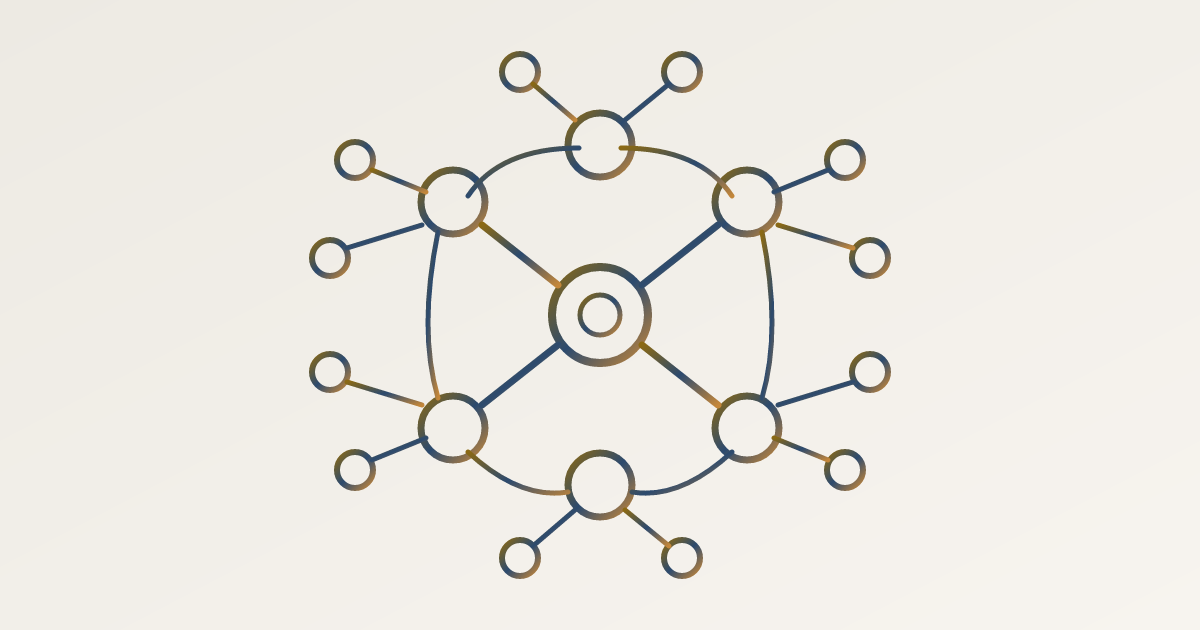
Most investors, when they think about their firm's network, are really thinking about their personal connections. That framing systematically underestimates the asset. Each portfolio company brings its own extended network: every co-founder, early hire, angel backer, design partner, and key customer relationship. None of those nodes belong to the partners directly, but all of them are reachable through the portfolio relationship.
The compounding math is real. A firm with 30 portfolio companies, each with a founding team of two or three and a dozen senior operators, sits on hundreds of distinct professional networks that collectively span tens of thousands of relationships. Many of those relationships exist in exactly the sectors, geographies, and functions the firm most wants to see deals in, often with more current access than the partners themselves have.
Second- and third-degree opportunities are frequently the most valuable ones. The founder's former colleagues at a scaled company, the customers who went on to build their own startups, the angels who co-invested and are now watching adjacent spaces: these are often warmer paths to a specific target than anything the firm could generate through its own outreach.
Axial's research found that the median private equity firm captures roughly 18% of relevant deals in its target market. Research published in the journal Venture Capital found that collaborative referral networks underlie approximately 70% of all VC-backed deals in the US. The portfolio is already embedded in that referral structure. Most firms simply cannot see it clearly enough to use it deliberately.
When the graph is made visible, the sourcing question changes in character. It shifts from "who do we know?" to "which of the thousands of relationships already inside our portfolio is the warmest path to this specific target?" That is a materially different question, and a materially more tractable one.
Why this asset stays dormant: relationship data scattered across systems no one reads together
The portfolio network exists. The problem is that it is distributed across systems that were never designed to communicate with each other. Individual partner inboxes hold years of relationship history. Calendar data records who met with whom and how often. LinkedIn connections capture professional proximity. Portfolio company Slack channels contain operational context. Deal memos include founder backgrounds that implicitly describe entire networks. CRM records, where they exist at all, reflect what someone chose to log, not what actually happened.
DATAVERSITY's 2024 Trends in Data Management report found that 68% of enterprises cite data silos as their primary barrier to extracting value from their information assets. Forrester Consulting has documented that knowledge workers spend roughly 12 hours per week manually gathering data as a result of those silos. In investment firms, the pattern is particularly acute because relationship knowledge concentrates in individuals rather than institutions.
The partner who backed a company knows its founders' networks in granular, contextual detail. No one else at the firm does. When that partner leaves, moves focus to a new sector, or simply gets stretched too thin, the relational context goes with them. Alpha Partners' Brian Smiga has described this problem directly in the context of relationship intelligence adoption: the institutional memory of a firm's relationship history is far more fragile than its partners tend to assume. New associates face a long ramp before they can navigate the firm's relationship graph effectively, and by the time they can, some of the warmest paths have already gone cold.
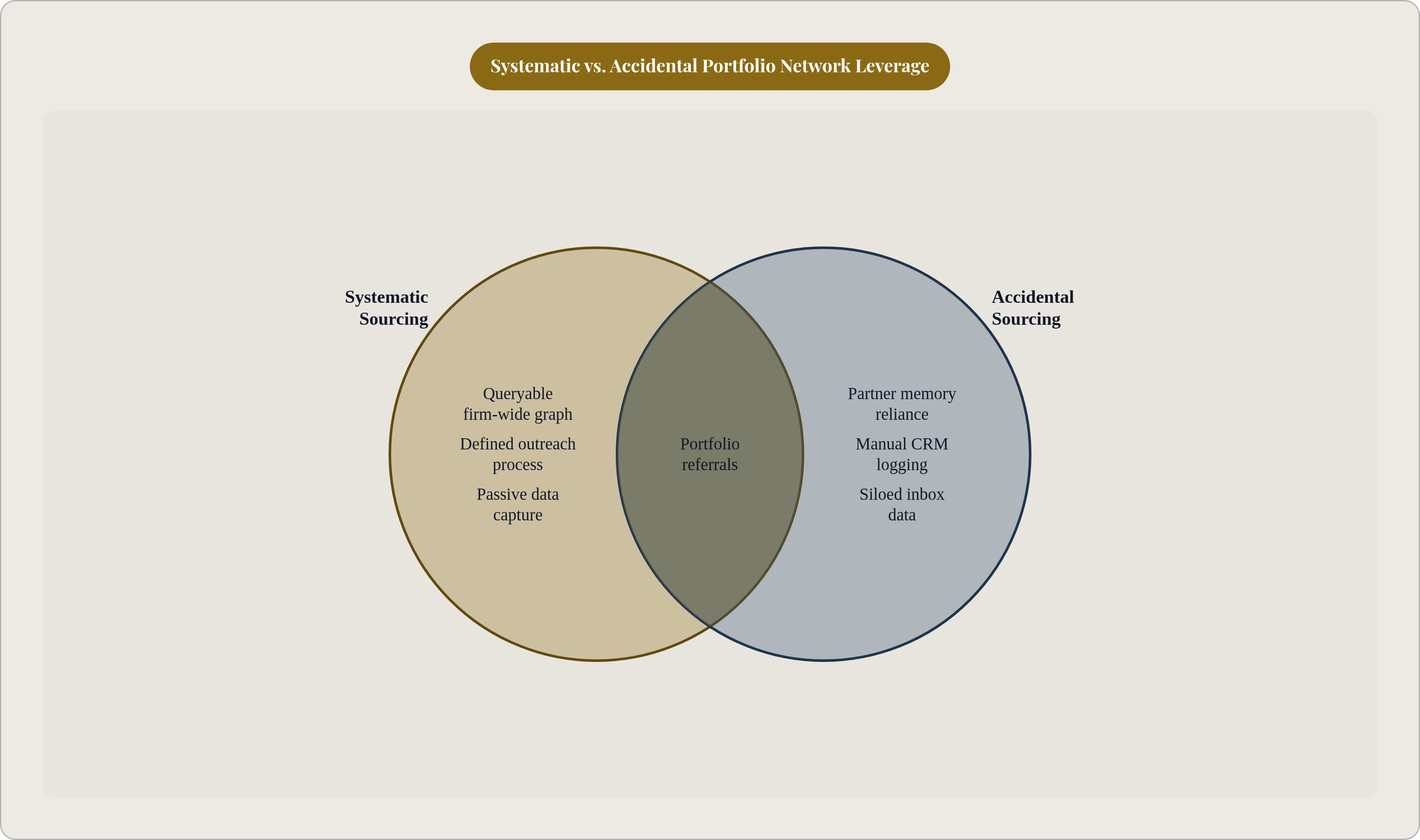
The CRM dependency trap compounds this. Most CRMs surface what was logged, not what actually happened. A relationship that was never manually entered does not exist in the system, which means it cannot be queried when it matters. Firms that rely most heavily on CRM hygiene are often the most blind to the relationships their portfolio has already built on their behalf.
The result is that portfolio network leverage becomes a function of individual memory and circumstance. When a partner happens to remember that a portfolio founder knows someone relevant, an introduction gets made. When no one happens to remember, the path stays invisible. That is a sourcing accident, not a sourcing strategy.
What it looks like when portfolio network leverage becomes a deliberate sourcing practice
The behavioral shift at top firms shows up in data. Affinity's 2025 Investment Benchmark Report found that top firms made a 16% year-over-year increase in introductions in 2024. When deal flow slowed mid-year, those same firms shifted toward connecting portfolio companies to talent and customers, using the portfolio graph as a support layer rather than treating it as a purely transactional sourcing tool. The portfolio network became two-directional: the firm provides value through connections, and deal flow surfaces as a natural byproduct.
Deliberate sourcing looks different from accidental sourcing in practice. Before any outreach to a new target, the first step is mapping which portfolio founders have direct or one-hop relationships with that target's team, their investors, or their key customers. The ask to the portfolio founder is specific, not open-ended: not "do you know anyone in climate tech?" but "do you know this person, and would you vouch for us to them?" The founder receives a prepared, contextual request.
The efficiency differential is significant. Affinity's research found that the most efficient PE firms generate one introduction connection for every 11 outreach emails, compared to 185 emails for the least efficient firms. That gap is almost entirely explained by how well the firm understands its own network before it reaches out, not by how aggressively it reaches out.
Documented results from firms that have built relationship intelligence infrastructure give the practice some texture. Pear Ventures converted 11,467 introduction paths. Future Planet Capital increased its pipeline by 395%. MassMutual Ventures triages opportunities roughly five times faster. These are not incremental improvements; they reflect a structural change in how deal flow is generated.
One cultural precondition is easy to overlook. Portfolio founders surface introductions when the relationship with the firm has been substantively supportive, not merely transactional at close. The reciprocity is not incidental to the model; it is the mechanism.
How AI and relationship intelligence make the portfolio graph queryable at scale
No partner can hold the combined relationship graph of thirty portfolio companies in working memory. I have watched smart, well-connected investors try to approximate this in spreadsheets. It does not work, and not just because the spreadsheet gets unwieldy. It fails because the data it represents is already months stale by the time anyone looks at it.
What relationship intelligence tools actually do, at their most useful, is aggregate the relationship signals already embedded in email, calendar, LinkedIn, and messaging history without requiring manual data entry. They score each connection by recency and interaction depth, not merely by whether a contact exists. They surface the warmest path to a specific target across the firm's combined relationship graph, including the portfolio's extended networks. They draft outreach in the professional's own voice, for their review, rather than sending autonomously.
The privacy architecture is not optional in this context. In high-trust professional environments, personal relationship context must remain private even as institutional relationship signals become collectively useful. A system that surfaces warm paths without exposing individual message content is a design requirement, not a differentiating feature.
Affinity's 2025 report found that 64% of investors now use AI to accelerate company research; the same infrastructure is increasingly being applied to relationship mapping. Forty-two percent of investors cite competition as the biggest factor impacting deal flow in 2025, and with a small number of established VC firms capturing a disproportionate share of total capital raised in 2024, smaller and mid-sized firms face real pressure to find sourcing advantages that do not require proportionally more headcount.
Alpha Watch's Rolo is built for precisely this environment: aggregating relationship data across the systems where professional relationships already live, building a queryable firm-wide relationship graph, and surfacing warm paths ranked by relevance, without autonomous action or exposure of private relationship context. The specific use case it is designed for is the moment a target arrives and the critical question becomes which portfolio founder is the warmest path to that specific person.
The equity consideration: portfolio network leverage concentrates access unless it's designed otherwise
I want to be direct about something that tends to get omitted from these conversations, perhaps because it complicates the efficiency argument, or perhaps because the people making that argument are not the ones most affected by the limitation.
Warm introduction networks reflect existing social graphs. Existing social graphs are not evenly distributed. Firms that source primarily through portfolio referrals risk reinforcing the same demographic patterns already embedded in their prior portfolio decisions.
A 2024 study in the Journal of Financial and Quantitative Analysis found that male participants in Harvard Business School's New Venture Competition who were randomly exposed to more VC investors were substantially more likely to start a VC-backed company post-graduation. Female participants showed no equivalent benefit, linked to a reduced propensity to initiate contact with investors they had been exposed to. The warm introduction system benefits those already disposed to use it, and that disposition is not randomly distributed across the founder population.
Investor Del Johnson has argued that warm intro systems can simultaneously promote exclusion and fail to surface the highest-return opportunities, because the population of founders who can navigate them skews toward those with existing institutional access. That argument is worth sitting with, not just acknowledging and moving past.
Systematic portfolio mapping partially addresses this. When the full portfolio graph is made visible, including second- and third-degree connections, it expands the surface area beyond who the partners personally know. Portfolio founders often have networks that look meaningfully different from the partners' own. Deliberately activating those paths, rather than defaulting to partner-level connections, introduces some structural diversity into the sourcing process.
But this does not solve the upstream problem. The portfolio itself reflects prior sourcing decisions. If those decisions were narrow, the portfolio graph will be narrow too. Expanding visibility into a skewed graph produces a more efficient version of the same skew. Firms that adopt relationship intelligence infrastructure without acknowledging this are optimizing for efficiency when the harder, more important problem is access. I do not have a clean resolution to offer here, only the observation that treating these as separate problems is probably how they stay separate indefinitely.
Making portfolio network leverage a firm-level capability rather than a partner-level habit
Most firms already benefit from portfolio referrals occasionally. The distinction between systematic practice and occasional benefit is that a firm-level capability works even when the right partner is not in the room, even when that partner has moved focus to a different sector, even when the target company is not yet on anyone's radar.
Building that capability has concrete institutional requirements. Relationship data must live in the firm's systems, not in individual inboxes, captured passively rather than dependent on manual logging. The portfolio's combined network must be visible to the full investment team, not just the partner who closed each deal. Post-investment engagement must keep portfolio founder relationships active and reciprocal. Querying the portfolio graph before any outreach must become a defined step in the process, so that "who is the warmest path to this target?" is the first question asked, not an afterthought when a deal is already competitive.
The compounding advantage grows with the portfolio itself. Each new company adds nodes connecting to targets the existing portfolio did not reach. Early investments in organizing the data pay increasing returns as the portfolio scales, because the graph accumulates in ways that partner memory alone could not sustain.
Most firms are not undernetworked. They are under-organized. The relationships that would source the next deal, open the warmest path to the most competitive opportunity, or surface the founder no one else has met yet are already inside the portfolio. Whether they stay invisible or become queryable is largely an institutional choice, not a function of how many business cards got exchanged at the last conference.