Warm Paths to OEM and Strategic Partnership Targets
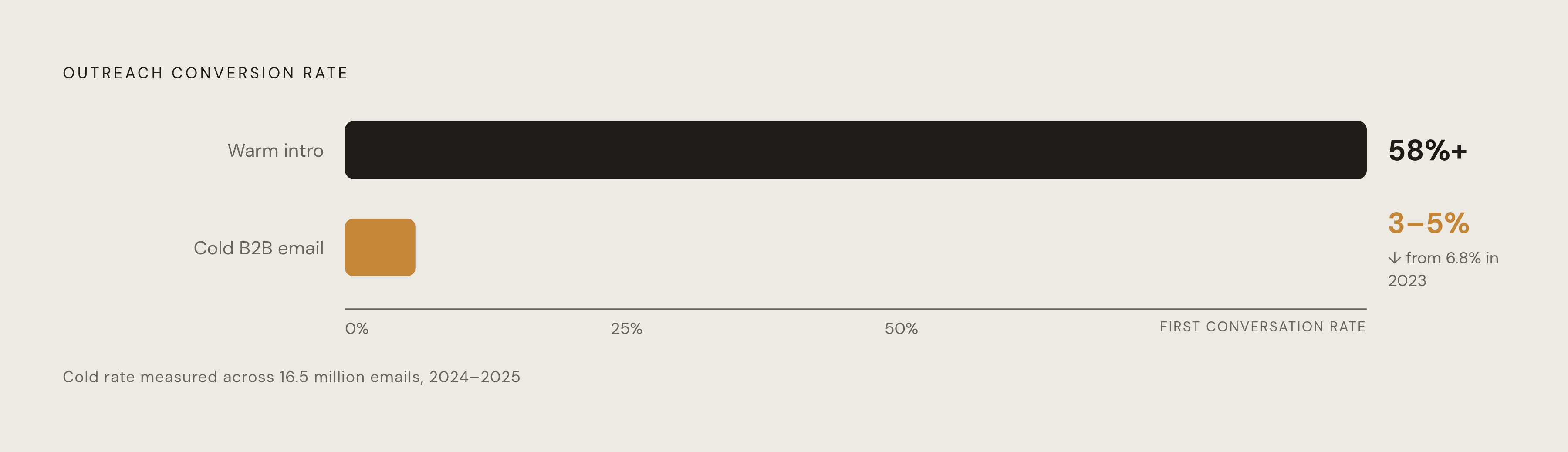
The gap between warm and cold approaches is not subtle, and it has gotten worse. Warm introductions convert to a first meaningful conversation at rates of 58% or higher. Cold email reply rates across B2B contexts sat between 3 and 5% in 2024 and 2025, down from 6.8% in 2023, across a dataset of sixteen and a half million emails. Ten to twenty times the conversion rate, trending further apart. Anyone still defaulting to cold outreach is swimming against a current that has gotten noticeably stronger.
The more interesting question is whether the decline in cold outreach performance is a temporary dip or something more structural. AI-generated email volume has flooded inboxes faster than buyers can consciously process, and buyers have responded the way people generally do when signal-to-noise collapses: they filter harder and respond less. That feedback loop does not obviously reverse.
Speed compounds the conversion advantage further. Proprietary deals sourced through warm introductions close thirty to fifty percent faster than opportunities entered through competitive processes. The structural reason is simple enough: when trust already exists, early conversations skip credential-building and go straight to strategic fit. Both parties arrive oriented toward partnership rather than toward evaluating each other's legitimacy.
In OEM and strategic partnership contexts, this speed differential bites hard. Secured Research puts the relationship runway for senior-level OEM partnerships at twelve to twenty-four months before a financing or integration program reaches the table. Every month spent navigating cold-approach friction is a month a competitor is gaining ground. The question of whether warm introductions outperform cold outreach is settled. The harder question is whether BD teams can find warm paths systematically, before the window closes.
Why the warm path into most OEM targets already exists inside the firm's network
Firms are not primarily limited by their reach. They are limited by their visibility into what they already have. That observation tends to feel counterintuitive until someone sits with the data for a moment.
Research from Harvard Business School found that nearly 70% of venture capital deals originate from connections already inside the investor's network. Sergio Monsalve of Roble Ventures has put that figure at 88% for his own firm: nearly all deals arrive through a tip or direct referral from existing relationships. Private equity sourcing data adds another angle. The average firm sees roughly 18% of relevant deals in its universe. The remaining 82% stay invisible, not because the firm lacks relationships with people who would know about them, but because the firm's processes cannot surface those relationships reliably.
Most BD professionals have a version of the same story. A partner pursues an OEM target for months through formal channels. After a competitor secures exclusivity, it surfaces that an operating advisor at their own firm spent five years working alongside the target's VP of Partnerships at a prior company. The warm path was there. The institutional process for finding it was not.
The Toyota-Waymo partnership announced in April 2025 is worth keeping in mind, not because the details of how it came together are public, but because of what its existence implies. A deal of that complexity, between organizations of that scale, does not materialize from a cold LinkedIn message. Relationships were cultivated, probably over years, by people thinking about fit long before any term sheet was imaginable. For every firm that was part of that conversation, there are others that were excluded, and the gap between them was most likely established long before April.
For teams pursuing OEM partnerships, the implication is direct. The path to the right senior decision-maker at a target OEM, the person who actually shapes partnership strategy rather than just evaluating inbound proposals, runs in many cases through someone already in the firm's relationship graph. The problem is access to that graph, not the graph itself.
Where the connection data lives and why it stays invisible
The relationship data exists. Years of email threads, calendar invites, LinkedIn exchanges, and meeting notes collectively describe a dense professional network. The problem is that no one has assembled it.
Most teams manage relationships across personal inboxes, individual spreadsheets, calendar applications, and CRM systems that may or may not be consistently updated. Critical context lives in one person's head or buried three folders deep in a thread no one else can find. When systems do not integrate, institutional knowledge becomes personal knowledge. The firm develops a dependency on human translators: the person who happens to know that a colleague once worked alongside a target executive, or who remembers a dinner from three years ago where a particular relationship was formed. When those people change roles or leave, the knowledge leaves with them.
An American Management Association survey found that 83% of executives believe their companies have silos, and 97% report that siloed data has had a material negative effect on the business. In BD and partnership contexts, the specific cost is concrete: promising connections fall through the cracks, relationship history disappears when people change roles, and no one can answer "who do we actually know at this target?" with any confidence.
A CRM that requires manual upkeep is, by definition, already behind. More pointedly, it is most out of date at precisely the moment a time-sensitive opportunity surfaces, because the team is focused on the opportunity rather than on data hygiene. It may not even be a process failure in the traditional sense. The incentive to keep records current collapses at exactly the moment accurate records matter most. That is a structural problem, and process discipline alone does not fix structural problems.
What a systematic approach to surfacing warm paths actually looks like
The starting point is not building new relationships. It is mapping the ones that already exist across email, calendar, LinkedIn, and messaging history into a coherent, queryable relationship graph. Passive capture, not manual entry. Any system that depends on people logging contacts will fail at the worst time, which is also the most predictable time.
Alexander Ross of Illuminate Financial has articulated what real depth looks like in practice: identifying ten to fifteen very senior change agents within a target organization who actually care about innovation and adopting early-stage solutions, rather than optimizing for volume. A hundred shallow connections to people who do not influence decisions are worth less than three solid relationships with people who do. That framing is worth internalizing, because most BD teams are still optimizing for breadth.
One underused signal source: asking existing customers which other companies they trust alongside you. A trust endorsement from a shared customer carries different weight than anything an analyst list can replicate. OEM partnership candidates surfaced this way arrive with social proof already attached, which changes the tenor of the first conversation considerably.
Once the relationship data is mapped, warm path scoring becomes possible: ranking connections by recency, interaction frequency, and relationship strength, not just by whether a name appears somewhere in a contact list. A contact from 2019 who has been untouched since is not the same asset as a contact from 2019 who has been engaged three times this year. That distinction is obvious when stated plainly; it is invisible in a static spreadsheet.
MassMutual Ventures offers a concrete illustration of the gap between what firms believe they know and what their data actually contains. After implementing a relationship intelligence platform, the firm surfaced 67,000 contacts and 43,000 organizations within sixty days, and triaged investment opportunities up to five times faster. The contacts were not new. They were there the whole time.
The efficiency gap between firms that can find warm paths and firms that can't
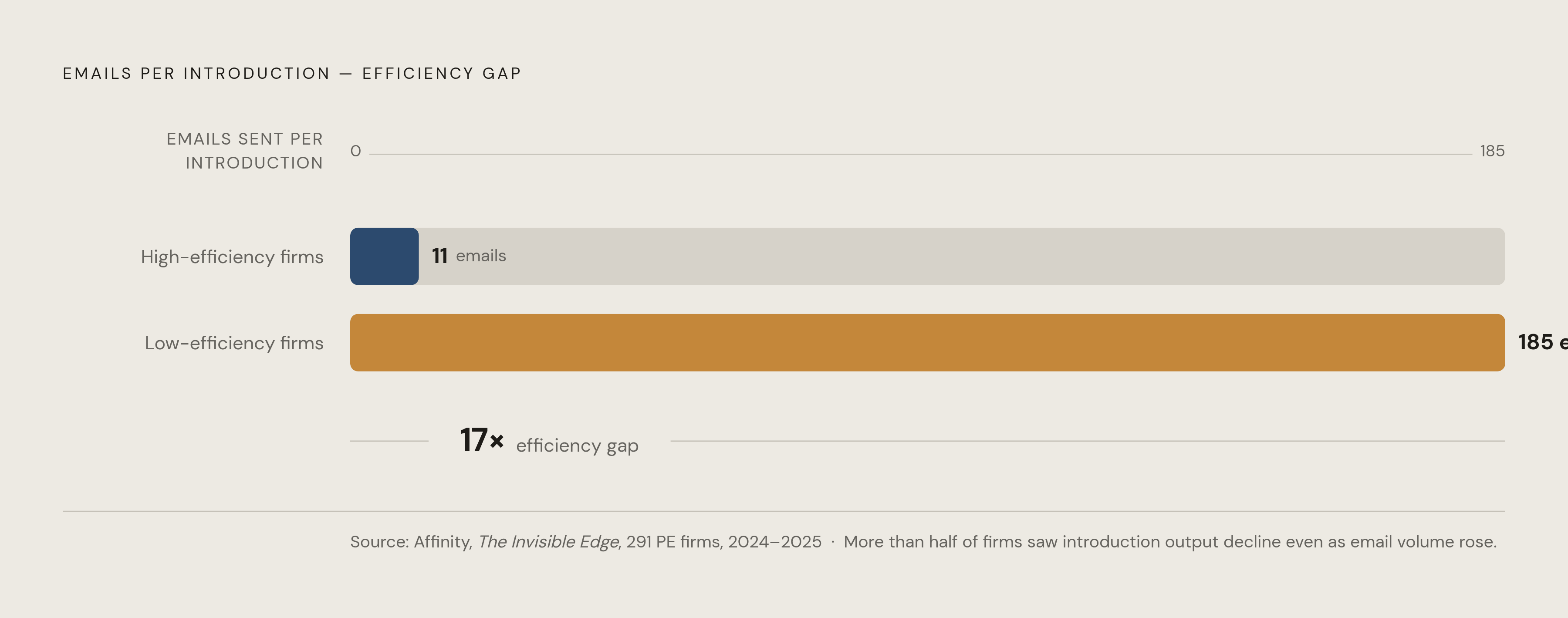
Affinity's Invisible Edge report, drawing on data from 291 private equity firms over two years, produced a number that deserves to sit with BD teams for a moment. The most efficient firms generate one introduction for every eleven emails sent. The least efficient require 185 emails to achieve the same result. That is a seventeen-times gap, and it does not come from the high-performing firms sending better cold emails. It comes from them identifying warm paths before they reach out.
The gap is also widening. More than half of PE firms in the dataset saw their introduction output decline significantly from 2024 to 2025, even while increasing email volume. More effort, worse results. That is what happens when volume substitutes for network visibility.
For OEM partnership targets, this dynamic maps directly. A BD team that can answer "who in our network has a meaningful relationship with someone senior at this OEM?" before picking up the phone is operating at a categorically different level than one that defaults to a LinkedIn InMail and waits.
There is also a compounding effect that does not show up in efficiency metrics. A cold approach that gets ignored does not simply fail; it forecloses. The recipient now associates the firm with unsolicited outreach. A warm introduction that is not the right fit this quarter remains a real relationship. The conversation that falls short in Q2 can still become the partnership that opens in Q4, because the trust was not eroded at first contact. Cold outreach has a way of making the future harder, not just the present, and no volume increase compensates for that erosion.
How AI can surface these paths without exposing the private context that makes relationships valuable
Anyone who has been inside a firm's data governance conversations knows the tension is real. Making relationship data collectively useful across a team creates real risks. A partner's private correspondence with a founder, an advisor's personal connection to a target executive: these are not assets to be pooled without careful controls. The objection is not paranoia. It reflects professional responsibility, and it deserves a real answer rather than efficiency rhetoric.
The regulatory environment reinforces this. IBM's 2025 Cost of a Data Breach report put the global average breach cost at $4.4 million, with incidents involving unsanctioned AI use adding roughly $670,000 on top of that. GDPR breach notifications surged 22% year-over-year to 443 incidents per day in 2025. The EU AI Act is now in force, with obligations phasing in through 2025, 2026, and 2027. For firms operating in financial services, healthcare, or enterprise technology, this is not a policy abstraction. It is a live compliance question.
What resolves the tension architecturally is a distinction between signal and content. Institutional relationship signals, meaning who knows whom, how recently, and through what general context, can be made visible across a team without surfacing the content of private communications. Permissioned access built into the architecture from the start, not retrofitted after the fact.
The practical implication is that a BD operator should be able to ask "who in our firm has the warmest path to the Head of Strategic Partnerships at a target OEM?" and receive a ranked, actionable answer, without that query exposing the substance of any colleague's private correspondence. The signal surfaces. The content stays protected. Whether current tooling reliably delivers on that distinction across all deployment contexts is unclear to me, and I have seen implementations that did it well and others that treated it as an afterthought. The architectural principle is sound; the execution varies considerably.
AI in this context should draft and recommend, not act unilaterally. The professional remains in control of every send, every introduction request, every piece of outreach that carries their name. The value is in reducing search time and increasing hit rate on warm paths; the human judgment about when and how to activate those paths stays where it belongs.
For firms in regulated environments, this is not a preference. It is the condition under which relationship intelligence tools get approved for use at all. The firms building this capability on a sound governance foundation are the ones that will still have it running in three years. The firms treating governance as a later problem are accumulating regulatory exposure and eroded partner trust at the same time, and those liabilities tend to surface when the firm is least equipped to absorb them.