When Your Firm Has Two People Who Know the Same Target and Neither Knows It
Silent duplicate outreach wastes warm paths that convert deals at dramatically better rates.

A partner and a vice president at the same firm can each spend weeks courting the same target's CFO, never once discovering the other exists. This is a story about where relationship data lives, who can see it, and what a firm forfeits when the answer is "almost no one.
Two people at the same firm can each know the same target and neither find out
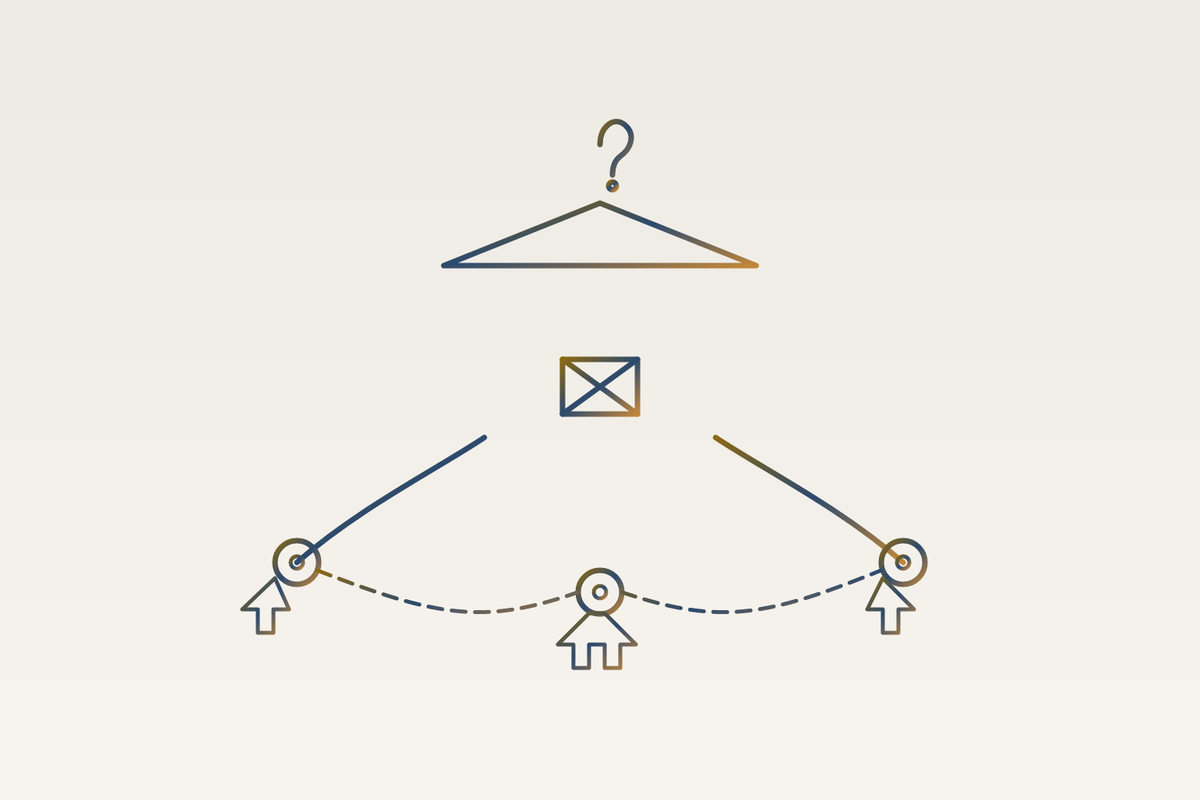
Consider the mechanics of it. A partner and a vice president can each know the CFO of a target company through different paths and pursue outreach on separate timelines, never learning the firm already has a warmer route sitting one floor away. A vice president two floors down worked with that same CFO at a prior firm and talks to them every few months about something unrelated to deals. That happens by default when relationship data lives nowhere except in the heads and inboxes of the people who hold it, not because of a failure of diligence.
The instinct is to blame the CRM. If the firm had insisted on better logging discipline, the thinking goes, this would show up as a duplicate record and someone would catch it. But manual CRM upkeep cannot close this gap, because a CRM is only as complete as the last person who remembered to log a call, and the senior professionals whose relationships carry the most weight are consistently the least likely to log them. Junior staff, who have the least valuable relationships to log in the first place, pay the data entry tax disproportionately.
That arithmetic appears outside deal teams too. Salesforce's seventh-edition State of Sales report found the average seller spends a minority of their time actually selling, with manual data entry consuming roughly two hours a week for the youngest reps, and while deal teams are not sales teams, the arithmetic of manual CRM upkeep is identical, with investment professionals costing more per hour. The result is structural. A firm can hold three distinct warm paths into a single target and know about none of them, while two of its own people unknowingly compete against each other inside that target's inbox. Nobody did anything wrong. The system simply never asked anyone to make the relationship visible to anyone but themselves.
The warm-path advantage is large enough to make this duplication costly
The duplication described above would be a curiosity if warm and cold outreach performed roughly the same, but they do not perform the same. The gap between them is wide enough to represent a measurable cost, not a rounding error.
Trust transfer is the mechanism behind that gap. A warm introduction moves a credibility judgment from the introducer to the target before the first conversation even starts, and that borrowed trust lowers the friction a cold message has to fight through on its own. Bessemer's 2025 origination economics study, built on data from 22 middle-market lending platforms, found that warm-sourced opportunities convert to closed deals at a materially higher rate than opportunities run through purely competitive processes. Path selection, not volume, decides outcomes here. Sending more emails does not substitute for sending the right person down the right path.
The advantage compounds on the back end of a deal, too. Lincoln International's origination productivity study found that warm-sourced deals consumed 41 percent fewer underwriting hours per dollar of committed capital than cold-sourced ones. A warm introduction doesn't just make the first call easier. It carries context, credibility, and trust deep enough into the process that both sides spend less time verifying what a stranger would have had to prove from scratch.
None of this is shrinking as private markets mature. PitchBook's 2025 deal-sourcing study found that a majority of middle-market unitranche transactions originated through intermediary referral, and that share has grown since 2022 even as direct lenders have expanded their own business-development headcount. Firms are spending more on outbound capacity and still finding that curated introductions carry more of the deal flow, not less. Why would that be, when direct sourcing has gotten cheaper and more automated? The trust a referral carries likely cannot be manufactured by adding headcount. It is worth asking what a firm gives up when it routes its second-warmest person to a target because the warmest path was sitting, invisible, on someone else's desk. It is a conversion penalty the firm pays without ever seeing the invoice, not a neutral substitution.
How siloed relationship data produces duplicate outreach
The gap between firms that can find their warmest path and firms that cannot compounds over time rather than costing once. It is measurable across outreach volume, introduction output, and deal outcomes, and it widens the longer it goes unaddressed.
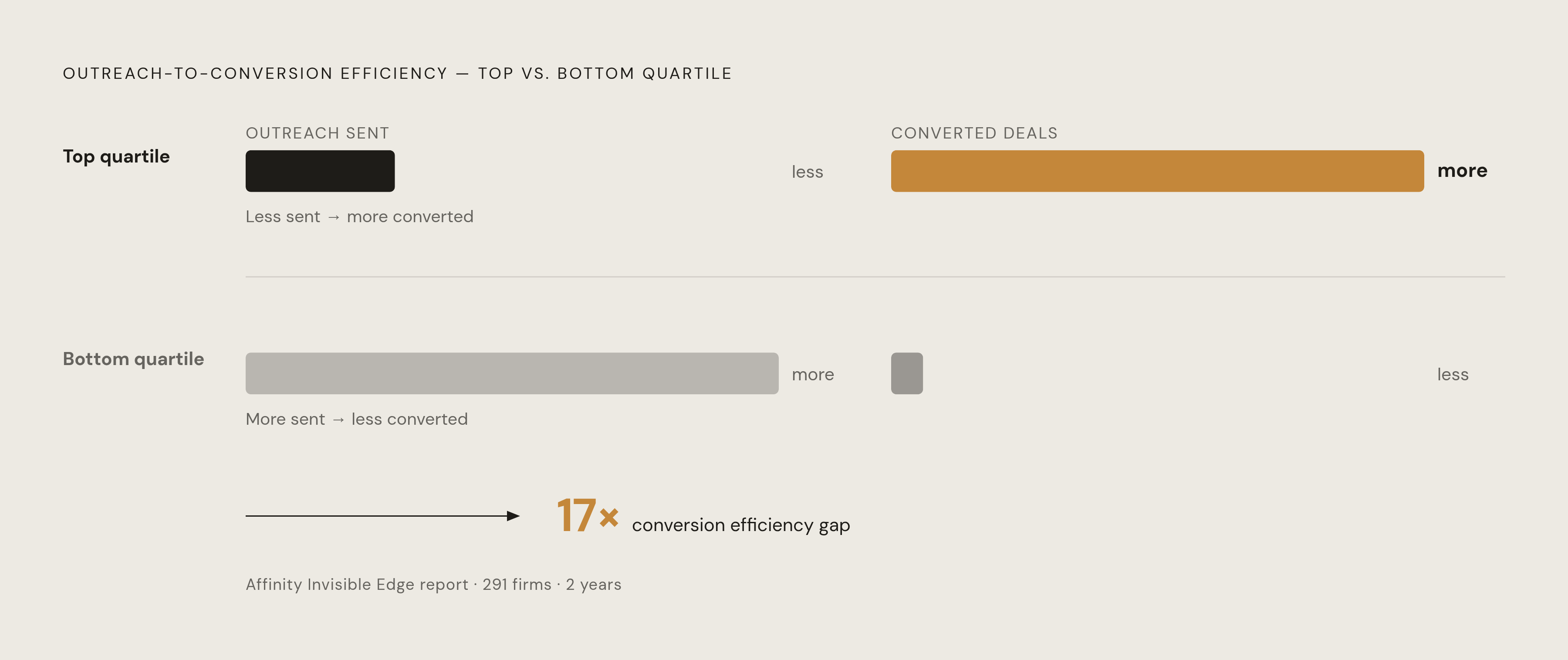
Affinity's Invisible Edge report, drawing on two years of behavioral activity across 291 private equity firms, found a 17x gap in outreach conversion efficiency between top- and bottom-quartile firms. The top quartile sent far less and generated more. That is not a story about effort. Firms in the bottom quartile were almost certainly working as hard, if not harder, than the firms outperforming them. Which paths they were working, and whether anyone at the firm could see which path was strongest before hitting send, made the difference.
The same data points to something sharper still: firms whose introduction output declined between 2024 and 2025 had often started from a position of relative strength, and their relationships went cold during a period of lower activity and simply never recovered. Firms that kept engagement consistent through the same stretch had warm relationships ready to go the moment deal activity picked back up. Relationship capital behaves like any other form of capital left idle, and it depreciates.
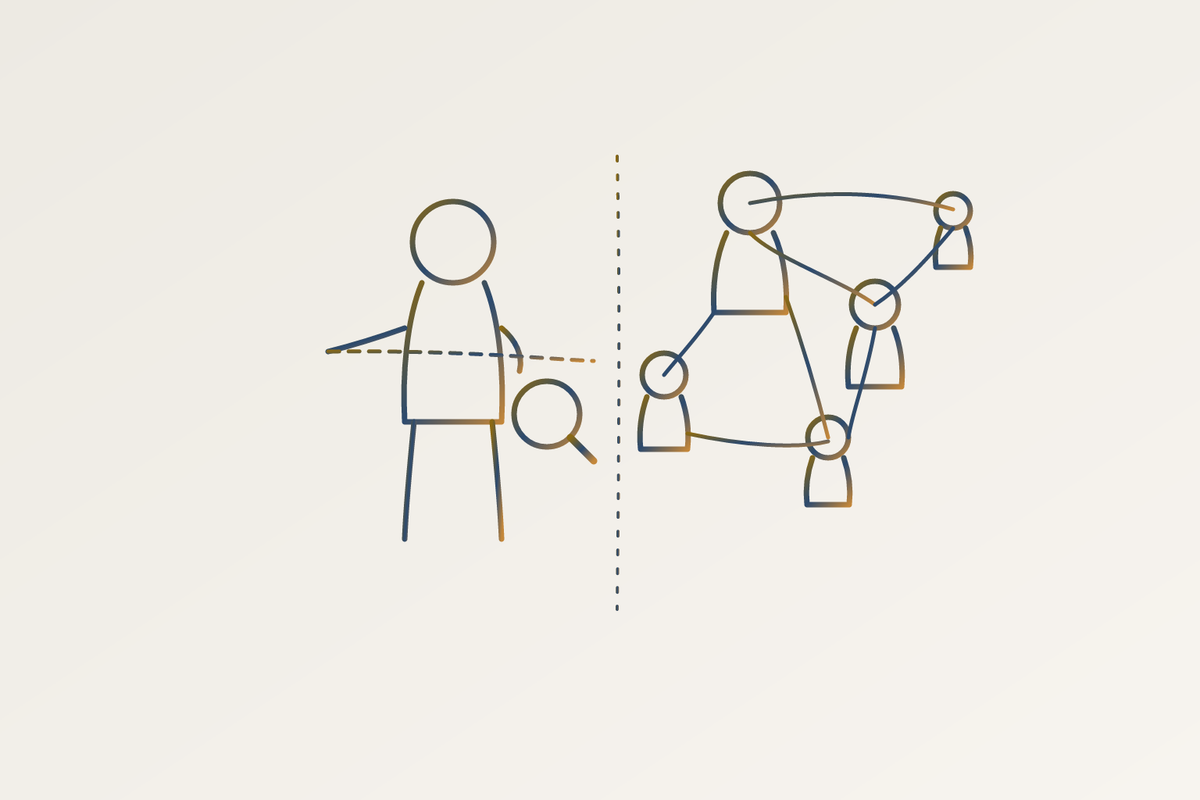
What produces the duplication in the first place is almost always the same behavioral pattern. Without a shared network graph, the answer to "who do we know at this company?" comes from a Slack thread, and a Slack thread surfaces whatever the first person to respond happens to remember. That answer is incomplete by construction, slow by design, and biased toward whoever is most vocal in the channel rather than whoever holds the strongest relationship. The deal team does not lack information. It lacks a system that can retrieve the information it already has.
Professional services firms run into a version of the same wall in a different shape. An audit partner's contacts sit invisible to the advisory team down the hall, and cross-selling that should happen on the strength of an existing relationship simply does not happen, because nobody on the advisory side can see that the path exists. The cost compounds further when a partner leaves the firm. Their departure takes their share of the network with them, and the firm loses not just a list of names but the relationship history that made those names worth anything. A contact without context is a cold lead wearing a warm lead's clothes.
What relationship intelligence does beyond a traditional CRM
Solving the problem described in the first three sections requires a system built to answer a specific question: who at this firm has the strongest relationship to this person, and when did they last speak? That question is the starting premise of relationship intelligence as a software category, and it is a different premise from the one a traditional CRM was built on.
A CRM tracks what people remember to type in. Relationship intelligence reads what people actually do and builds a live map of the firm's network from that activity directly. Passive capture changes what the system can answer compared with manual entry. A CRM can tell an analyst that someone logged a call with a given company. It cannot tell that analyst who at the firm has the strongest relationship with that company, because strength was never something anyone was asked to log.
Five components separate a functioning relationship intelligence system from a contact database with a score bolted onto it. Automated activity capture connects to email and calendar and treats every sent message, reply, and accepted meeting as a data point worth recording, with no manual logging required of anyone. Meridian's guide to relationship intelligence for deal teams identifies this as the entry point for most firms that have not yet brought technology into how they run relationships, precisely because it asks nothing of the senior people whose relationships matter most and who are least likely to log anything voluntarily. Contact and company enrichment extends that picture past what lives in any one inbox. Relationship strength scoring ranks connections by how frequently and how recently two people have actually interacted, rather than by whether someone remembered to add a contact to a list. Network mapping builds a graph of who at the firm knows whom across every team, surfacing paths that would otherwise require institutional memory and a well-timed Slack thread to find. Introduction path identification surfaces the warmest route from any person at the firm to any target.
A CRM built to track portfolio companies and fund-level reporting is architecturally a different animal from one built to answer who has the strongest relationship to a given founder. Many deal-flow CRMs were built to track companies moving through a pipeline, not to carry relationship history across fund vintages, and that relationship history gets lost between funds because the system storing it was never designed to hold onto it in the first place. That architectural gap is the whole difference for a firm trying to solve duplicate pursuit. Relationship intelligence shows which of those two people holds the stronger path and can draft the introduction in that person's own voice. One system produces a record. The other produces a decision.
Differences among relationship intelligence platforms in 2026
Once a firm accepts that it needs relationship intelligence rather than a better-disciplined CRM, the next question is which platform actually fits how the firm works. The category in 2026 splits along two axes: how many sources feed the warm graph, and whether the platform stops at surfacing a path or actually runs the introduction. Most vendors are strong on one axis and close to absent on the other.
Boomerang's 2026 buyer's guide frames the category along exactly these two dimensions: discovery breadth, meaning how many connector pillars (team, customers, board and advisors and investors, partners) feed the graph, and activation depth, meaning whether the platform stops at surfacing a path, handles part of the ask, or runs the full warm-intro motion end to end. Boomerang itself maps all four connector pillars and drafts, routes, times, and follows up on introductions inside tools firms already use, including Slack, Salesforce, Outreach, and Gong, with pricing directionally around $15,000 to $25,000 a year for a ten-person team and customers including the cybersecurity firm Armis and the product-demo platform Storylane.
Affinity serves venture capital and private equity with a single-pillar structure, mapping partner email and calendar, showing the path and drafting the ask but not routing or tracking it, priced directionally between $25,000 and $80,000 a year, with customers including Bain Capital Ventures, Kleiner Perkins, and Notable Capital, and additional use among 8VC, Motive Partners, MassMutual Ventures, and Invus Opportunities.
UserGems tracks champion job changes across multiple pillars, including CRM champion records, contact-level intent, calendar and meeting data, and more than 21 additional signals, with partial activation through alerts and automated outbound rather than full warm-intro orchestration, priced directionally between $15,000 and $60,000 a year, serving customers including Mimecast, Lattice, and Greenhouse. Centralize maps two pillars, team network and CRM contacts, with partial activation that surfaces a path and generates outreach while leaving connector routing manual, priced directionally between $18,000 and $40,000 a year, founded in 2023 out of YC's Winter 2024 batch. Connect The Dots builds a trust graph across team and extended personal networks, with partial activation that surfaces high-trust paths and drafts asks without signal-triggered automation, priced directionally between $20,000 and $50,000 a year, serving enterprise SaaS and consulting firms.
Vieu combines account planning with relationship intelligence across team and external enrichment pillars, generating account plans and suggested introductions while leaving activation rep-driven, sold at custom enterprise pricing to enterprise SaaS and cybersecurity firms. Common Room aggregates community and product signals attributed to individual people, with partial activation through signal workflows and no warm-intro motion, priced directionally between $20,000 and $80,000 a year, serving customers including Notion, Figma, and Grafana. Introhive maps one pillar, partner email and calendar, surfacing the path but not running the introduction, priced directionally between $50,000 and $150,000 a year, and reportedly serving 40% of top-20 law firms and 85% of top-20 accounting firms, with an AI-powered Intelligence Suite shipped in October 2025.
Rolo takes a different shape from most of the field. It builds a firm-wide relationship graph connecting email, calendar, LinkedIn, and messaging apps, surfaces warm paths, and ranks connections by relevance and recency rather than by whether someone remembered to log them. It drafts outreach in the user's own voice without sending autonomously or exposing private context, a design built for environments where deal-level permissions and privacy architecture have to be requirements from day one rather than features added later. A firm cannot surface which of two colleagues holds the stronger path to a shared target without giving every colleague enough visibility into the graph to ask the question, and it can only do that safely with an architecture built from the start to answer that question without leaking what either person's inbox actually contains.
Across the landscape, most vendors sit at one or two discovery pillars with low-to-partial activation, and the real buying decision in 2026 is whether a firm wants one platform that maps the full graph and activates it, or two platforms that each handle half the job.
Buying relationship intelligence without solving duplicate pursuit
Buying the software is the easy part. Surfacing a warm path is necessary, but nothing about owning the tool guarantees anyone acts on what it shows. Whether the path actually gets used depends on firm culture, on whether incentive structures reward the person who has the strongest relationship instead of the person who moves first, and on data quality that no software purchase fixes by itself.
That last point deserves scrutiny, because it is where a lot of relationship intelligence deployments quietly stall. S&P Global's Private Equity and Venture Capital Outlook, surveying global private markets participants, both fund managers and limited partners, found that a majority of respondents rated AI as ineffective for deal sourcing, and separately identified fragmented and unstructured data as a key barrier to data quality. Other barriers cited alongside it included a lack of internal expertise, data privacy concerns, and doubts about model accuracy. The irony is exact: the same fragmentation that relationship intelligence exists to solve is the condition that keeps a meaningful share of firms from trusting what the software tells them once it's installed.
Better data hygiene up front would help, but a harder problem remains: nobody owns the decision of who acts on a visible path. A platform can surface the single warmest path to a target, and a firm can still let two people chase that target independently if nobody owns the decision of who goes first, if the partner who finds the path has no incentive to hand it to a colleague who holds it more strongly, or if the firm's culture rewards whoever reaches out fastest rather than whoever reaches out best. Visibility changes what a firm can see. It does not, on its own, change who acts, when they act, or whether the firm has built a process that turns a visible path into a single, coordinated move. That is the work relationship intelligence makes possible. It is not the work relationship intelligence does by itself.