What Happens to Institutional Relationship Data After a Fund Closes
Tacit relationship data vanishes when funds close, destroying years of accumulated network value.
Fund wind-down follows a script, and it's a script everyone in the industry already knows by heart: settle the management fees, settle the performance fees, pay down any loans, book the accruing legal and audit expenses, finalize NAV. It's methodical, well-worn, and, in a narrow sense, complete. But complete for what, exactly? The protocol covers every financial liability a fund carries and offers no equivalent treatment for what might be its least tangible, and possibly most valuable, asset: the network of relationships built up over the fund's life. Years of LP contacts, co-investor ties, founder touchpoints, banker introductions, operating partner referrals, all of it accumulates quietly across a fund's lifespan, and none of it appears anywhere near a balance sheet.
This is a structural problem, not a case of one GP cutting corners or one back office dropping the ball. It's structural. The industry has simply never defined relationship data as something a fund "owns" in the first place, so there's nothing in the wind-down checklist asking what happens to it. That gap is the subject of this piece: what actually happens to institutional relationship data once a fund closes, why it degrades faster than anyone expects, and what firms planning a successor vehicle or a spinout stand to lose if they treat this the way the industry always has, which is to say, they simply don't address it.
Institutional relationship data: composition and location
Before getting into what's lost, it helps to be precise about what's actually there. Institutional knowledge inside a fund splits into two rough categories, and they behave very differently once people start walking out the door.
The first is explicit knowledge: deal memos, CRM notes, term sheets, portfolio dashboards. This is the stuff that's written down, structured, and sitting in a system somewhere. If an associate leaves, the Notion database doesn't leave with them, it stays put, fully intact, waiting for the next person to open it. Explicit knowledge is the easy half of this problem.
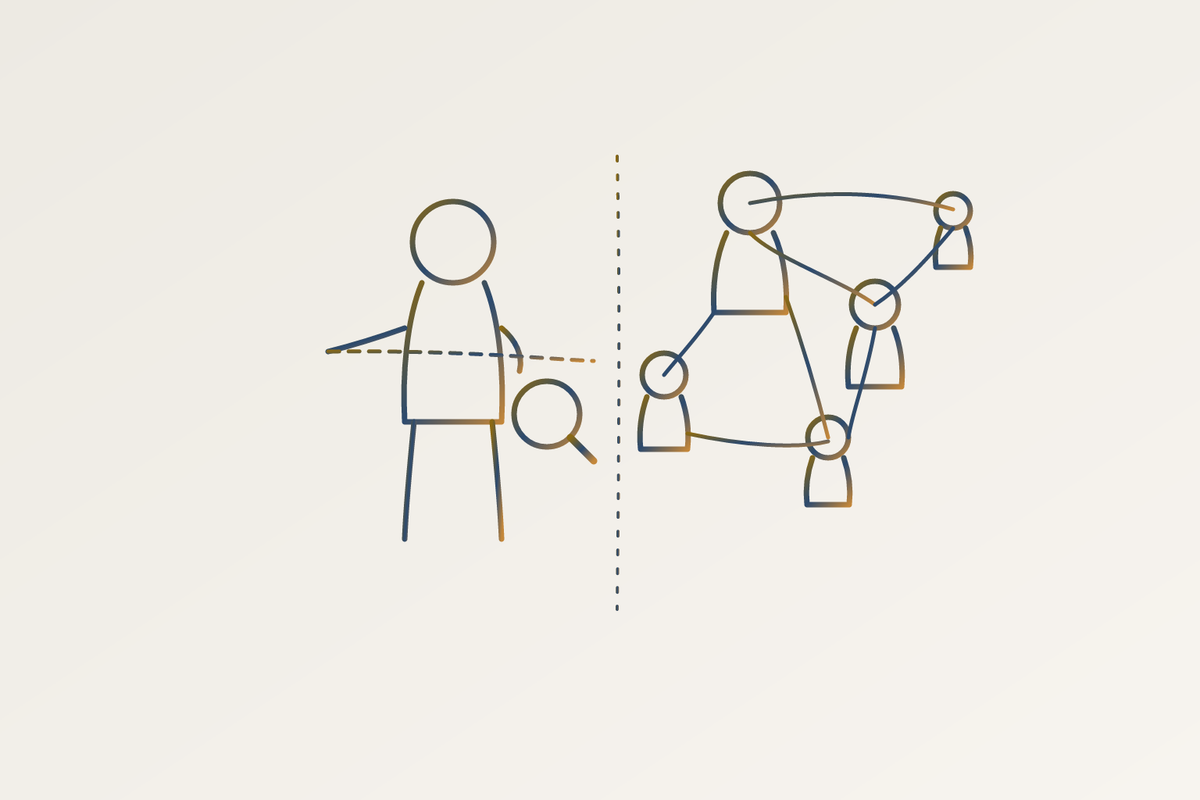
Tacit knowledge resists being written down and is harder to transfer. Which founder conversation actually shaped the investment thesis? Which banker made the one introduction that mattered? Which LP came in because a specific co-investor vouched for the fund over dinner? None of that lives in a CRM field. It lives in the relationship graph itself, the map of who introduced whom to which LP, which founder got referred through which co-investor, which banker has a warm path into which sector, and how warm or cold any given connection has gone stale over time.
And where does that graph physically live? Email inboxes. Calendar histories. LinkedIn connections. Scattered messaging threads. People's heads. Not, notably, in any governed system that the firm actually controls. That's the crux of the whole problem: explicit data tends to survive a closure reasonably intact, because it was built to be stored. Tacit relational data almost never gets stored, because it was never built to be stored.
Fragmentation erodes the asset long before a fund closes
Does wind-down create this fragmentation, or does it just expose something that was already broken? The honest answer is the latter. Fragmentation isn't a closure problem, it's a pre-existing condition, and it's endemic across the industry, not confined to funds on their way out the door.
FE fundinfo's whitepaper on fund data infrastructure puts a number on what most people in the industry already sense anecdotally: a majority of firms report data fragmentation across siloed systems, and nearly half say manual processes are still draining their resources. These are firms fully in the swing of things, not struggling outliers. These are firms that are actively operating, fully staffed, raising and deploying capital as usual. The rot, if that's the right word, is baked into the system long before anyone starts talking about a wind-down timeline.
Part of the reason is structural over-reliance on individual people. When institutional knowledge sits in someone's head rather than in a system the firm actually governs, that person becomes a single point of failure. People shift roles, they deepen relationships in one area while letting others go quiet, and most of that movement appears first in email threads and calendar entries, long before it ever gets logged in a CRM, if it gets logged there at all. So there's a permanent, compounding gap between what's actually happening across a firm's network and what any system reflects. By the time a fund reaches wind-down, that gap has usually been widening for years. Closure doesn't create the decay. It just delivers the last blow to something already halfway gone.
The four typical outcomes for data when a fund closes
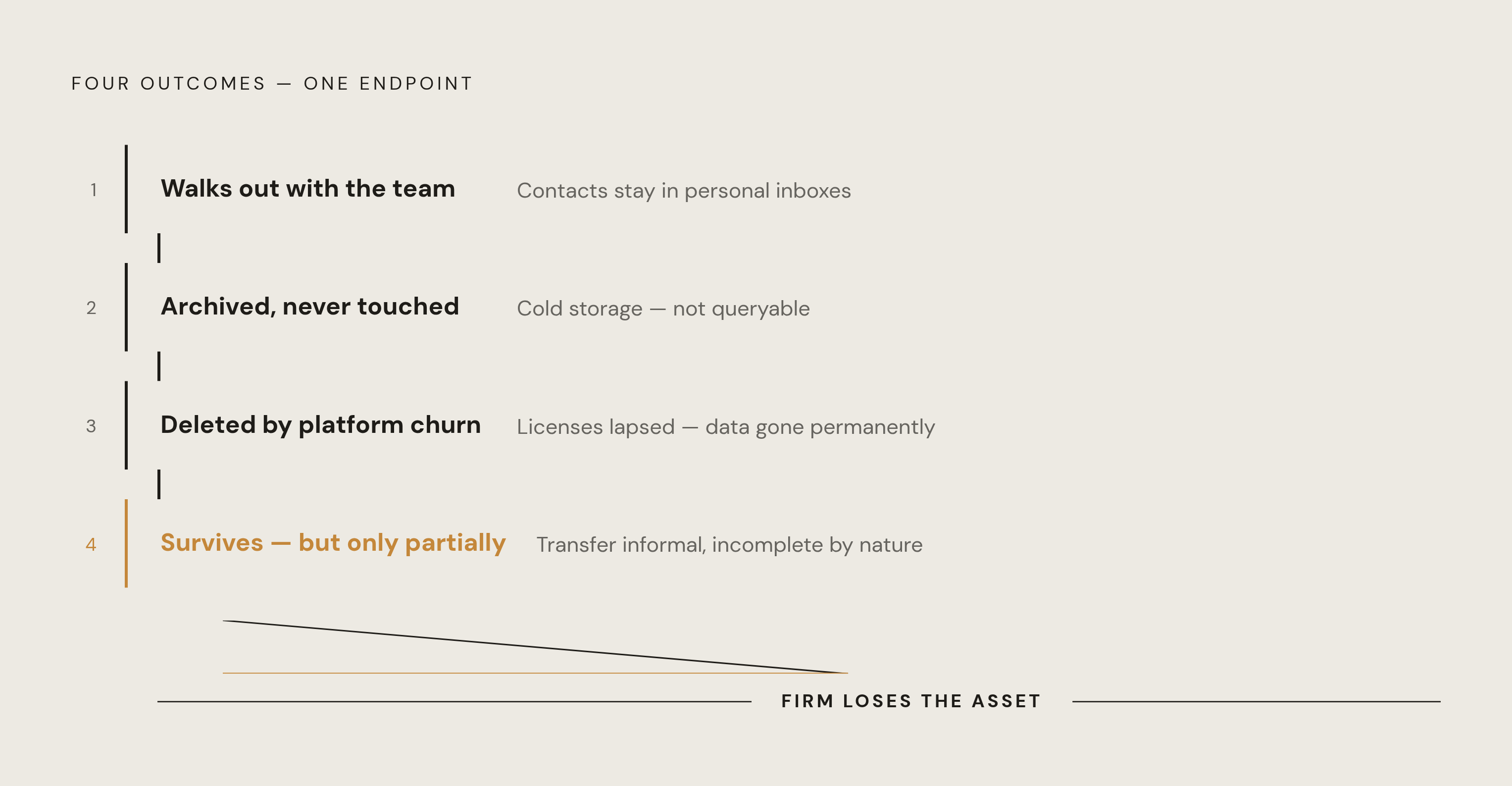
So what does actually happen to relationship data once the closure process starts? In practice, there are four outcomes, and most funds end up living out some combination of all four rather than cleanly falling into just one.
It walks out with the team. When partners and associates scatter to new funds, spinouts, or operating roles, they take their contacts with them, informally, in their personal inbox, their own LinkedIn, their memory. The firm keeps no copy of any of it. The institution simply loses the asset, in full, the moment the person walks out.
It gets archived, but never touched again. Some firms do export CRM records or email archives as part of standard records retention. That satisfies a compliance checkbox, technically. But archived data sitting in cold storage isn't queryable, isn't scored, isn't connected to any live network map. It exists the way a sealed box in a storage unit exists. Archived is not the same as active, and it's certainly not the same as intelligence.
It gets deleted by platform churn. Email accounts get decommissioned. SaaS subscriptions lapse. CRM licenses expire and nobody renews them. Whatever relationship history lived only inside those systems is gone, permanently, with no copy anywhere else.
It survives in a successor vehicle, but only partially. But that transfer is almost always informal, dependent on whichever individuals happen to carry the knowledge personally, and incomplete by nature. Anything held by a departed team member, or stored in a system that didn't get carried forward, simply doesn't make the trip.
It's also worth considering that the damage here isn't only about data. Vague or delayed communication during a wind-down can fuel real anxiety among LPs and co-investors, and it can lead to disputes that erode relationships built up over years. The loss carries weight beyond the informational. It's trust, and trust doesn't archive well either.
Relationship capital's faster depreciation than financial capital during wind-down
Financial assets, broadly, hold their value on a predictable curve during wind-down. A portfolio company's valuation doesn't suddenly collapse just because the fund that owns a stake in it is closing down. Relationship capital works nothing like that. It depreciates, actively, continuously, the moment nobody's tending to it.
An LP contact who goes cold may, by the time a successor vehicle is in market, have re-allocated, changed personnel, or shifted mandate. Nothing flags that as a red flag, because there's no system flagging it. Co-investor relationships attenuate the same way, once the shared deal context that gave them a reason to talk regularly disappears. Bankers and intermediaries need steady reinforcement too. Silence, to them, doesn't read as neutral. It reads as disengagement.
A SHRM study of HR professionals found that a meaningful share said client and partner relationship knowledge would be difficult, or very difficult, to rebuild if highly tenured employees left or retired suddenly. That finding wasn't about fund managers specifically, but the mechanism it describes maps directly onto this problem. And the timing couldn't be worse: wind-down periods often stretch 12 to 24 months, and that's exactly the window in which relationship maintenance tends to lapse entirely, which only steepens the decay curve. For any GP eyeing a successor fund, that creates a genuinely compounding bind. The network they'll need most urgently is depreciating fastest at precisely the moment they have the least capacity to rebuild it.
The Smithson Investment Trust case as a visible example of structured closure without relationship protocol
Smithson Investment Trust offers a useful, fully public illustration of how orderly a financial wind-down can look while the relationship question goes entirely unaddressed. Smithson was a British investment trust managed by Fundsmith, founded in 2018 and listed on the London Stock Exchange under the ticker SSON, where it raised £822.5 million at IPO, well beyond what anyone initially expected.
On 12 November 2025, the trust announced a scheme of reconstruction: its assets would transfer into the Smithson Equity Fund, with existing shareholders given a choice between cash redemption or rolling their stake into the new vehicle. The stated reason was straightforward, a persistent discount to net asset value that had dogged the trust since early 2022. Smithson came off the FTSE 250 Index on 6 February 2026, shareholders voted in favor of the reconstruction, and the company was formally wound up on 27 February 2026, under chairperson Mike Balfour.
Procedurally, this is about as clean as a closure gets. Shareholder vote, asset transfer, formal winding up, each step documented and public. What the public record doesn't show, and there's no reason to expect it would, is any protocol at all for the institutional relationship data accumulated over eight years of operation (the LP-equivalent shareholder contacts, the intermediary relationships, the analyst relationships that built up around a fund of that scale and profile). That's the point: the absence reflects a pattern across the industry, unrelated to Smithson specifically or to Fundsmith's handling of the reconstruction. It's the point. If even a closure this well-run, this well-documented, this publicly scrutinized has no visible relationship data protocol, that absence is the industry default. It's the industry default.
The hedge fund consolidation wave of 2025–2026 concentrating the relationship data problem
Zoom out from any single closure and the picture gets more urgent, not less. Consolidation across the hedge fund and multi-strategy space picked up noticeably through 2025 and 2026, according to Within Intelligence's Hedge Fund Trends report. The list of closures from that period is not short: Aaron Weiner's Atlantic Wolf, running roughly $3 billion in AUM, closed. The CPP-backed multi-analyst platform Taproot closed. Eminence, a 27-year-old, $7 billion equity fund, closed. AllianceBernstein's multi-manager vehicle AB Arya closed. Eisler Capital wound down in the latter part of 2025.
Each of those closures moves more than capital. Each one sends years of LP relationships, co-investor networks, and intermediary connections into the same unprotected wind-down zone described throughout this piece, with no standard mechanism catching any of it on the way out.
The fund of funds world tells a parallel story. Preqin data, as analyzed by Altss, shows the number of active FoFs globally declined significantly between 2019 and 2025. Each one of those consolidations represents another relationship graph that may or may not have survived the transition intact, and there's no industry mechanism currently in place that would tell anyone which outcome is more common.
What successor-vehicle and spinout firms stand to lose
This is where the abstraction turns into a line item. Picture a GP two years into a wind-down, now trying to raise a successor fund. According to Altss's LP guide, a typical fund of funds runs a decision cycle of roughly 3 to 6 months, while a public pension fund might take 12 to 18 months to land on a decision. A GP who let LP relationships go cold across a two-year wind-down is walking into those cycles from a standing start, effectively re-earning trust that used to already exist.
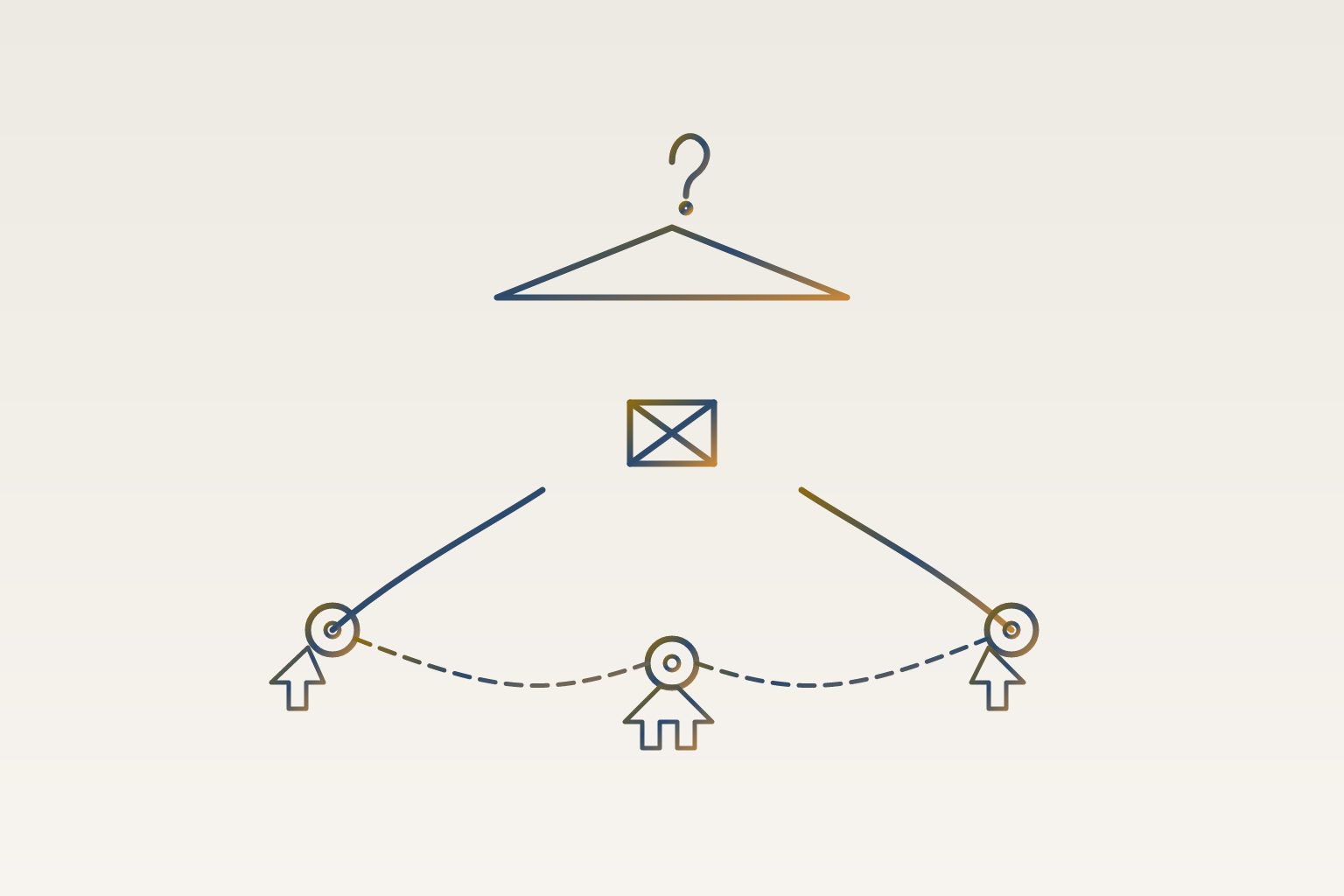
What exactly is at risk here? LP relationship history is not the formal due diligence questionnaire, but the informal record of which conversations actually happened, what objections came up, what an LP's real mandate looked like beneath the official language. Co-investor warm paths affect whether a specific introduction made by a specific partner at a specific firm can be recreated for the next fund or whether it dies with the person who made it. There's also everything sitting one or two degrees out in the firm's collective email and calendar history, connections that were never surfaced or mapped in the first place, and sourcing relationships with bankers, advisors, and founders who trusted the original fund's name and now have no clear signal about whether that trust extends to whatever comes next.
None of this happens in a vacuum, either. Affinity's Investment Benchmark Report found that 42% of investors name competition as the single biggest factor shaping deal flow. A successor fund that can't reactivate its warm paths on day one isn't just starting slow, it's actively ceding ground to competitors whose networks stayed visible and intact the whole way through.
The compliance and regulatory context making the data governance problem harder to defer
There's a temptation to treat all of this as a problem for later, something to sort out once the closure paperwork clears. The regulatory backdrop makes that increasingly hard to justify. By 2026, the US alone has 20 states with comprehensive privacy legislation on the books, GDPR enforcement in Europe keeps maturing, and new AI-specific rules are stacking on top of both, producing a genuinely tangled patchwork that raises compliance costs and risk for any firm operating across state lines.
On the US side, the SEC's private fund adviser rules, adopted in August 2023, got vacated in full by the Fifth Circuit in June 2024 before they ever took effect, so they did not increase compliance costs for FoFs or accelerate consolidation (the direction of travel is toward more scrutiny of how data is held and transferred, not less). But that reversal shouldn't be read as regulatory retreat. The broader direction is still toward tighter scrutiny of how data gets held and transferred, not looser.
During wind-down specifically, questions that firms were comfortable deferring for years suddenly can't be avoided: who has access to LP contact data, on what legal basis, for how long, and under what controls. Firms without any governed relationship data infrastructure end up boxed in on two fronts at once. They can't extract any real value from the network they spent years building, and at the same time, they have no way to demonstrate to a regulator that the data was ever handled responsibly. The EU's Digital Operational Resilience Act (DORA), fully effective since January 17, 17, 2025, requires financial institutions to implement comprehensive ICT risk management and third-party risk management, with privacy implications that extend into wind-down scenarios where data systems are being decommissioned.