Why the Strongest Sourcer at a Firm Is Rarely the Most Connected
Firms source better by surfacing existing connections than by hiring the most connected partner.
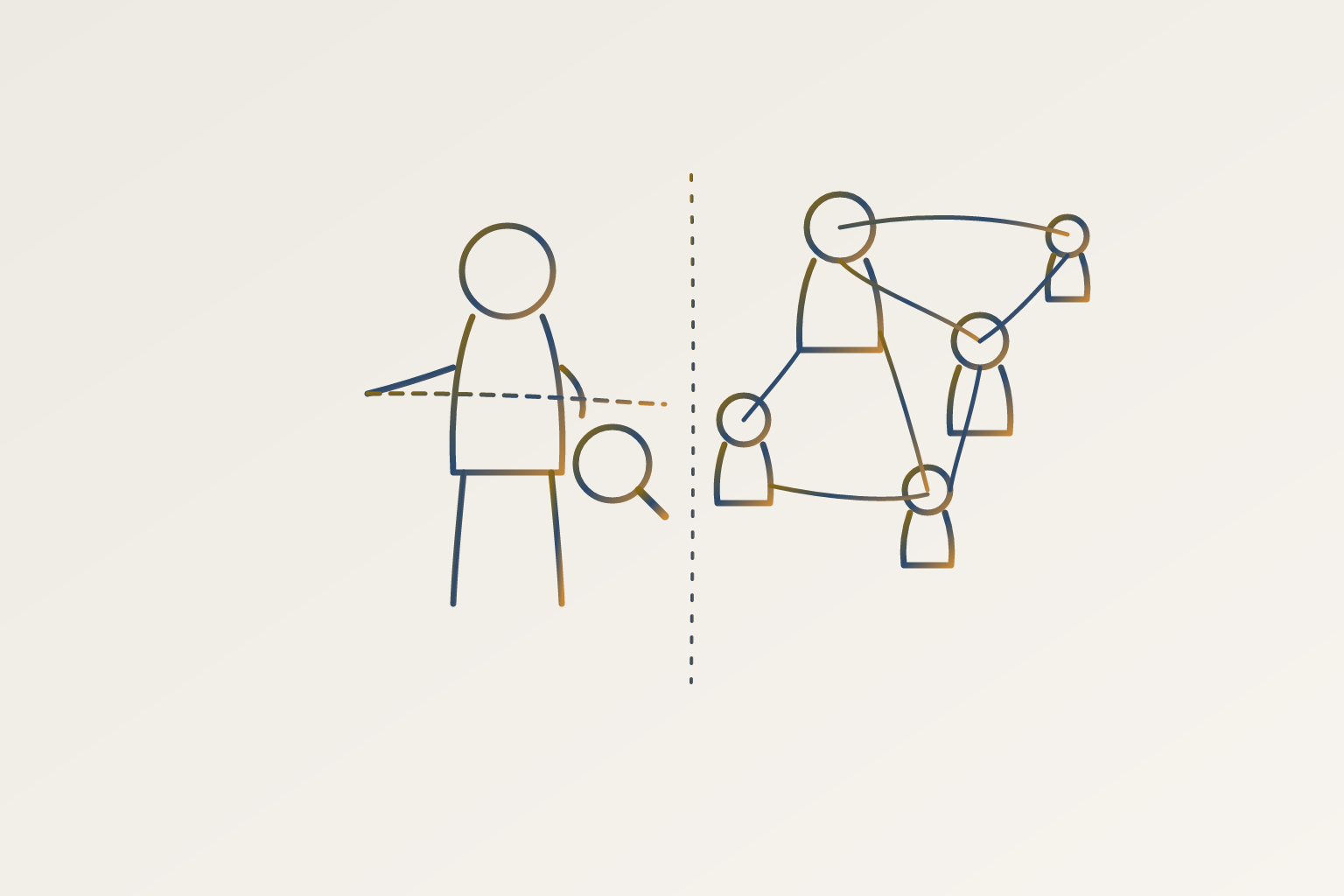
A partner spends another Tuesday working the conference circuit, collecting badges and business cards, while two desks away a colleague's inbox holds an unused introduction to the exact founder that partner has been chasing for months. That gap, between effort and access, is the subject of this piece. Sourcing advantage does not come from how many people a dealmaker knows. It comes from whether the firm can see, and act on, the relevant connections it already has.
Sourcing volume versus sourcing advantage
Most firms run on a simple, unexamined model of what makes a strong sourcer: someone who shows up at every conference, takes every coffee meeting, and keeps a contact list that stretches into the thousands. That model rewards visible activity. It says nothing about whether that activity produces access to the specific person, company, or opportunity a deal requires.
Star-power sourcing built this way is fragile. A partner who closes deals through sheer personal reach carries an asset that belongs to that partner alone, not to the firm. When that person leaves for a competitor, retires, or simply gets pulled into other priorities, the relationships they cultivated leave with them. The firm is left with the same office, the same capital, and a sourcing pipeline that has quietly emptied out.
The deeper issue is less visible and more expensive to ignore. Most firms already hold the network they need to win the next deal. The warm path to a target company often exists inside the firm right now, sitting in a colleague's sent folder or a former deal team's calendar history. It stays invisible because relationship data lives scattered across individual inboxes, personal contact lists, and the memories of whoever happened to take that meeting three years ago, rather than inside a system the whole firm can query. Sourcing advantage, understood this way, is a visibility problem and an intelligence problem, not a contact-count problem. The firms pulling ahead on origination are the ones that have figured out that distinction and built around it.
Why Warm Introductions Convert at a Different Rate Than Cold Outreach
The gap between a warm introduction and a cold email is not a matter of degree. It reflects a different cognitive process entirely. When a trusted mutual connection vouches for an introduction, the recipient starts from a position of assumed credibility rather than default skepticism. They are not evaluating a stranger from zero; they are extending trust that has already been established with someone else and transferred through the introduction itself.
Nielsen research backs this up at the broadest level: the most trusted signal any buyer receives is a recommendation from someone they know personally, a pattern that holds in B2B contexts as much as consumer ones. That pattern appears directly in buying behavior: 84% of B2B decision-makers start the buying process with a referral. A sourcer who cannot route outreach through a trusted relationship is working at a structural disadvantage before the first message is even sent, competing for attention against people who skipped that cold step entirely.
Not every warm introduction carries the same weight, either. The strength of the connector matters as much as the existence of the connection itself. An introduction from a portfolio founder to an investor carries a different kind of social proof than one made by a casual acquaintance, even when both technically qualify as warm paths, because the founder's credibility and stake in the relationship travel with the introduction.
In private credit, the advantage compounds further. A deal that arrives through a trusted intermediary comes pre-validated, not just on the borrower's financials but on behavioral quality, how the sponsor operates under pressure, how reliable their prior representations have been. That pre-validation accelerates term sheets, reduces the number of processes that fall apart midstream, and frequently shows up in better economics for the lender, because less of the deal's risk has to be priced in as unknown.
The best individual networker versus the firm's best sourcing asset
Here is the fallacy most firms operate under without ever naming it: treating one partner's personal network, or one business development professional's contact list, as though it were the firm's network. These are categorically different things. A partner's personal network of contacts is personal property, built over a career, shaped by that individual's history and relationships. The firm's network is the sum of every employee's professional relationships combined, and it is almost always far larger than any single person's slice of it, if anyone bothered to add it up.
Combining the email and calendar history of a co-founder, a head of sales, and a handful of key advisors produces a network that is a multiple of what any one of them could claim alone. The share of target accounts reachable through some warm path, rather than cold, rises sharply once that combination happens. Most firms never perform this combination. They leave each person's relationships siloed inside that person's own tools and memory. The firm operates, in practice, as though it only has access to whichever individual happens to be working a given deal.
That failure carries a real time cost. Partners spend a substantial share of their working week on networking activity meant to keep the deal channel full, because relationship capital that has not been systematized has to be manually maintained by the people who personally hold it. Every hour spent re-earning access that the firm technically already has is an hour not spent underwriting, negotiating, or sourcing something genuinely new.
The data backs the efficiency case. In middle-market lending, warm-sourced opportunities convert to closed deals at a dramatically higher rate than purely competitive processes, and they consume far fewer underwriting hours per dollar of committed capital. That is a measurable operational advantage that appears in close rates and staffing costs.
The standard objection to all this runs: senior partners already know everyone who matters, so the network is fine as it stands. That might hold at the first degree of connection. But the relevant link to a target company is frequently one step removed from the senior partner, sitting inside a colleague's history rather than the partner's own. Without a system that surfaces that second-degree path, it stays invisible, and the deal goes to whoever finds it first.
How relationship data gets trapped inside firms
Relationship intelligence locked inside one partner's inbox behaves the same way revenue intelligence trapped in a single department's spreadsheet does: the value exists, but nobody who needs it can get to it. A firm can be sitting on exactly the connection a deal team needs and still lose the deal when that connection never reaches the people running the process.
The failure is as much cultural as it is technical. When systems do not talk to each other, institutional knowledge attaches itself to whichever individual happens to hold it, and that person becomes a kind of human bridge spanning the gaps between disconnected data. It works, for as long as that person stays at the firm. It stops working the moment they leave, taking the bridge with them and leaving the gap exposed again.
Financial services firms feel this acutely. When front-office advisors cannot see the active relationships a client already holds elsewhere in the firm, cross-selling stalls out and a competitor often steps into the opening, because nobody internally could see that the relationship existed.
CRM systems that depend on manual data entry make the problem worse instead of better. When logging a contact or an interaction is a chore, it tends not to happen, and the system meant to preserve the firm's institutional memory of relationships stays thin or stale right when a deal team needs it most. Affinity's research finds that relationship intelligence tools which automate data capture save dealmakers a significant amount of time each year that would otherwise go to manual entry, hours that, absent automation, are either lost to the task or simply never spent, leaving CRM records incomplete at the moment they matter.
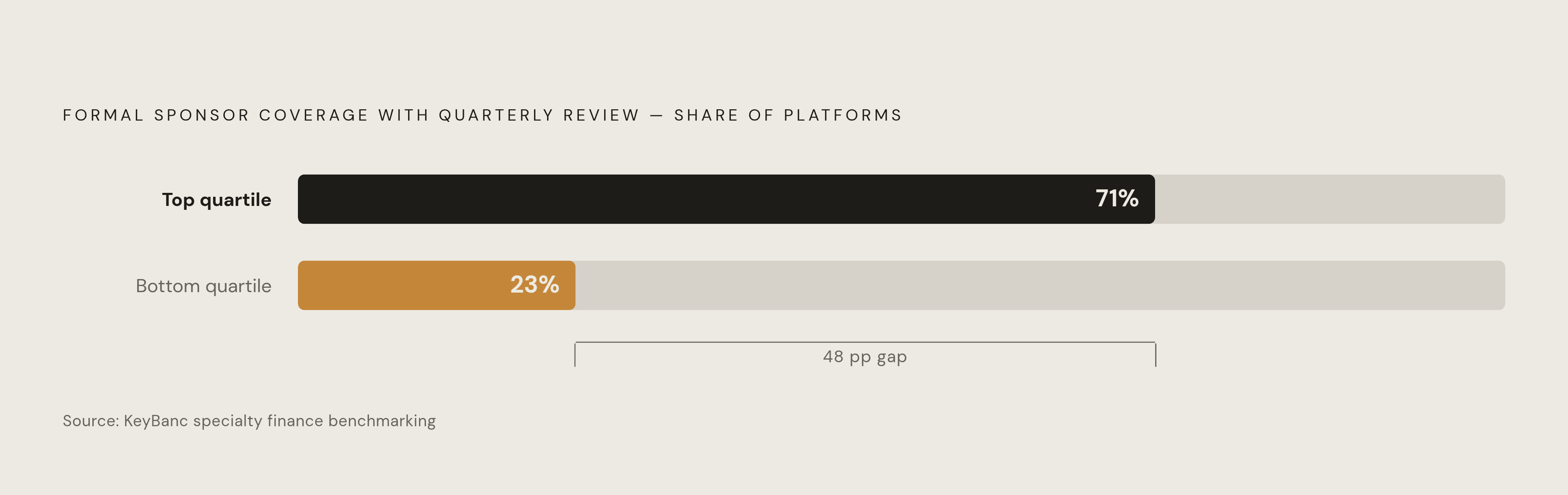
Origination data shows the gap starkly between firms that have addressed this and firms that have not. Among the top quartile of platforms by origination productivity, 71% maintained formal sponsor coverage models with quarterly review processes, according to KeyBanc's specialty finance benchmarking. Among the bottom quartile, only 23% did. That spread does not close on its own. It widens, because every lapsed contact, every missed timing window, and every departed employee takes a piece of unsystematized relationship history with them, and the firms that never built a system to capture that history in the first place have nothing left to recover.
What firms that have operationalized relationship intelligence do differently
The firms winning on origination treat relationship capital as an operational discipline with defined coverage models and explicit contact-cadence targets rather than as an individual skill some partners happen to have and others don't. The infrastructure they build makes the collective network visible and queryable to anyone on the deal team, rather than locked inside whoever happens to hold the relevant relationship.
Motive Partners increased the number of annual deals reviewed by 66% after adopting relationship intelligence infrastructure. Notion Capital now screens significantly more companies annually than it did before making a similar shift. Neither of those is a marginal efficiency gain from better organization. Both represent a structural change in how the firm accesses and acts on the network it already had.
Direct lending offers a clearer picture of what the discipline looks like in daily practice. Platforms including Antares, Owl Rock, and Audax Private Debt have moved relationship management out of the category of soft skill and into measured process. Origination teams at these platforms track contact cadence with priority sponsors, monitor refer-out rates from intermediaries, and follow renewal probabilities at the individual deal level, the same way other parts of the business track underwriting metrics.
A newer entrant illustrates a different technical approach to the same underlying problem. Originalis AI, described by RRE Ventures general partner Vic Singh in a June 2025 essay, takes a graph-based approach to figuring out which subnetworks to activate for a given deal. Rather than starting from the question "who do I know who can vet this?", the system works from domain expertise, relationship strength, and relevance to the specific opportunity, to surface the right people with the right context at the right time.
Across every one of these examples, the pattern repeats: none of the performance gains came from adding more contacts to anyone's list. They came from making the connections that already existed visible and routable to the people who needed them. The problem these firms solved was never reach. It was visibility.
The Visibility Advantage in Off-Market and Second-Degree Opportunities
The highest-returning deals tend to be the ones that never appear in a database or a banker-run auction in the first place. Off-market opportunities, discovered through direct relationships with owners, management teams, and trusted intermediaries, are structurally invisible to any firm operating only at first-degree network depth, because by definition nobody at that firm has a direct line to the people involved.
Firms that rely instead on competitive auction processes end up competing primarily on price. That dynamic pushes valuations up and expected returns down for everyone bidding. Proprietary sourcing functions less as a stylistic preference and more as a returns thesis in its own right: the deals worth the most are frequently the ones that never reach a formal process at all.
Timing plays as large a role here as the connection itself. The most efficient private equity firms build relationships with target companies well before any transaction timeline exists, watching for liquidity signals such as ownership transitions, CEO retirements without a clear succession plan, or corporate divestitures of non-core business units. That orientation, acting on a signal months or years ahead of a mandate rather than reacting once one appears, depends entirely on the firm having visibility into its collective network long before any specific deal need arises.
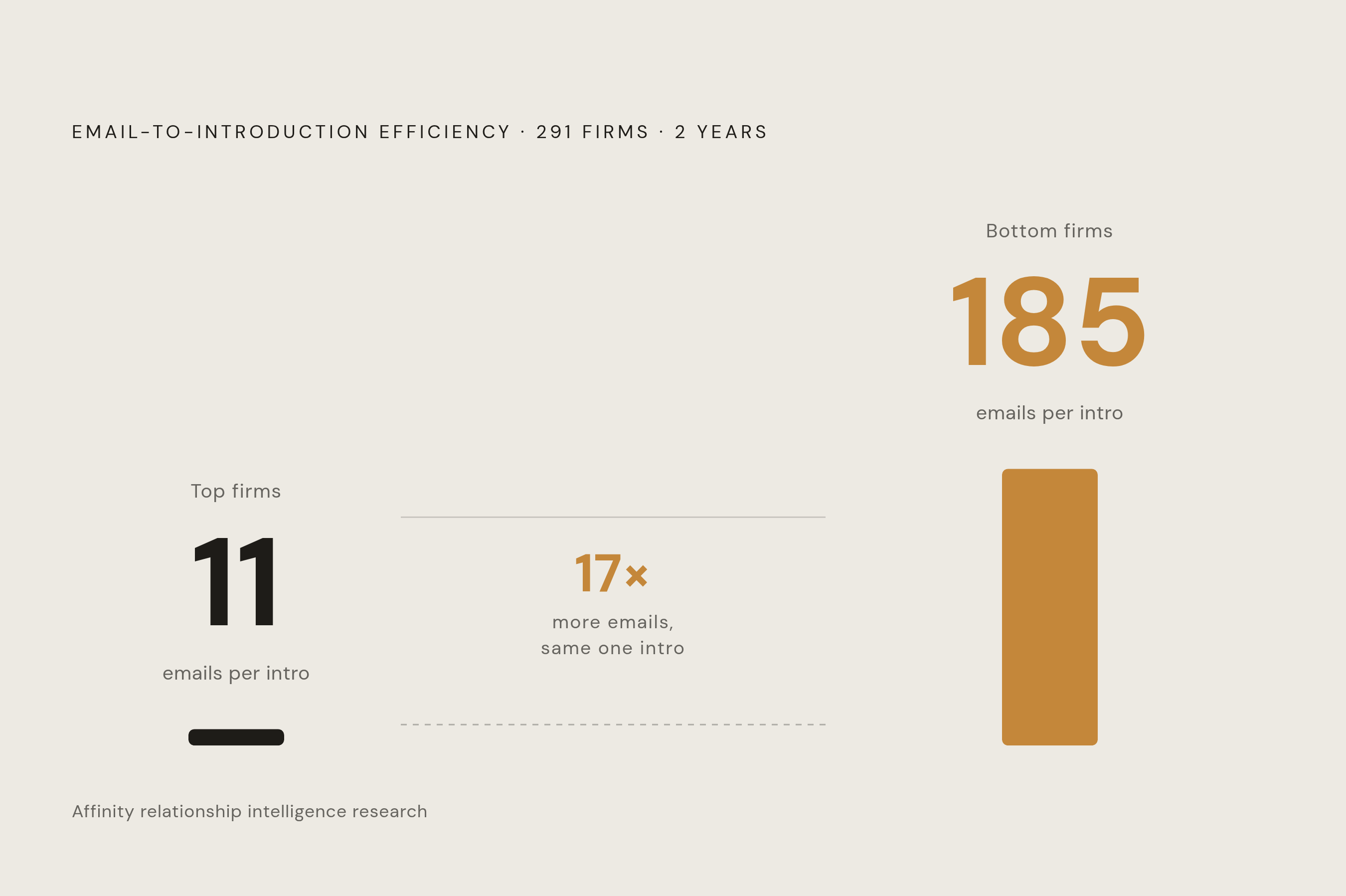
The research below shows this efficiency gap between visibility and volume most starkly. Affinity's research, drawn from 291 private equity firms studied over two years, found that the most efficient firms generate one introduction for every 11 emails sent, while the least efficient need 185 emails to produce the same single introduction, a 17x gap in efficiency. Second- and third-degree connections, the ones most likely to unlock an off-market opportunity, are also the ones most likely to sit completely invisible inside a firm's collective history, dormant simply because nobody thought to look for them. That is the gap this entire piece has been pointing toward: the value sitting unused is largest precisely where the returns on finding it are largest too.
Why Trust Is the Precondition for Relationship Intelligence
Making relationship data visible across a firm raises an obvious and legitimate concern: whose data is this, who gets to see it, and what happens to a partner's private conversation history once it enters a shared system. The infrastructure to activate a firm's collective network already exists. Deploying it inside high-trust professional environments requires a principled answer to those questions, because without one, the people whose relationships make the system valuable will not use it.
Personal relationship context and institutional relationship signals are not the same category of information, and a well-designed system treats them accordingly. A partner's private conversation history with a specific contact is one thing. The signal that a connection exists between two people, that someone at the firm has a path to someone at the target company, is a separate category of information, and a system can expose that signal while keeping the underlying conversation history private.
The organizations moving fastest on AI-powered relationship intelligence inside high-trust environments share a common feature: permissioned data architectures built in from the start. Compliance in this context functions not as a constraint bolted onto the system afterward but as the foundation that makes firm-wide deployment possible at all, rather than limiting the tool to whichever individual power users are comfortable sharing everything.
The trust question is a governance question as much as a technical one. Firms that roll out relationship intelligence tools without clear rules about permissioning tend to meet resistance from the very people whose networks the system depends on pooling. Adoption stalls, and the collective graph that was supposed to make everyone's sourcing stronger stays sparse, populated only by whoever was willing to opt in without guarantees. Getting the architecture right is the condition that makes the network effect possible in the first place.
Permissioned visibility, built around surfacing the signal of a connection without exposing the private context behind it, is one working example of this principled approach in practice. That design choice is what separates a tool dealmakers will actually feed with their real networks from one they quietly route around.
The strongest sourcer at a firm is the person, or the system, that can see which relevant connections already exist across the organization and activate them with enough trust in what the system surfaces to act on it. Visibility, not volume, is where sourcing advantage actually lives.
Sources
- The State of Warm Intros 2026: 60+ Stats Every B2B GTM Leader Should Know
- A deep dive into relationship intelligence, and why it matters in private capital
- Warm Intros & Referrals for B2B Sales in 2026
- The Warm Introduction Premium: Why Relationship-Sourced Deals Still Close at Better Terms - ABF Journal
- Deal Sourcing: Process, Strategies & Best Practices [2026]