Why the Best Intro Request Gets Ignored Anyway
Good intentions fail when firms lack systems to execute them.
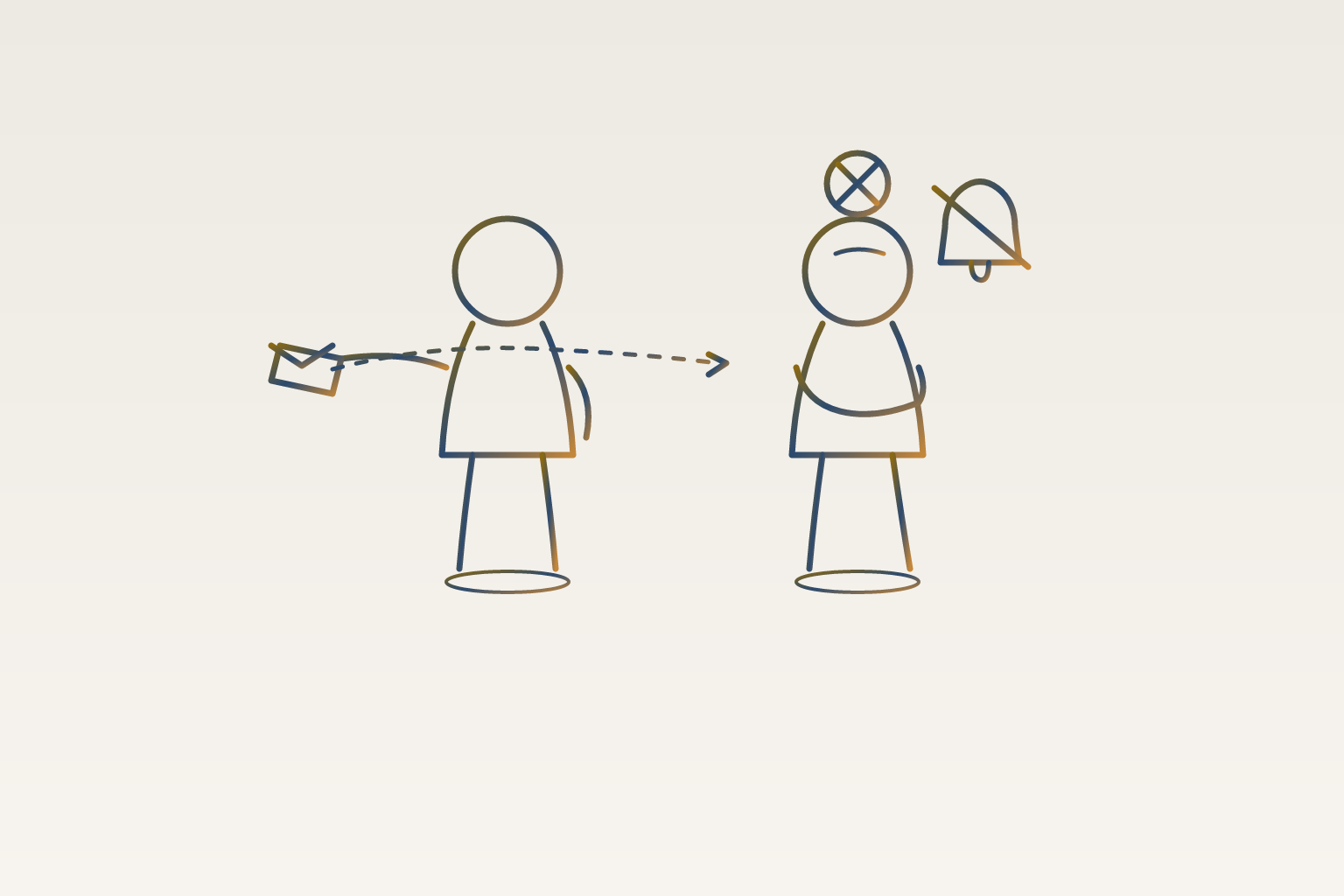
The request was well-written, the relationship was real in every way that should have mattered, and the connector said yes. Then nothing happened. That sequence, familiar to anyone who has ever asked a colleague to make an introduction, is usually diagnosed as a problem of craft: the ask was too vague, the relationship too thin, the timing off. The evidence points somewhere else. Warm introductions fail predominantly at the moment of execution, because the path from "willing to help" to "help delivered" runs through infrastructure that most firms simply don't have. This piece traces that gap, from the neuroscience that makes warm introductions valuable in the first place, to the business cost of leaving that value unclaimed, to the specific point where the path collapses, and finally to what it would take to fix it.
Why warm introductions outperform cold contact
To understand why a failed introduction is such a costly failure, it helps to look at what makes a successful one so powerful. Cold outreach from an unfamiliar name activates the brain's threat-detection system, centered in the amygdala, and the result is a defensive posture: skepticism rises, trust barriers go up, filtering kicks in before the message is even read closely. A warm introduction changes the chemistry of that first contact. When an introduction comes through someone trusted, the brain releases oxytocin, which lowers defensiveness and primes the recipient for a conversation approached with genuine interest rather than suspicion. The introducer is, in effect, lending their own credibility to the exchange, and the recipient's brain treats that loan as a safety signal. That transfer of trust is only as strong as the relationship behind it: warm introductions are five times more likely to result in a successful meeting when the introducer has a substantial pre-existing relationship with the recipient. A passing reference to a mutual acquaintance in an otherwise cold email does not reproduce this effect, because there is no real introducer placing anything on the line. If this mechanism is as powerful as the research suggests, then every introduction path that exists inside a network but never gets activated is a specific, measurable transaction that simply never got made.
The performance gap between a warm path and any alternative
ExecAtlas's own internal research found that warm introductions produce roughly 15 times the response rate of cold outreach to executives. Partner-sourced deals close more often, close faster, and reach significantly larger deal sizes than opportunities generated through outbound effort, and The State of Warm Intros 2026 reports that most B2B decision-makers begin their buying process with a referral. That detail reframes what the "warm path" even is: not a premium shortcut reserved for the lucky, but the default route through which serious decisions get made. Partner referral conversion from lead to deal runs dramatically higher than general industry referral averages, the same 2026 synthesis finds, and Crossbeam's ELG Insider analysis documents specific cases where partner-attached pipeline and ecosystem introductions drove materially higher close rates and deal sizes, including one case where involving a partner in qualification raised deal size by a third to nearly half. Meanwhile the alternative channel keeps getting weaker on its own: cold email reply rates have compressed for six straight years, and the unit economics of cold outbound now only work for products with very short sales cycles and very high volume. The warm path is pulling further ahead of the cold one every year, which raises an obvious question: if the gap is this wide and this well documented, why do so many warm paths inside a firm's own network still go unused?
Where the introduction dies: the connector's invisible gap
Consider a deal team that has every reason to believe a useful introduction exists somewhere in its network. A sales rep's CTO once worked alongside the CFO of a target account; nobody on the deal team knows this, because nobody has a way to see it. The goodwill is presumably intact, and the path to a warm introduction sits one conversation away. It never gets made because the path operates invisibly until someone happens to surface it by memory or coincidence.
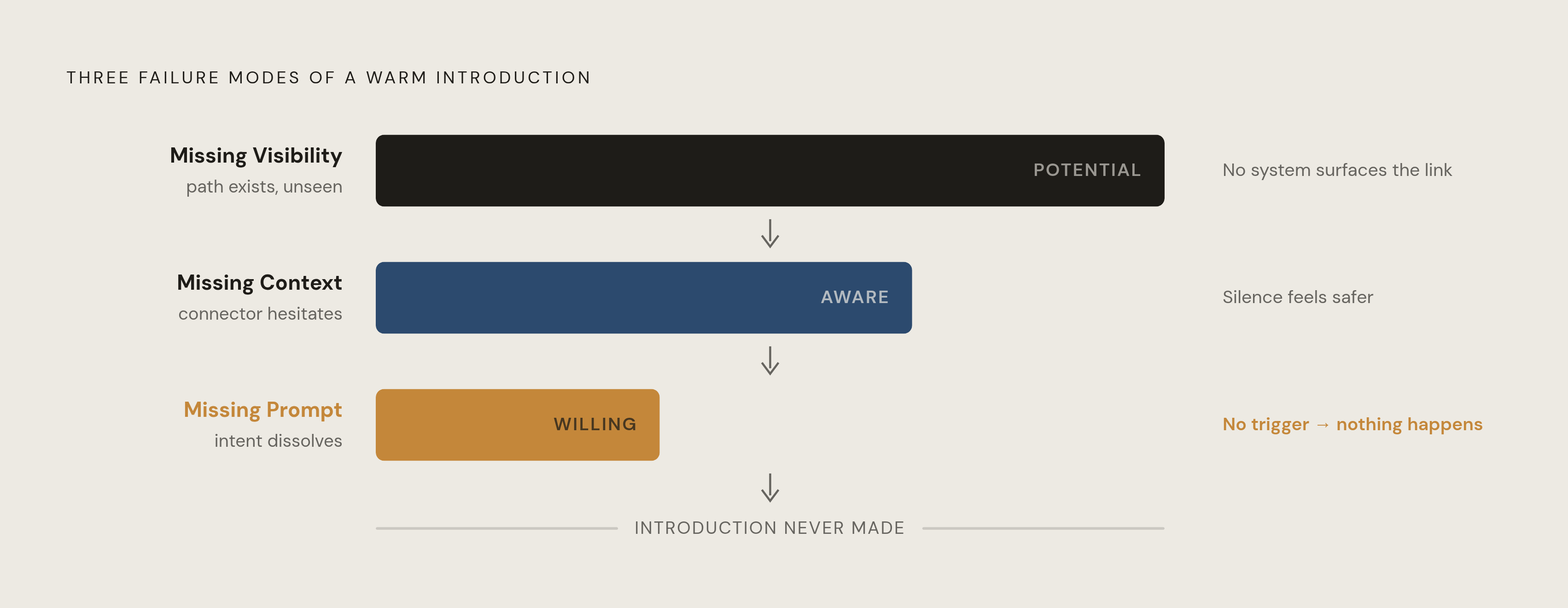
That scenario illustrates a pattern that recurs across three distinct, compounding failure modes, all of which can be present even where the underlying relationship is completely genuine. The first is missing visibility: nothing in the firm's systems surfaces that a sales rep's CTO and a target account's CFO once worked together, so the connector simply doesn't know the path exists. The second is missing context. Even when a connector knows both parties, they often lack enough current information about what the requestor needs or what the recipient currently cares about to frame the introduction with any confidence, and connectors are naturally reluctant to make introductions they suspect might fall flat, particularly when no mutual benefit is obvious to them. The third is the missing prompt: the connector may be entirely willing in principle, but the moment to act never quite arrives, because relationship maintenance happens asynchronously and, absent a trigger, good intentions dissolve into the noise of competing priorities.
These three gaps feed each other. Jared Fuller's framing in ELG Insider captures why the stakes are personal for the connector: leveraging an introduction means borrowing someone else's hard-earned trust, not simply asking for a referral. Because that risk falls on the connector rather than the requestor, and because an introduction request that arrives without enough context does nothing to offset that risk, inaction becomes the rational, safer default. The willing connector and the completed introduction are separated not by bad intent but by a gap that nothing in the current workflow is built to close.
Why institutional relationship data makes this failure structural
It would be convenient to treat this as a problem of individual discipline, solvable if connectors simply paid closer attention or kept better notes. The deeper pattern says otherwise. Most firms have no institutional architecture for storing, surfacing, or sharing relationship intelligence. Who knows whom is rarely documented in any form that can be queried across a team; relationship mapping, where it happens, is done by hand, incompletely, and infrequently, so visibility into second- and third-degree paths simply doesn't exist at the organizational level. Whatever institutional knowledge does accumulate tends to live with specific individuals who become informal brokers of context, and when those people leave the firm, that knowledge leaves with them, compounding the same silo problem the firm already had.
Financial services shows the sharpest version of this pattern. Relationship managers, through years of handling accounts, learn that CRM records systematically understate the real shape of a relationship: a subsidiary is logged but not the parent company, a single contact is logged but not the full committee that actually makes decisions. Once that gap becomes apparent, relationship managers stop trusting the system and start keeping their own shadow records, which by definition cannot be shared with anyone else. Investment banks that adopted large CRM platforms specifically to build institutional relationship memory ran into the same wall, GlobeNewswire's coverage of that pattern shows: adoption stayed low, deal impact stayed minimal, and bankers reverted to email threads and personal spreadsheets, leaving relationship knowledge exactly as scattered as it was before the platform existed. Source Code Deals' sourcing guide finds that competitive intensity for off-market deals is rising fast in private equity sourcing, where many firms draw on the same data providers and converge on the same opportunities. In that environment, the only real differentiator left is proprietary relationship access, and proprietary access requires exactly the kind of institutional visibility into a firm's own network that most firms have never built. The connector's failure is the predictable output of an information environment that gives no one a reliable way to see what the firm, collectively, already knows.
Why the CRM cannot fix this
The obvious objection at this point is that firms already have a system built to hold relationship data: the CRM. The trouble is architectural: a CRM is built to record what has already happened, not to surface what should happen next, and most CRM data is too incomplete and too stale to be trusted at the exact moment someone needs it. Validity's State of CRM Data Management in 2025 found that while nearly every organization treats CRM data as operationally central, a substantial majority report that less than half of that data is accurate and complete, with measurable consequences that include deals lost each quarter directly attributable to data quality failures.
That gap isn't a matter of sloppiness. A CRM stores contact records and logs interactions, but it depends on someone manually entering information, so it is structurally always behind the reality of how relationships are actually developing, as Articuler's comparison of CRM and relationship intelligence systems lays out. The financial services pattern described earlier generalizes well beyond that industry: once a system is seen as untrustworthy, people stop feeding it data, and once people stop feeding it data, it becomes even less trustworthy, leaving firms with a CRM that looks active on paper but is operationally useless for surfacing introduction paths in real time. Adding AI features on top of a degraded data foundation doesn't fix any of this. The Validity report specifically flags that organizations are layering AI capabilities onto CRMs without addressing the underlying data problems, which compounds the issue rather than resolving it.
A CRM functions as a system of record, while surfacing warm paths requires a system of intelligence, one that captures relationship signals passively, updates continuously, and proactively recommends who to contact and when, instead of waiting for a human who remembered to log the right field. That is a different kind of system, built for a different job, and no amount of better CRM hygiene changes what the underlying architecture was designed to do.
What closing the connector's gap requires
Closing the connector's gap means giving the willing introducer three specific things they currently lack: visibility into the path, enough context to vouch for both sides with confidence, and a timely prompt that turns willingness into action. None of these are things a manually maintained CRM can reliably deliver, for the architectural reasons just described.
Visibility means a firm-wide relationship graph, one that maps second- and third-degree connections across the places professional relationships actually live, email, calendar, LinkedIn, messaging, rather than depending on any individual to remember and type in a relationship history. Affinity's analysis of deal sourcing frames the problem in exactly these terms for private markets: the highest-returning deals tend to flow through direct relationships with owners and management teams, and finding those paths ahead of a competitive auction requires seeing the full shape of the network, not just the contacts sitting one degree away. Rolo approaches this directly by connecting the systems where relationships already live and turning scattered, fragmented history into a relationship graph that can actually be queried, giving deal teams and operators sight of warm paths they already hold but have had no way to see.
Context means relationship signals surfaced and ranked by recency and relevance, so a connector can make an introduction they can genuinely stand behind rather than a cold gesture toward a mutual contact they barely remember. The psychology research cited earlier is explicit that connectors hold back on introductions they suspect might flop, because the social capital risk falls on them if it fails. What a connector needs is enough signal to judge, with reasonable confidence, that an introduction will actually serve both parties. Rolo's approach to ranking relationships by relevance and recency, paired with outreach drafted in the requestor's own voice, cuts the friction of acting on a path without taking the professional's own judgment out of the decision.
The prompt turns visibility and context into something that actually happens. A relationship graph that sits quietly in the background, available only to someone who thinks to go looking for it, solves nothing. The architecture has to surface the path at the moment it matters, nudging the connector toward the specific, low-friction action of making the introduction, rather than leaving that action to compete against everything else filling a given week.