How to Build a Partnerships Tracker That Works for BD and Investor Teams
Mapping your actual relationship network unlocks the warm introductions that close most deals.
What relationship data means in the context of a partnerships tracker
A partnerships tracker that only records deal status is solving the wrong problem. It can tell a team where a deal stands, but it can't tell them who can get them in the door, and for BD and investor teams, that second question usually decides the deal's fate. Most trackers stop at contact identity, capturing only a name, a title, a firm, maybe a LinkedIn link. Everyone captures that layer because it's the easiest one to capture. It also says almost nothing about whether anything is actually going to move.
Two layers sit underneath contact identity, and both carry more weight than contact identity ever will: interaction history and connection topology. Interaction history is the running record of every email, call, meeting, and follow-up between two parties, and it's what establishes recency and warmth. Connection topology is the map of how a team actually reaches a given person: through whom, at what remove, along which path. If a firm skips that second layer, it can technically "know" hundreds of investors or partners while having no real idea which of its own people could pick up the phone and get a same-day reply.
Recency does more work here than volume does, and most CRMs get this backwards because they're built around cumulative activity counts. A contact who was emailed two hundred times in 2021 looks strong on paper. But if nobody's spoken to them since, that relationship is cold, full stop. Two touches in the past month tell a team more than two hundred touches from four years ago ever could.
That's the real difference between a contact and a relationship. A contact is a name and an email address sitting in a database. A relationship has direction (who reached out to whom), a history (what's actually been said and done), and an owner (the specific person on the team who holds that connection). A tracker that can't tell those two things apart is tracking an address book.
For investor teams, the graph gets more layered still. Founders, LPs, co-investors, advisors, board members: each group expects a different cadence of contact and carries different intro leverage. An LP writing a sizable check expects a different rhythm of engagement than a board observer at a portfolio company, and treating the two identically flattens information that matters the moment it's time to make an ask.
Why the warm-path problem is bigger than most teams realize
Roughly 70% of venture capital deals come through network relationships, and most firms still don't have the tooling to activate the networks they already sit on top of. The deal flow is there, embedded in relationships that already exist. It goes untapped because nobody built a system to surface it.
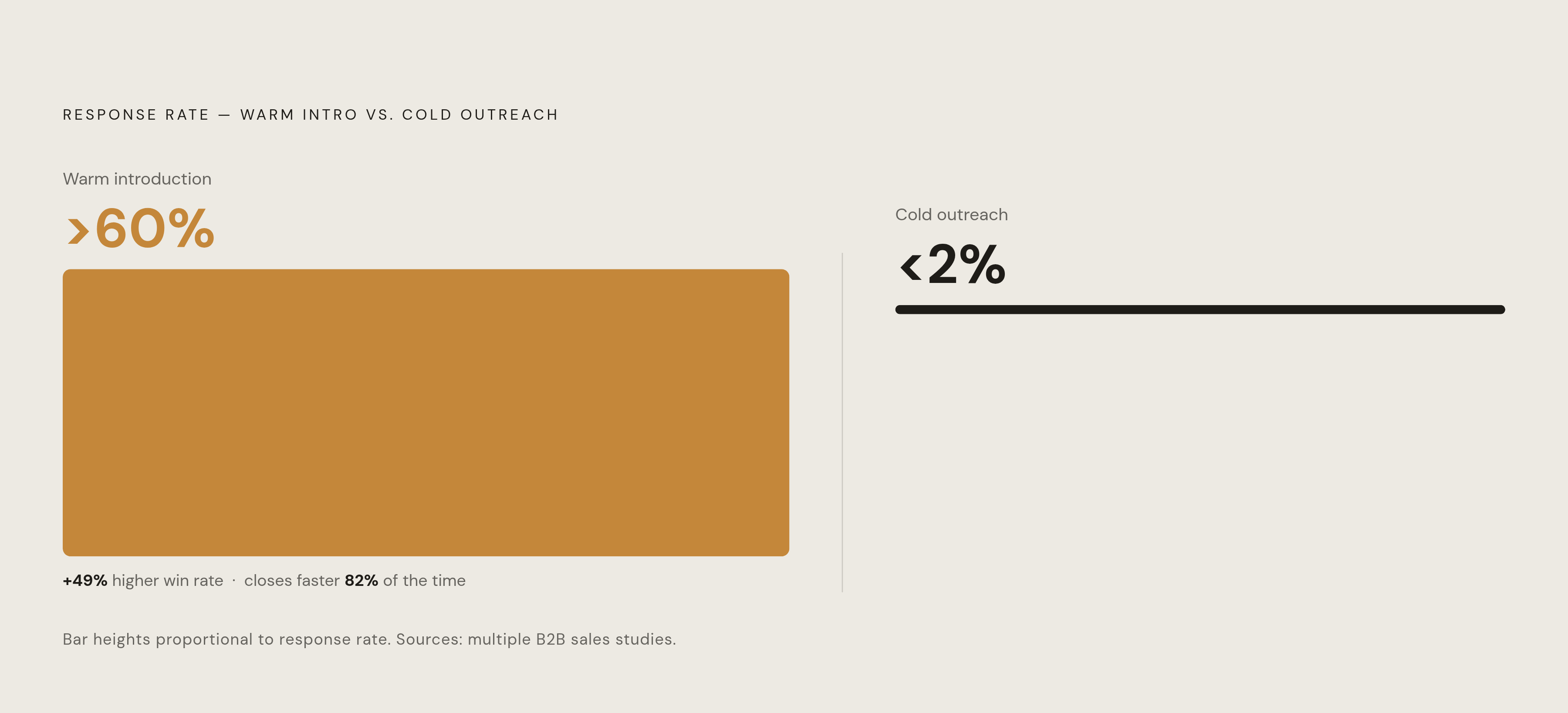
Data outside venture backs this up. Norwest's B2B Benchmark Report found that 65% of B2B pipeline now comes through warm channels rather than cold outreach. Commsor's Warm Intro Gap Report, which surveyed 1,305 sales and go-to-market leaders, sharpens the picture: warm-intro deals close faster 82% of the time, with win rates running 49% higher than cold-sourced deals. Warm introductions get a response over 60% of the time. Cold outreach gets a response under 2% of the time. That gap doesn't separate a good channel from a mediocre one, it separates a channel that works from one that mostly doesn't.
So why does this stay unaddressed? Look at the scale of what's sitting latent inside a typical portfolio. A Series B B2B SaaS company usually carries somewhere between four and seven institutional investors on its cap table, and each of those investors backs somewhere between twenty and fifty other portfolio companies. Multiplied out, a single Series B company sits at the center of a first-degree connector graph running somewhere between 100 and 350-plus warm paths. Most of those paths never get mapped. Fewer still get activated.
Nobody has to track the network for it to exist. A tracker that skips connection topology can't tell a BD lead that the warmest path to a target account runs through an investor's other portfolio company, three degrees removed from where anyone thought to look. That's a structural blind spot, not a data-entry failure. It's a structural blind spot.
The fields that belong in a relationship-first partnerships tracker
Every field on a good tracker earns its place by capturing relationship context. If it doesn't, it doesn't belong on the sheet, no matter how easy it is to fill in.
Most trackers already handle baseline identity well enough: contact name, firm, role, LinkedIn profile, partnership type (LP, co-investor, co-sell partner, channel partner, OEM, advisor), and deal or relationship stage. None of that is wrong. It's just not enough to run a warm-path search on.
Most trackers skip the fields doing the real work. Last meaningful interaction should log the date, the channel, and who on the team owned it, giving a fuller picture than a generic "last contacted" timestamp that tells nobody anything about quality. Relationship owner needs to name the specific person with the warmest connection to that contact, and that's often not the deal lead assigned in the CRM. Connection path records how the relationship originated: introduced by whom, at what remove. Relationship strength signal, whether scored or just qualitative, should read strong, warm, cold, or dormant, and it needs to decay automatically if nobody refreshes it. Intro history rounds it out: which introductions has this contact made on the firm's behalf, and to whom.
Investor teams need a handful more. LP tier and check size range. Co-investor overlap, flagging shared board seats or shared investors across portfolio companies, often reveals a path nobody thought to check. And a warm-path field to the founder or GP naming who inside the firm can actually make that introduction. Document the concrete connection.
How to keep relationship data current without building a manual-update burden
Relationship data decays faster than almost any other field in a CRM. A connection that was warm six months ago might be cold today, and no amount of careful data entry up front protects against that kind of decay.
If keeping a tracker accurate requires someone to log every call, every intro, every follow-up by hand, the tracker will fall behind. Updating a spreadsheet is the last thing anyone does after a meeting ends, when it happens. It's the last thing, when it happens. Research suggests that roughly a third of CRM data is inaccurate at any given time, and that number is what you'd expect from a system that depends on humans remembering to do extra work after the work that actually mattered is already done.
Manual logging was never going to scale, so the fix has to be structural too: auto-capture. Build the tracker to pull data from where relationships already live instead of asking anyone to re-enter what already happened. Email and calendar sync should log interactions automatically, timestamped and attached to the right contact record without anyone touching a keyboard. Meeting notes and follow-up threads should link straight to the relationship record.
Recency also needs to become an automated signal instead of a manual calculation. A flag showing whether a relationship has been touched in the last 30, 60, or 90 days does more to keep a tracker honest than any policy asking people to update fields more often. Nobody has to remember to check anything. The system tells them.
How to structure the tracker so warm paths surface at the moment they're needed
A tracker can hold excellent relationship data and still fail completely if nobody can query it fast enough when a deal opportunity actually shows up. Call that the activation gap. It's where a lot of otherwise well-built trackers quietly stop being useful.
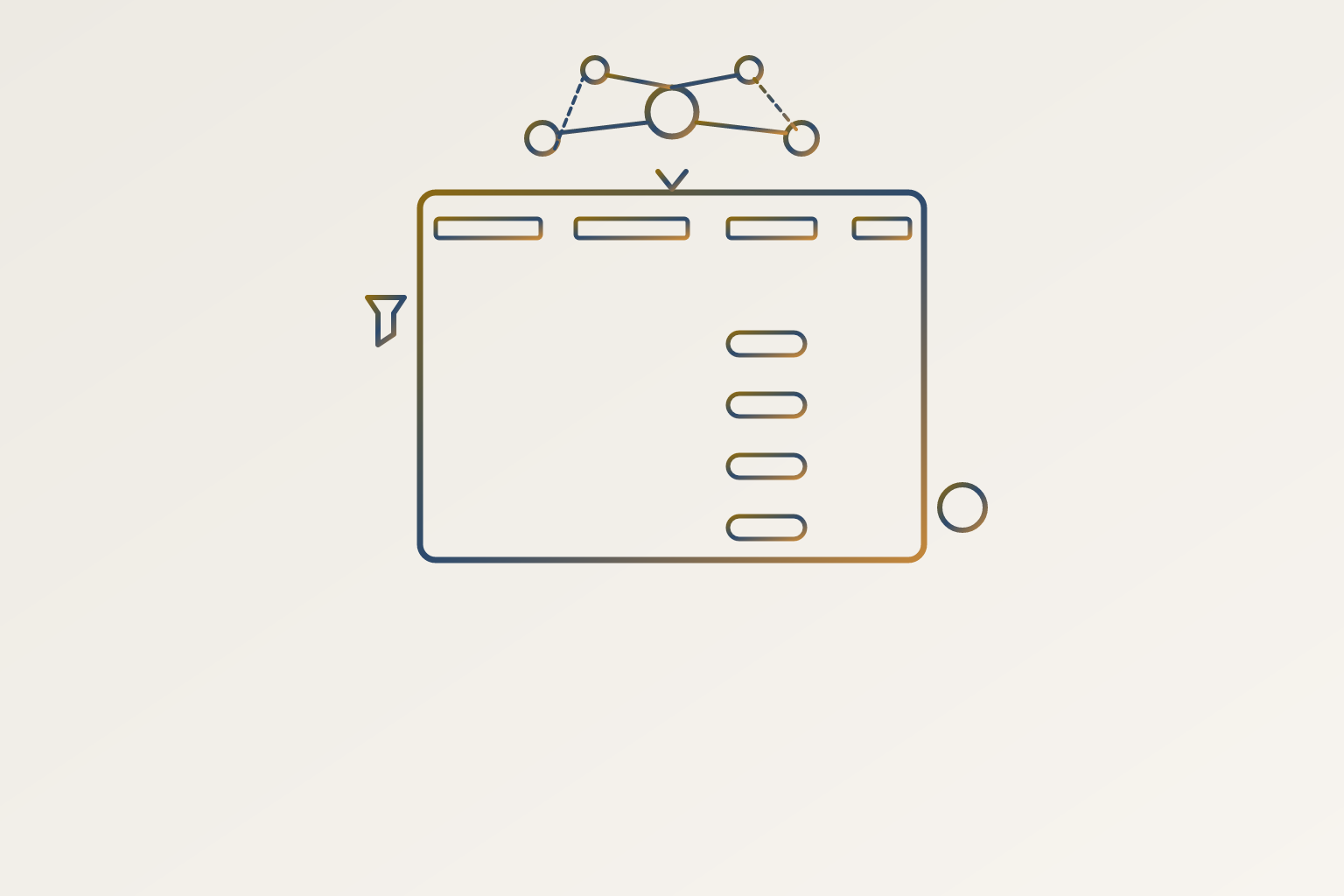
Can the tracker answer "who on the team can reach the CEO of Company X" as fast as it answers "what's the status of Company X"? Most tools can't, because most tools are built as lists organized around a single contact or a single deal, and lists are bad at answering questions about paths. Finding a warm path is a graph question: who connects to whom, through what intermediary, at what strength. A flat list forces someone to reconstruct that graph by hand, in their head, which defeats the purpose of tracking it.
One workable structure organizes contacts around four connector pillars, each with its own cadence and its own rules for engagement. Team networks make up the first: lowest friction, highest volume, usually one ask away from activation. Board members, investors, and advisors form the second, lower in volume but often highest in leverage for enterprise or investor-level targets, and these asks typically need to route through internal approval before they go out. Customer champions make up the third pillar and carry the highest trust of any group, particularly at the moment a champion changes jobs. A flag that identifies champion mobility, someone who advocated for the product moving to a new company, turns a moment that would otherwise pass unnoticed into a live opportunity. Partners round out the fourth pillar, activated less by cadence and more by intent signals. The tracker needs to surface the right partner contact the instant a trigger event fires.
Tag every contact by pillar, and a request routes to the right kind of ask automatically, instead of someone guessing whether pinging a board member for an intro is even appropriate for a given target.
How institutional relationship data breaks down across teams
Data silos rank among the most commonly cited operational headaches at the organizational level: 80% of organizations say silos actively hinder how they operate. That's a broad, cross-industry problem, but it appears in a specific, costly way inside BD and investor teams.
Relationship intelligence tends to live inside individual inboxes and calendars rather than any shared system, and that's the design flaw most firms never fix until it costs them something. When a partner or a VP leaves the firm, the context walks out the door with them: who they actually knew well, how warm those relationships really were, which introductions they'd already made on the firm's behalf. None of that survives an offboarding process built around forwarding an email account to someone else.
Solving it means aggregating relationship signal across the team without exposing personal message content nobody agreed to make public. What should be shared is narrow and specific, covering the fact that a relationship exists, a strength signal, who owns the connection, and the date of the last interaction. What has to stay private is just as specific: the content of individual messages, and any personal context a contact shared in confidence.
That distinction is why permissioned architecture belongs in the design from day one, not bolted on later as a compliance afterthought. A junior analyst has no business reading a managing partner's LP correspondence. But that same analyst should be able to see that a warm path to a given LP exists and runs through that partner, without needing to read a single email to know it. Visibility into the graph, privacy over the content: build both into the same system, and that's what separates a tool people trust from one they quietly work around.
Tools that can serve as the relationship intelligence layer for a partnerships tracker
The right tool depends on what a team is actually trying to do, whether that's sourcing venture deals, running BD at a SaaS company, managing wealth management relationships, or staffing professional services engagements. Two axes shape the outcome in ways most vendor pitches skip over. Discovery breadth measures how many relationship sources actually feed the graph. Activation depth measures whether the tool just surfaces a warm path or actually helps run the introduction end to end. Most platforms in this category, as of 2026, cover one or two connector pillars on discovery, with activation depth that's partial at best and often fairly shallow.
Affinity positions itself as an AI-first CRM built for private capital, and it fits Tier 1 and Tier 2 VCs, growth equity firms, M&A advisory shops, and family offices best. On discovery, it pulls from multiple pillars at once, drawing on partner email and calendar auto-capture, multiple enrichment sources, a browser extension, an Interactions API, and a meeting notetaker. Activation depth runs lower, warm paths surface in the platform rather than the introduction running itself from there. Affinity reports being trusted by more than 3,300 private capital firms, with a graph built on a substantial base of logged interactions and relationships, and its Ascend platform handles procedural work at each stage of a deal. Pricing runs in tiers across Plus, Professional, and Enterprise plans, with costs scaling by team size and feature set. Firms using it include Bain Capital Ventures, Kleiner Perkins, and Notable Capital.
4Degrees takes a narrower but deeper approach on relationship mapping, built specifically for VC, PE, and investment banking teams by people who came out of investing roles themselves. Its strength is network-driven deal sourcing: advanced relationship mapping, warm introduction pathways, and scoring that reads communication patterns to estimate relationship strength. It fits VC and PE teams that want strength scoring built directly into the deal pipeline rather than living in a separate system that needs constant cross-referencing.
Neither tool solves every piece of this on its own, and nobody should expect one to. What both point toward is the same underlying shift: a partnerships tracker earns its keep not by logging what already happened, but by telling a team, at the exact moment they need it, who can make the next call.