Warm Handoff Process Between Origination and Deal Execution Teams
Losing relationship context between sourcing and execution teams kills deals before they start.
A deal doesn't die because the target lost interest or the numbers stopped working. It dies in the fifteen minutes between when the originator sends a "handing this off to the deal team" email and when the deal team actually picks up the phone. What gets lost in that window is the relationship itself. What the target valued was the relationship itself, or at least the parts of it that made the target want to engage.
The origination-to-execution handoff
Deal origination is the front end of the dealmaking process, the phase where PE firms, investment banks, and VC shops go looking for opportunities before anything resembling a formal transaction exists. The lifecycle runs in five recognizable stages: target identification and thesis alignment, initial outreach and relationship initiation, relationship cultivation and monitoring, initial screening and thesis validation, and finally LOI and exclusivity negotiation. Each stage has its own rhythm, and the pace varies wildly depending on how the deal originated.
An intermediated deal, one that arrives through a banker or an advisor, can move from stage three (cultivation) all the way to stage five (LOI) relatively quickly. A proprietary deal, the kind sourced directly through a firm's own network, might spend well over a year just working through stages one through three before it's even ready for screening. That gap matters, because the amount of relational capital built up before the handoff varies enormously, yet the handoff itself gets treated the same way regardless of which path the deal took to get there.
The transition between stage four and stage five, screening to LOI, is where the handoff actually happens, and it's also where most competitive deals are decided. Not because the execution team lacks skill. Most firms simply have no formal handoff artifact: no document, no structured record of what was learned during sourcing, nothing that converts months or years of relationship-building into something the execution team can pick up and use immediately. The knowledge sits with whoever sourced the deal, and hoping they remember to mention the important parts in a hallway conversation is not a process. It's a gamble dressed up as one.
The composition of relationship context and the difficulty of transferring it
Relationship context gets talked about like it's a contact record, reduced to a name, a title, an email address, maybe a note about the last time someone reached out. That undersells it badly. Relationship context is the accumulated knowledge of who knows whom, how trust actually got established between two humans, what got said in the early conversations that nobody wrote down, and what the founder or management team genuinely cares about, as opposed to what they say they care about in a pitch deck.
Break it into three pieces, because each one fails differently at handoff. Relational history is the sequence of touches: who made the first introduction, which portfolio company CEO picked up the phone to vouch for the fund, how many times the originator showed up at the same industry conference before the target started taking calls seriously. Trust provenance is how credibility got earned, whether through demonstrated sector knowledge, honest feedback given on a deal that got passed on, or simply showing up consistently over months or years without asking for anything in return. Conversational context is the substance underneath both: what was actually discussed, what commitments got made even implicitly, and what sensitivities appear in conversation and are never typed into a CRM field.
So why does this vanish so easily at handoff? Because none of it lives anywhere structured. It lives in email threads, in calendar history, in the originator's memory of a conversation from fourteen months ago. The only way to transfer it is for the originator to remember to say it out loud, at the right moment, to the right person. That's a fragile mechanism for something this valuable, and firms that treat it as reliable are making a bet they haven't priced correctly.
This is a version of a much older organizational problem: institutional knowledge trapped inside individual employees. When that knowledge lives only in someone's head, the business becomes dependent on a human translator, and if that person leaves, gets pulled onto another deal, or forgets to mention something under time pressure, the knowledge goes with them. In deal firms this is especially acute, because a senior partner's personal relationships often are the proprietary deal flow. Lose the translator, and the pipeline goes quiet with them.
Relationship context built during sourcing and destroyed at handoff
The sourcing relationship isn't built in a single conversation. Stage two and stage three of the lifecycle, relationship initiation and cultivation, can stretch across months or years: regular sector coverage calls, quarterly check-ins with the same banker, and, critically, honest feedback given on deals the firm passed on. A firm that gives thoughtful, candid feedback on a passed process preserves its credibility for the next one. Bankers remember who wastes their time and who doesn't, and that memory shapes who gets called first the next time something good comes along.
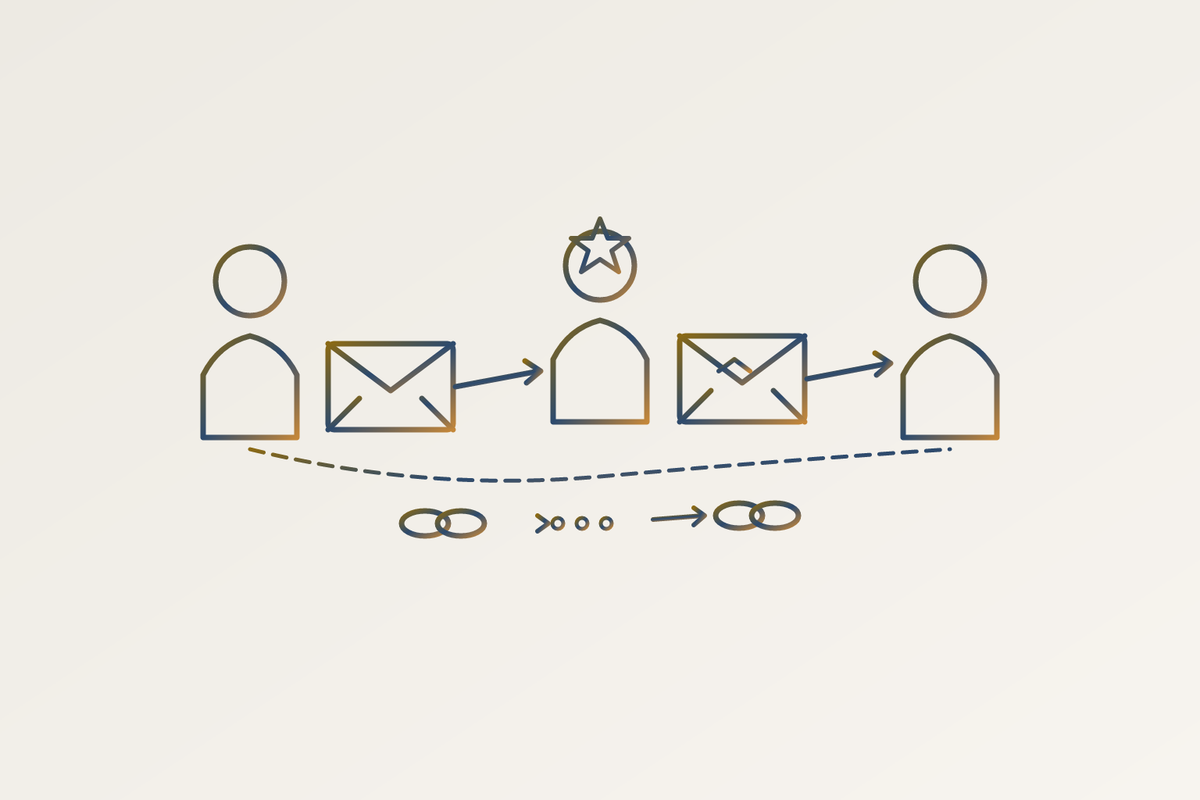
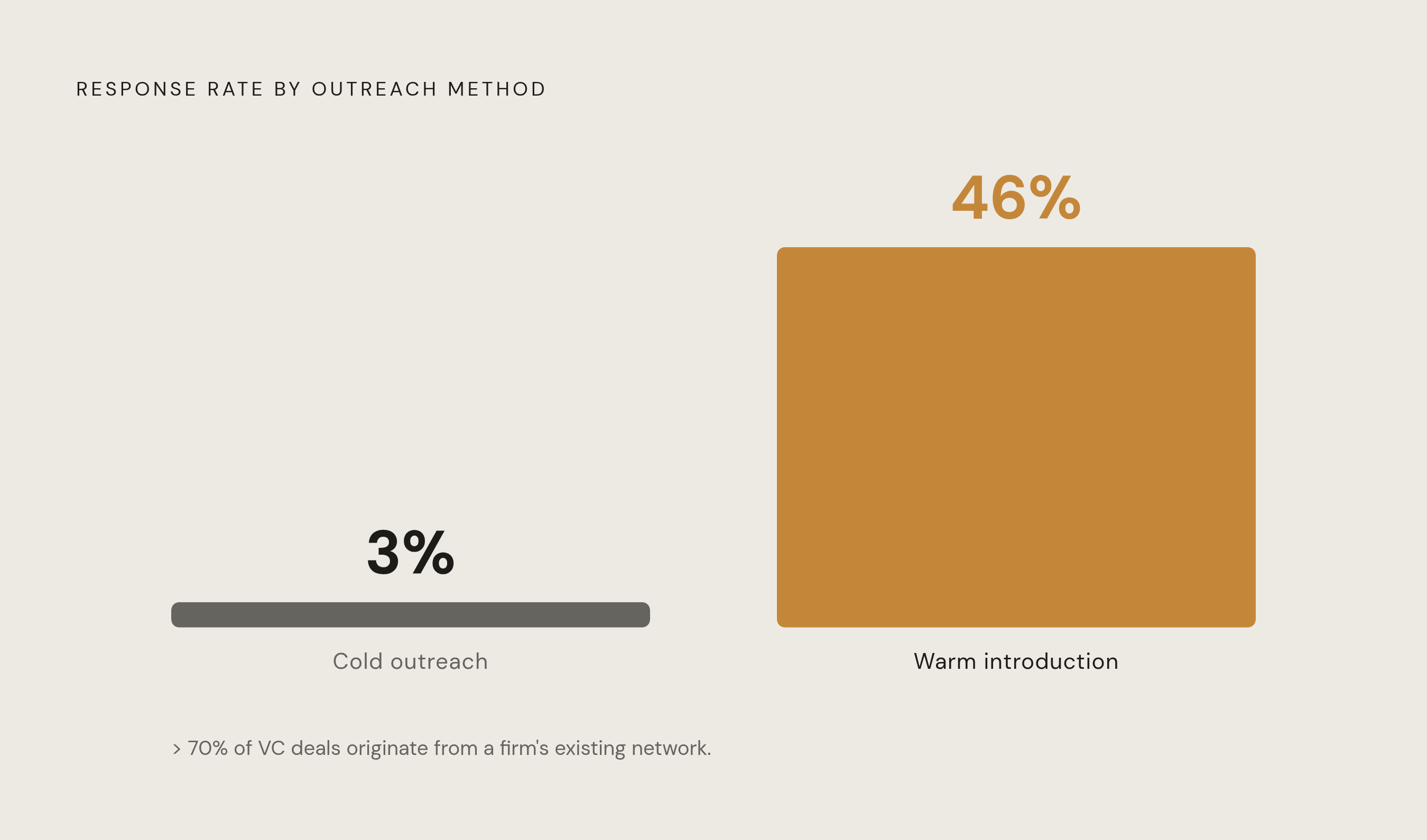
Warm introductions are where almost everything starts. More than 70% of VC transactions originate from a firm's existing network, and the initial contact in most cases comes through someone vouching for someone else rather than a cold email landing in an inbox. Cold outreach gets roughly a 3% response rate, while a warm introduction gets around 46%. That's not a marginal edge; it's an order-of-magnitude gap, and it means the relationship functions as a structural precondition for the deal rather than a nice-to-have layered on top of it afterward.
What's actually happening in a warm introduction is a transfer of trust. The introducer's credibility gets loaned to the new party, and that endorsement is frequently the entire difference between a founder taking the call and a founder ignoring it. So when the execution team shows up at the handoff moment stripped of that borrowed credibility, never having been introduced through the same channel, they are, for all practical purposes, cold calling. The deal has been "warm" for eighteen months on the firm's side of the ledger, but the person on the other end of the phone doesn't know that. All they know is a new voice showed up asking questions the old voice already had answers to.
Structured handoff document contents needed to transfer relational memory, not just deal data
The handoff document is supposed to work as a bridge, taking everything accumulated during the sourcing cycle and turning it into something the execution team can act on right away, without needing to interrupt the originator every time a question comes up. Most firms don't have a formal version of this. What they have, if anything, is a deal memo covering thesis, financials, and market sizing. That's necessary, but it addresses none of what's actually missing.
The execution team already knows how to read a P&L and run diligence. Nobody needs to teach a deal lead how to build a model. What's missing is the relational layer: the explanation of how this specific deal arrived on the desk and why this specific counterparty is willing to engage.
A handoff document built to preserve relational memory needs a handful of components, and each one answers a question the execution team would otherwise have to guess at. The introduction chain matters first: who made the original introduction, what their relationship to the target actually is, and why the target agreed to engage in the first place, with names attached rather than job titles. A trust provenance narrative comes next, describing how credibility got built, what sector expertise got demonstrated, what was said about the fund's value-add, and what feedback loops shaped the relationship over time. A conversational history should cover the key topics discussed, any commitments made along the way, and whatever the founder or management team has signaled about priorities, worries, or timeline. A sensitivities log needs to flag topics to avoid, prior outreach that got declined and the reason why, and any interpersonal dynamics that shaped how the relationship developed. And a relationship map should show who else inside the firm has existing ties to people at or adjacent to the target, including the second-degree connections nobody on the execution team would think to check for.
Skipping the relational layer leaves a document that captures deal economics and thesis alignment and nothing else, which describes most of what firms currently produce. That's a summary memo wearing a handoff document's clothes.
Surfacing the relationship map inside a firm before the handoff
Firms that go looking uncover, on average, more than 300 contacts and 700 relationships per user they didn't know existed inside their own network. Sit with that number for a second. It means the collective relational asset of a firm is almost always bigger and more relevant than any single team member, including the person running the deal, actually knows.
Why does this happen? Data silos, mostly. Companies lose somewhere between 20% and 30% of annual revenue to inefficiencies caused by fragmented data, and deal firms are not exempt from that math. In a firm running deals, the practical consequence is that a warm path to a target might already exist, sitting quietly in some other partner's contact list or inbox, invisible to the execution team simply because nobody thought to look, or because there was no way to look even if they'd wanted to.
That's because relationship data doesn't live in the CRM. It lives in email, in calendar history, in the back-and-forth of messaging threads that never get logged anywhere formal. Relationship intelligence, as a category, refers to the automated capture, analysis, and activation of that data across an organization's network: it surfaces who knows whom, how well, and in what context, without requiring anyone to manually enter it. Framed this way, the sourcing-to-execution gap looks less like a knowledge gap and more like a visibility problem. The execution team starts with the firm's collective knowledge already available to it. It's starting from ignorance of what the firm, collectively, already knows. Surfacing that network before the handoff, rather than after the first outreach attempt goes sideways, is what turns a blind execution team into one with three or four warm paths it didn't know it had.
The technology layer's capabilities and limits in supporting a warm handoff
Two different philosophies compete for space here, and they solve different problems. One camp is relationship intelligence platforms, tools like Affinity and 4Degrees, that auto-capture a firm's network directly from email and calendar activity, turning it into a searchable, firm-wide asset without anyone needing to type much of anything in. The other camp is configurable systems of record, tools like DealCloud, Altvia, and Salesforce, which give teams deeply customizable pipelines and fund records but depend on people actually entering and maintaining the data by hand.
That second category runs into a familiar wall. Over 60% of CRM failures trace back to people-related problems, not technology limitations. Low adoption means incomplete data, incomplete data means unreliable forecasts, and the same failure mode applies directly to handoff documentation: a system that depends on a busy originator remembering to log every relational nuance will, eventually, have gaps exactly where it matters most.
Auto-capture tools sidestep that dependency, at least for the mechanical part of the problem. A platform reading email and calendar activity can surface contact history, relationship strength, and warm paths that would otherwise require a senior partner to sit down and narrate everything from memory, a process that's slow, incomplete, and dependent on that partner being available and willing on the day it's needed. A handoff that actually travels with the deal, rather than staying trapped in one person's head, depends on this infrastructure layer existing before the handoff moment arrives, not after.
Affinity's own trajectory gives some sense of where the market is heading. Affinity has continued expanding its presence in the private equity market, growing its base of PE firm clients over time. Its AI features are designed to surface relationship data and network connections without requiring someone to manually search or export data first. But technology like this only surfaces the network and the history. An originator's explanation of why a founder got nervous during the last call, or of what the executive team really cares about, comes from the conversation itself, since the diligence questions produce that concern rather than concealing it. No platform captures that. It still takes a human sitting across the table, saying it out loud.
The handoff meeting as the transfer mechanism (structure and sequencing that preserves relational continuity)
The document is an input to the transfer, which happens in the meeting, where the originator narrates the parts that never make it onto paper: tone, nuance, the agreements that were never made explicit but that both sides understood anyway. That happens in the meeting, where the originator narrates the parts that never make it onto paper: tone, nuance, the agreements that were never made explicit but that both sides understood anyway.
Who needs to be in the room? The originator, obviously, along with the deal lead on the execution side, and ideally someone from the execution team who already has an existing, warm connection to somebody at or near the target, even if that connection has nothing to do with this particular deal. That third person often turns out to be the most valuable addition in the room, because they can pick up a relational thread the originator never even knew existed.
Sequencing is the whole point here. It's the whole point. The meeting needs to happen before the execution team makes any contact with the counterparty, full stop. One misaligned outreach, one email or call that contradicts what the target was previously told, signals to that counterparty that the firm's internal communication is sloppy. And once a target starts wondering whether the left hand knows what the right hand is doing, that doubt doesn't go away easily.
What does the originator actually need to say out loud that the document can't capture on its own? The emotional temperature of the relationship, for one: is this a founder who's anxious about the process, genuinely excited about the fund, or quietly being courted by two other buyers at the same time? Then there are the informal signals, things said in confidence about timing pressure, price sensitivity, or how a particular advisor tends to operate. There's the question of who inside the target organization is the real champion of the deal versus who's simply been kept informed as a courtesy. And there's whatever the fund has implicitly promised in terms of involvement, pace, or process style, because founders remember those promises even when nobody wrote them down.
Compounding sourcing advantage built by firms that get this right over time
A handoff that preserves relational context doesn't just move the current deal along faster, though it usually does that too. It signals to the counterparty that the firm operates with continuity and actual care for the relationship, and that signal shapes whether the founder comes back with the next deal, or refers the fund to someone else down the line.
The logic here is the same one that governs feedback on passed deals: honest, thoughtful handling preserves credibility for whatever comes next. A counterparty who feels like the handoff was smooth, respectful, and coherent, like the fund actually talked to itself before picking up the phone, remembers that fund differently than one who felt like a stranger, forced to re-explain their own business from scratch. That memory outlasts any single transaction.
This compounds at the market level too. In a recovering deal market, firms with established origination infrastructure hold a head start that takes competitors years to close. A handoff process built to preserve relational continuity is part of that infrastructure, not an add-on bolted to it. And the flywheel keeps turning: firms that systematically capture relationship context at every handoff build a relationship graph that gets more valuable with each deal that passes through it. Given that firms already uncover more than 300 contacts and 700 relationships per user they didn't know they had, every well-documented handoff adds another layer to a graph that's already larger than anyone on the team realizes. Firms that treat that graph as an asset worth maintaining, rather than an accident of who happened to answer whose email, are the ones still winning warm introductions five years from now. Everyone else will still be cold calling.