Tacit Knowledge vs Explicit Knowledge in Professional Networks
AI-powered relationship intelligence can surface the trust networks firms already own but can't see.
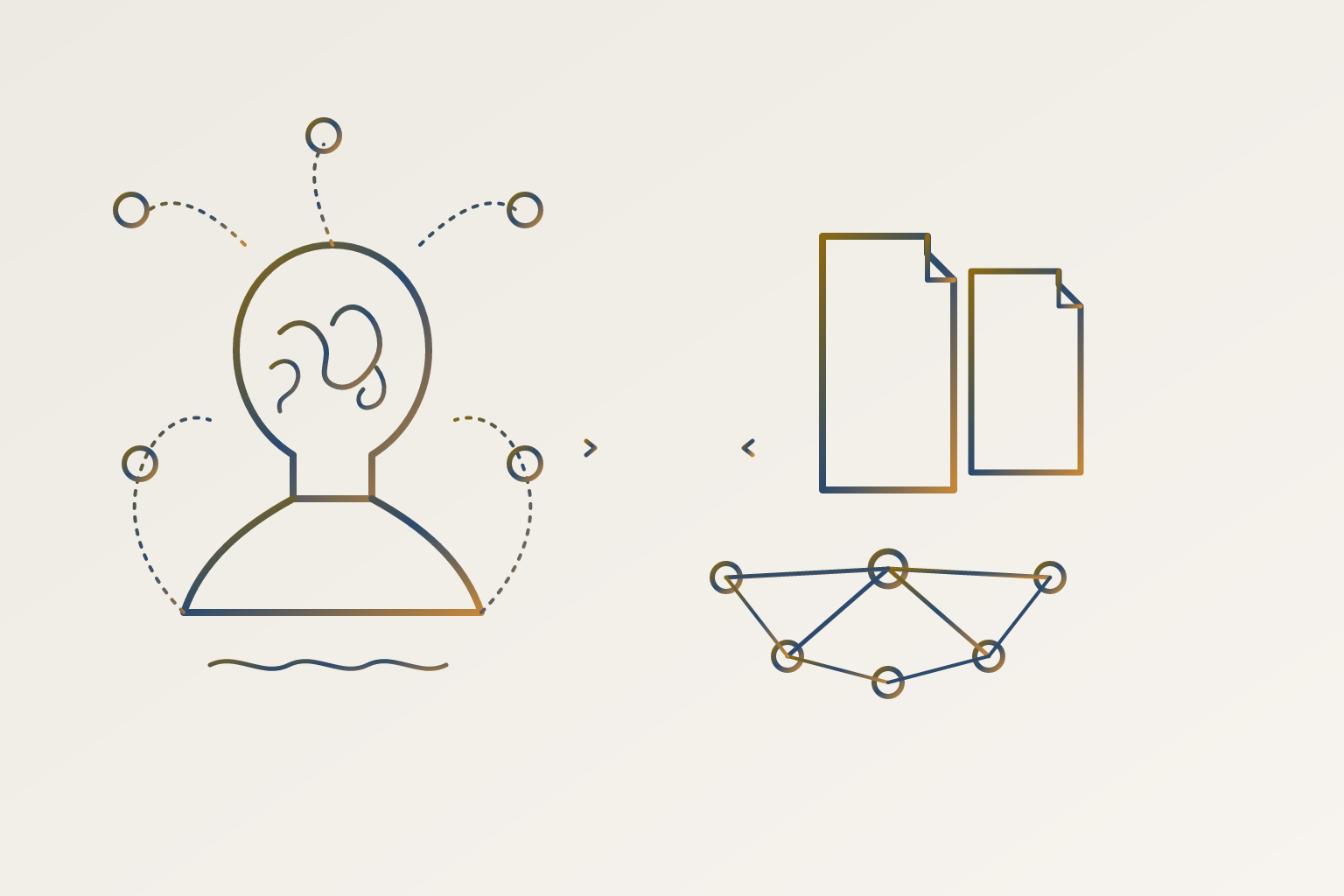
Any professional network runs on knowledge nobody wrote down: who trusts whom, who owes whom a favor, which introduction lands and which one falls flat. Michael Polanyi named this gap in 1966, "we can know more than we can tell," and that gap is the reason firms sitting on decades of contact data still can't answer a simple question: who at this company can actually reach that person? The rest of this piece works through why that gap exists, what it costs, and what changes once AI starts closing it, though closing it carelessly creates a different problem.
Polanyi's The Tacit Dimension split knowledge into two kinds, and knowledge-management researchers have spent sixty years arguing over the boundary. Tacit knowledge gets learned through doing, and it resists being written down in full. Explicit knowledge is formal and abstract, the sort of thing that fits cleanly into a database field. The literature distinguishes among several types of tacit knowledge. Some covers physical skill, riding a bike being the example everyone reaches for. Some could, in principle, get spelled out; it just hasn't been yet, because nobody's bothered or because the effort isn't worth it. The hardest kind is baked into how an organization functions, and no single person holds enough of it to write the whole thing down even if they tried.
A fourth category matters more than the other three combined for anyone running a professional network: know-who. It sits next to know-what and know-how in the literature, and it covers something specific, namely who trusts whom, who has real access to whom, and which relationships are warm rather than just names on a list. This is not a philosophical curiosity. Any contract meant to govern the transfer of this knowledge is structurally incomplete, because the knowledge itself can't be verified and lives inside a person, not a system. Moving it from one person to another takes sustained contact, repeated interaction, and trust built over years. None of that transfers through a spreadsheet, and no amount of better field design fixes that.
Tacit Signals as the Foundation of Professional Networks
Any CRM entry, when opened, looks complete: name, title, company, last-contacted date. All legible, all static, all explicit knowledge in the purest Polanyi sense.
What the CRM can't tell you is whether the relationship is warm or purely transactional. It can't tell you who vouches for whom, which introduction would land naturally, or what got left unsaid in the last meeting because both sides already understood it. That's relational tacit knowledge behaving exactly as Polanyi described: knowledge that could, in theory, be written down, but in practice is in someone's head and their inbox instead.
This knowledge moves through ordinary contact with suppliers, customers, and partners. The network itself isn't a static list, it's the medium the knowledge travels through, passed person to person through collaboration and plain social contact. That's where know-who concentrates nearly all its value. Knowing a contact exists is trivial. Knowing the texture of that contact, how often it happens, how recently, whether trust has actually been established, makes an introduction work or fall flat.
Draw a network map from explicit data alone, LinkedIn connections, CRM entries, and it looks thorough. Draw a second map from tacit signals, who actually returns a call, who has real pull with a specific decision-maker, and the two maps diverge fast. Most professional missteps live in that gap. Firms act on the explicit map, confident it reflects reality, and then get blindsided when the tacit map tells a different story.
The Value Locked in Tacit Network Knowledge, as Revealed by Warm Introductions
A warm introduction is a transfer of trust. The introducer is effectively saying, "I've already assessed this person, they're worth your time," and that's a signal no cold email can carry, no matter how carefully it's written.
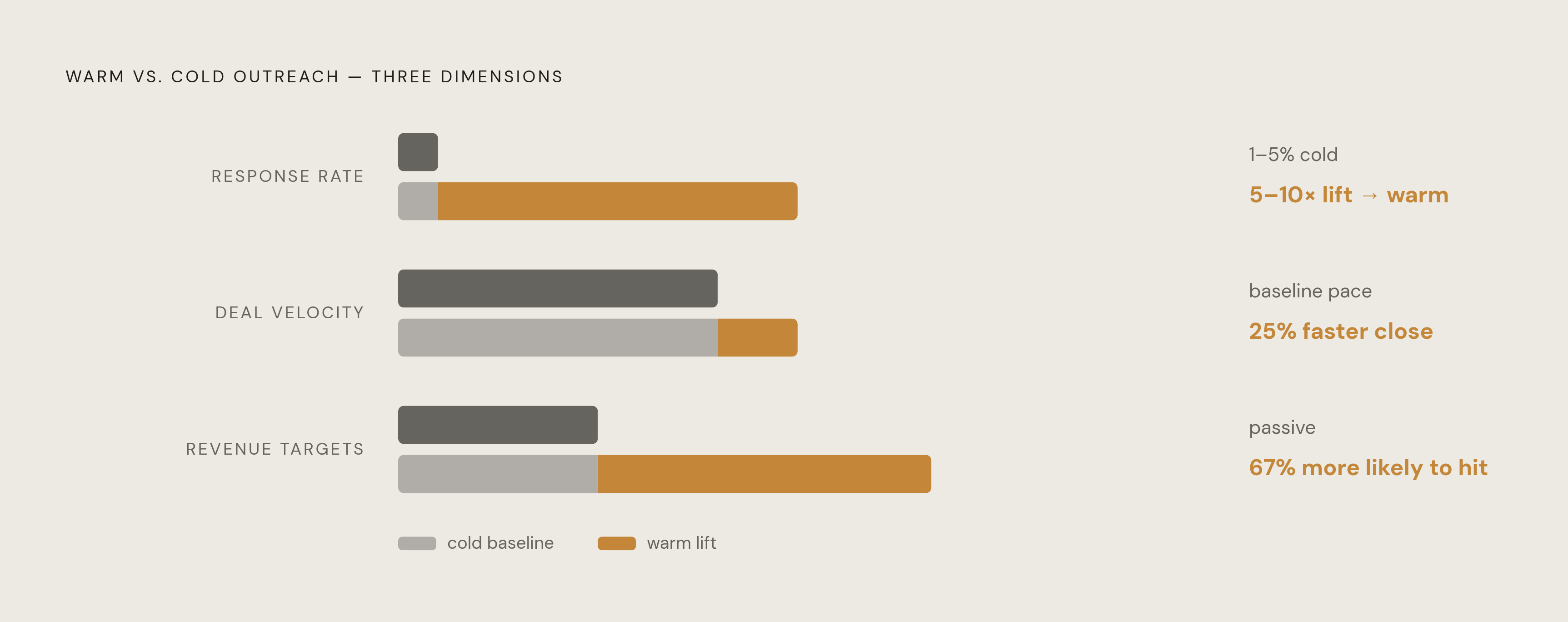
Cold outreach draws a response rate of somewhere between 1 and 5 percent. Warm introductions perform 5 to 10 times better at driving meaningful conversations. Better copywriting doesn't explain that gap, and neither does better timing. The entire lift comes from the trust already embedded in the introduction, something cold outreach can't fake regardless of how personalized the message gets.
The effect compounds past just landing the meeting. Affinity's research shows that relationship scores, which identify who at a firm holds the strongest tie to a given decision-maker, close deals up to 25% faster. Deal size follows a similar logic: senior decision-makers who control the largest budgets are usually the hardest people to reach cold, and among the easiest to reach through a trust network that's already real. Introhive's data shows companies that actively work their relationships are 67% more likely to hit revenue targets.
So the obvious question follows. If warm introductions carry this much weight, why isn't every professional working their network harder? Not for lack of will. Most firms simply can't see their own networks clearly enough to act on them. That's not a discipline problem; it's a structural one.
Firms' Failure to See the Tacit Network Knowledge They Already Own
IBM's Institute for Business Value CDO Study found 77% of respondents agree that data silos block real-time analytics and decision-making, and 83% believe those same silos undermine innovation by keeping departments from sharing what they know. Yet most firms keep storing relationship knowledge in exactly the places guaranteed to keep it siloed: individual inboxes, personal calendars, someone's memory.
In professional services and investing, this takes a specific shape. A senior partner's contact graph lives in their email, their calendar, their own head, full stop. None of it is visible to the junior associate hunting for a warm path to the same target the partner could reach with one phone call. Industry data suggests over 70% of VC transactions originate through personal connections. Most deal flow already runs on tacit network knowledge that most firms have no systematic way to map or share.
The cost is most visible when someone leaves. A senior dealmaker walks out the door with an entire contact graph in their head, one that took years to build and that the firm never had visibility into while it was still there. What's left behind is a dependency on a handful of informal "translators," the people who quietly bridge a firm's siloed systems by memory and habit. They burn out faster carrying that weight, and once they leave too, the knowledge they held is gone for good, not just inconvenient to rebuild.
CRM quality makes this worse, not better. Forrester research cited by Introhive found 47% of organizations name data quality as a top CRM challenge, and 44% cite reliance on manual processes as another. A CRM that depends on manual upkeep is always a step behind, and it fails right when it matters most, when a deal is moving fast and nobody has a spare ten minutes to update a field. IDC Market Research estimates companies lose 20% to 30% of revenue annually to data-silo inefficiencies of exactly this kind, revenue lost because the knowledge that could have closed the deal was sitting in the wrong person's head.
AI's Conversion of Relationship History into Visible, Actionable Network Intelligence
The task is mapping that knowledge, codifying it, and embedding it into systems without flattening the texture that made it useful originally.
CMR lays out five moves: find where the tacit knowledge actually lives, codify it without losing its nuance, embed it into semantic structures an AI agent can reason over, get people and AI working together rather than in sequence, and make sure leaders, not vendors, decide how the AI gets used. The same logic has been observed outside networking as well, where AI agents pull from informal material, issue-resolution histories, and discussions never written up as formal procedure, to build a living model of institutional judgment instead of a static checklist. The same logic maps onto relationship graphs directly: pull from the informal record, email threads, calendar entries, meeting notes, to build a living model of who actually knows whom, rather than a contact list that goes stale the day someone saves it.
Applied to professional networks, that means AI tools that turn unstructured email and calendar data into scored, actionable relationship intelligence: who knows whom, how recently, how strongly, and through what shared history. This isn't just theoretical. Research on generative AI in apprenticeship systems, published by Guo and Hu in Intelligent Decision Technologies, ran a controlled experiment with 50 participants and found statistically significant gains when AI tools converted tacit expertise into explicit guidance: expressiveness scores of 85 versus 70 for the control group, verbal expression at 88 versus 72, learning capacity at 86 versus 71, all with p-values under 0.01.
Relationship intelligence platforms built on this logic are already in use among dealmakers. Affinity, used by firms including Bessemer Ventures for relationship scoring, describes the shift as putting a firm "in front of those types of founders where there might be something net-new on the horizon, in a way that we didn't have the visibility into before." 4Degrees and Introhive do similar work, and the broader 2026 deal-sourcing landscape includes tools like Grata, SourceScrub, and Clay. The time savings are concrete: Affinity's data suggests a relationship layer that auto-captures and enriches contact history saves each user up to 220 hours a year that would otherwise go into manual entry. A Sourcescrub survey cited by Grata found 49% of dealmakers already use AI tools nearly every day, so adoption isn't a future-tense question anymore.
What all of this actually does is make the tacit visible without pretending to replace judgment. Human judgment still decides whether an introduction is appropriate and whether a relationship has enough weight behind it to lean on. The AI's job stops at surfacing the right relationship at the right moment; it was never meant to make the call itself.
Trust and Privacy as Preconditions for Surfacing Tacit Network Knowledge
Tacit network knowledge is valuable precisely because it isn't public. That creates a real tension: making it visible across an entire firm, without controlling who sees what and on what basis, exposes the knowledge, and that exposure undermines the trust that generated it originally.
Trust is the mechanism that makes tacit knowledge transfer possible at all, and inside a professional network that trust is personal and conditional by nature. Share a contact without permission and the relationship takes damage, regardless of how good the intent was. Most firms' governance infrastructure isn't ready for this shift. Most firms' governance infrastructure is still catching up, reacting to problems as they surface rather than getting ahead of them, which is a dangerous posture given what's at stake.
Shadow AI sharpens the risk further. Microsoft's Cyber Pulse report found 29% of employees already using unsanctioned AI agents for work tasks, a genuinely alarming number in any environment where relationship context is this sensitive. The line separating firms handling this well from firms stuck in legal review comes down to proactive permissioning: enforcing a user's data choices before data ever enters an AI pipeline, not after a regulator or a client asks an uncomfortable question.
Personal relationship context has to stay private even as institutional relationship signals get made collectively useful across a team. Those two things are separable with the right architecture, but conflating them is the default failure mode, and it's the one that breaks trust fastest. AI in this context should draft and recommend, not act on its own. The professional stays in control of every send, every share, every introduction, because autonomy without a human in the loop is what actually breaks a trust network, not the presence of AI itself.
Security certifications are table stakes at this point, not a differentiator. What actually separates one relationship intelligence platform from another is the permissioning model: how much individual relationship context stays protected while firm-level signals get shared where they're genuinely useful. Return to Polanyi once more. Tacit knowledge holds its value precisely because it can't be seized or repossessed. Tools that respect that quality extend what a professional can do with their own network. Tools that ignore it end up destroying the very asset they claimed to be surfacing.