Quantifying the ROI of Relationship Intelligence Infrastructure
Warm introductions convert 10-15x better than cold outreach at the C-suite level.

Cold email reply rates fell from 6.8% in 2023 to 5.8% in 2024, across a dataset of 16.5 million emails. A 15% drop in a single year isn't noise. I've tracked this trend for a while now, mostly because clients kept asking why their numbers looked worse than last year's deck, and it lines up with everything else happening in the channel right now.
Four things are happening at once, and none of them are going away. AI-generated outreach has flooded inboxes, so every cold message competes against a wave of near-identical, machine-written pitches for the same three seconds of attention. Google and Yahoo tightened sender authentication requirements through 2024 and into 2025, so a growing share of cold volume never clears spam filtering before a human even sees it. A typical B2B purchase now runs through 6 to 10 stakeholders, each one a fresh filter the message has to survive. And the people on the receiving end are fielding over 100 sales emails a week, plenty of which get auto-sorted before the subject line registers.
Stack those four forces and you get a denominator problem. The volume needed to hit quota keeps climbing while the numerator, replies and booked meetings, stays flat or shrinks. Run that forward a few years and cold outreach starts looking less like a channel you optimize and more like a treadmill nobody can step off. Warm outreach works better, and the numbers below make that obvious pretty fast. What's harder to answer, and what the rest of this piece tries to get at, is what it actually costs a firm to leave that advantage sitting unsystematized, year after year, while everyone keeps pouring more volume into a channel that's quietly losing ground.
Lever one: conversion rates and what the warm-path premium is actually worth
Warm introductions convert at a meaningfully higher rate. Cold outreach converts at a much lower rate. That's not a one-off survey result plucked from a single vendor's blog post; the ratio holds across multiple 2025 datasets built by people who weren't talking to each other. At the C-suite level the gap widens further still, with warm referrals converting at 10 to 15 times the rate of a cold contact.
Turning that into a dollar figure for your own firm isn't complicated, at least not the arithmetic part. Take current pipeline volume and average deal size, then apply the conversion differential to whatever share of pipeline is sourced cold versus warm today. Shift even 20% of pipeline from cold to warm and the lift on closed revenue compounds, because you're not just adding deals to the pile. You're swapping low-probability deals for high-probability ones at roughly the same level of effort.
But that headline ratio is hiding something, and it's worth sitting with for a second. "Warm" covers a wide spectrum, and the variable actually doing the work is the connector's credibility, not the bare fact that a connection exists somewhere in a CRM field. An introduction from someone with weak, infrequent contact to the target converts a lot closer to cold than most people assume. It's technically warm; it just doesn't carry the weight a decision-maker needs to skip their usual skepticism. So the real lever isn't "warm versus cold," it's relationship scoring: weighting a connection by recency, frequency, and shared context instead of treating "we're connected" as a binary switch. A platform that scores strength this way captures more of the conversion premium than one that just maps who knows whom on paper.
Lever two: cycle compression and what recovering lost time is worth in revenue terms
Take one documented case. A warm introduction secured a 30-minute executive meeting within 5 days, and the deal closed in 4 months against a typical 9-month cycle for that kind of sale. That's about 55% shorter. In healthcare procurement, a warm intro cut a vendor evaluation from 6 months down to 6 weeks. Across enterprise cases more broadly, warm-driven cycles run substantially shorter than cold-sourced ones, and that range shows up often enough that it stops looking like an outlier.
Why does trust compress time this much? When a connector the decision-maker already trusts has vouched for the meeting, the early qualification stages, the ones that usually eat the first two or three months of an enterprise sale, get skipped almost entirely. The buyer isn't spending weeks figuring out whether you're worth taking seriously, because someone they already believe has done that work already.
Converting that compression into dollars runs through three paths, and they don't all show up on the same line of a P&L. Shorter cycles mean more deals fit into a fixed period, so the same team closes more without adding headcount. Earlier close means revenue gets recognized sooner, which helps cash position and makes forecasting less of a guessing game. Fewer touches per deal also lowers cost of sale, and that line item adds up once you apply it across a whole pipeline instead of eyeballing one deal at a time.
For investors, the stakes cut sharper than a plain efficiency argument. A compressed diligence path on a competitive deal can be the difference between getting allocation and finding out later the round closed without you. Speed decides outcomes here, well beyond whatever a dashboard shows. On the private equity side, firms combining integrated intelligence platforms with a systematic sourcing process report 40% to 50% faster deal cycles and meaningfully higher bid success rates on targeted acquisitions. Read that carefully and the underlying pattern is a win-rate story as much as a productivity one.
Lever three: the deals that never appear in a traditional pipeline
In venture, roughly 70% of deals originate through network connections, against roughly 10% from unsolicited cold inbound, per Harvard Business School survey data. Sergio Monsalve of Roble Ventures puts his own figure even higher, at 88%. However you slice it, the network is the primary sourcing asset for most investment firms. Full stop.
So here's the uncomfortable follow-up question. If the network is the asset, why do most firms have no systematic way to actually see what's in it? Firms that adopt relationship intelligence platforms uncover, on average, more than 300 contacts and 700 relationships per user that were previously invisible to the organization, according to Introhive. There's an entire second network sitting inside the firm that nobody could see until somebody went looking for it, which is a strange thing to admit about your own most valuable asset.
The reasons it stays hidden are mundane, and that's exactly why they persist year after year without anyone fixing it. Relationship data lives scattered across individual inboxes, calendars, LinkedIn messages, and Slack threads, and nobody's pulling any of it together. The colleague who happens to know the right OEM contact often has no idea a teammate three desks over needs precisely that introduction right now. When that employee leaves the firm, the relationship leaves with them; no institutional memory survives, just a gap where a warm path used to sit.
The off-market premium is the part that should worry anyone comfortable with how things run today. The best deals frequently never touch a competitive process at all. They flow quietly to whichever firm had the warmest, earliest path in. Quantifying this lever means estimating what share of closed deals in a given period were network-sourced, then asking the harder question underneath it: what would the win rate look like with access to two or three times as many of those paths? The gap between those two numbers is roughly the addressable value of the infrastructure. This is the exact problem Rolo is built around: aggregating relationship signals across email, calendar, and messaging into a graph the whole firm can query, so the warm route to a target that already exists somewhere inside the organization shows up before the deal closes, not after someone mentions it over drinks three weeks too late.
The silo tax: what firms are already paying without knowing it
IDC research puts the cost of data silos at 20% to 30% of annual revenue lost to inefficiency. For a firm doing $10 million a year, that's $2 to $3 million evaporating with no line item anyone can point a finger at. Gartner separately estimates the cost of bad data at $12.9 million annually across organizations, and Harvard Business Review lands close by, at roughly $15 million a year on average. Three different research shops, three numbers in the same neighborhood.
There's a knowledge-worker version of this tax too, and it hits senior teams the hardest. Forrester Research found knowledge workers spend an average of 12 hours a week chasing data across disconnected systems. Multiply that by what a senior BD operator or investment associate costs per hour, and the number stops being abstract fairly quickly.
Relationship data specifically is expensive to leave siloed, for two reasons that feed each other. The vast majority of enterprise data is unstructured (emails, meeting notes, chat threads), and most of it never makes it anywhere another person could search it. And relationship context decays on top of that. A contact who was warm six months ago might be cold today, and a system with no sense of recency can't flag that the signal already expired. It'll happily recommend an intro through someone who hasn't spoken to the target in a year.
There's a human cost buried in here as well. Someone at the firm inevitably becomes the informal bridge across these gaps, the person everyone corners with "didn't we already talk to this guy?" That role burns people out, and when they finally leave, the institutional memory walks out the door with them. Worth noting: 58% of VC deals originate through professional networks, co-investor referrals, or portfolio-company introductions, per the same Harvard Business School data. That's exactly why a tool that captures data passively, pulling from systems people already use rather than demanding manual entry, has a structural edge over one that depends on people changing how they work. Behavior change at scale almost never actually happens, no matter how good the tool is; I've seen enough CRM rollouts die quietly to believe that one.
Why the scalability constraint is the real argument for infrastructure
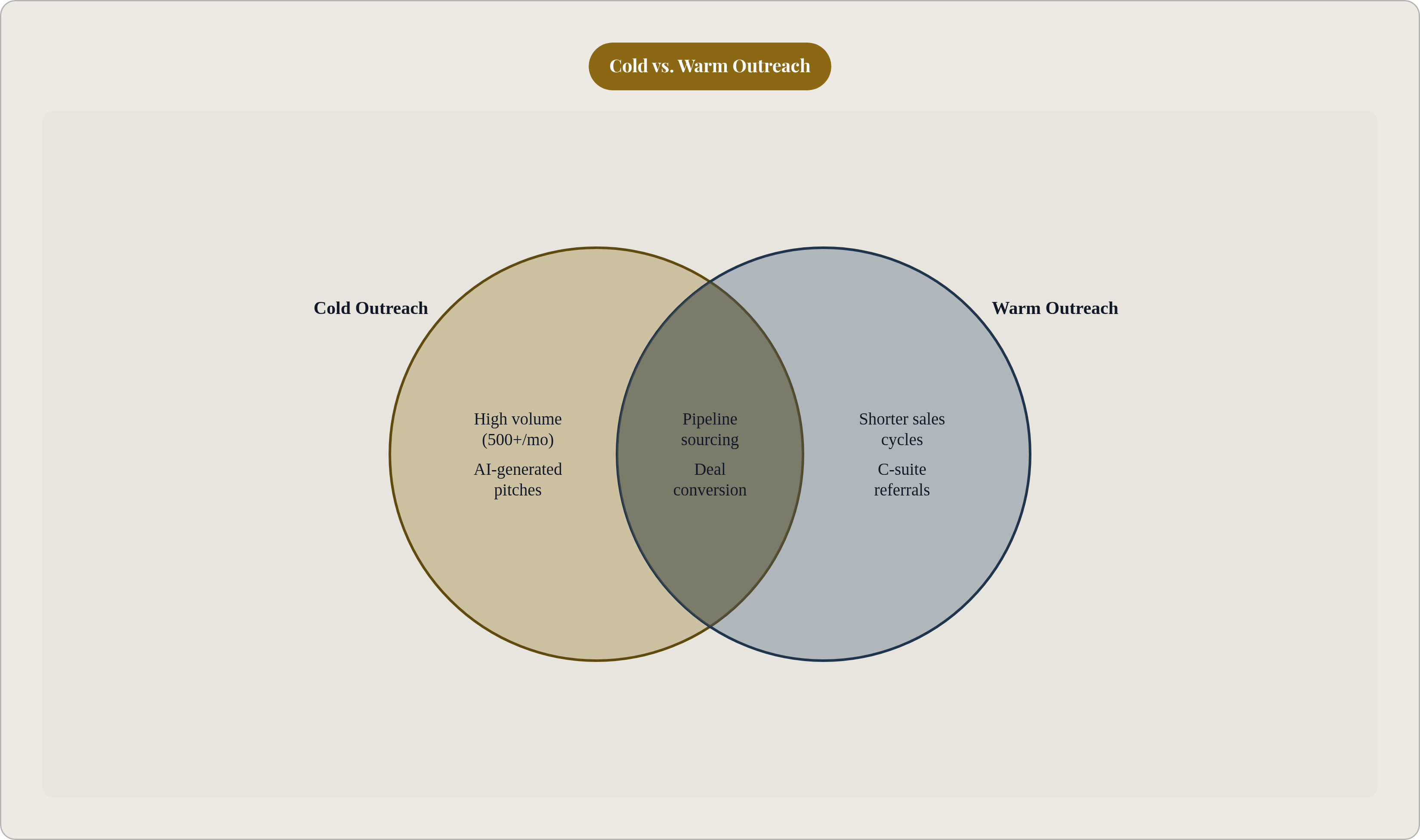
Here's the ceiling that makes this whole conversation necessary. The average sales professional can secure only 5 to 8 quality warm introductions a month. A well-run cold campaign, meanwhile, can reach 500 or more targeted prospects in that same window. Warm paths convert better per touch; cold outreach scales further per hour. Neither fixes the other's problem on its own, and pretending otherwise is how firms end up over-investing in whichever lever their org chart happens to reward.
What infrastructure actually does is expand the supply side of warm paths, making the full depth of a firm's network visible and searchable so people can find and activate introductions that would otherwise sit unused in someone else's inbox. In venture specifically, VCs spend about 22 of their 55 weekly working hours on networking just to keep deal flow moving. Infrastructure that surfaces paths automatically claws back a real chunk of that time for actual evaluation work, instead of relationship archaeology.
The three levers don't just stack, they multiply. A deal sourced through a warm path that closes 50% faster and converts at 14.6% instead of 1.7% isn't three separate improvements bolted together. It's a multiplied return, because each lever changes the conditions the other two operate under. Run that model across a whole team, not one standout rainmaker, and you get institutional lift instead of one person's personal network quietly paying off for them alone. The median investor reviews more than 80 opportunities to land a single investment, involving an average of 3.1 full-time team members and 20 separate management meetings per deal. Infrastructure that surfaces warmer, better-qualified opportunities earlier in that funnel changes the economics of every stage downstream, not just the time spent at the very top.
Building a firm-specific ROI model across the three levers
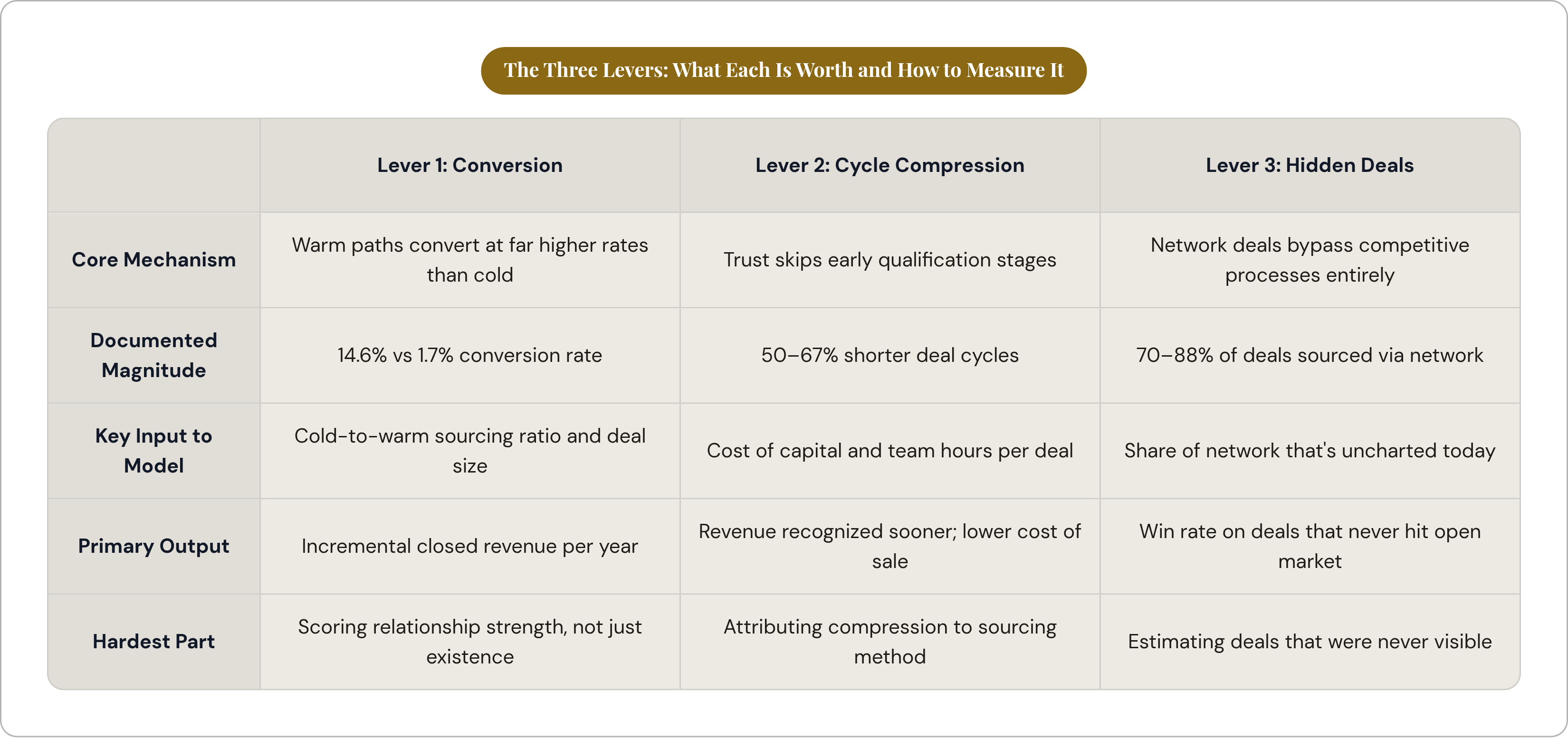
So how does a firm actually build this instead of nodding along at the numbers in a meeting and moving on to the next slide? Start with lever one. Take the current cold-to-warm sourcing ratio, average deal size, and conversion rate by channel, then apply the 14.6% versus 1.7% differential to whatever incremental pipeline shifts toward warm sourcing. The output is incremental closed revenue per year, and honestly, it's the easiest of the three to defend in a budget meeting.
Lever two needs the current average deal cycle length, whatever cost of capital or revenue-recognition timing applies to your business, and a fully loaded cost per team hour. Apply a 50% to 67% compression to the warm-sourced share of the pipeline. The output is revenue recognized sooner plus a reduction in cost of sale, and both matter, even though the first one tends to get all the attention in the room.
Lever three is the hardest to pin down, and often the biggest once you actually manage it. Estimate the share of your addressable market reachable through the firm's existing but uncharted network. A rough, conservative proxy: if current sourcing captures most reachable warm paths, what's the remainder worth? It won't be a precise number. It'll still be a real one, worth writing down and revisiting a year later to see if you were close.
Layer in the silo tax as an offset, not a fourth lever. Current headcount cost attributed to manual relationship tracking and data-chasing, using the 12-hours-per-week Forrester benchmark applied to relevant team pay, is a cost-reduction line that shortens the payback period on everything above it.
What falls out of this model is the actual point of the exercise: infrastructure that addresses all three levers at once compounds across them. A firm that grows its warm-sourced pipeline, closes it faster, and finds deals that would otherwise stay invisible ends up operating under a different cost structure than its competitors, deal by deal, not just stacking three small wins on a spreadsheet somewhere. Rolo's approach fits this directly, connecting email, calendar, LinkedIn, and messaging into one queryable relationship graph, passively, without asking anyone to keep a CRM updated by hand, while keeping drafting assistance in the professional's own voice so the person stays in control of every send. That combination hits the scalability ceiling, the silo tax, and the visibility gap at once, instead of picking one and hoping the other two sort themselves out.
The trust and privacy conditions that determine whether the infrastructure actually works
None of this works if nobody trusts it enough to actually use it day to day. A CRM that needs manual upkeep is a CRM that's always a little stale, and a relationship graph built on stale data starts recommending introductions that are just wrong. One bad suggestion, one "warm" intro that turns out to be someone who hasn't spoken to the target in two years, and the whole system takes the hit for it. Trust, once spent, is expensive to earn back. Maybe more expensive than building it was in the first place.
Privacy cuts the other direction, just as hard. Aggregating relationship data across a team creates real institutional value, sure, but it also creates real risk if someone's personal context gets exposed to colleagues or, worse, to counterparties without their say-so. In high-trust environments, venture, private equity, law, banking, a privacy failure isn't a compliance footnote buried in an appendix somewhere. It's a relationship-ending event, and often with exactly the people the firm most needs to keep close.
That tension points to a specific architecture requirement, not a vague policy statement nobody actually reads. A system needs to surface collective network signals without exposing the individual relationship context underneath, permissioned by design rather than by a document sitting unread in a shared drive. Showing "your colleague has a warm path to this founder" is useful, but showing the actual content of their correspondence to get there is a liability waiting to happen. That distinction is what makes adoption durable instead of something legal shuts down by month three.
There's an autonomy piece too, and it matters more than it sounds on first read. In relationship environments where the stakes run this high, the professional has to stay in control of every message going out under their own name. AI that drafts in someone's voice and recommends the next move, but never sends anything on its own, preserves the one thing a warm introduction is actually supposed to transfer: personal credibility, distinct from automated volume dressed up to look like it came from a person.
The three-lever model holds up, and the data behind it holds up across sources that never coordinated with each other, which is part of why it's worth taking seriously in the first place. The infrastructure to capture that return exists right now, not in some hypothetical future release two years out. The firms that actually realize it will be the ones that built the system on a foundation their own network trusts, because a warm path only stays warm as long as the people on both ends believe it was handled with care.