AI-Drafted Outreach That Matches a Professional's Voice
AI can now draft emails in your actual voice, not a generic one.

Warm introductions convert at a substantially higher rate. Cold outreach gets 3%. Nobody disputes those numbers much, but they don't explain themselves either; the gap between them is trust, borrowed trust, and this piece is about what happens to that trust once AI starts drafting the messages carrying it across the wire.
Here's the mechanism, stripped down. When someone introduces you, the recipient extends you credit before reading a word you've written. They trust the introducer's judgment, and that judgment transfers, provisionally, onto you. The transfer only holds if you show up sounding like someone worth that trust: the rhythm of your sentences, your register, what you reference, how you open and close a message. Swap that in for something generic and the recipient can't place you anymore.
AI drafting tools sit in the middle of this now. A founder who used to send twelve thoughtful follow-ups a week can send fifty without much more effort than the twelve took. Whether that's a win depends on one thing, and it's the only thing: do those fifty still sound like a person the recipient recognizes, or do they sound like the twelve did, thinned out and stretched over more messages than the voice can cover?
What professional voice actually consists of, and why it is harder to replicate than it looks
Voice isn't style in the literary sense. It's closer to a fingerprint: pieces that are each learnable on their own, nearly impossible to fake together all at once. Sentence rhythm is one piece. Some people write in short bursts; others build longer compound sentences that carry a qualification or two before landing anywhere. Register is another, and it shows up in small stuff, contractions or no contractions, how formal the salutation runs, whether warmth gets said outright or just assumed between two people who already know each other well enough to skip it.
Then there's the piece a lot of people miss: reference anchors, the specific shared context someone habitually reaches for, things like a mutual connection's name, the conference where you last spoke, or a detail from an earlier conversation that proves you were actually listening. Closing patterns matter too, since some people put the ask up front while others bury it in a soft aside near the end so it doesn't feel transactional. What's missing matters as much as what's there. Someone who never uses exclamation points, or never writes past three sentences no matter the occasion, gets defined by that restraint just as much as by anything they include.
People inside high-trust professional networks have read enough of a sender's messages, sometimes across years, to clock when something's off, even when they can't say exactly what changed. That's the uncanny valley problem, and it cuts against intuition in a specific way. A transparently templated cold email doesn't bother anyone, because the recipient knows exactly what it is and reads it accordingly. An email that's almost right, though, slightly generic in a way that doesn't fit the sender they know, creates real unease. The near-miss sticks in memory in a way a template email never does.
None of this is abstract, either. Professionals spend, by some estimates, upward of two and a half hours a day managing email, so wanting to move faster through that volume makes sense on its face. Speed bought at the cost of being recognized is a bad trade whenever the relationship on the other end actually matters. What would it actually take, technically, to solve for recognition at scale, instead of papering over the problem with a friendlier prompt? That's worth sitting with before going any further.
How AI voice-matching actually works under the hood, and where the architecture has to start
There's a real difference between a style prompt and voice matching, and vendors blur it constantly, sometimes on purpose. Tell a model to "write formally" or "sound warm and casual" and you get a generic register, one of maybe a dozen defaults the model reaches for on command. That output represents a voice, not the sender's own. Real matching requires the model to read what a person has actually written, not what they say about how they write. Self-description is unreliable in a specific and consistent way: people think they write briefly and don't, think they're formal and are actually pretty loose in practice. The correspondence itself is the only honest record on offer.
So what does the model need to see? Sent email history, a wide range of it: deal outreach, warm intros, follow-ups, the awkward decline-gracefully emails nobody enjoys writing. Range matters almost as much as volume. A model trained on someone's last three weeks of email picks up how they write when things are calm, but it misses how they write under deadline pressure, or in a two-line note to someone senior versus a decade-long peer. Voice shifts by context, and a model that's never seen the shift smooths everything into something flatter than the real thing.
That's the case for the tool living inside the email client itself, connected live to the sent folder, rather than existing as a paste-in box where someone drops a few samples and hopes for the best. A handful of pasted examples gives a model a snapshot, while a live connection gives it a pattern that keeps updating as the person's own writing changes.
Now the part most vendors would rather not get into. The same sent history that makes voice matching work is some of the most sensitive data a professional owns: deal terms, personnel discussions, private referrals, exact negotiation language, all sitting in that folder together. What happens to it once the model has learned from it, and does it persist somewhere after training, or feed a shared model that other users draw from later? Who at the vendor can query it, and under what circumstance? Zero retention after calibration is a reasonable bar, and anything beyond that needs a specific, stated reason rather than a reassuring shrug. Built correctly, this means training a model per user, not per firm, so what's shaped by one person's inbox never leaks into another person's draft, even inside the same company.
Why voice fidelity matters more in warm-path outreach than anywhere else
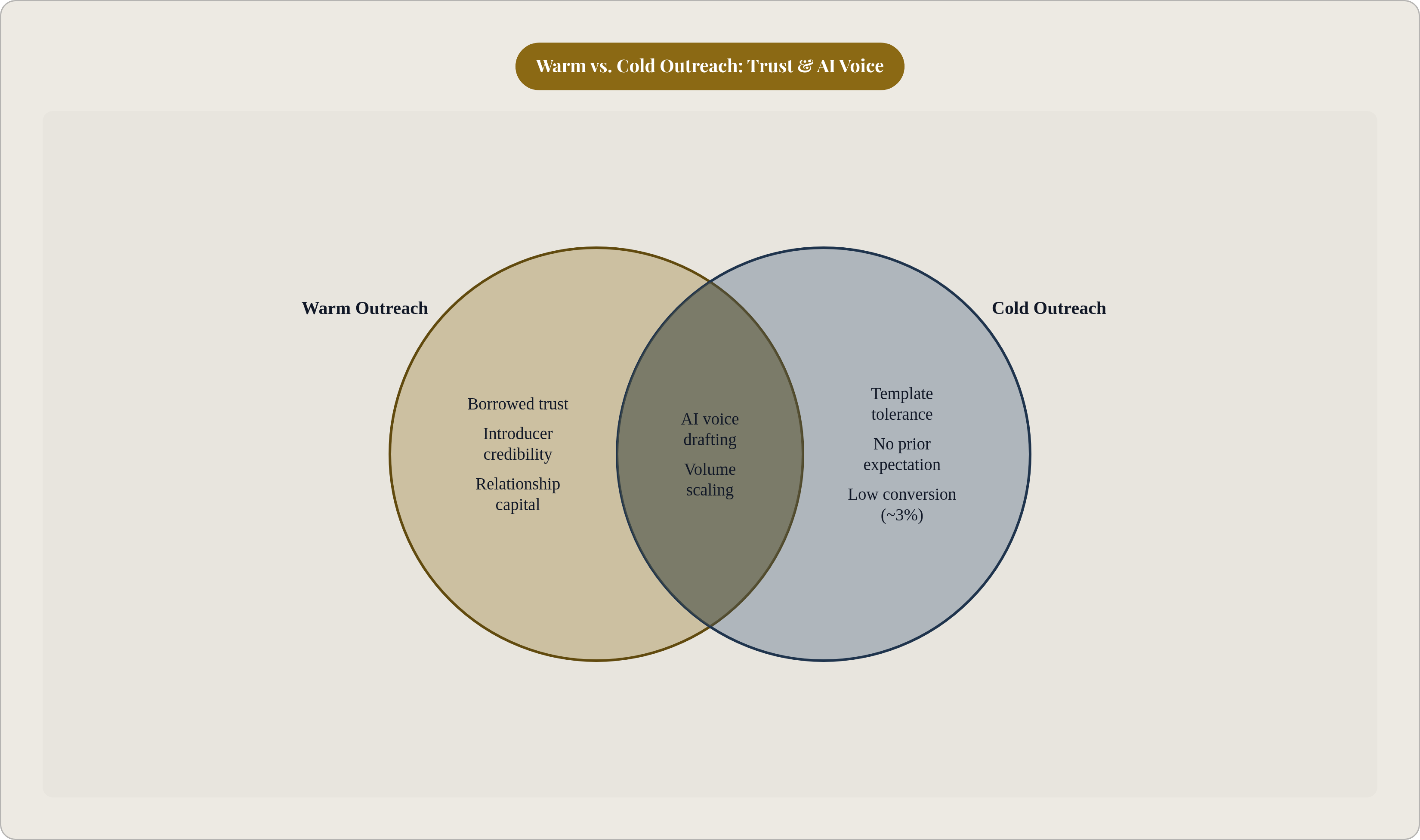
Warm-path outreach is a three-party arrangement, and it's easy to forget the third party exists at all: sender, recipient, and the intermediary who made the introduction. That intermediary's credibility rides on this too, and not abstractly. They vouched for a person's judgment, their taste in relationships, their ability to follow through with something that reads as genuine rather than mechanical. A message that reads as generically AI-drafted doesn't just land on the sender; it lands on whoever put their name behind the introduction.
That 46% figure assumes the message showing up after the introduction actually delivers on what the introduction promised. Picture a founder coming off a conference with thirty new contacts, drafting thirty follow-ups with AI, sending them in a voice that's subtly, almost imperceptibly, not quite their own. Most recipients won't say a thing, but a few will notice, and one or two of those will mention it to a mutual contact, half in passing, in a conversation that never gets back to the sender directly. Small cost, real cost still, and in a deal ecosystem, small costs compound faster than people expect.
Deal flow in venture and founder circles runs on reputation nearly as much as it runs on merit. Being known for outreach that feels considered builds on itself over time, the same way a reputation for generic, obviously-automated messages compounds in the other direction. Cold outreach carries different stakes here since there's no existing relationship expectation to violate, so voice drift barely registers there. Warm-path outreach lives entirely inside that expectation instead. Roble Ventures' Sergio Monsalve has cited a figure worth sitting with rather than nodding past: 88% of deals at some firms originate from network referral, not cold sourcing. In an ecosystem that dependent on relationship capital, every message down a warm path either adds to that capital or quietly draws it down.
The signals that distinguish AI drafts that sound like the sender from AI drafts that sound like AI
The tells are consistent once you start looking for them. "I hope this finds you well" is the obvious one, mostly because almost nobody opens a message that way to someone they actually know. Symmetric sentence length is subtler but just as telling. Real writing has rhythm, a couple of short sentences followed by a longer one that unpacks a thought, while uncalibrated AI output tends to land every sentence at roughly the same length as the one before it. Watch for superlatives too: "incredibly excited," "truly exceptional," phrases nobody actually says to someone they've met twice in passing.
There's also a tendency to over-explain the ask. Instead of stating the request cleanly, the draft hedges it with three qualifying clauses a real voice would have cut on instinct. Maybe the most telling gap, though, is generic context standing in for specific context: "given your work in the space" instead of the actual project name, the actual event where the two people met, the detail that proves someone was paying attention rather than filling in a field.
A well-calibrated draft does the opposite, across the board. It opens the way the sender actually opens messages to someone they know moderately well, not overly formal, not falsely warm either. It puts the ask where that person tends to put it: direct and early for some senders, softer and held to the end for others. It uses a specific hook instead of a placeholder, and it respects length. Emails between fifty and a hundred and twenty-five words tend to draw the strongest response rates, so a good model should be trimming toward that range rather than padding a draft out to sound thorough.
Try this test on any draft. If editing it mostly means fixing facts or adding a detail the model didn't have, the voice model did its job, but if editing it mostly means fixing how it sounds, rewriting the opening, cutting the superlatives, the voice model failed regardless of how polished the underlying content looked on first read. The sharper version of this test belongs to the recipient, not the sender. If they can't tell it was AI-drafted, the tool worked; if they read it and quietly think, this doesn't sound like them, damage got done, even if nobody says so out loud.
What it takes to deploy voice-matched AI outreach across a team without collapsing individual voice into a firm-wide template
Firms want the efficiency of shared AI infrastructure, reasonably enough. If every partner's outreach starts sounding like the same underlying model, the firm loses differentiation exactly where it matters most, at the relationship layer, more than it gains from the efficiency. Worse is the scenario where a junior associate's drafts start sounding like a senior partner's, because eventually someone in the network notices two people at the same firm writing suspiciously alike. That noticing costs trust for both of them, not just one.
The architecture that actually holds up keeps these layers apart. Each person gets a voice model trained on their own sent history, calibrated to them and nobody else. Sitting separately is the firm-level relationship data: the network graph, the warm paths between the firm's contacts and a given target, the chain of who introduced whom in the first place. The voice model can pull context from that layer, knowing a particular warm path exists, without letting the shared layer overwrite what makes each person's draft sound like them specifically.
Consider what the relationship graph layer can do on its own, apart from drafting anything. Affinity has shown some of this: MassMutual Ventures reportedly surfaced more than 67,000 contacts within sixty days of implementing the platform, mapping a network that had been sitting invisible across individual inboxes the whole time. That's a real capability, and a different one from writing the message that actually travels down a given path once it's found. Neither substitutes for the other. A firm that nails network mapping but flattens everyone's voice into one template has solved maybe half the problem.
There's a boundary worth holding here, and it's not a small one. AI surfaces the path and drafts the message, then it stops; the professional reviews, edits if needed, sends. Nothing goes out on autopilot, and that's not a compliance feature bolted on for comfort; it's the mechanism that keeps the whole arrangement credible, since the sender's name is on the message and their judgment has to sit behind it regardless of who typed the first draft. Autonomous sending, even done flawlessly on the technical merits, removes the intentionality that made the warm path worth walking in the first place.
Rolo has built roughly in this shape: connecting to email, calendar, LinkedIn, and messaging to build a firm-wide relationship graph, surfacing warm paths ranked by relevance and recency, drafting outreach in each individual's own voice, without sending on its own and without letting one person's private context leak into someone else's queries.
The privacy architecture that makes voice-matched AI outreach safe to use on sensitive professional communications
This objection deserves real scrutiny, because sent email history in professional contexts is genuinely sensitive material. Deal discussions, term sheet language, personnel conversations, confidential referrals, all of it lives in the same folder a voice model needs to read in order to work at all.
The regulatory climate is tightening around exactly this, too. Recent surveys of business leaders put AI data privacy at or near the top of implementation barriers, with around 69% citing it as their primary concern in some findings, and regulatory worry specifically climbed from roughly 42% to 55% within a single year. In a professional environment built on trust, that caution isn't paranoia; it's the correct calibration to what's actually at stake for the people whose names are on those emails.
So what's the floor for any tool touching this correspondence? Zero data retention after the voice model calibrates is the first piece; sent history trains the model, then it doesn't linger anywhere in the vendor's infrastructure afterward. Per-user model isolation is the second: one professional's data never bleeds into another's output, even at the same firm, even on the same plan. A permissioned access architecture matters too, one where the tool reaches only what's explicitly connected, no shadow indexing of adjacent accounts or shared inboxes nobody agreed to. Data residency carries real legal weight for firms working across jurisdictions covered by GDPR or the EU AI Act, and it's not a detail to leave for the contract lawyers to sort out later.
The standard emerging for AI agents handling this kind of data resembles zero-trust security applied somewhere new: every request verified fresh, access held at the least-privilege level a task actually requires, behavior monitored continuously rather than checked once at onboarding and forgotten. SOC 2 or ISO 42001 matter as a floor, but they're table stakes now, not a differentiator. The architectural choices above are what actually separate trustworthy-in-practice from merely compliant-on-paper. Rolo treats this as core design rather than a bolt-on: private relationship context stays private to each individual, even while the collective signal from the network graph becomes something the whole team can draw on.
How to evaluate whether an AI drafting tool is actually matching your voice or just personalizing a template
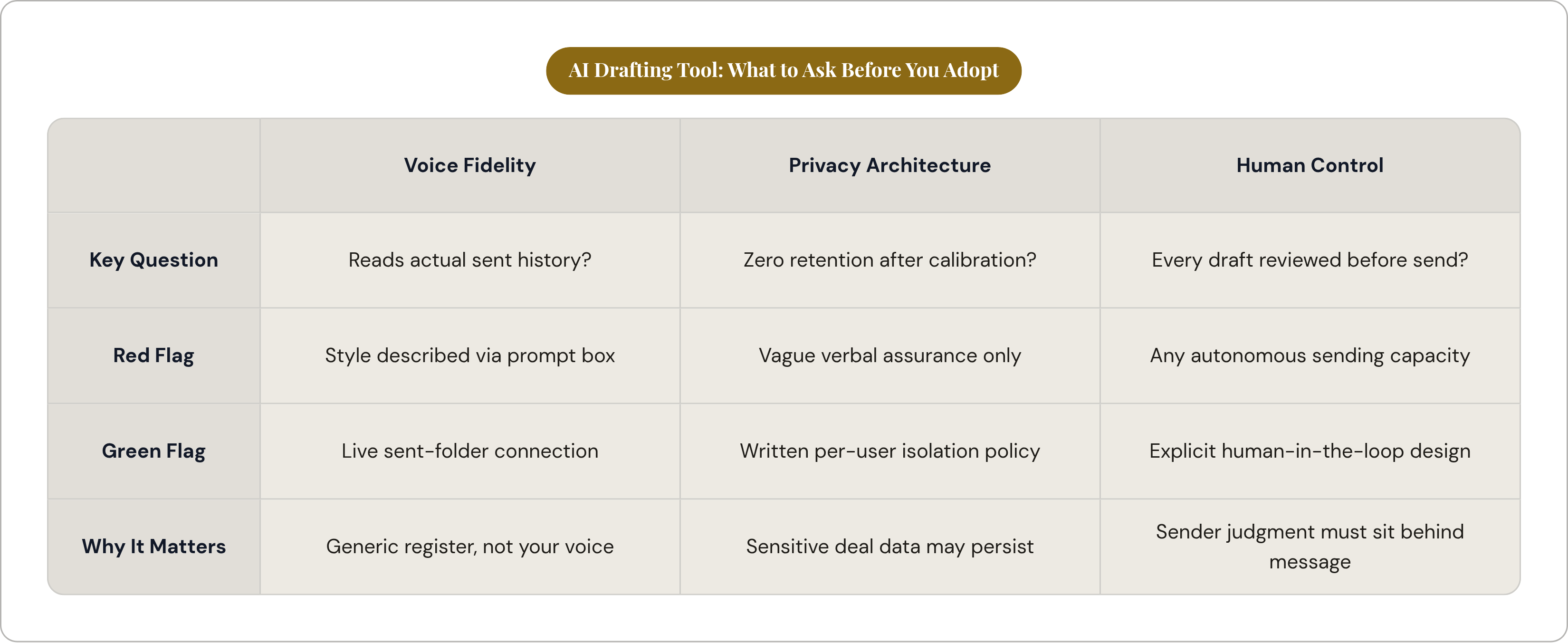
Before adopting anything in this category, ask a short set of direct questions and pay attention to how easily the answers come. Does it read your actual sent history, or are you describing your style in a prompt box somewhere? What happens to that history after training, and is there a written retention policy or just a verbal assurance from a sales call? Does your voice model stay isolated from everyone else on the platform, colleagues at your own firm included? Can you see and edit every draft before it sends, or does the tool have any capacity to send without you in the loop? Does it know who introduced you, how recently you last spoke, what the relationship's actual history looks like, or is it drafting in a vacuum with none of that context?
That last question points at something worth naming plainly: relationship context is what separates AI outreach drafting from plain AI email drafting. A tool that nails your voice but has no visibility into your network is still, functionally, drafting cold. A tool that finds the warm path and writes the note built to travel down it draws on context the first kind never touches. That difference is most of the value in this category.
Run a simple test before full deployment. Draft five emails through the tool to people you know well, hand them to a colleague who also knows those same contacts, and ask directly whether anything reads off. If the same messages get flagged twice, you've found exactly where the voice model is weak, and you know what to push on before trusting it with anything that matters.
Good, in practice, looks almost boring: composition time drops, the edits you make are about facts and context rather than tone, response rates hold steady against your own non-AI outreach, and nobody in your network mentions, even in passing, that your emails feel different lately. Rolo is one option built specifically for that bar, aimed at investors, founders, and operators, connecting to where relationships already live, drafting in each user's own voice without sending autonomously, and keeping relationship data permissioned so it stays private to whoever it belongs to. It's a narrow target, but it's the same one this piece has been circling from the start: outreach that scales without losing the one thing that made it worth sending in the first place.