Relationship Data Governance Policies for Investment Firms
How to stop relationship data from walking out the door.

Financial data has custodians, audit trails, a compliance officer who signs off on how it's stored and who gets to touch it. Relationship data has none of that. Emails, calendar invites, meeting notes, LinkedIn threads sit scattered across personal inboxes and half a dozen disconnected tools, and at most funds, nobody has actually been assigned to own any of it. This piece works through what a real governance policy for that data looks like: who owns it, how it moves across a team, what has to stay private, and how compliance obligations shift once a firm starts treating relationship data as the asset it actually is.
Is a partner's email thread with a founder firm property, or personal correspondence because it happened to run through her inbox? Does a junior associate's introduction to an LP belong to the associate who built that relationship over three years of coffee meetings, or to the fund that pays her salary? When someone leaves, does the relationship history walk out the door with them, or does it stay behind as something the firm already paid for in headcount and time?
Most firms never answer these questions until a senior partner walks out mid-fundraise, or a deal falls apart because the context that shaped the thesis left with the associate who ran diligence. Studies on enterprise data have shown for years that most of what a company generates goes unused for any strategic purpose; one often-cited estimate puts the figure at somewhere around 68%. Relationship data at investment firms follows roughly the same pattern. It sits in inboxes and notebooks nobody's been authorized to read, generating no return on the years it took to build. What's being governed here is one of the firm's more consequential assets, full stop. Treating it as a technical afterthought, something IT handles or nobody handles, is exactly how firms end up losing it.
What "relationship data" actually encompasses at a fund
Most governance frameworks fail at step one because they define the scope too narrowly. Relationship data is a sprawling, messy set of records most firms have never actually inventoried in one place. It's far more than a contact list with names and emails attached, and that's before anyone even gets to the question of who's allowed to see it.
Start with email threads: deal conversations, LP updates, co-investor correspondence, the slow-build outreach to a founder who took eighteen months to say yes. Calendar records matter more than people give them credit for, because who met whom, how often, and over what stretch of time reveals relationship strength even if nobody ever reads what was actually discussed. Meeting notes and call summaries are often the richest source of deal context a firm has, and also the least governed, usually living in a partner's personal Notion page or a Google Doc nobody else can open. LinkedIn messages and other chat-app history are increasingly the first point of contact with a founder or an LP, and almost none of it gets captured anywhere a firm could later point to. CRM data is the most structured item on this list and, oddly, often the least current, since manual entry lags behind whatever's actually happening in the field. Introduction chains, who introduced whom to whom, carry implicit social obligations that shape how a firm navigates its own network later, even though nobody writes any of it down.
Each of these carries a different level of sensitivity and a different kind of legal exposure. A calendar pattern showing frequent meetings with a public company's CEO ahead of an earnings call sits in a very different regulatory category than a founder's fundraising timeline shared over dinner in confidence. That gap points to the first real classification decision any governance policy has to make: separating relationship metadata (who contacted whom, how often, how recently) from relationship content (what was actually said, what got promised, what got disclosed).
Most firms currently treat all of it as one pile, filed away and forgotten. Better to think of it as a structured asset class, where different data types carry different rules depending on what they actually are. Once that shift happens, the rest of this gets a lot easier to reason about.
The four ownership questions a governance policy must answer
Ownership at an investment firm isn't a clean binary between the firm and the individual. It's layered, and a policy that pretends otherwise collapses the first time somebody tests it.
Who owns the relationship record itself? The firm owns the institutional fact that it has a relationship with a given LP, founder, or co-investor. The individual, though, holds onto something the firm doesn't: the tone of the relationship, the trust built over years, the private commitments made across a hundred small conversations nobody wrote down. Conflate the two, treat them as the same asset, and the policy has created exactly the trust problem it was supposed to prevent.
Then there's who can see what. Visibility should be tiered by role. A partner's LP relationships shouldn't be freely browsable by a first-year analyst without someone explicitly granting permission, though team-level visibility, just knowing who at the firm knows this person and how warm the path is, serves everyone without exposing the actual conversation history. The term for this is permissioned access, and a real policy has to spell out what each role can query, not just catalog what data technically sits on some server somewhere.
The departure question is where this gets financially real. When the person who ran initial diligence on a deal leaves the firm, the specific founder conversations that shaped the investment thesis often leave with her, because nobody wrote them down anywhere the firm could retrieve them later. Associate-level churn is more or less predictable at most funds; a policy should assume it happens and build around that assumption instead of treating every departure like some unforeseeable crisis. That means handoff protocols, minimum documentation standards before someone's last day, and defined read-access windows for departed staff's historical records.
And then the newest question, the one almost no firm has actually settled: who authorizes relationship data to feed into an AI system? When a firm deploys a tool that reads email and calendar data to surface warm introduction paths, somebody has to have actually signed off on that read. Opt-in versus opt-out, set at the individual level with a firm-wide default, belongs in the policy itself. It shouldn't be left to whatever a vendor happens to ship as the default setting.
How relationship data flows across a team and where it breaks down
Even a firm that has carefully worked through all four ownership questions above often has no policy at all for how the data actually moves. Who can share it, in what form, into which systems?
Take the invisible introduction problem. A firm might already have a real connection to a target company's board member, sitting quietly in a partner's contact history from three years back. Nobody on the current deal team knows it exists, so the warm introduction never happens and the team cold-emails instead. Or the mirror image: without a shared view of who's already reached out to whom, two people at the same firm contact the identical prospect within a week of each other, sending conflicting messages. Sometimes it's worse than that; everyone assumes someone else already made contact, and nobody does.
At larger funds this shows up regionally too. The APAC team doesn't know EMEA is already three conversations deep with the same LP, because relationship data gets siloed by desk instead of pulled together at the firm level. Same failure as the individual-level version, just scaled up across floors, or continents.
A governance policy has to map where these breakdowns actually happen. Onboarding is one: a new hire has no visibility into relationship context that predates her arrival, so she rebuilds paths that already existed. Cross-team handoffs are another, where a BD conversation never reaches the deal team that eventually closes the transaction. Portfolio management is a third: the relationship history a firm built with a founder during diligence often goes invisible to the operating team that supports the company after the check clears. LP relations rounds it out, where contact history managed by one partner for a decade goes opaque to whoever inherits that relationship when she moves on.
The flow section of a governance policy needs to spell out what triggers a relationship record becoming visible firm-wide, what requires someone to explicitly share it, and what stays siloed by default unless someone decides otherwise.
What stays private even inside a firm's relationship intelligence layer
Here's the failure mode that actually kills adoption. Partners and associates figure out that the firm can read their email, and they stop writing candid deal notes. The policy, built to capture and govern the data, ends up destroying the very thing it was meant to protect.
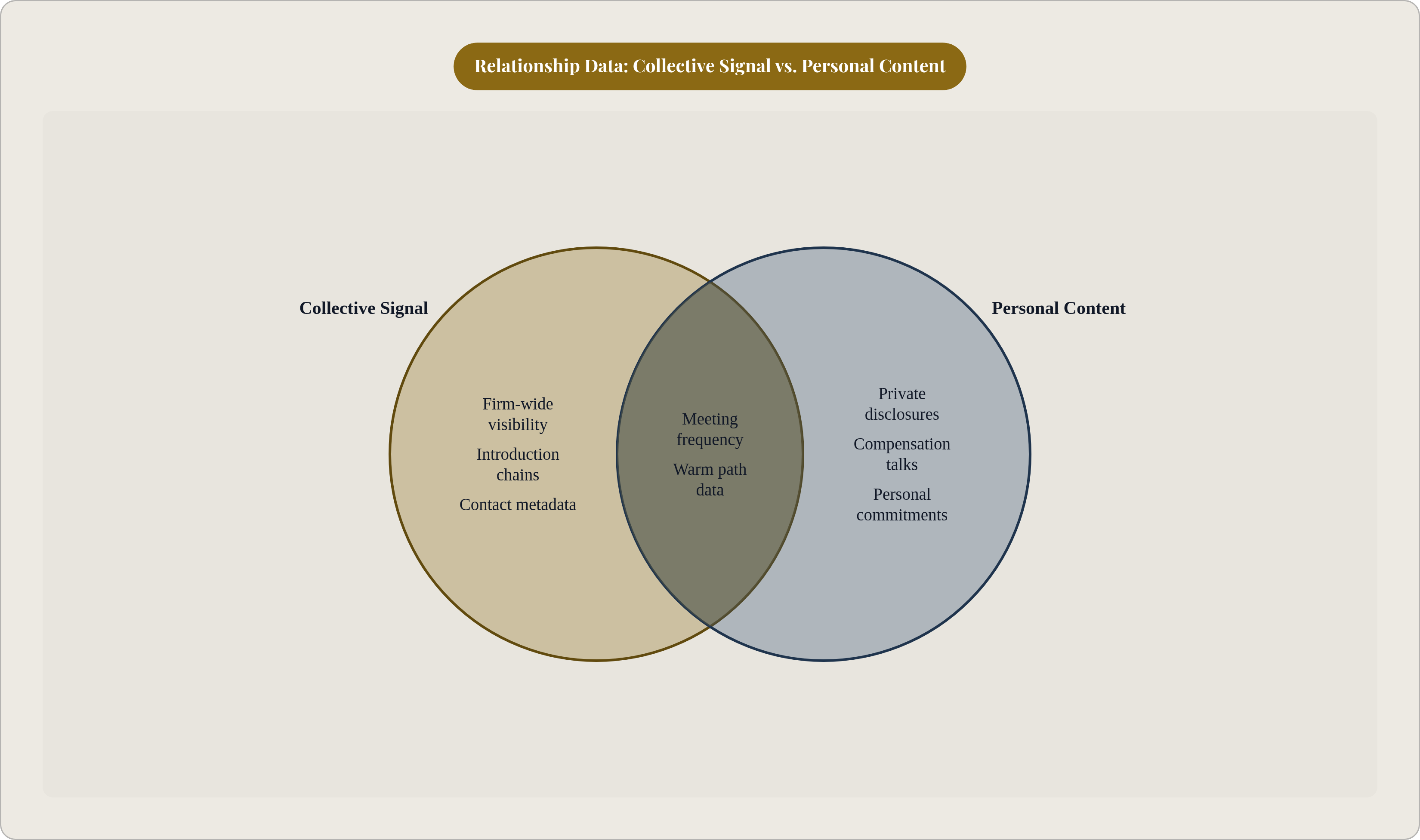
Privacy inside the firm is a design requirement, not a loophole to patch later, because relationship data only has value if the people generating it trust the system enough to keep contributing honestly. A workable permissioned setup rests on a clean split between two categories. Collective signal, the fact that the firm has a relationship with someone, the knowledge that the strongest path to a target runs through a specific partner, can be visible across the whole firm at no real cost. Personal content, what that partner actually said in a private conversation, what was promised, what a founder disclosed off the record, stays under that partner's control.
Some categories should be individually controlled by default, no exceptions carved in later: compensation conversations with portfolio company executives, confidential disclosures a founder makes outside a formal diligence process, LP communications touching personal financial information. And there are messier overlap cases too, like a partner whose college roommate happens to now be CFO of a target company, where professional and personal relationships tangle together in ways a policy has to account for rather than pretend don't exist.
One specific technical risk is worth calling out on its own. Retrieval-based AI tools, the kind built on RAG architecture, pull context from a pooled data store the moment someone runs a query. If that retrieval doesn't enforce access controls at the document level, a completely innocent question about a contact can surface content the person asking was never supposed to see. That's just what happens when nobody puts the right constraints in from the start; it's not a hypothetical edge case, it's the default outcome of skipping this step.
So the policy needs to say, in plain terms, that individual opt-outs from AI training and AI retrieval get honored automatically, upstream of any analytics environment, not patched in by hand after the data's already been indexed somewhere. Trust earns adoption, and adoption is the only thing that makes the data governable at all.
The compliance and regulatory layer that investment firms cannot ignore
Relationship data governance doesn't happen in a vacuum. It sits inside a regulatory environment that most firms' current, informal practices don't come close to satisfying.
Start with the baseline. SOC 2 Type II governs how data gets stored, accessed, and protected, and it applies directly to any third-party tool a firm uses to pull relationship data together across email and calendar systems. GDPR and CCPA give LPs and founders, as data subjects, actual rights over the personal data a firm holds about them, including whatever relationship data lives inside an email-connected AI tool. And for European operations, DORA, the EU's Digital Operational Resilience Act, standardizes how financial entities manage ICT risk and oversee third-party vendors. A fund using a SaaS relationship intelligence platform has to actually assess that vendor's resilience and get contractual protections in writing, not just assume they're covered.
The AI-specific gap is the one moving fastest right now. Firms are pointing AI tools at relationship data faster than governance frameworks can keep up, and research on this consistently finds that only a small share of organizations with AI governance committees would call those committees mature, or proactive rather than reactive.
A few risk areas deserve particular attention because the exposure is concrete, not theoretical. Insider trading risk shows up in calendar metadata: a pattern of frequent contact with a public company executive right before a material event can become a real problem if the firm can't show exactly what was and wasn't shared in those meetings. Cross-border data transfer is another: LP relationship data sitting on a US-based AI platform can run afoul of GDPR if the LP is an EU institutional investor and there's no data processing agreement covering the transfer. Third-party vendor risk is the quiet one, easy to miss until it isn't; a firm that connects its email system to a relationship intelligence platform without running a vendor assessment first has created an exposure that regulators, and increasingly LP due diligence teams during fundraising, will find and ask about.
The compliance section of a governance policy shouldn't read like a checkbox exercise. It should map each data type defined earlier in this piece to the specific regulation that actually governs it, and name a person who owns that mapping. Vague accountability is the same as no accountability here.
Building the policy: a practical structure for investment firms
A workable policy has five parts.
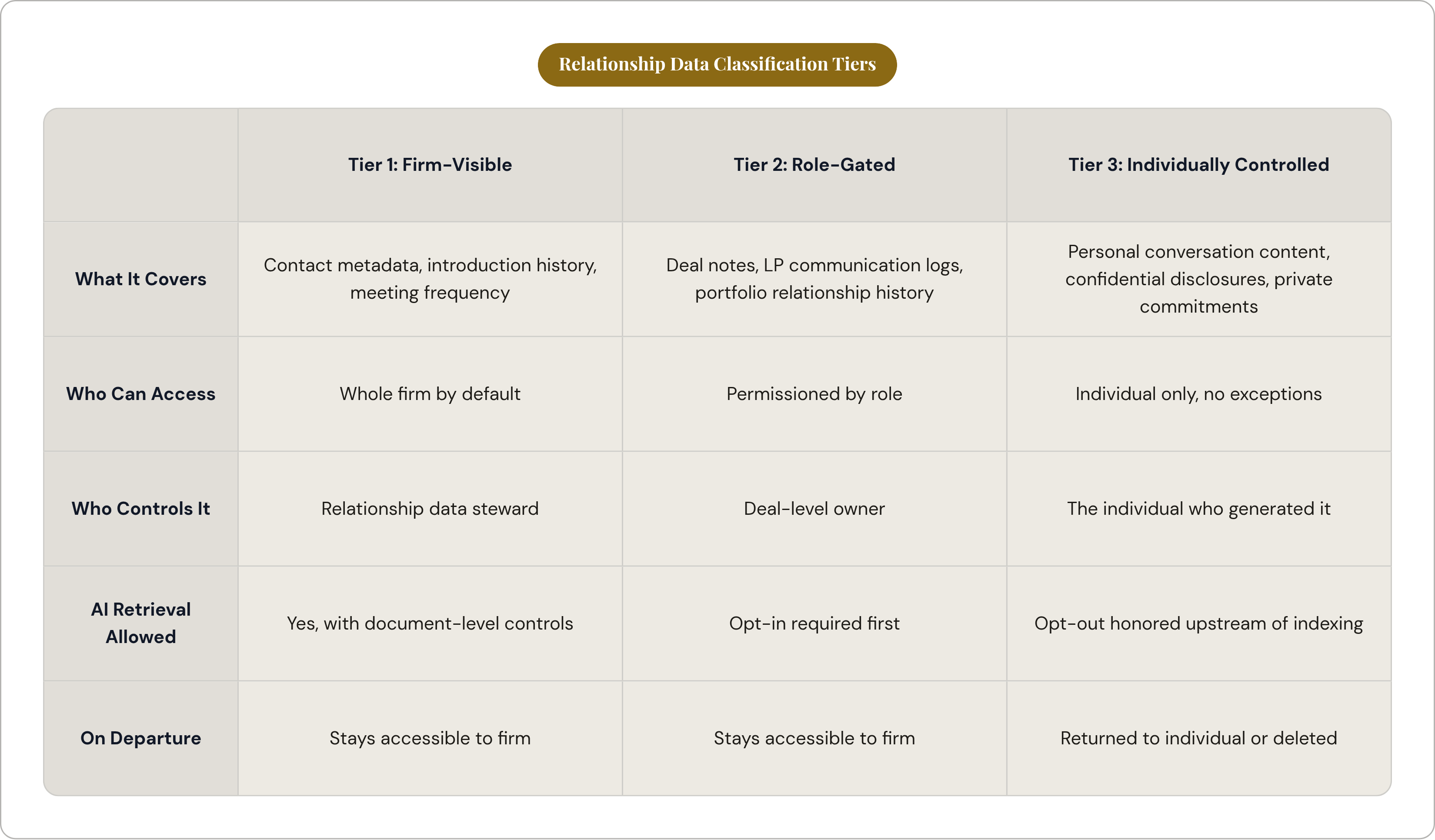
The first is a data classification schema. Tier 1, firm-visible, covers institutional relationship existence, contact metadata, introduction history, and meeting frequency signals. Tier 2, role-gated, covers deal context notes, portfolio company relationship history, and LP communication logs. Tier 3, individually controlled, covers personal conversation content, confidential disclosures, and privately negotiated commitments.
The second is ownership and stewardship. Somebody has to be named as the relationship data steward, often the COO or Chief of Staff at a smaller fund, a dedicated governance role at a larger one. That steward's authority should be clearly bounded: she can flag misclassified data, she cannot read Tier 3 content, and she reviews vendor agreements before they get signed. Relationship records should be owned at the deal level, not just the contact level, so when a deal team changes hands there's a clear new owner instead of an orphaned record sitting unattended somewhere.
The third is a departure and transition protocol. Before anyone leaves the firm, a minimum documentation standard should require that key relationship context for active deals and active LP relationships gets captured somewhere shared, not left sitting in a personal inbox. A defined read-access window matters too: departed staff's Tier 1 and Tier 2 records stay accessible to the firm, while Tier 3 records get returned to individual control or deleted according to whatever the employment agreement specifies.
The fourth is AI and tool access rules. Any tool connecting to email, calendar, or messaging data belongs in a vendor registry with a completed data processing agreement on file, no exceptions. The default posture should be opt-in at the individual level for content indexing, with opt-out available anytime, and the firm-level default written directly into the policy instead of left to whatever a vendor ships out of the box. Retrieval has to be permissioned at the document level, not just the user level, before any of these tools get pointed at Tier 2 or Tier 3 data. Rolo is one example of a tool built around this constraint: relationship signals surface across the firm without exposing the underlying personal conversation content, and the system never sends outreach on its own. Whoever's using it stays in control of every action the platform recommends.
The fifth is review and audit cadence. An annual policy review tied to the LP due diligence cycle makes sense, since LPs now ask increasingly pointed questions about data governance as part of standard operational due diligence. A quarterly vendor review checks that connected tools still comply with the firm's classification schema and that access controls haven't quietly drifted. And an incident response protocol should define, ahead of time, what actually counts as a relationship data breach, whether that's unauthorized Tier 3 access by a staff member or exfiltration of Tier 1 data by someone on their way out the door, along with exactly who gets notified and when.
How governance policy changes what relationship data can actually do for a firm
A governance policy can read like a list of restrictions. But that's the smaller half of the story; what governed data makes possible matters more than what it locks down.
A firm that has classified, permissioned, and organized its relationship data can do things with it that an ungoverned firm simply can't. Warm path visibility is the clearest example. Once relationship data is governed and pulled together properly, a deal team can query the entire firm's network to find the strongest path into a target, not just whatever the lead partner happens to remember off the top of her head, but what a second-year associate or a newly hired general counsel knows without anyone else realizing it.
Introduction chains follow the same logic. Top-performing funds make more of them, year over year, not because their partners network harder than everyone else's, but because the paths that already exist inside the firm's collective relationship history actually surface when somebody needs them. Done well, governance turns a pile of scattered, ungoverned data into something the whole firm can use, without asking anyone to give up the privacy that made them willing to keep contributing to it in the first place.