Siloed Network Data Across Email Calendar and Messaging Apps
Warm introductions convert twenty times better, but companies keep losing them in siloed inboxes.
Gartner has pegged the aggregate cost of bad data at $12.9 million annually per organization. That number arrests attention until you recognize what it fails to capture: the particular cost that accrues when the product being sold is the relationship itself.
Knowledge workers spend roughly 20% of their working week searching for information across disconnected systems, according to enterprise productivity research that has circulated long enough to stop surprising anyone, which is precisely the problem. For a deal-making professional, those hours are not an efficiency issue. They are the difference between being present when the window opens and arriving to find it already shut.
The 82% of companies that acknowledge making critical decisions on stale information encounter a specific version of this in relationship-intensive work. "Stale" here doesn't mean an outdated market forecast. It means acting on a connection that has gone cold without anyone registering the chill, or being unaware that another has recently warmed because it lives in a colleague's inbox.
The real cost almost never appears in a dashboard. It is the warm path sitting in a sent folder that nobody surfaced, the introduction that would have moved a deal, never made because the firm's collective network remained invisible to the one person who needed it. Post-mortems attribute this to relationship management failures or poor process. It is more accurately an information architecture failure: a pipeline problem that presents as a personnel problem.
Why Warm Paths Close More Deals, and Why They Keep Going Unwalked
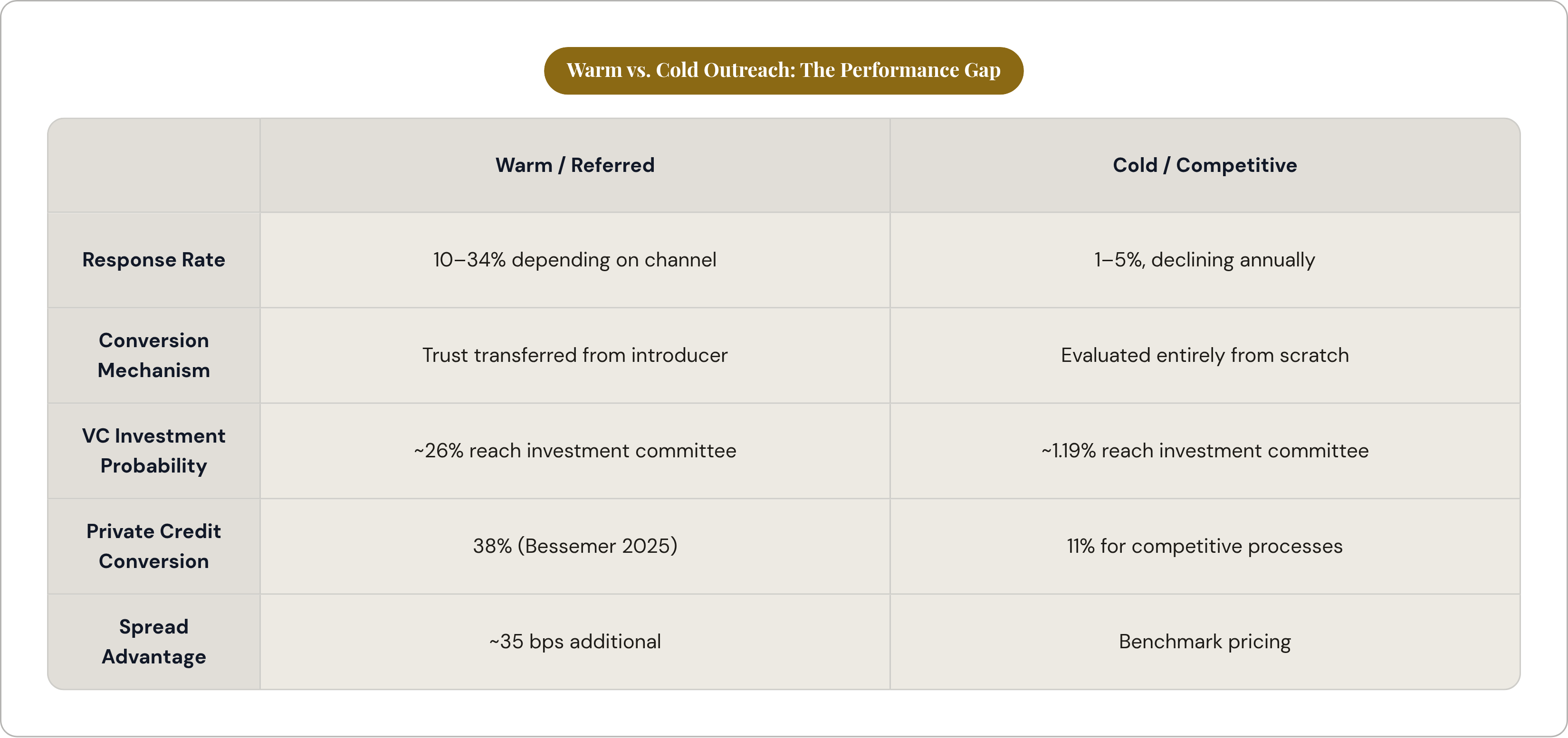
Warm outreach generates responses somewhere between 10 and 34% of the time, depending on channel and context. Cold email sits at 1 to 5% and has been declining for years. That gap is structural, not tonal. The mechanism is trust transfer.
Harvard Business Review research has documented that referrals and introductions convert at three to five times the rate of non-referred approaches. When someone arrives recommended, the cognitive cost of evaluating them is already partly underwritten by the trust the introducer carries. The familiarity heuristic does real work here: a warm introduction lowers the friction of engagement in ways that preparation, tone, and timing cannot replicate.
In private credit and middle-market lending specifically, the consequences show up in the economics. Bessemer's 2025 origination research found that warm-sourced deals convert at 38% versus 11% for competitive processes, and carry an average 35 basis points of additional spread. The warm path does not just open the door; it changes the terms on the other side of it.
So why does it go unwalked? The connection is rarely absent. It goes unwalked because the person who needs it doesn't know it exists at the moment it matters. The relationship is real, buried in a calendar entry or an email thread from two years ago, inaccessible to anyone who wasn't on the original exchange. Fragmented data doesn't destroy the relationship. It renders it invisible at precisely the moment it would have been most useful.
How Investor and Founder Networks Are Especially Exposed to Silo Risk
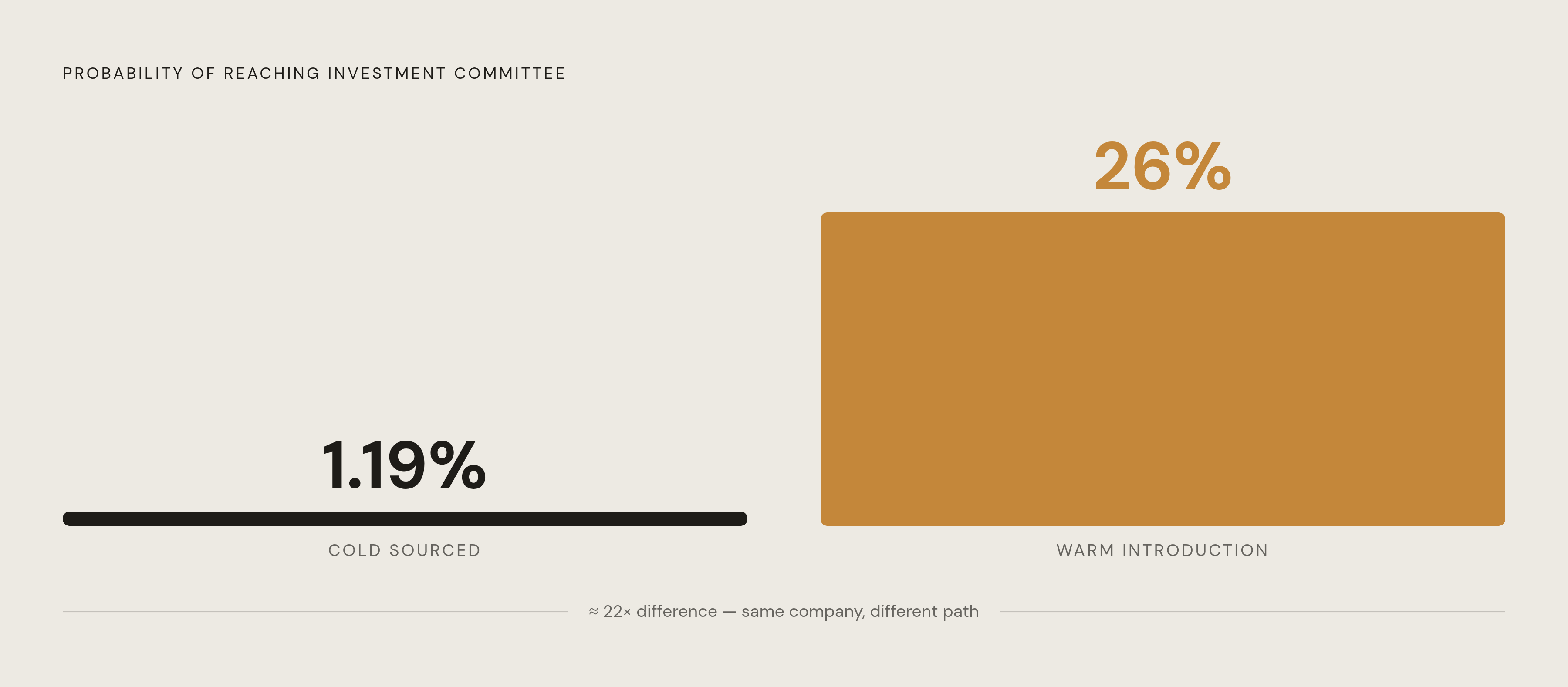
Harvard Business School research puts roughly 70% of venture capital deals as originating from within the investor's existing network. VentuRank data sharpens that into something harder to argue with: a cold-sourced company carries approximately a 1.19% probability of reaching investment committee; a company arriving via warm introduction carries a 26% probability. Same company, different path, roughly twenty times the outcome.
Sergio Monsalve, Founding Partner at Robles Ventures, has said directly that for the vast majority of his firm's deals, the team was either tipped off or referred through their network. The network is not a supplement to deal sourcing. It is the sourcing function.
For founders, the dynamic runs in the same direction. The warm path to a particular investor, OEM partner, or enterprise buyer almost always exists somewhere inside the collective network. The trouble is that "collective" is aspirational when every relationship lives in a separate inbox. Someone on the business development team needs an introduction that is likely within reach, held by someone who left the firm, sits in a different office, or simply wasn't part of this particular conversation. The institutional memory of that connection is siloed, inaccessible to anyone outside the original thread.
The asset exists. The visibility does not.
The Specific Ways Email, Calendar, and Messaging Data Fragment Relationship Intelligence
Email is the longitudinal record. It captures depth: the number of exchanges, the span over which they occurred, the formality of language, the direction of asks. "Let me introduce you to X" lives in email. The structural failure is that email is searchable only by the person who owns the inbox; across a firm, it is effectively invisible.
Calendar is the cadence signal. Meeting frequency tells you whether a relationship is actively maintained or quietly lapsing in a way that email alone cannot. Co-attendance patterns sketch informal coalitions that never make it into any CRM record. The problem is that calendar is treated as scheduling infrastructure rather than relationship data. It is rarely exported, almost never analyzed alongside anything else.
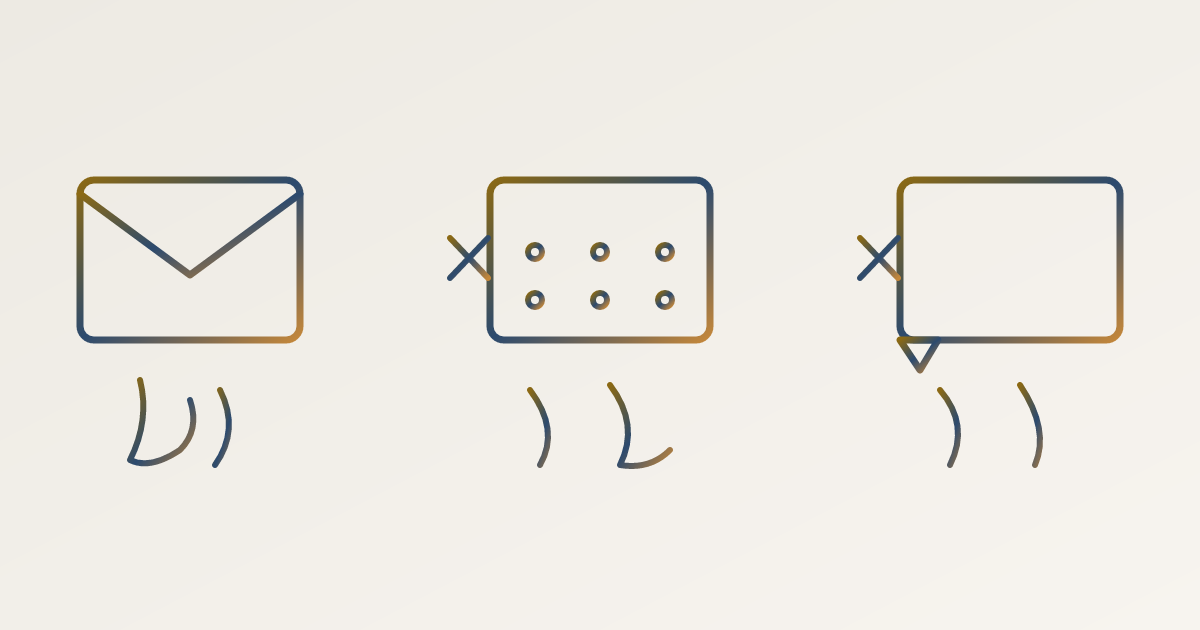
Messaging apps are where things get inconvenient. The real ask, the one that actually moves a deal or surfaces an opportunity, frequently happens on WhatsApp or Slack before it enters any official process. Tone, response speed, willingness to engage off-channel: these are stronger indicators of relationship strength than most formal correspondence. They are also almost entirely outside any institutional capture system. Because messaging is treated as ephemeral by default, the highest-signal data in the relationship stack is the most consistently lost.
When these three systems operate in isolation, every relationship has three partial pictures. Reaching a single client can mean starting in email, switching to a project tool, jumping to a CRM, referencing a spreadsheet, and cycling back to email, none of which surfaces the relationship-strength signal that is actually decision-relevant.
Why CRM Doesn't Solve This, and Often Makes It Worse
The standard response to relationship data fragmentation is "put it in the CRM." That response misunderstands the problem.
CRM systems are built to track deal stages and account history. They were not designed to capture relationship depth, recency, or the informal signals that indicate whether a warm path is actually walkable today. The manual upkeep problem compounds this structurally: a system that requires professionals to log their own relationship activity will tend to lag reality. The entry happens after the meeting, after the email, after the moment when the information would have changed a decision. If it happens at all.
There is a deeper issue underneath the upkeep failure. CRM treats relationship data as an input to be manually entered rather than a signal to be continuously captured. It is built for retrieval, not for inference about who in the firm's network can reach a specific person today. When a key relationship manager leaves, the CRM record they leave behind is a skeleton: dates, company names, deal stages. The actual texture of the relationship, the context of years of exchanges, the informal trust built in conversations that never made it into a log field, left with them. That is an architectural failure, not a data hygiene problem.
What Unifying That Data Makes Visible, and What It Enables
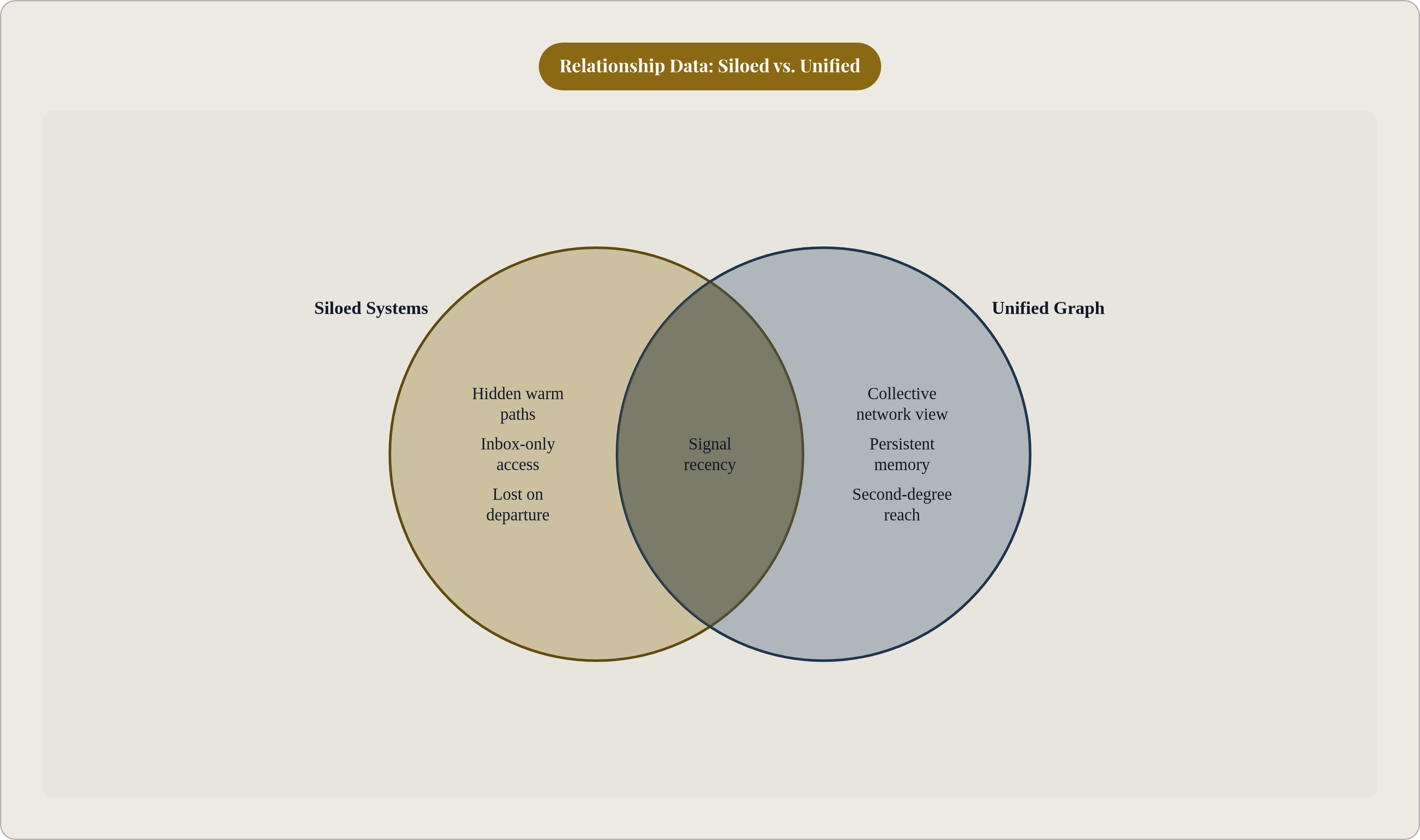
The shift that unification produces is not from "no data" to "data." It is from data trapped in three separate places to data that can be queried as a single relationship graph. The value is in what becomes surfaceable that was previously invisible by default.
Specifically: which person in the firm holds the strongest, most recent relationship with a specific target; which connections are actively maintained versus quietly lapsing, before they fully cool; the second- and third-degree reach the firm has built collectively; and an institutional memory that persists through personnel change, because the relationship record no longer walks out the door with the person who built it.
MassMutual Ventures surfaced more than 67,000 contacts and 43,000 organizations within 60 days of connecting their relationship data, and their Managing Partner noted the team could discover and triage investment opportunities up to five times faster. Per PitchBook's 2025 data, 54% of middle market unitranche transactions originated through intermediary referral, up from 47% in 2022. Being early to the warm path is a structural edge in a market where that share keeps rising.
The output of unification is not automation. It is visibility. The professional still makes every call, drafts every message, decides every introduction, but with the full picture of the firm's collective network rather than the slice they personally hold.
The Trust and Privacy Constraints That Any Unification Approach Must Clear
The objection to connecting email, calendar, and messaging to a shared relationship graph is legitimate. Personal communications becoming institutional data raises real questions about privacy, consent, and exposure. This is not an objection to be managed with reassuring language in a product brochure; it is a design problem, and it has to be solved architecturally.
One counterargument worth considering: fragmentation carries its own security risk. Per a 2024 report, 70% of organizations operating with data silos suffered a breach within the prior 24 months. The assumption that siloed data is inherently safer does not hold up empirically.
But the trust question is not simply whether to unify data. It is how to do so without exposing private relationship context, and that depends on a distinction most implementations collapse too quickly. Two layers require different treatment: personal context, meaning the content of a private email or the details of a sensitive conversation, which must remain private; and institutional signal, meaning the fact that a connection exists, its strength and recency, which can be made collectively useful without exposing the underlying content. Conflating those two layers is the design failure that kills adoption. It is also, in practice, the most common mistake firms make when they attempt this.
A permissioned architecture, in which each professional controls what relationship data they contribute to the firm's shared graph, earns trust through design rather than through policy promises. The human-in-the-loop principle follows: the system surfaces the warm path and may draft the outreach, but the professional decides whether to send it and what it says. No autonomous sends. No exposure of private context without explicit review.
Whether that balance holds at scale, across firms with different cultures and different tolerances for data sharing, I don't think anyone has yet answered convincingly, including the firms currently building toward it. The ones that preserve the distinction between institutional signal and personal context will likely compound over time, their graph more valuable as more relationship data flows through it, and still trusted by the professionals whose contributions make it work. The ones that collapse that distinction will find out quickly why it mattered.