Building a Firm-Wide Relationship Memory Layer
Warm introductions drive 70% of VC deals, but most firms can't find them when it matters.

Most firms already have the deal-sourcing edge they're chasing. It's sitting in employee inboxes, buried in calendar histories, threaded through email chains nobody's opened since the deal closed. Harvard Business Review looked at nearly 900 VCs and found that over 70% of deals originate from a firm's existing network, so the bulk of deal flow depends on relationship data most firms can't actually pull up when they need it. That's a strange place for an industry built entirely on relationships to end up.
Call it relationship intelligence: who knows whom, how well, through what history. It sits scattered across a firm's people rather than anywhere useful, so firms end up with plenty of reach but no way to see or route through half of it. This piece walks through why that gap exists and what closing it actually takes.
How warm introductions actually work and why they outperform cold outreach at every stage
A warm introduction works because it transfers trust from one person to another. When someone vouches for a deal or a founder, they're spending their own credibility, and that pre-vetting collapses weeks of relationship-building into a single email. The person on the receiving end isn't sizing up a stranger; they're responding to someone their trusted contact already decided was worth the time.
These warm paths come from everywhere: portfolio founders, angel investors, accelerator mentors, operators who've actually built something, advisors sitting on twenty years of relationships nobody at the firm has fully mapped. It's less a channel than a web, and any given node in it can activate a different flavor of trust depending on who's asking.
Speed is where this stops being theoretical. Referral-driven deals close up to 69% faster than cold-sourced ones, and in a competitive round, that speed is often the whole ballgame. Showing up two weeks after the firm that got the warm intro means showing up too late, full stop. Sergio Monsalve at Roble Ventures has said 88% of his deals came through a tip-off or direct referral. For a firm operating at that level, that's not a nice-to-have; that's the sourcing engine.
So why do so many firms still treat relationship-finding as a soft skill, something left to one person's memory and hustle, when most of their deals are moving through exactly this kind of warm path? It's worth sitting with, because the answer says a lot about what comes next in this piece.
What the efficiency gap between firms actually reveals about network utilization
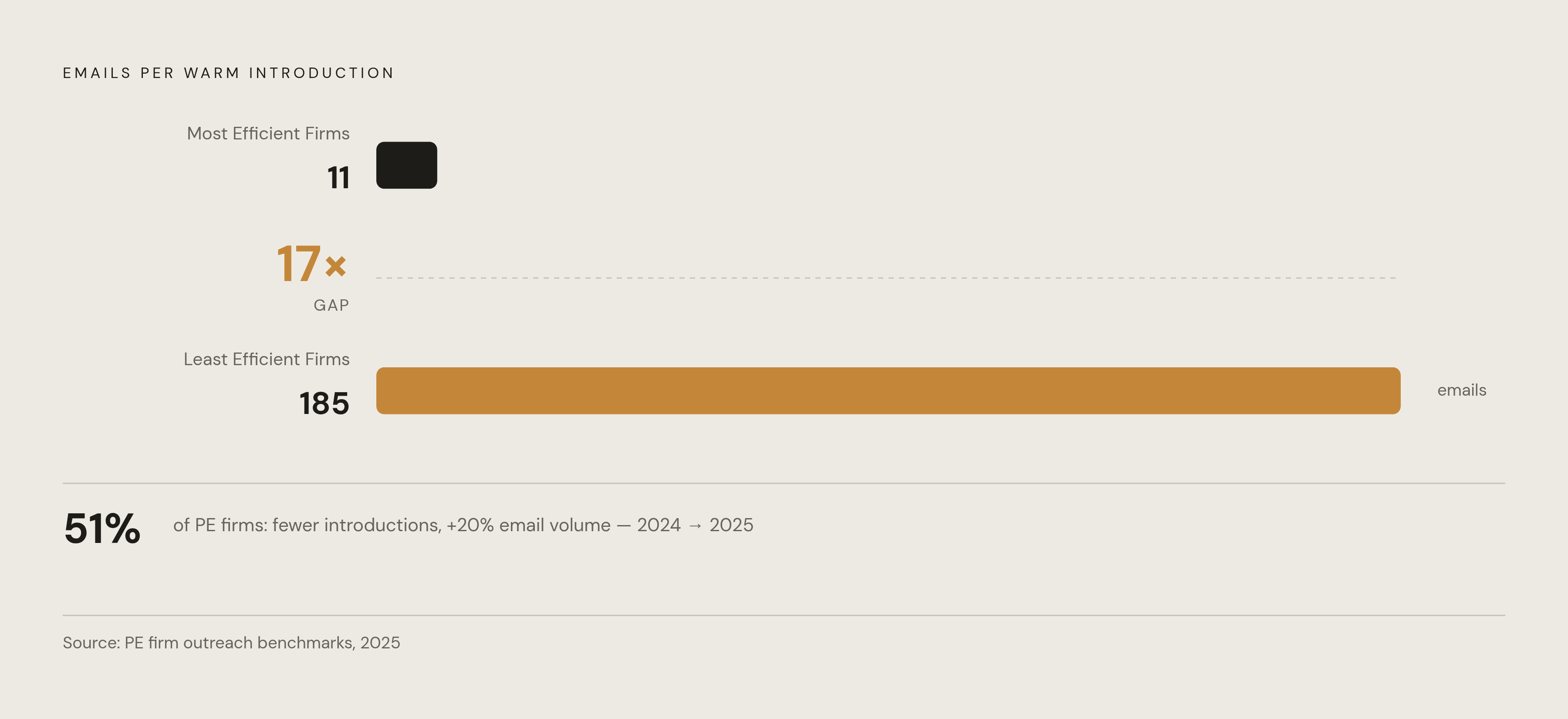
Affinity ran its Invisible Edge research across 291 private equity firms and found a number that should stop you mid-scroll: the most efficient firms generate one introduction per 11 emails sent. The least efficient need 185 emails for the same result, seventeen times the effort for the same outcome.
Seniority doesn't explain that gap, and relationship quality doesn't either. Effort clearly isn't the difference, since a firm sending 185 emails per introduction is obviously not coasting. What separates the two groups is visibility: whether a firm can see the network it already has and route through it, or whether it's guessing and hoping volume covers for it.
The trend line makes this worse before it gets better. Fifty-one percent of PE firms saw introduction output drop sharply between 2024 and 2025, even while email volume climbed 20% over the same stretch. More effort produced worse results. The network underneath wasn't getting any easier to see, so pouring more outreach into it just generated more noise.
What did the firms doing well actually do differently? According to Affinity's 2025 Investment Benchmark Report, top performers ended 2024 with 4% fewer new contacts year-over-year, even as their networks grew for two straight quarters. They worked the people they already had harder instead of chasing more of them. Line that up against the introduction-rate gap above and the pattern holds: visibility into what's already inside the walls beats knocking on more doors outside them.
How relationship intelligence disappears when employees leave
The average U.S. knowledge worker sticks around a job for 4.1 years, per 2024 Bureau of Labor Statistics data. A firm turns over its entire workforce roughly every four years, and every departure takes more out the door than a job title and a laptop.
What leaves is the relationship history that person carried around in their head, mostly unwritten: who they knew, how well, what was said last, where a conversation drifted off before it went quiet. Gartner estimated in 2024 that 70 to 80% of enterprise knowledge is tacit, meaning nobody wrote it down anywhere retrievable. Relationship context lives almost entirely in that bucket. Nobody's typing "spoke with the CFO for twenty minutes about her son's soccer game, she mentioned they're raising in Q3" into a CRM field, and nobody ever has.
The cost isn't abstract. Deloitte put institutional knowledge loss at $1.3 trillion a year for U.S. companies in 2024, and McKinsey pegged the toll on mid-sized S&P 500 companies between $228 million and $355 million annually from attrition and disengagement alone. Professional and business services had nearly 1.3 million job openings as of December 2025. In that world, a client relationship starts degrading the moment the person covering it walks out the door.
Enterprise accounts feel this hardest. Long deal cycles, a dozen stakeholders, a buying committee that took months to map, and one personnel change can send the whole thing sliding back months, sometimes for good. Relationship capital sitting only in someone's personal inbox is a liability with a four-year fuse, and most firms are carrying more of it than they'd admit.
Why CRMs do not solve this and what a relationship memory layer does differently
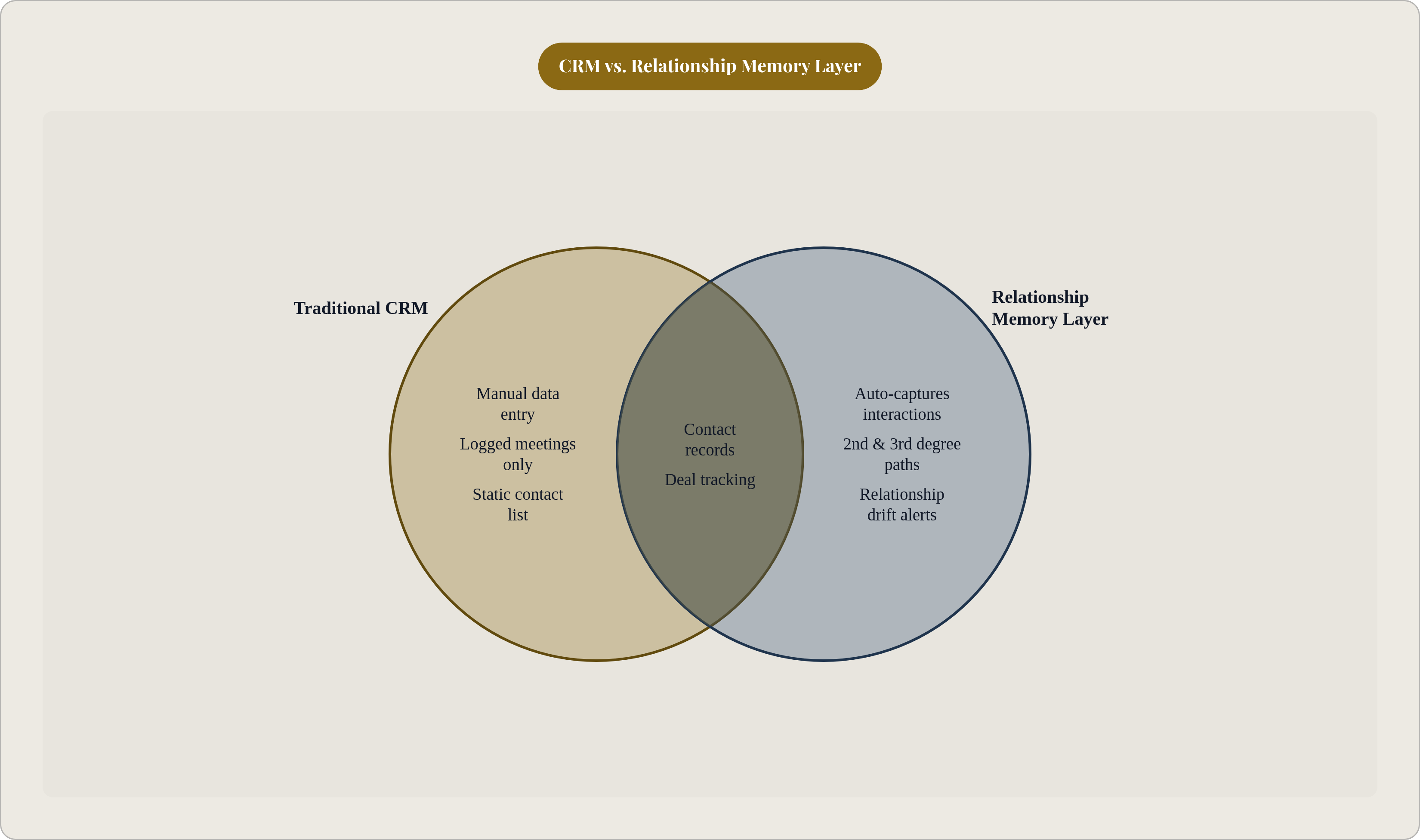
Here's the blunt version: a CRM can tell you every meeting your team has ever logged, but it almost certainly cannot tell you who on your team actually knows the CFO at your top target account. That gap is the whole problem.
This keeps happening because CRMs run on manual entry, and any system that depends on a human remembering to log a relationship will run stale eventually. Worse, it fails exactly when it matters most: the moment you're scrambling to find a warm path fast, the CRM has nothing new to tell you.
A relationship memory layer takes a different approach. It plugs into where professional relationships actually live, email, calendar, LinkedIn, messaging, without asking anyone to type a single thing. It builds a graph that updates itself, showing who knows whom across the whole firm, scored by strength, recency, and relevance. Second- and third-degree connections, the ones nobody thinks to ask about because they don't even know they exist, become visible and searchable. The system can surface a warm path to a target even when the user has no clue their colleague once sat next to that person's college roommate at a conference two years back.
What gets uncovered tends to surprise people. Platforms in this category routinely surface more than 300 contacts and 700 relationships per user, most of which were sitting invisible in the firm's own CRM the whole time. MassMutual Ventures is a case worth sitting with: within 60 days of implementation, the firm surfaced 67,000 contacts and 43,000 organizations. Managing Partner Eric Emmons has said this let his team discover and triage investment opportunities up to five times faster. Which raises the obvious follow-up: how much of that number reflects better tooling, and how much reflects a firm that simply hadn't audited its own contact base before?
A relationship memory layer doesn't replace the CRM as system of record. It sits on top of it, adding the intelligence layer that finally makes a firm's existing network something you can query instead of something buried six inboxes deep.
The four-step lifecycle that turns scattered interaction data into a queryable network
Four stages, each building on the last, run the full cycle.
Capture comes first, with interaction data pulled automatically from email metadata, calendar events, meeting notes, whatever's connected, with zero manual entry. Enrich comes next: external signals like company data, role changes, funding events, and news get layered on, so a raw interaction turns into something with actual business context instead of sitting there as a bare data point. Analyze comes third; relationships get scored by strength, recency, and relevance to whatever deal or search is live, and the graph gets mapped to surface paths two or three degrees removed that nobody would find from memory alone. Then Activate: the system surfaces the right path at the right moment, drafts outreach in the user's own voice, points to the warmest possible introducer, and flags relationship drift before a once-strong contact goes cold and stays that way.
What does automating all of this actually buy the people doing the work? Affinity's research found investors tapping into relationship insights increase deal flow by 25% and save over 200 hours a year on contact and data entry alone. Hours saved is a slippery thing to measure well, and vendor research always has an interest in the answer, so weigh that number accordingly. Even a fraction of that gain would justify the shift for most firms.
The human element doesn't disappear here. The platform drafts and recommends, but the professional still decides what actually goes out the door. AI speeds up the motion; the judgment call stays with the person who should be making it. Per Affinity's 2026 Predictions Report, over half of investors already spend more than 21 hours a week on deal research alone, and 24% spend 41 to 60 hours weekly. Stack manual relationship-data management on top of that, and you've handed someone a second full-time job they never applied for.
How leading platforms approach this problem and what they trade off
This category isn't one-size-fits-all, and treating it that way is how firms end up with the wrong tool bolted onto the wrong workflow. Different platforms are built for different firm types, different data sources, different habits. The right pick depends on what a firm is actually trying to fix, not which vendor has the slickest demo.
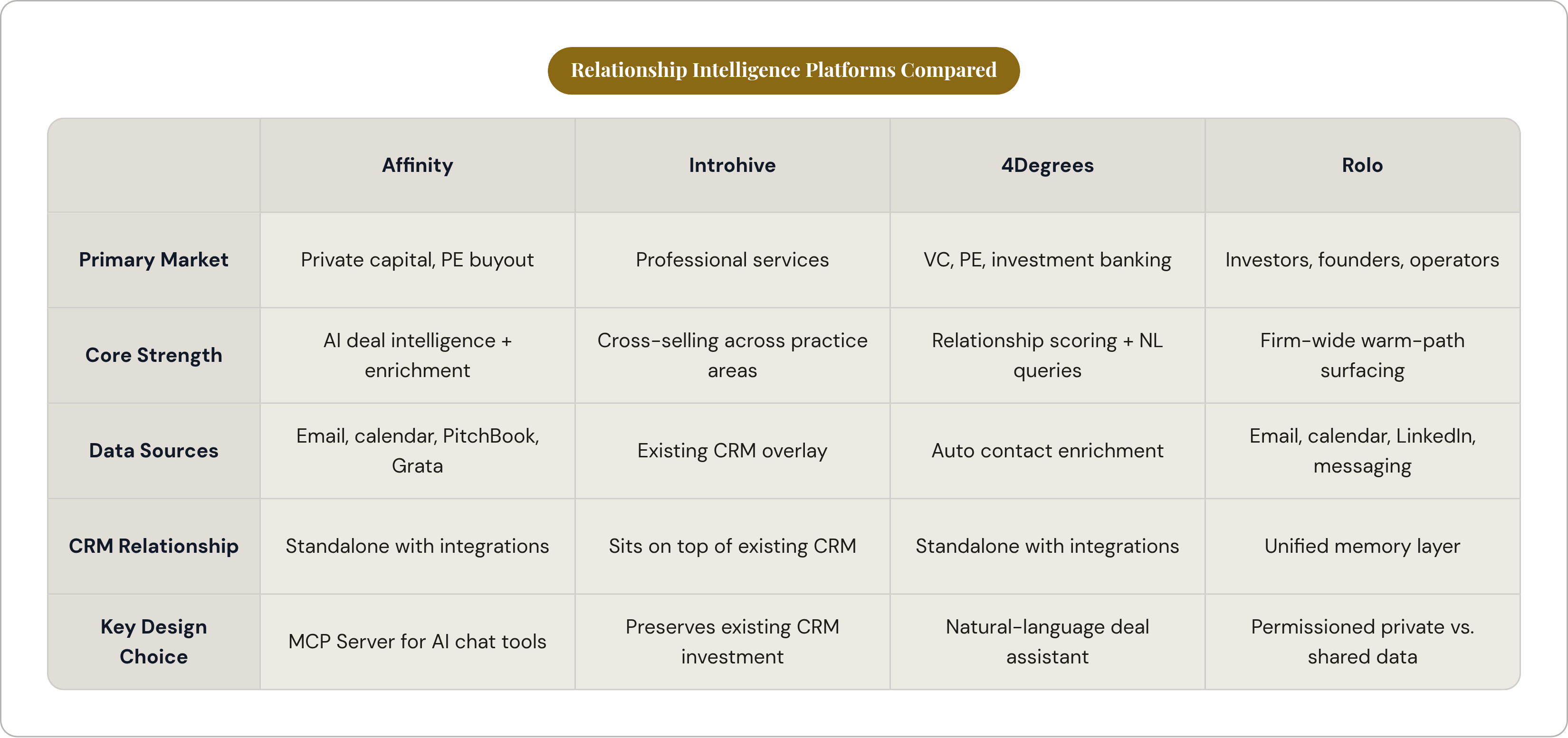
Affinity is built specifically for private capital, used by thousands of private capital firms including over 250 PE buyout teams. It automates data capture across email, calendar, and meetings, layers AI deal intelligence on top, and pulls enrichment from PitchBook, Grata, and SourceScrub. Its MCP Server integration lets teams query relationship and deal data directly from Claude and ChatGPT, a real convenience for teams already living inside those tools all day. Though it's fair to ask how much of that value depends on a firm already having clean CRM data to begin with.
Introhive plays a different game entirely, built for professional services: law, accounting, consulting. It has hundreds of thousands of users across over 90 countries and sits on top of an existing CRM rather than replacing it, which matters for firms that already sunk years and budget into that CRM. Introhive shipped its AI-powered Intelligence Suite in October 2025, and its real strength is cross-selling: making one partner's contact book visible to colleagues in other practice areas who'd otherwise never know it existed.
4Degrees leans relationship-intelligence-first, built for VC, PE, and investment banking teams. It offers automatic contact enrichment, relationship strength scores, customizable pipelines, and a natural-language assistant that answers questions about CRM data directly, with ChatGPT and Claude integrations for deal evaluation.
Rolo, from Alpha Watch, takes the firm-wide route, built for investors, founders, and operators working in high-trust, high-stakes environments. It connects email, calendar, LinkedIn, and messaging into a single queryable memory layer, surfaces warm paths ranked by relevance and recency, and drafts outreach in the user's own voice without ever sending on its own. The permissioned architecture underneath is a meaningful design choice: personal relationship context stays private while institutional relationship signals become collectively useful. How that architecture holds up at scale, across a firm with hundreds of users and years of accumulated data, is the kind of thing that only really shows up once firms have lived with it a while.
There's a pattern worth naming plainly here. The 2018 to 2024 era of this category mostly ran on a single connector source, usually email or a CRM sync, and called it a day. The platforms gaining ground now map the warm graph across every connector, team, customers, board, advisors, partners, and run the full warm-intro motion end-to-end instead of handing back a bare contact list. Firms choosing between these options should weigh their primary use case, whether that's sourcing, cross-selling, or founder access, against their existing CRM investment and how seriously they actually take data privacy, not just how seriously the sales deck says they do.
Why permissioned architecture is not optional in a firm-wide relationship graph
Making relationship data useful across a whole firm means aggregating everyone's personal interaction history in one place. That raises a question nobody gets to dodge: who actually gets to see what?
This isn't hypothetical anymore. AI data privacy jumped to the top implementation barrier cited by business leaders, up to 69% from a much lower share in under a year. That's a fast-moving number, and firms building or buying into a relationship graph need to take privacy seriously from day one, not bolt it on after something breaks.
Here's the distinction that actually solves it: institutional relationship signals, the fact that someone at the firm has a strong connection to a target, can be visible across the team without exposing the private content underneath. A colleague should be able to see that you know someone well, but they shouldn't be able to read what the two of you actually discussed, or pull up your emails. That's the design problem good permissioning is built to solve, and it's the entire trust model the rest of the system depends on.
In practice, that means each team member controls which of their own interactions feed into the shared graph. Personal context stays locked down; the network signal, the who's-connected-to-whom layer, becomes shared and institutional.
The governance risk here isn't theoretical either. Fifty-three percent of organizations have already dealt with AI agents exceeding their intended permissions, and nearly half have had a security incident involving an AI agent in just the past 12 months. That's why the AI-as-drafter principle carries so much weight: a relationship memory layer that drafts outreach but never sends on its own keeps a human in the loop for every action that actually matters. It's a trust requirement for the professionals using the thing, and a practical guardrail against exactly the kind of overreach those numbers describe.
For enterprise buyers, SOC 2 compliance and audit-ready data handling stopped being differentiators a while back. They're the floor now. The real question worth putting to any vendor is whether the architecture was designed for trust from day one, or stitched onto something that was never built with this in mind.
What it takes to make a firm's network a durable institutional asset
The shift here is simple to describe and hard to execute: moving from a network that lives in scattered inboxes and evaporates with every resignation, to one that's persistent, searchable, and owned by the firm rather than by whoever happens to be holding it this quarter.
What actually changes once this is in place? A new partner can pull up the firm's entire relationship history with a target on day one, instead of spending three months rebuilding context that already existed somewhere on a former colleague's old laptop. A BD operator who suspects a warm path exists somewhere inside the firm can go find it, rather than defaulting to a cold email because searching felt too slow to bother with. Relationship drift, contacts quietly going cold because nobody happened to notice the gap, becomes something you can see and fix before it turns permanent.
The numbers back this up, at least in direction: relationship-intelligence-enabled firms report up to a 25% increase in deal flow and save over 200 hours a year per team member, according to Affinity's research. That gain comes from visibility into a network the firm already had. Still, firms evaluating this for themselves should treat vendor-reported figures as a starting point for their own diligence, not a promise carved in stone.
Sixty-four percent of investors already use AI to speed up company research. The firms pushing that same instinct into relationship intelligence, not just research, are the ones actually closing the gap between the effort they put in and the deal flow they get back out.
The relationship data is already there, sitting in inboxes and calendars across every firm right now, whether anyone's bothered to look or not. The only question left is whether a firm treats that as a perishable asset that walks out the door every four years, or finally builds the infrastructure to make it something the whole firm actually owns.