Asking for an Introduction Without Burning the Introducer
Structure your introduction request so the connector can forward it without editing a word.
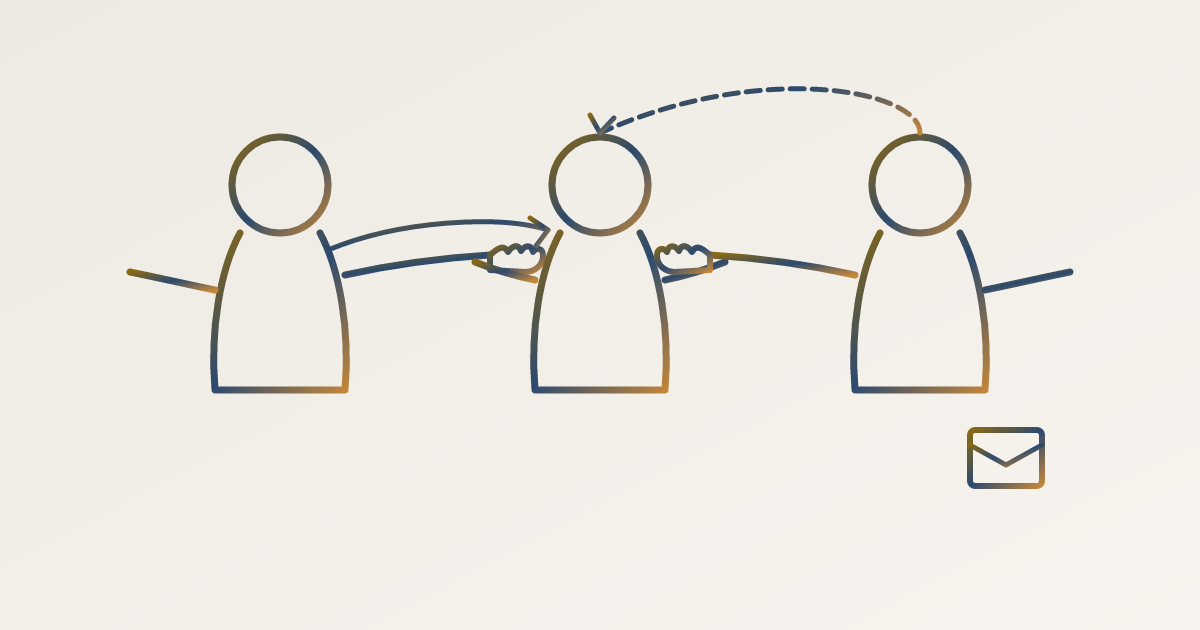
Most introductions fail not because the connector is unwilling, but because the ask creates problems the connector must solve before they can forward anything. The failure precedes the email.
The first problem is asking too soon. If you connected at a conference two weeks ago, or the only basis for the relationship is a shared alumni network, the connector has no real context to offer. They know your name, not your character or your work. Asking them to vouch for you before that context exists puts them in an impossible position: either they make a weak introduction they can't stand behind, or they decline and feel awkward doing it. But what if the relationship feels solid enough from your side — does that mean it is?
Second is the vague ask. "I'd love to connect with her" tells the connector nothing about why the meeting matters, what the asker brings to it, or whether it's worth the target's time. The connector now has to construct a rationale from scratch, labor the asker should have done.
Third is the one-sided pitch. When a request is framed entirely around what the asker needs, "I'm hoping to get her perspective on my fundraise," the connector cannot credibly describe why the meeting benefits the person being introduced to. They become a courier for someone else's agenda rather than a trusted node linking two people who might actually be useful to each other.
Fourth is the work dump. The asker expects the connector to write the email, establish the context, manage the thread. This is not a favor request; it is a task assignment. The connector's social capital gets spent, and they are expected to supply the labor as well.
That last failure mode rarely gets named, which is precisely why it does the most damage. Think about your peripheral contacts: the people you've met briefly at industry events, added on LinkedIn, never worked with closely. When someone asks you to introduce them to those contacts, you lack the standing to vouch with any real substance. The discomfort isn't reluctance to help; it's that helping would require overstating a relationship that can't bear the weight. Showing up uninvited in someone's inbox, without context or credibility, signals something to the inbox owner about the connector's judgment, which is precisely the thing connectors cannot afford to sacrifice.
Gauging Whether the Ask Is Fair Before Making It
The first question is not "can they introduce me?" It's whether the ask is reasonable given the relationship that actually exists. A useful test: could this person, if contacted by the target after the introduction, describe your work, your judgment, and your character from firsthand experience? If you're uncertain, the relationship probably can't support a full introduction request.
Before committing to the ask, send a brief pre-ask. Something like: "I'm not sure how well you know her, but if the relationship is close enough that it would feel natural, I'd welcome an introduction." This does two concrete things. It surfaces whether the connector has real standing, and it gives them a graceful off-ramp. The connector who says "to be frank, we've only met a couple of times, so I probably wouldn't be the right person" has spared everyone an awkward, hollow introduction. That is a useful outcome, not a failed one.
This stage also intersects with what careful connectors call the double opt-in: confirming the target is open to meeting before forwarding anything. It is also worth considering how this two-stage process affects what you include in your initial message. You may be writing something that gets shared in two steps rather than one forward, and that changes the structure.
The goal here is not to audit the connector. It's to protect them from a position where they either make an introduction they can't substantiate or have to decline a request from someone they like. A clean pre-ask that surfaces the problem early is better for everyone involved.
Building the Forwardable Email That Does the Connector's Job for Them
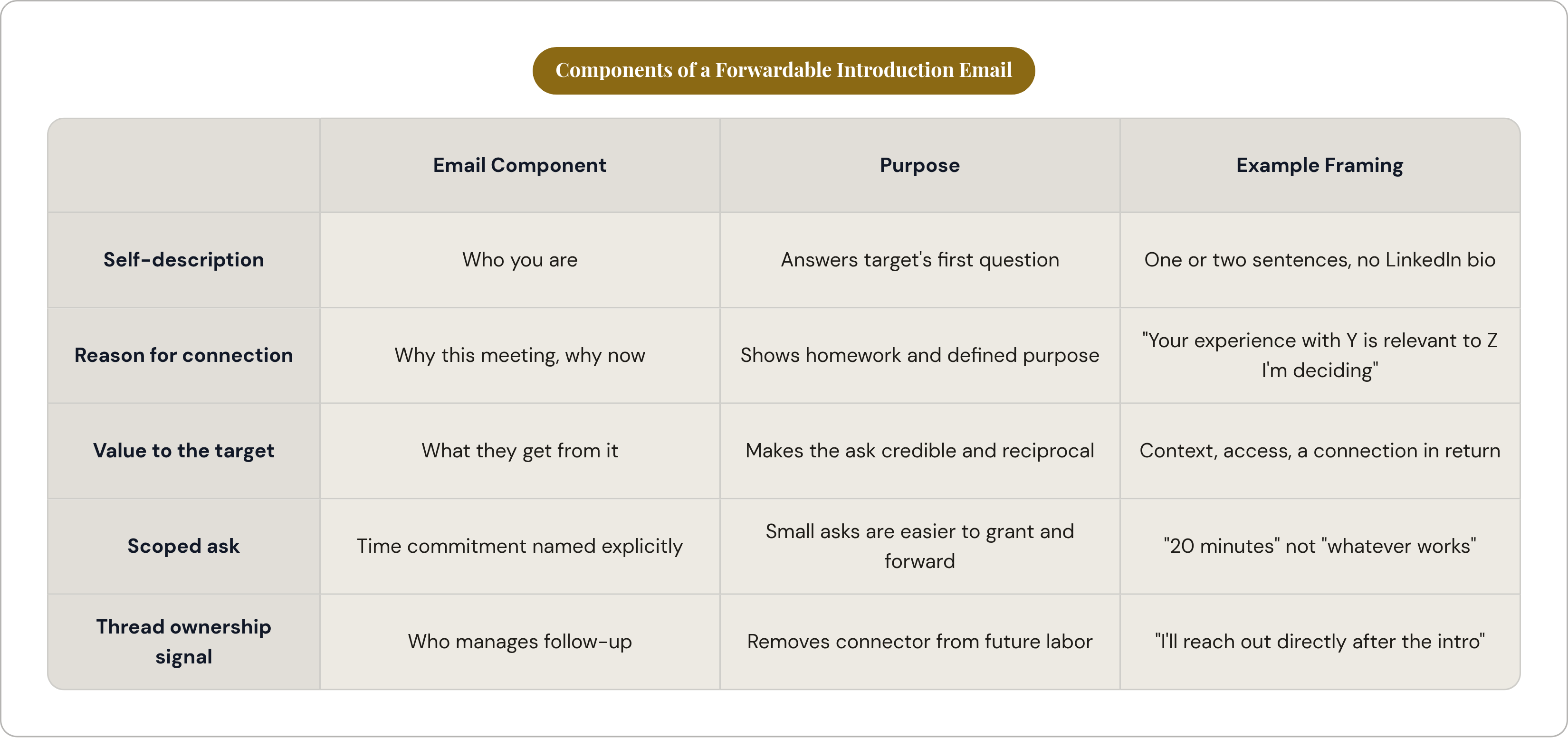
The operative standard is simple: if the connector can forward your message without changing a word, you've done your job. Everything in the forwardable email should be written for the target's eyes, not the connector's, even though the connector receives it first.
Start with a crisp self-description, who you are in one or two sentences, written for someone who has never heard of you and has no obligation to care yet. This is not your LinkedIn summary. It's the sentence that answers the target's first question before they have to ask it.
Follow with a specific reason for the connection. Not "I'd love to get your perspective," but something like: "I'm building X, and your experience navigating Y is directly relevant to a decision I'm working through because of Z." The specificity signals that you've done your homework and that the meeting has a defined purpose. Vague requests don't get ignored because connectors are ungenerous; they get ignored because connectors can't vouch for something they don't understand.
Then articulate what's in it for the person being introduced to. If you cannot answer this, neither can the connector. A meeting request framed entirely around the asker's need is one the target has every rational reason to decline. Think about what you can offer: relevant context, a perspective they might not have, access to something useful, a connection in return. Name it explicitly, even if briefly.
Scope the ask down. A 20-minute call, not "whatever time works." Small asks are easier to grant and easier to forward.
Finally, signal that you will own the thread after the forward. Something as simple as "I'll reach out directly once you've made the introduction" removes the connector from any future management responsibility. They should be done the moment they hit send.
One practical note: if your initial message contains context that's sensitive or that the target shouldn't see, flag it separately to the connector and offer a clean, forwardable version as a follow-up. Connectors notice that kind of situational awareness.
How Timing and Pacing Protect the Relationship with the Connector Over Time
Every introduction request draws down something. The account has to be replenished between draws, or the balance falls to zero before either party notices, which tends to be precisely the moment you'll need it most.
The practical implication: don't ask the same connector for more than one introduction in the same period. The right interval depends on the relationship's depth, but several months is a reasonable floor, and the more significant the ask, the longer the recovery period before the next one.
Closing the loop is not optional. After the meeting happens, go back to the connector, tell them what occurred, be specific. The connector has put their reputation on the line and has a legitimate interest in knowing whether it paid off. One who hears nothing about what became of an introduction grows reluctant to make the next one. One who hears "that turned into a partnership" becomes an enthusiastic advocate. The feedback itself is part of the value exchange.
Reciprocity functions as infrastructure in well-run networks. The posture to maintain is a standing willingness to make introductions in return, not as transactional quid pro quo, but as a general orientation toward the relationship. Connectors who are also being connected sustain the symmetry over time.
At the firm level, this dynamic has real operational consequences. If introduction requests flow out through one or two people but those connectors see no value flowing back, the firm's network access degrades quietly. Enthusiastic connectors become reluctant ones. The erosion is incremental, and eventually quite expensive.
Giving the Connector a Graceful Exit Without Making the Ask Feel Fragile
Making it easy to say no increases the probability of yes. People are more willing to help when they don't feel cornered by the act of helping. The connector who feels they can't decline without damaging the relationship will either make a reluctant introduction or avoid the situation entirely, and a reluctant introduction is often worse than none. The target can sense the lack of conviction in the forward, and the connector's credibility suffers for it.
The language of the graceful exit is simple: "Only if the relationship is close enough that it would feel natural; no pressure at all if it isn't." This framing filters for quality. The connector who says yes after being given the out is making the introduction willingly, and will vouch with real conviction rather than going through motions.
On follow-up: if the connector declines or goes quiet, leave it alone. Following up on silence or a soft no signals that you're prioritizing your own need over their comfort, which is precisely the asymmetry this entire approach is designed to prevent. Silence after a clean, gracious ask is information. It tells you something about the relationship, the timing, or the fit of the ask. Treat it as such.
Why the Strongest Path to a Target Is Usually Already Inside the Firm's Existing Network
That raises an important question most firms experience but rarely name cleanly. The warm path to a given target almost certainly exists somewhere across the team's collective email history, meeting records, and professional contacts. The challenge is that no one can search across it.
The operational consequence is predictable. Warm introductions that could have happened don't, because no one knew to ask a particular colleague. Relationship context lives in one person's head. When someone leaves the firm, their relationship context leaves with them. The LP relationship that lived in a departing VP's inbox, the portfolio referral that came through a now-departed principal: these don't transfer. They disappear.
The data makes the problem concrete. Ninety-six percent of venture capitalists source deals directly from their own networks, and 89 percent use warm introductions or referrals as a primary deal-sourcing mechanism. The bottleneck in most firms is not the size or quality of the network. It is the inability to see what is already there.
This is a visibility problem, not a scale problem. The introduction often already exists; it just can't be found in time to be useful. Every piece of etiquette and framework in this article is beside the point if the firm cannot identify the right connector in the first place. The question of who to ask precedes the question of how to ask, and most firms have no systematic answer to the first one.
What Relationship Intelligence Tools Actually Do, and What They Should Never Do
The category of tools that addresses the visibility problem does something conceptually simple but technically nontrivial. They aggregate signals from email, calendar, and professional networks into a queryable picture of who knows whom, how recently, and with what frequency. Instead of asking your team "does anyone know someone at this firm?", you can surface who has the strongest, most recent relationship with a given target based on actual interaction history, not job titles or org charts.
Relationship scoring, when it works, shifts the prioritization question from guessing to observing. It changes "I think Sarah might know him" to "Sarah has had twelve substantive interactions with him in the past six months, and no one else on the team comes close." That specificity matters when an introduction request carries real stakes.
Network mapping adds a further dimension: the inferred path. Not just who has a direct relationship, but who on the team has a path through a former colleague or shared investor connection. These second-degree paths are invisible without the technology and often represent the strongest route.
The adoption data is instructive about where practitioners' trust in these tools currently sits. Nearly half of dealmakers now use AI tools daily, but only 13 percent rely on them for investment decisions, down from 40 percent the prior year. Practitioners appear to be pulling AI back from judgment and keeping it in the infrastructure layer, surfacing paths rather than choosing them. Intel Capital's COO Jennifer Ard put the line plainly: "We will never have AI make investment decisions because so much of it is about relationships. But AI can streamline tasks, helping us focus on people and strategy."
That line holds regardless of the tool's capabilities. AI should surface the path and, where useful, draft an initial message for human review. It should not send anything autonomously, act on behalf of a relationship without explicit instruction, or expose one person's private relationship context to others without their knowledge. The moment a tool operates beyond those constraints, it undermines the trust it was built to support.
The Privacy Constraint That Makes Relationship Intelligence Safe to Use at the Firm Level
There is a real tension here, and glossing over it doesn't serve anyone. Making relationship data collectively useful across a team requires aggregating it. Aggregating it creates genuine exposure risk. Fifty-three percent of organizations identify data privacy as their top concern when implementing AI tools, per Cloudera's most recent global report. In professional contexts where relationships carry confidentiality implications, including LP relationships, deal negotiations, and sensitive referrals, that concern is not abstract.
The shadow AI threat makes the concrete version visible. IBM's 2025 breach report found that one in five organizations experienced breaches through employees pasting sensitive data into unauthorized tools, adding an average of $670,000 to breach costs. Meeting notes, client context, relationship details: these are exactly the categories of information that end up in AI-assisted workflows, and exactly the categories that create exposure when the tools handling them lack proper controls.
The architectural solution is a separation between what is collective and what is private. Relationship signals, specifically who knows whom, the recency and frequency of interaction, can reasonably be made visible across a team. That is the information needed to identify the right connector. Relationship content, what was discussed, what was agreed, the nature of the personal relationship, stays private to the individual unless they explicitly choose to share it. These are not the same category, and the architecture needs to treat them as distinct before any data enters the pipeline.
SOC 2 Type II and ISO 27001 certification matter, but they are table stakes. A firm evaluating tools in this category should be asking not "are you certified?" but "what can my colleague see about my relationships, and what requires my explicit consent?" The architecture question matters more than the badge.
When that architecture works, the firm can see that a warm path to a target exists without anyone seeing why the relationship is warm. The visibility problem gets solved without creating a new one.
Putting the Framework Together: What the Full Introduction Request Looks Like End-to-End
In practice, this collapses into six moves.
Find the right connector first. Use whatever visibility your team has, whether memory, conversation, or a relationship intelligence layer, to identify who has the strongest, most recent substantive relationship with the target. Not the most prominent name on the team; the most qualified one for this specific ask.
Before making the ask, gauge the relationship. Send a brief pre-ask to confirm the connector has real standing and to give them a natural off-ramp. This protects the connector and surfaces weak relationships before they become weak introductions.
Write the forwardable email. Crisp self-description written for the target. A specific reason for the connection. A clear articulation of what's in it for the person being introduced to. A scoped ask with a defined time commitment. A signal that you will own the thread after the forward. If anything is sensitive, offer a separate clean version.
Give the connector an explicit out. Make declining easy, linguistically and structurally. The quality of the introduction scales directly with the willingness of the person making it.
Once the forward goes, the connector is done. Own the follow-up thread completely.
After the meeting, report back to the connector specifically. This is what replenishes the relationship and keeps them willing to vouch for you again.
The through-line across all six moves is the same principle: the asker's job is to make every stage of this process easier for the connector than it would have been without the asker's preparation. Warm introductions carry the response rates they do, roughly 70 to 80 percent compared to 5 to 10 percent for cold outreach, not because of the format, but because of the transferred credibility underneath. Everything here is, ultimately, about protecting that credibility, which is not yours to spend.