Data Residency and Sovereignty Requirements for Cross-Border Investment Firms
Banking secrecy law, not server location, determines real data sovereignty risk.
Cross-border investment firms don't get to pick which data laws apply to them. Every jurisdiction where a firm has investors, operations, or counsel attaches its own rules to the same underlying data, and those rules stack rather than compete. This piece walks through how that stack forms, which layer gets ignored most often, and what architecture actually satisfies most of it at once. The position here is blunt: the layer most firms treat as an afterthought, banking secrecy law, carries the sharpest teeth of the three, because it's the only one that can put a named executive in front of a criminal court rather than a fine committee.
Three terms get used interchangeably in board decks, and they shouldn't be. Where the servers physically sit determines data residency, a geographic fact. Data sovereignty is a legal fact: which country's courts and agencies have authority over that data, no matter where it sits. Data localization is a government mandate forcing the first two to line up inside its borders. A fund can satisfy residency (EU customer data sitting on servers inside the EU) while failing sovereignty, because the company running those servers is headquartered in another country whose laws reach across borders. and subject to a CLOUD Act order that has nothing to do with geography. The cleanest illustration of the gap is a law that lets domestic authorities compel a U.S.-headquartered provider to hand over data no matter where that data physically lives. Server location just makes people feel like the conflict is resolved. Server location just makes people feel like the conflict is resolved, and it isn't.
So picture a fund with limited partners in one region, back-office staff in another country, and outside counsel in a third jurisdiction. That fund sits inside GDPR, GLBA, and MAS TRM all at once, on the same records, at the same time. That's the organizing question for everything below: how do these obligations layer on top of each other, and what does an architecture look like that can hold all of them without contradicting itself?
The three-layer compliance stack every multi-jurisdiction investment firm inherits
Sovereignty compliance in financial services doesn't work like a menu where a firm picks the strictest applicable rule and calls it done. It's additive. Three layers stack on top of each other, and each one has a different target and a different kind of teeth.
Layer one is baseline privacy: rules governing the personal financial data of customers wherever they live. One regional privacy law, another regional financial-data law, various other regional equivalents elsewhere. What makes this layer tricky is its reach past borders. These laws apply based on where the customer sits, not where the firm's headquarters happens to be, so a fund headquartered in one country. fund with European limited partners is squarely inside GDPR's scope whether it likes it or not.
Layer two is operational resilience: rules governing cloud infrastructure, third-party technology risk, and system continuity. DORA in the EU, MAS TRM in Singapore, APRA CPS 234 in Australia. The distinctive feature here is that these obligations don't stop at the firm's front door. They flow down the supply chain to the cloud vendors and software providers the firm relies on, and vendors become direct subjects of the regulation themselves.
Layer three is banking secrecy, and this is the one most compliance programs treat as somebody else's problem. Germany's §203 StGB alongside BaFin oversight, Luxembourg's CSSF, France's ACPR under the Monetary and Financial Code, Switzerland's FINMA. These are criminal statutes, and the liability can attach to named individuals, not just the firm as an entity.
A firm doing business in Germany sits under all three layers at once. Passing a GDPR audit does nothing to discharge banking secrecy exposure under §203 StGB. Most compliance teams underweight layer three precisely because it reads as banking law rather than data law, and it's easy to file under "not our department," right up until a German LP's records move through a compromised vendor platform. The next four sections walk through this stack in order, starting with the layer everyone at least recognizes.
GDPR as the baseline layer: what it requires of investment firms operating across EU jurisdictions
GDPR applies to any firm processing the personal data of EU residents, full stop. Headquarters location doesn't matter. A U.S.-based fund with European limited partners is in scope the moment it starts collecting their information, regardless of where its offices or its data centers sit.
The provision that matters most for sovereignty purposes is Chapter V, which restricts how personal data leaves the EU. Transfers are only permitted under an adequacy decision, standard contractual clauses (SCCs), or binding corporate rules. An earlier ruling struck down the prior cross-border data-transfer framework between two major jurisdictions. Privacy Shield framework and, more importantly, made clear that SCCs alone can't override a CLOUD Act order. A contract clause doesn't stop a government subpoena served directly on a cloud provider. Article 48 spells out the conflict directly: personal data can't be handed to a non-EU authority based solely on a foreign court order. So a firm running its EU customer data through U.S.-headquartered cloud infrastructure without customer-managed encryption sits in structural tension with Article 48, no matter which country the servers are physically in.
A comparable financial-data protection law. parallel is GLBA, which requires financial institutions to protect consumer financial data and limit how it's shared with third parties. The updated Safeguards Rule from 2023 requires encryption in transit and at rest, access controls, and multi-factor authentication. Firms that meet GDPR's higher encryption bar generally satisfy GLBA's requirements at the same time, so building to the stricter standard first saves duplicated work later.
The financial stakes aren't abstract. GDPR fines run up to €20 million or 4% of global annual turnover, whichever is larger, and that number has visibly reshaped how firms buy cloud services. Regulatory compliance now ranks as the top factor in cloud vendor selection for a large share of organizations, according to TechClass data. According to reporting in BizTech drawing on IBM's 2024 Cost of a Data Breach Report, financial services ranked as the industry with the second-highest average breach cost, at $6.08 million. Baseline privacy compliance is a financial risk calculation with real stakes. It's a financial risk calculation with a dollar figure attached.
DORA: why the EU's operational resilience regulation reaches directly into cloud architecture and vendor contracts
DORA, formally Regulation (EU) 2022/2554, entered into force in January 2023 and became fully applicable on January 17, 2025. It covers essentially every EU financial entity: banks, insurers, investment firms, payment processors, even crypto-asset service providers, and it pushes obligations directly onto the third-party ICT vendors those entities rely on.
Article 30 is where sovereignty gets written into contract law itself. Contracts with ICT providers now have to specify data location and exit strategies, not as good practice but as a hard regulatory requirement. Firms also have to show operational continuity: that they can keep running if a third-party ICT provider fails, that they control their own failover and backup procedures rather than depending on a vendor's goodwill during an outage, and that no single vendor holds enough concentrated control over critical functions to become a lever a foreign government could pull.
This has already reshaped vendor selection. Per Kiteworks, a large majority of banks (68% in the 2024-2025 window, though this figure hasn't been independently verified by the European Banking Authority) updated their vendor assessment processes specifically to address sovereignty requirements after DORA took effect. Vendors that can't show customer-managed encryption and clear geographic data isolation are getting quietly filtered out of EU financial services procurement lists before the conversation even reaches contract terms.
For an investment firm, the choice of cloud provider stopped being an IT department decision somewhere around January 2025. It's a direct compliance matter now, with contract language that has to satisfy whichever regulator sits over the relevant market, whether that's the relevant national regulator for the market in question. And DORA doesn't sit in isolation. By 2026 it converges with the EU AI Act and GDPR into a single overlapping compliance surface for any firm running AI tools, which the AI section further down unpacks in more detail.
Banking secrecy laws in Germany, Luxembourg, France, and Switzerland: the criminal liability layer most compliance programs underweight
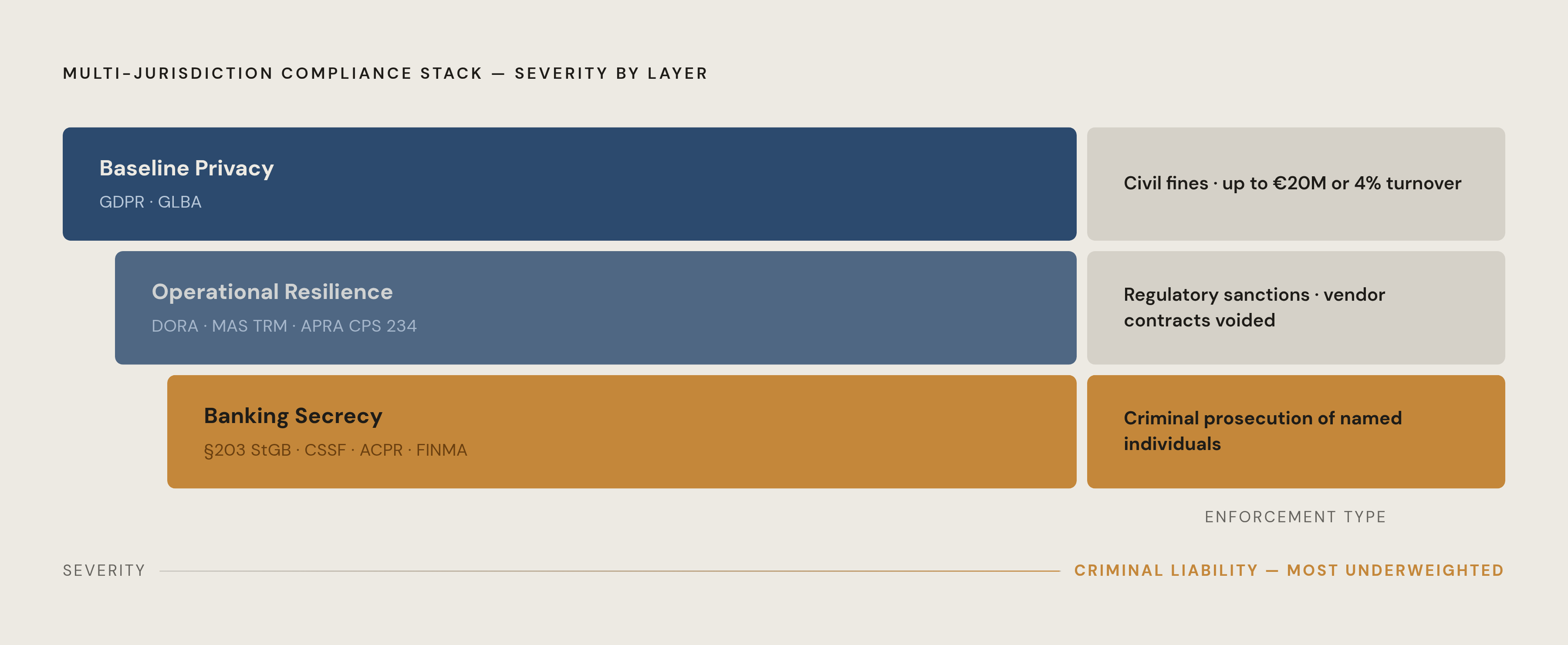
Banking secrecy laws are criminal statutes, and that's the categorical difference separating this layer from the first two. Not civil regulations with a fine schedule attached: actual criminal code. Unauthorized disclosure of a customer's financial information can lead to prosecution of the individual executives responsible, on top of whatever corporate penalty the balance sheet absorbs.
The governing frameworks vary by country but share this criminal character. Germany runs this through its criminal code, with BaFin providing regulatory oversight. Luxembourg's version sits with the CSSF, the Commission de Surveillance du Secteur Financier. France codifies it in Article L.511-33 of the Monetary and Financial Code, overseen by the ACPR. Switzerland writes it into Article 47 of the Banking Act, supervised by FINMA.
None of these jurisdictions accept "the vendor did it" as a defense. A firm can't contract its way out of criminal liability by pointing at a software provider after the fact. So picture a cross-border investment firm sharing LP data, deal pipeline details, or relationship records through a platform whose provider could be compelled by the CLOUD Act, or by a Chinese authority under China's own data laws. That firm isn't just risking a data breach headline. It may be exposing named partners and executives to criminal prosecution under the banking secrecy law of wherever that LP happens to be domiciled.
At that point, data sovereignty turns from a compliance exercise on a slide deck into a personal legal question for specific people at the firm. Most compliance programs pour their modeling effort into GDPR and DORA exposure, and that makes a kind of sense, because those fines are quantifiable: a firm can put a number on them and hand that number to a board. Banking secrecy exposure is harder to model precisely because criminal liability doesn't come with a neat percentage-of-turnover formula. But harder to model doesn't mean less severe. If anything, it's the opposite, and treating it as the smaller problem because it resists a spreadsheet is exactly the mistake most programs are making right now.
Asia-Pacific obligations that stack on top for funds active in Singapore and Australia
Two more frameworks join the stack for any fund with a footprint in Singapore or Australia, and both share DORA's basic structure even though they were written independently.
Singapore's Monetary Authority runs the MAS Technology Risk Management guidelines, which cover cloud infrastructure, third-party ICT risk, and data residency for regulated entities there. It plays roughly the same role for Singapore that DORA plays for the EU. Australia's version is APRA CPS 234, which governs information security for financial entities and similarly pushes obligations down to third-party service providers rather than letting firms treat vendor risk as somebody else's job.
The shared thread across MAS TRM, CPS 234, and DORA is that none of them let a financial institution outsource accountability. The vendor might run the infrastructure, but the regulatory responsibility for what happens to that data stays with the fund.
Layer this onto the earlier example. A fund with EU investor relationships carries GDPR, DORA, and banking secrecy exposure. Add U.S. operations or investors, and GLBA joins the pile. Add Singapore counsel or portfolio exposure, and MAS TRM stacks on top of all of it, on the same overlapping data. No single framework's compliance discharges the others; each has to be satisfied on its own terms. The gap appears predictably in most multi-jurisdiction firms: solid documentation for whichever regime dominates their headquarters location, usually GDPR or GLBA, and thin, underdeveloped documentation for the secondary jurisdictions. APAC frameworks tend to get the least attention, mostly because they're the ones bolted on last, after the primary compliance program is already built around a different regime.
The CLOUD Act structural conflict's practical implications for investment firms using U.S.-headquartered cloud providers
U.S. authorities can compel a U.S.-headquartered provider to hand over data it holds, regardless of where that data physically lives. Storing the data in a data center located in another country doesn't change this. The obligation attaches to the company itself.
That collides directly with GDPR Article 48, which says personal data can't be handed to a non-EU authority on the strength of a foreign court order alone. So a cloud provider headquartered in one country. cloud provider holding EU customer financial data, faced with a lawful CLOUD Act order, is stuck between two legal systems that both claim authority and neither yields. The investment firm caught in the middle can't instruct its provider to defy a lawful order from its home government. government order, and yet under GDPR and under banking secrecy law, the firm remains the party accountable for what happens to its customers' data. Nobody in that chain walks away clean.
This isn't a rare edge case for firms serving European customers. An estimated 97% of Europe's cloud infrastructure market is dominated by non-European providers, according to TechClass. That means the CLOUD Act conflict is a documented structural risk built into the default vendor landscape most EU-facing investment firms are already using. It's baked into the default vendor landscape most EU-facing investment firms are already using, right now, today.
What actually resolves this, rather than just managing around it, is customer-managed encryption: a setup where the provider physically cannot decrypt the firm's data, even under a valid compulsion order. A provider that can't read the data can't hand over readable data, no matter which government shows up with a subpoena. Per Kiteworks, this single design choice satisfies GDPR, DORA, PCI DSS, and banking secrecy obligations all at once. One architectural decision closes a legal gap that no amount of contract language or jurisdictional lawyering has managed to close on its own.
Sovereignty exposure at multiple points in the data lifecycle created by AI tools deployed inside investment firms
AI complicates all of this because it doesn't behave like a static file sitting on a server. As Nair put it in BizTech (July 2026), generative AI "doesn't function like simple data. Questions about sovereignty occur at multiple points, training time, fine-tuning time, deployment time and inference time." Each of those points is a separate moment where data could cross a jurisdictional line, and firms often map only one of them, if that.
An AI system isn't just the model. It includes vector databases, inference logs, and fine-tuning datasets, and any of these can hold sensitive financial data with its own sovereignty claims attached. For an investment firm, that sensitivity runs high: LP records, deal pipeline communications, relationship intelligence, counterparty details. Feed any of that into an AI system hosted outside the firm's controlled environment, and the question of where sovereignty applies, which used to attach cleanly to a CRM database, now applies separately to a training run, an inference log, and a fine-tuning checkpoint.
The EU AI Act, Regulation (EU) 2024/1689, now runs alongside DORA for financial institutions using these tools. A Digital Omnibus on AI, approved by the Council on June 29, 2026, pushed back the timeline for the high-risk regime, with stand-alone Annex III systems now facing a December 2, 2027 deadline and embedded Annex I systems pushed to August 2, 2028. The penalties attached are steep: up to 7% of global annual turnover, which for a large institution could run into the hundreds of millions. And the EU Parliament has already flagged that guidance on how the AI Act overlaps with existing financial services law is thin, which leaves firms with real legal uncertainty they can't just wait out.
The gap appears in a predictable place: firms that have carefully mapped data residency for their CRM and cloud storage frequently haven't mapped where their AI tools actually process data. Firms that have carefully mapped data residency for their CRM and cloud storage frequently haven't mapped where their AI tools actually process data, where the inference logs land, or whether the model provider's infrastructure even meets DORA's Article 30 requirements. Relationship intelligence tools sit right in the middle of this exposure, since they ingest email, calendar entries, messaging data, deal conversations, LP contact records, the whole paper trail behind how a warm introduction actually happened. That's the firm's most sensitive relational and transactional record, and it deserves the same sovereignty scrutiny as the CRM, not less. Most firms give it far less.
The practical architecture that satisfies most of the stack simultaneously
Strip away the jurisdictional differences and GDPR, DORA, GLBA, banking secrecy law, MAS TRM, and APRA CPS 234 all converge on the same underlying demand. Data sits in the right jurisdiction, the financial institution controls the encryption keys, and data movement stays auditable in a way that holds up to a regulator's questions.
Start with a sovereign data inventory, a living document (not a one-time slide presentation) that maps every major data set to its origin, the frameworks that govern it, its sensitivity level, and which regulations actually apply. This is increasingly the artifact regulators expect to see directly.
Pair that with in-environment data security: scanning and classifying data where it already sits, inside the firm's own infrastructure, instead of copying it out to a vendor's cloud for analysis. That single design choice removes the risk of sensitive data leaving the firm's control during a routine security scan or an AI processing job, which is exactly the kind of quiet, unglamorous data movement that tends to slip past compliance review.
Customer-managed encryption remains the keystone: a provider that cannot decrypt the firm's data cannot hand that data to any government authority, period, regardless of which country's court issued the order. That one architectural decision resolves the CLOUD Act tension under GDPR and satisfies DORA's Article 30 encryption key management requirement in the same stroke. A single technical choice rarely does double duty across two entirely different regulatory regimes. A single technical choice rarely does double duty across two entirely different regulatory regimes, but this one does.
Layer on a jurisdictional threat assessment, distinct from a standard risk assessment, that maps out the specific scenarios where a legal order (a CLOUD Act request, a foreign intelligence demand, a banking secrecy investigation) could reach into the firm's data against its interests. This needs legal counsel who actually knows each jurisdiction the firm operates in, drafted with that specific expertise instead of assembled as a generalist compliance memo passed around after the fact. Contracts with cloud and AI vendors need to spell out data location, governing legal jurisdiction, exit strategies if the relationship ends, and internal governance roles, since DORA's Article 30 treats these as required contract terms, not optional nice-to-haves.
None of this is a certification a firm earns once and files away. DORA, the AI Act, and state-level privacy law are all still moving, and the map of obligations a firm faces today won't match the map it faces in two years. The architecture has to be built to be audited repeatedly and updated as the ground shifts, because the ground is, in fact, still shifting.