Stakeholder Analysis Matrix for Investment Relationship Planning
Investors waste existing networks by failing to prioritize relationships that matter most.

A stakeholder analysis matrix and how investment teams can use it
Most investors already have the network they need. What they lack is a way to see it clearly: which relationships in the pipeline can move a deal forward this week, and which ones need six more months of groundwork before an ask makes sense. A stakeholder analysis matrix solves that visibility problem, and this piece walks through how to build one, score it, and keep it from going stale as deals move through the pipeline.
The instinct in venture and private equity always runs toward addition: go to another conference, join another LP dinner circuit, cold-email another founder. But research from Harvard Business School found that nearly 70% of deals originate from a firm's existing network. The sourcing edge most firms chase outside the building is already sitting inside it, mostly unseen. The average private equity firm reportedly accesses only around 18% of relevant deal flow in its universe, so the large majority of opportunities never reach it. That's not a reach problem so much as a mapping failure: nobody sat down and traced what the firm's own relationships already touch. And once a meeting happens, the odds get unforgiving fast. Conversion from first meeting to funded investment runs close to 1% even at top-tier VC firms, which leaves almost no room to waste an introduction on the wrong person, in the wrong order, at the wrong time.
The framework itself didn't start in finance. Stakeholder analysis matrices come out of project and organizational management, where they've long been used to map people by their influence over an outcome and their interest in it. Applied to investment relationship planning, the logic holds, just with different inputs feeding the two axes.
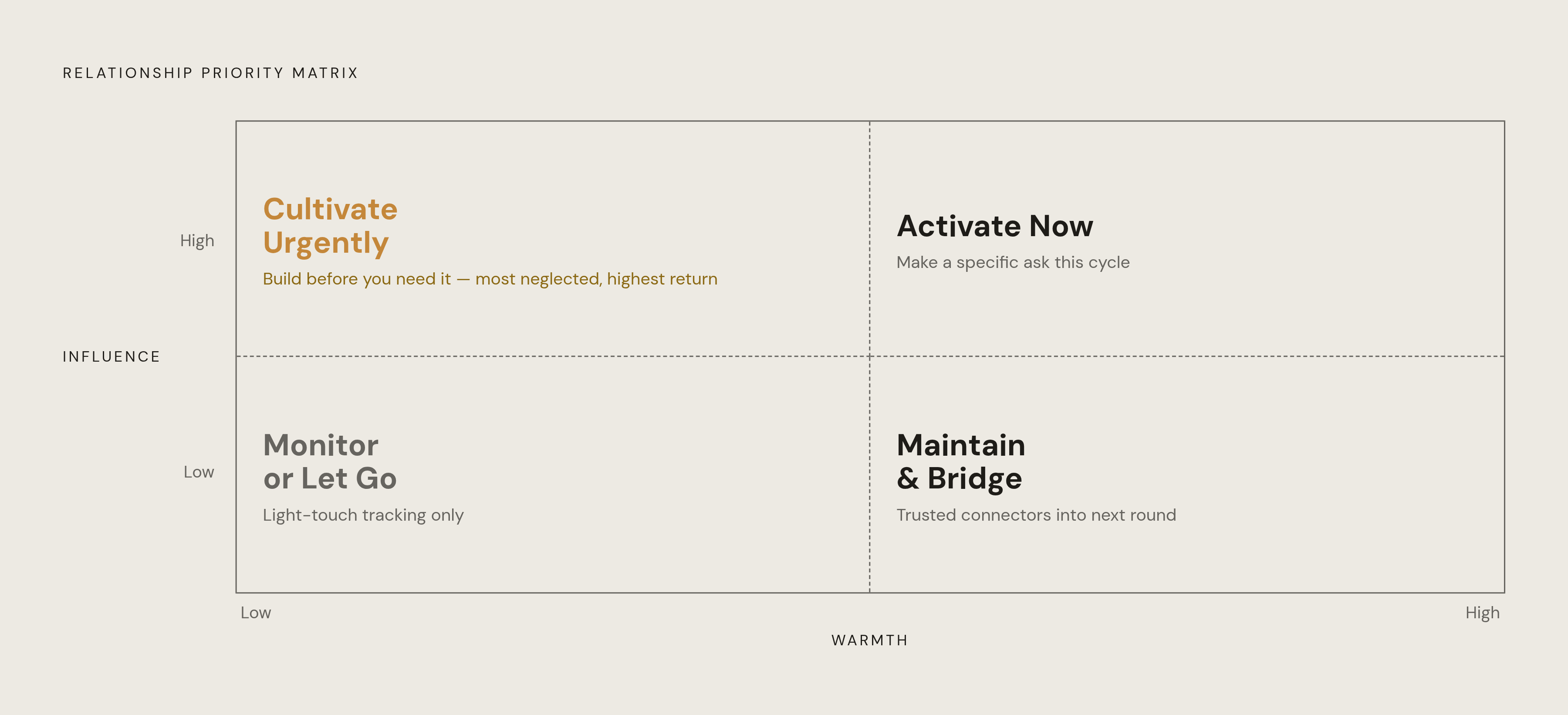
The matrix runs on relationship influence, how much a given person can actually move a deal, an introduction, or an LP commitment, crossed against relationship warmth, how recent, how frequent, and how deep the existing contact with that person has been. Crossing those two axes produces four quadrants. High influence and high warmth means activate now. High influence and low warmth means cultivate, and cultivate urgently. Low influence and high warmth means maintain the relationship and use it as a connector into other people. Low influence and low warmth means monitor from a distance, or let it go for now.
A third dimension worth layering in is path distance, meaning whether the stakeholder is a direct contact or someone reachable through one or two intermediaries. That third axis turns the matrix from a static snapshot into something closer to a route planner.
A CRM records who exists in a database. That's the whole job, and it's a limited one. The matrix ranks who to move toward and in what order, which is what actually determines the sequence a deal follows. A spreadsheet of names does nothing to help with sequencing, and treating a CRM as though it solves that problem is where a lot of firms go wrong first. The matrix isn't something built once and filed away either. Warmth decays. Influence shifts when someone changes roles or funds. The map needs refreshing continuously as deals develop, throughout the fundraising cycle.
How to define and score each stakeholder dimension for investment relationships
Scoring only works if the criteria are concrete. So what actually counts as influence in an investment context?
Start with LP or co-investor capacity: can this person commit capital themselves, or bring others who will? Deal referral power asks whether this person sees off-market flow before it hits a wider marketing process. Gate-keeping matters too: does this person control access to a founder, a board seat, or an OEM relationship the investor actually needs? Expert network value counts as well, since some contacts shift conviction through diligence signal alone, not capital. Secondary influence deserves its own line: connectors sitting at network hubs, lawyers, bankers, accelerator partners, who routinely surface warm paths into everyone above them.
Warmth is a separate, and in some ways trickier, measurement. Recency asks when the last substantive interaction happened, a real meeting or referral, not a newsletter open. Frequency asks how often genuine contact occurred over the past year. Depth asks whether the interaction involved something more than pleasantries: mutual disclosure, a favor, a co-investment, shared context that signals actual trust rather than mere familiarity. Decay rate varies by relationship type. A former colleague or past co-investor tends to reactivate almost instantly after a dormant stretch, while a cold acquaintance picked up at a conference loses reachability fast, sometimes within weeks.
Path distance breaks into three tiers. First-degree means a direct contact, reachable without going through anyone else. Second-degree means one trusted mutual stands between the investor and the target. Third-degree means two hops, which requires figuring out which first-degree contact holds the bridge to the second-degree one.
A simple 1-to-3 or 1-to-5 scale on each dimension produces a composite score for ranking purposes, and the precision of the scale matters far less than consistency. Apply the same criteria across the whole network, or the ranking becomes noise. Here's the calibration mistake that wrecks most matrices before anyone even notices: warmth scores get inflated for people who are simply pleasant. A contact who replies warmly to every email but has never once made a referral is not a high-warmth stakeholder for deal purposes, full stop. Friendliness and professional activation are different things, and conflating them is how a matrix stops being useful while everyone keeps trusting it anyway.
Mapping stakeholders across the four quadrants and what each demands from an investor
Quadrant one, high influence and high warmth, is where near-term deal movement lives. These are the paths most likely to produce an introduction, a co-investor check-in, or an LP commitment inside the current cycle. The action here is direct: make a specific ask, and don't dilute it with vague relationship maintenance this contact doesn't need. Leaning too hard on a small group here burns goodwill fast. The matrix, by making the thinness of this quadrant visible, is often the first thing that reveals how few of these relationships actually exist, and that revelation alone is worth the exercise.
Quadrant two, high influence and low warmth, is the most important quadrant in the exercise, and it's also the one most firms neglect, because it produces nothing right now. This is the target list for future investment, not present activation. Founders who build relationships with five or more VCs a full year before raising have been reported to close their rounds meaningfully faster. The same logic runs the other direction for investors courting GPs, LPs, or deal sources: the time to build the relationship is well before it's needed, ideally months ahead of any term sheet. Action here means patient, structured re-engagement: sharing something genuinely useful, making a small introduction, showing up at the same event twice, building recency and depth before ever making an ask. Quadrant two runs on a cultivation horizon, not a transaction horizon, and treating it otherwise defeats the point of tracking it at all.
Quadrant three, low influence and high warmth, tends to get undervalued, and that mistake deserves correcting early. These contacts are trusted bridges into quadrants one and two, not capital sources or deal originators. They're trusted bridges into quadrants one and two. Accelerator partners, sector-focused lawyers, former portfolio operators, prolific angel investors, these people often sit exactly here. The right move is to keep the relationship warm through small reciprocity, and to treat any introduction coming from this quadrant as high-signal, because the person on the receiving end already trusts this connector's judgment.
Quadrant four, low influence and low warmth, isn't a permanent bin, and treating it as one wastes information. A founder who's pre-product today might be raising a Series A in eighteen months. The right treatment is light-touch tracking, a funding announcement, a milestone post, a mention in trade press, rather than spending relationship energy now on something not yet ready to pay off. The matrix ranks where to direct finite attention at a given moment. It says nothing about anyone's worth.
Sequencing introductions: using the matrix to find warm paths across degree distance
Most proprietary deal flow sits at least one degree removed from the investor looking for it. That's why path distance matters as much as influence or warmth: it turns a ranked list into something navigable.
The sequencing logic runs in a fairly clean line. First, identify the target, a founder, an LP, a corporate development lead. Then find who in quadrant one or three holds a direct relationship with that target, and rank the candidate bridges by warmth in both directions, since the best bridge is warm with the investor and warm with the target at the same time. Brief that bridge before asking for anything. A cold request for an introduction, even from a strong quadrant-one contact, produces a lukewarm intro. A properly briefed request produces a warm one, because the bridge knows what to say and why it matters.
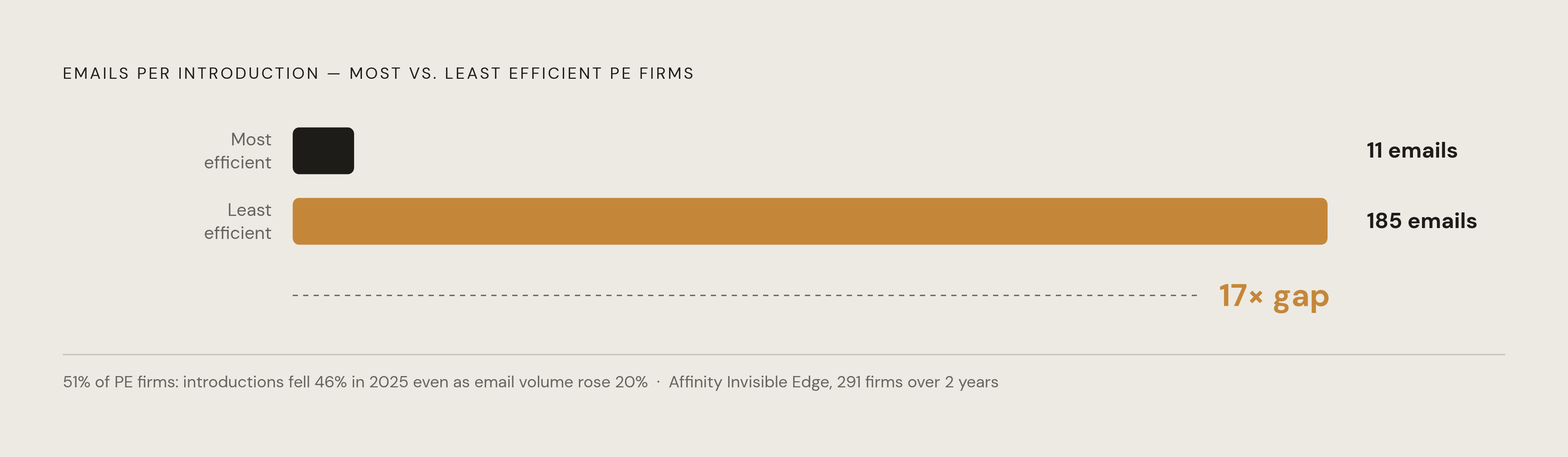
The efficiency gap here is not small, and the numbers back that up. Affinity's Invisible Edge report, which studied 291 private equity firms over two years, found the most efficient firms generate one introduction for roughly every 11 emails sent, while the least efficient firms need around 185 emails to produce the same single introduction. That's close to a 17-times gap, driven mostly by whether outreach travels through a warm path or gets fired blind into the void. The same report found that 51% of PE firms saw introduction output fall by 46% between 2024 and 2025, even while email volume rose 20% over the same stretch. Sending more, without a map for where it should go, just produces noise, and apparently a lot of firms are learning that the hard way right now.
Second-degree paths require activating one bridge. Third-degree paths require activating a chain of two, and every additional hop adds delay and dilutes the warmth signal a little more. That's the calculation the matrix forces an investor to make: is this third-degree path worth the extra hop, or is it faster to build direct warmth from scratch? Put practically, the matrix doubles as a sequencing calendar. Whatever sits in quadrant two today, with the right cultivation, is quadrant-one material in six to twelve months.
How institutional relationship data gets lost and breaks the matrix at the firm level
One partner's matrix is a useful personal tool. A firm-wide matrix is closer to a competitive asset, but most firms can't build one, because each partner's relationship history lives only in that partner's inbox and calendar, invisible to everyone else at the firm. That's the real bottleneck, and it has nothing to do with scoring methodology.
The failure modes that follow are concrete. A founder reaches out, the email sits buried in one partner's inbox, and six months later that founder has raised from a rival firm at double the valuation, because nobody else at the shop even knew the conversation happened. Multiple partners independently evaluate the same deal, unaware another partner is already deep in diligence, and co-investment coordination falls apart before it starts. LP relationship management turns reactive by default: firms scramble in the weeks before a fundraise instead of running proactive touchpoints across the full LP map year-round.
The root problem is a data problem, and a specific one at that. Years of email threads, call notes, and calendar history, which is the actual evidence of who's warm and who's influential, stay locked inside individual inboxes and never make it into anything resembling a shared relationship graph.
US Capital Global offers a useful illustration of what changes when that data gets shared instead of hoarded. By mapping its global investor network so bankers across offices in Palm Beach Gardens, Newport Beach, London, Zurich, and Singapore can see each other's relationships, a connection one banker built decades ago becomes a resource the whole firm can draw on even after that banker retires. Research on venture capital networks has found a positive link between information sharing and investment performance, and firms that diversify their connection types instead of clustering into tight cliques tend to get more varied signal and less confirmation bias. A shared, firm-wide matrix is one direct route to both, but the matrix is only as good as what feeds it. A firm that can't see its own collective relationship history has no real way to map its collective warm paths, no matter how well the scoring criteria look on paper.
Where AI fits into building and maintaining a stakeholder matrix at scale
Manual upkeep is where most matrices quietly die. Without some form of automation, warmth scores go stale, new contacts never get classified, and the map drifts away from reality right when a deal is moving fastest and accuracy matters most.
AI-driven relationship intelligence tackles a few of these gaps directly. It can pull interaction signals from email and calendar activity, so recency and frequency scores stay current without someone manually logging every call. It can surface warm-path suggestions across an entire team's combined network, flagging that a target is reachable through a colleague's quadrant-one contact even though the person doing the search has never met that contact directly. It can flag decay before a relationship goes cold: a quadrant-one contact untouched in eight months is sliding toward quadrant two, and a good system raises that flag before the slide finishes. It can also draft outreach in a person's own voice for re-engagement, not sending it automatically, but preparing something the professional reads, edits, and approves before anything goes out.
The adoption curve backs this up. Affinity's 2026 Predictions Report puts AI use for company research at 64% of investors, and AI use specifically for investment decisions more than doubled year over year, from 13% to 28%. That's not a fringe experiment anymore, and firms treating it as one are already behind.
There's a real accuracy floor to respect before anyone gets too comfortable, though. Stanford research found generic large language models hit only around 42% accuracy on complex business analysis tasks, worse than a coin flip for anything resembling an investment decision. A generic model guessing at context it was never given is a different animal from relationship intelligence built on structured, firm-specific communication data, and conflating the two is how a firm ends up trusting a tool it shouldn't. Affinity also reports that firms using relationship intelligence platforms close deals meaningfully faster and save over 200 hours a year that would otherwise go into manual contact and deal entry.
One principle stays fixed regardless of how capable the tooling gets: the human has to stay in the loop. AI can surface the path and draft the ask, but the decision to send it, and how it's worded, belongs to the person whose name is on it. In a high-trust business like this one, the credibility of a relationship belongs to the person holding it, never to the software sitting behind them.
Purpose-built relationship intelligence tools investors are using to operationalize this
Not every tool on this list solves the same problem, and picking the wrong one for the job wastes a year of adoption effort. Some are built around passive data capture, some around post-close workflow, some around the LP reporting grind that sits entirely outside deal sourcing. Knowing which category a firm actually needs matters more than any feature comparison.
Affinity offers relationship intelligence and network mapping built for VC and PE. It automates data capture from email and calendar, scores relationship strength, and surfaces introduction paths across a firm's collective network. Bessemer Venture Partners is among the firms using it, and its custom scoring fields let a firm weight relationship signals according to its own criteria rather than a fixed default.
4Degrees runs an AI-powered relationship CRM with an MCP integration connecting into ChatGPT and Claude for meeting prep and deal evaluation, built by former investors rather than outside software vendors. some firms have reported saving more than 100 hours a year on manual lead entry through automation, and some firms have achieved substantial increases in the number of organizations they could track.
Intapp DealCloud is an AI-powered deal and relationship platform aimed at private equity and investment banking, built with post-close lifecycle work in mind, the kind of workflow a generic CRM was never designed to hold.
SatuitCRM is purpose-built for buy-side investment professionals: institutional asset managers, wealth managers, hedge funds, and private equity firms. It's built around the LP relationship and portfolio reporting work that sits outside what a general-purpose CRM covers.
Picking among these for stakeholder-matrix purposes comes down to one practical question above the rest, and it's the one that separates a matrix that survives contact with a busy quarter from one that doesn't. Does the tool capture warmth signals on its own, from communication data that already exists, or does it depend on someone remembering to type it in? A matrix built on manual entry decays the moment the team gets busy, and the team always gets busy, no matter how disciplined the launch felt in month one. A matrix built on data the firm already generates, just by doing its job, does not carry that same expiration date.