SOC 2 Type II Requirements for Relationship Intelligence Vendors
Data from email, calendar, and messaging gets audited for who can access it and how it's protected.
Relationship intelligence platforms pull data from more places at once than almost any other SaaS category on the market: email, calendar, LinkedIn, Slack or other messaging apps, and contact databases, all live, all simultaneously. That aggregation is exactly why SOC 2 Type II matters so much here, and why the version most vendors show buyers deserves closer reading than it usually gets. This piece walks through what the report actually tests, which criteria should never be missing from a credible scope, and where auditors dig hardest when the product in question is built on AI touching personal contact data.
Start with the distinction that trips up a lot of buyers. A sales CRM holds structured fields that someone typed in. A relationship intelligence layer holds continuous behavioral signals pulled from accounts that belong to individual employees, not the company, and that difference changes everything downstream. The data isn't transactional, it's personal and ongoing: private email threads, calendar entries, message history, and inferred signals like contact-strength scores that the platform generates on its own. For investors, founders, and business development teams operating in high-trust environments, a data exposure here isn't just a compliance footnote. It can end a relationship, or a deal.
People often call SOC 2 a certification. It is nothing of the sort. It's an attestation: an independent CPA firm reviews a company's controls and issues an opinion on whether those controls meet the relevant Trust Services Criteria. There's no pass/fail badge to hang on a website, no seal that means the same thing every time it's used. Buyers are supposed to actually read the report, not just confirm one exists, and most don't, which is precisely how weak scopes slide through procurement unnoticed.
The standard in place for 2026 is still the 2017 Trust Services Criteria, updated with revised Points of Focus in October 2022. No replacement framework has landed since. Five criteria sit under that umbrella. Security is mandatory in every single engagement and covers unauthorized access. Availability means systems are up when they're supposed to be. Processing Integrity means processing is complete, accurate, timely, authorized, and valid. Confidentiality means sensitive information stays protected from exposure. Privacy governs how personal data gets collected, used, and eventually disposed of.
Then there's the Type I versus Type II question, and this is where a lot of vendor claims fall apart under scrutiny. Type I checks whether controls are designed well at one moment in time, essentially a snapshot taken on a good day. Type II tests whether those same controls actually worked, continuously, over a defined stretch, usually three to twelve months. A vendor waving a Type I report is telling a buyer what their controls look like on paper, not whether anyone followed them last Tuesday. Most enterprise buyers ask for Type II specifically because it proves sustained behavior instead of good intentions. Per Sprinto's 2026 guide, a first Type II report can take four to twelve months to complete end to end, and some vendors choose a shorter observation window just to get through the door faster. That shortcut is worth noticing when it shows up: a three-month window is a much thinner slice of evidence than a twelve-month one, even though both get called "Type II."
Why does this matter more for relationship intelligence vendors than for, say, a project management tool? Because these platforms never stop ingesting. A point-in-time snapshot can't tell a buyer whether controls held up during a high-volume ingestion spike, an employee offboarding, or a model update that changed how relationship scores get calculated. Enterprise procurement teams increasingly require SOC 2 Type II from vendors before moving to technical evaluation. Arrive without it, and the conversation may not start at all.
The bar keeps rising past just having the report, too. The bar for evidence quality is rising as well. Static screenshots submitted as evidence are getting challenged more often, with auditors increasingly expecting continuous-monitoring exports with timestamps that prove controls were actually running throughout the full window, not just at the moments someone remembered to take a picture.
Which Trust Services Criteria apply to relationship intelligence vendors, and which are non-negotiable
Security is baked into every SOC 2 engagement, full stop. For this category specifically, it covers unauthorized access to the relationship graph itself, the email and calendar integrations feeding it, and the AI inference layer generating scores and recommendations on top of all that.
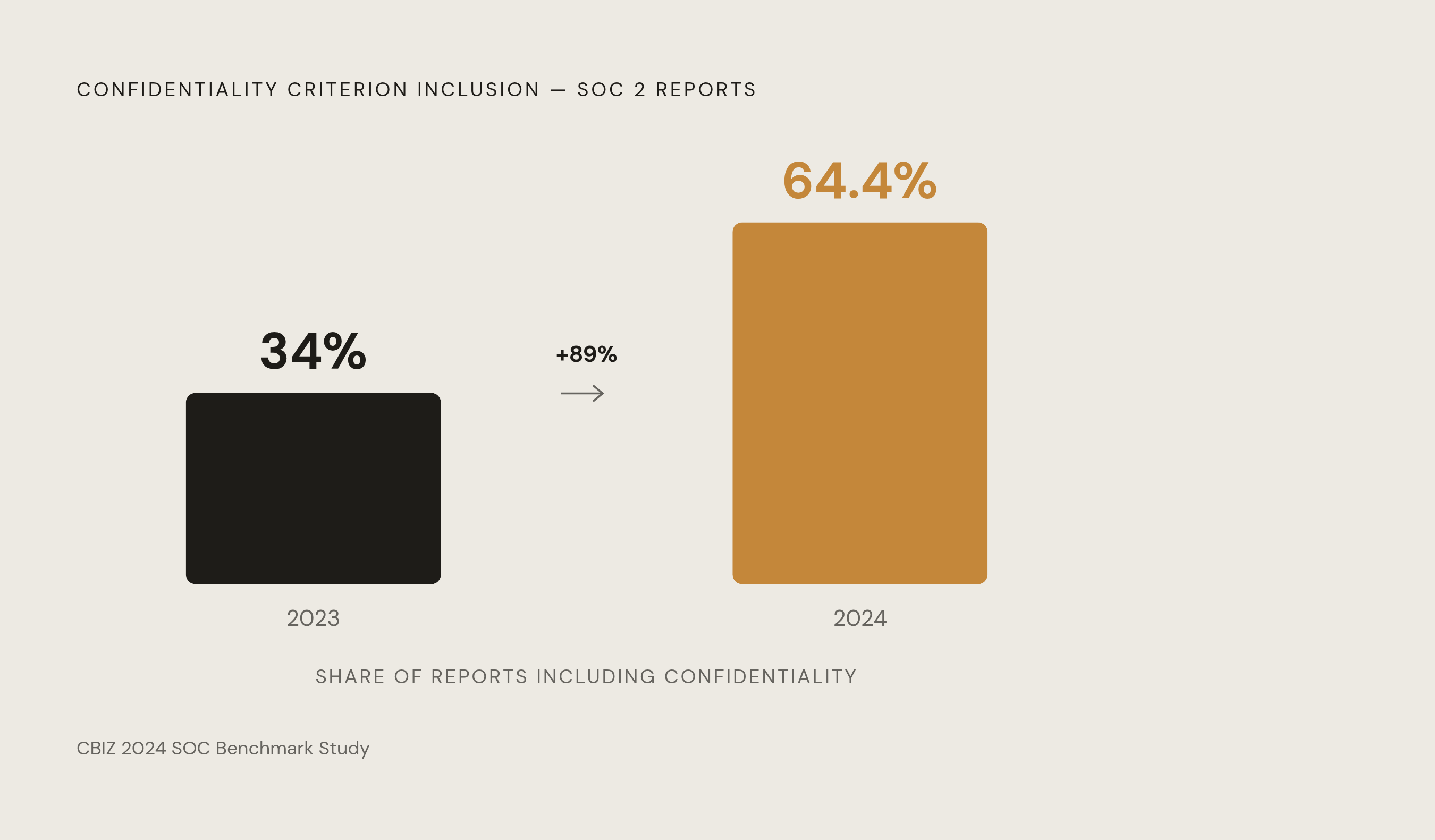
Confidentiality is where a lot of vendors get exposed for cutting corners, and it deserves to be treated as close to mandatory as a "non-required" criterion can get. Per the CBIZ 2024 SOC Benchmark Study, Confidentiality now shows up in 64.4% of SOC 2 reports, up from just 34% in 2023. That's a substantial jump in inclusion rate, and it's not a coincidence. A relationship intelligence vendor that leaves it out of scope should get questioned by any buyer who reads past the cover page. The test is simple enough: look at what the vendor has promised in writing, in its MSA, its information security policy, its terms of use. If the vendor says contact data stays private and permissioned, Confidentiality needs to be in scope. If it falls short, that gap matters beyond mere technicality. It's the vendor telling a buyer that the promise was never independently checked.
Privacy is following a similar trajectory, for a specific reason. SureCloud's 2026 guide notes that once a business processes customer data with AI, leaving Privacy out of scope gets harder to defend. Relationship intelligence platforms process personal professional data by definition: names, communication history, tenure of a relationship, inferred affinity scores. Privacy's collection, use, retention, and disposal requirements (P1 through P8) apply directly, and there's no credible argument for scoping it out.
Processing Integrity matters here in a way that's easy to underestimate, mostly because "processing" sounds abstract until it isn't. AI-generated relationship scores, warm-path rankings, and outreach draft quality all feed into decisions that carry real stakes, so buyers need assurance that auditors actually tested whether those outputs are accurate.
Availability rounds it out, and it's not abstract either. A deal-sourcing alert that lands 48 hours late, or a warm-path query that fails mid-fundraise, has consequences that show up on a term sheet, not just a support ticket.
None of this scoping is cosmetic. Buyers who know what to look for will notice which criteria got excluded and ask why. A narrow scope on a data-rich product is itself a signal, and it's rarely a good one. If a vendor's report includes only Security, that omission should be read as a decision, not an oversight.
How the Security criterion applies to the multi-source data ingestion architecture these platforms run on
Security spans nine control categories, CC1 through CC9, with roughly 33 individual criteria packed inside. For relationship intelligence vendors, three areas draw the most attention: access control, system monitoring, and change management.
Multi-source ingestion is what makes the attack surface so wide in the first place. Every connected source, an email provider, a calendar system, LinkedIn, a messaging app, represents its own OAuth or API integration that has to be secured on its own terms. Auditors don't just check that the connections exist. They test whether token management policies are actually in place: rotation schedules, scope limitations, revocation procedures when an employee leaves or a contract ends. API key lifecycle documentation and role-based access control matrices come up as standard evidence requests in nearly every review.
Access management gets its own layer of scrutiny. Multi-factor authentication is expected for all administrative access, and auditors want to see MFA logs and policy documentation, not a statement that MFA is "supported" and nothing behind it. Least-privilege principles need to apply across internal roles too: who can actually query the relationship graph, who can view contact-level communication history, who has the ability to touch model configurations. User access reviews need to happen at defined intervals, and any gaps in review activity during the observation window are the kind of finding auditors are likely to flag.
Encryption is table stakes at this point, in transit and at rest. But the documentation behind it is what actually gets tested: key management practices, whether through hardware security modules or cloud-native key management services, and a data classification scheme that distinguishes different categories of data by their sensitivity and risk profile. Treating all three the same way is a common shortcut, and it tends to show up as a finding, because the risk profile of a raw email thread is not the same as the risk profile of a computed affinity score.
Logging and monitoring round out the picture: continuous tracking of authentication attempts, API call patterns, and access to relationship data, paired with incident response procedures that were actually tested during the observation window. Incident response procedures need to have been tested within the observation window to carry weight as evidence.
Then there's the vendor layer. Relationship intelligence platforms lean on cloud infrastructure providers and third-party AI model vendors almost without exception, so auditors will look at whether those third-party relationships have been formally reviewed for security risk. Informal arrangements are unlikely to satisfy that scrutiny.
What auditors examine under Confidentiality when the product is a firm-wide relationship graph
Confidentiality asks whether sensitive information stays protected through its whole lifecycle: collection, processing, storage, deletion. For a relationship intelligence platform, "sensitive information" turns out to be a much bigger category than it first appears.
There's the raw email and calendar content pulled from individual accounts. There are the derived signals, relationship strength scores, last-contact dates, communication frequency, which are themselves inferences drawn from private data and carry their own sensitivity, separate from the raw material they came from. And there's the graph as a whole, which reveals the shape of an organization's network and can expose confidential deal activity, LP relationships, or competitive intelligence just by showing who's connected to whom.
That firm-wide view creates a specific architectural problem worth sitting with. Individual relationship context has to stay private to the person who built it. But institutional relationship signals, who at the firm knows whom, need to be usable collectively without leaking the personal communications underneath them. Auditors look for permissioning controls that enforce that boundary at the data layer itself, not as a setting in the user interface that a determined employee could route around with a support ticket and a favor.
What does the evidence trail actually look like? Data classification documentation showing which elements count as confidential and how they're labeled. Access control logs proving employees only see the relationship signals they're cleared to view. Retention and deletion policies covering what happens to a departing employee's relationship data, and on what timeline. Contractual confidentiality obligations flowing through to vendor and subprocessor agreements.
The growth in Confidentiality's inclusion rate, from 34% of reports in 2023 to 64.4% in 2024 per the CBIZ 2024 SOC Benchmark Study, tracks directly with this kind of buyer pressure. Procurement teams are reading line by line now. A vendor whose report stays silent on Confidentiality is, in effect, telling buyers that the permissioning architecture underneath the whole product has never been independently tested.
How the Privacy criterion applies when AI continuously processes personal professional contact data
Privacy and Confidentiality sound similar but do different jobs. Confidentiality protects information from exposure to people who shouldn't see it. Privacy asks a more basic question: does the vendor have the right to hold and process this data at all, and is it handling collection, use, retention, and disposal the way it's supposed to?
Here's the structural problem relationship intelligence platforms run into, one that most SaaS products never face. Most of the personal data flowing through the system doesn't belong to the user. It belongs to the contacts, the people showing up in someone's email and calendar who never agreed to anything about how this vendor handles their information. Auditors under the Privacy criterion look at notice, consent, and data minimization controls for exactly this population. It's a harder problem than a product where the user and the data subject are the same person, because these third parties are external and, practically speaking, unreachable. Nobody is sending a consent form to every contact in a partner's inbox.
What auditors expect to see: documentation of notice and consent, meaning what users were actually told about how contact data gets ingested and used. Evidence of data minimization, whether the platform grabs everything available from a connected inbox or only what's genuinely necessary to generate a relationship signal. Retention and deletion schedules with defined time periods and proof that deletion actually happens, not a policy stating that it should. And a process for handling requests from a contact who wants to know what data exists about them, or wants it corrected or removed.
AI processing adds another layer on top of all this. When a model ingests years of communication history to produce a single relationship score, it's processing personal data at real scale and speed, often without a human reviewing each individual inference. Per SureCloud's 2026 guide, auditors increasingly want documentation on where training data came from and how automated decisions get made. No formal AI-specific Privacy rule exists yet, so auditors are applying existing criteria to a genuinely new kind of processing, and that gap between the framework's age and the technology's speed is exactly where weak vendors hide.
There's a regulatory dimension worth flagging too, particularly for vendors selling into UK-regulated financial firms. The FCA, PRA, and Bank of England's joint Critical Third Parties regime (PS24/16/PS16/24) took effect on 1 January 2025, though it only applies to providers HM Treasury actually designates, with the first designations set to take effect 13 July 2026. Once designated, a critical third party has to provide assurance directly to regulators. Relationship intelligence vendors operating in that space should expect Privacy and Confidentiality to get examined right alongside SOC 2 during procurement, not as an afterthought bolted on at the end.
Where AI systems draw the sharpest auditor scrutiny under Processing Integrity and vendor-management criteria
No AI-specific SOC 2 criteria exist as of 2026. None. Auditors are working with the same 2017 Trust Services Criteria they've always had, applying Processing Integrity, the vendor management pieces inside Security, and general risk assessment controls to systems that didn't really exist in their current form when the framework was written.
Per SureCloud's 2026 compliance guide: "Auditors haven't been handed a new AI checklist, so they're improvising with the criteria they already have. That's actually harder to prepare for than a fixed rule, because you can't just tick a new box. You need a named owner for every model you call and a paper trail that shows someone was watching it." That's a fair description of where the pressure actually sits right now: on documentation and ownership, not on some new AI-specific rulebook that doesn't exist and isn't coming soon.
Processing Integrity, specifically PI1, requires that processing be complete, valid, accurate, timely, and authorized. Applied to a relationship intelligence platform, that turns into a direct question, asking whether the relationship scores, the warm-path rankings, and the outreach drafts are actually accurate, and whether they are built from the data they claim to be built from. Auditors want audit trails showing how a specific output got generated, what inputs produced what result, not confirmation that a model ran on schedule. AI scoring systems need to show they don't quietly degrade over time either. Model drift, stale training data, or a broken integration can all produce outputs that look confident and turn out to be wrong, and that's squarely a Processing Integrity risk even when nothing "breaks" in the conventional sense. A relationship score that's confidently wrong is arguably worse than a system that's visibly down, since nobody knows to distrust it.
Then there's the vendor management question, and this is where a lot of AI-driven products carry hidden exposure that founders don't think to disclose until an auditor asks directly. If the platform calls a third-party AI model API from any major provider, that provider is functionally a subprocessor handling personal relationship data, whether anyone frames it that way internally or not. Auditors expect a named owner for each model vendor, documented risk assessments, and contractual security terms, the same rigor applied to any other critical subprocessor. SureCloud's 2026 guidance calls out shadow AI specifically here: tools adopted informally by internal teams without going through security review. That's flagged as a live, current audit risk, not a theoretical one, and it's often the exact gap that surfaces first when an auditor starts asking who actually approved which model.