Relationship Follow-Up Cadence Recommendations from AI
AI can personalize follow-up timing by learning each contact's actual response patterns.
Follow-up timing is the tell. Most professionals still run a fixed clock (day one, day three, day seven) on every contact regardless of who that contact actually is, even though their inbox and calendar already hold most of what they'd need to do better. This piece makes a fairly direct argument: cadence should bend to the relationship, AI is decent at reading the signals already sitting in your email history, and the gap between what firms know and what their systems act on is wider than most people want to admit.
The follow-up advice that circulates in sales and business development got built for strangers. Send on day one, again on day three, then day seven, then day fourteen, then give up or hand it to a manager. Fine for cold outbound, where the only data point available is whether someone opened an email. Try that same script on a founder re-engaging a past investor, though, or a BD operator following up after a warm intro from a mutual friend, and it falls apart almost immediately. You already know things about this person: when you last spoke, how they tend to respond, whether the relationship runs warm or just lukewarm. Defaulting to a generic five-touch sequence anyway is a bit like handing someone a stranger's instruction manual for a person you've known ten years.
Here's the odd part, and it's worth sitting with for a second. The professionals holding the richest relationship context are often the ones most likely to reach for the bluntest tool on the shelf. A partner with eight years of history with an LP still gets nudged by a CRM to "follow up in 3 days," as if that LP wandered in off a purchased list last week. One widely cited McKinsey estimate puts the share of lost deals attributable to forgetting and late follow-up, rather than price or product or a sharper competitor, at roughly a third. That's a timing failure. Timing failures happen precisely when the system managing your outreach doesn't know what you already know. So the real question, the one this piece keeps circling back to, is whether AI can close that gap: whether it can read the signals sitting quietly in your relationship history and turn them into a cadence that actually fits each contact, without you sitting down and working it out one relationship at a time.
What relationship history actually contains — the signals AI can read
Every professional generates relationship data constantly, whether they think of it that way or not: every email sent and received, every calendar invite accepted or quietly ignored, every LinkedIn message, every scrap of a meeting note buried in some doc. It's all signal. Almost none of it gets read systematically. It just sits there until whoever wrote it happens to remember it exists.
So what's actually in there? Recency is the obvious one. When did the last real exchange happen, and who started it? A contact you traded three emails with last Tuesday needs different handling than one you haven't heard from since March. Frequency matters too, though less as a raw number and more as a pattern. Some relationships run quarterly, others weekly, and a cadence that ignores that baseline will feel off to the person on the other end even if they can't quite say why.
Response latency is subtler, and it gets overlooked constantly. Does this contact usually reply within hours, or does a two-week gap mean nothing at all because that's just their pace? Without a baseline, "they've gone quiet" tells you nothing. You need to know what silence means for that specific person before you act on it. Depth matters separately from frequency. Was the last exchange a two-line acknowledgment, or an actual back-and-forth with real questions in it?
Then there are the triggers sitting entirely outside the conversation itself: a job change, a fund closing, a company announcement. These are the moments that make outreach land as timely instead of arbitrary, and they usually show up in a LinkedIn post or a press mention long before anyone thinks to check.
Why do these signals beat any rule you could write down in advance? Because they describe the relationship as it is right now, not as you assumed it to be six months ago when you last touched a CRM field. They also update themselves. A contact's behavior this quarter tells you more than any static tag ever could, and reading it costs nothing if the system doing the reading is already watching your email and calendar.
And here's the gap, and it's a wide one. Industry surveys on CRM adoption at professional services and investment firms routinely find partner-level usage stuck in the single digits, even at firms that paid for enterprise licenses years ago. A large share of a firm's top-client relationships, by some estimates well over half, live only in individual inboxes, invisible to everyone else at the firm. The signals exist. Almost nobody reads them in any structured way. Closing that gap, turning scattered interaction history into something resembling a coherent picture of relationship health, is the whole premise behind a relationship intelligence layer. It doesn't invent new information. It reads what's already there.
How AI converts those signals into a cadence recommendation
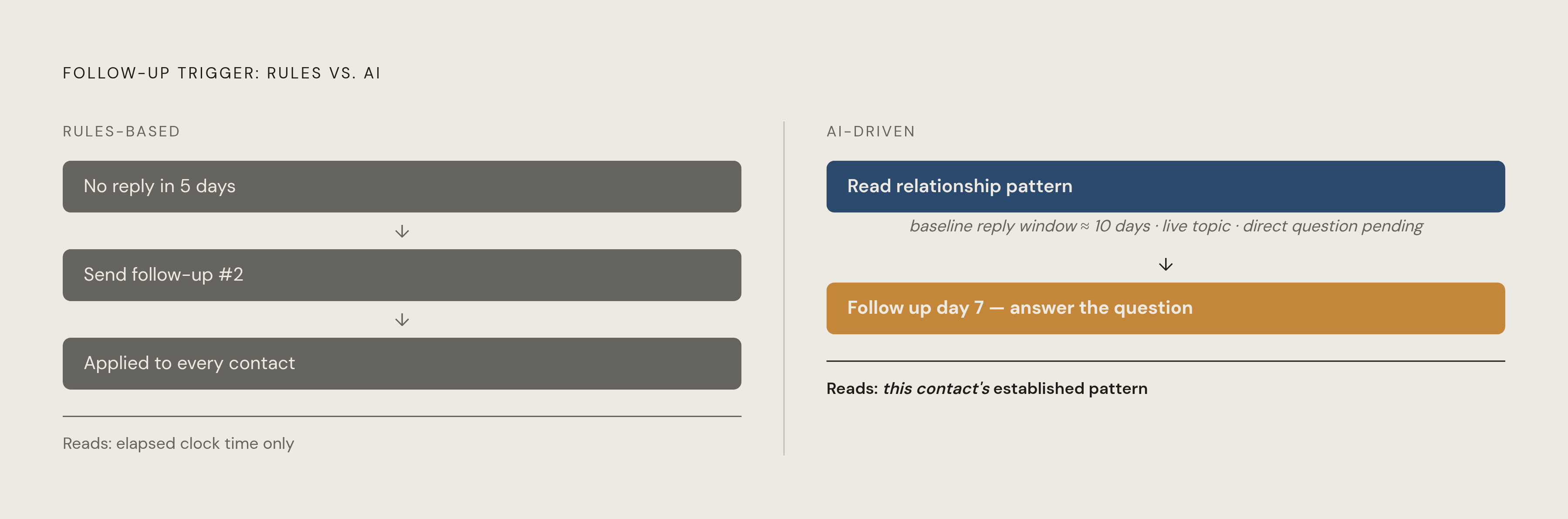
So how does a pile of email metadata turn into "call this person Thursday"? Mechanically, it's a weighting problem. Recency, frequency, response behavior, and outside context get combined into a score for a given contact, and that score maps to a recommended action and a timing window. Simple enough on paper. What matters more is that the scoring has to run continuously, not get slapped on once as a label and left alone.
Contacts don't sort neatly into hot, warm, and cold buckets, no matter how clean that looks in a sales deck. Relationship strength sits on a gradient, and the gradient moves as behavior moves. A system tracking it should be re-scoring more or less all the time. One of the more useful things it can catch is drift: a contact who used to reply within a day and has now gone three weeks silent is sending a very different signal than a contact who's always taken a month to answer anything. You can't tell the two apart without the baseline, which is the entire point of tracking response latency in the first place.
Timing isn't the only variable in motion, either. A job change, a funding announcement, an email opened but never answered: these all shift when the next touch should land, and a system watching for them can act on the moment instead of waiting for a fixed interval to run out. Channel and tone get learned the same way. If someone reliably picks up the phone but ignores email, that's worth noticing and acting on, rather than defaulting to whichever channel happens to be easiest to automate.
Rules-based automation looks similar on the surface. It isn't doing the same job, though. A rules-based system says: no reply in five days, send follow-up number two, and it says this to everyone, forever, regardless of who they are. An AI-driven recommendation says something closer to: this contact's baseline reply window runs about ten days, they're mid-conversation on a live topic, and their last message had a direct question in it, so a follow-up at day seven that actually answers that question is the right call. One approach is efficient at doing the wrong thing consistently. The other takes longer to build and is right more often, which is a fair trade in most relationship-driven work.
There's a bigger distinction underneath both, though. The recommendation needs to show up as a prompt, never fire on its own. The AI prepares the timing and drafts the message; a person decides whether to send it, when, and in what form. That single design choice separates a tool that belongs in high-trust environments from one that's a liability waiting to happen. An AI sending on your behalf without review is making commitments to your investors or clients that you never actually agreed to. An AI that tells you the right moment and hands you a draft to edit is doing something closer to what a sharp executive assistant does, minus the payroll.
One more point worth raising now, because it resurfaces later: none of this works if giving a team access to relationship signals means exposing anyone's actual email threads to their colleagues. A firm-wide graph of who knows whom can exist without anyone reading anyone else's inbox. That's the condition under which anyone agrees to use the thing at all, and it's worth remembering as we get into the mechanics of scoring.
How relationship strength changes the recommended cadence structure
Not every relationship deserves the same rhythm. A good recommendation system has to place each contact where it actually sits, not where you'd prefer it to sit. Three broad categories cover most of the real estate here, though actual relationships blur the lines constantly, and any framework that pretends otherwise is lying a little.
Start with active, high-frequency relationships: a current investor, a portfolio founder you talk to often, a deal counterpart mid-negotiation. Cadence here should track deal stage and an already-established rhythm, not elapsed calendar time. The AI's job is noticing when that rhythm breaks. Silence from someone who usually shows up every few days is the signal worth flagging, not some generic 30-day trigger that would apply equally to a stranger. Follow-up in this category is less about persistence and more about catching drift before it becomes an actual gap.
Warm but episodic relationships sit differently: a former colleague, a second-degree connection, a past co-investor you haven't worked with lately. Real foundation, no current momentum. The risk is letting enough time pass that reconnecting starts to feel awkward on both sides. The right approach tracks the gap against that specific relationship's historical frequency rather than a blanket threshold; someone you've heard from twice a year needs a very different alert point than someone expecting monthly contact. And the outreach itself should lead with something real, a mutual connection's news, a relevant deal, an actual congratulations, instead of a bare "checking in" that reads as exactly what it is.
Then there's the freshly introduced relationship: someone from a warm intro, or a first meeting that needs a follow-up. Probably the highest-risk category, because the margin for error cuts both directions. Move too fast and you look presumptuous. Wait too long and the momentum from the introduction evaporates. A reasonable structure follows up within the first 24 hours with something concrete to offer, then spaces later touches based on how, or whether, the contact responds. Three to four touches across the first one to two weeks is a fair baseline. After that, the relationship either settles into episodic maintenance or, if there's a live opportunity, escalates.
What actually makes this valuable isn't any one category on its own. It's holding all of them simultaneously across hundreds of contacts, without the professional needing to remember which relationship belongs where. That kind of mental bookkeeping degrades under pressure. And pressure, inconveniently, is exactly when the highest-stakes relationships need the most careful attention, not the least.
What firms lose when relationship data stays siloed across individuals
The problem that makes one person's follow-up inconsistent gets worse at the firm level, not better, because now the data isn't just scattered across time. It's scattered across people who never compare notes with each other.
Picture two partners at the same firm, both independently managing a relationship with the same LP. One spoke to that LP two weeks ago; warm, current, easy. The other is about to send a re-engagement email that will read as cold, because as far as they know, it's been eight months of silence. Neither partner knows what the other one knows. The LP, meanwhile, is left wondering whether anyone at this firm actually talks to each other.
That's not a rare scenario. It's closer to the default state at most firms without a shared relationship layer. Research on CRM data quality finds that somewhere between 25 and 40% of records are inaccurate at any given time, which means even firms that try to formalize relationship tracking are often working from a record that's wrong precisely when accuracy matters most.
The organizational cost runs deeper than one awkward email, though. When someone leaves a firm, years of relationship history, the threads, the meeting context, the sense of where a deal actually stands, walk out the door with them unless that history lived somewhere other than a personal inbox. New hires inherit contact lists that read like cold outreach targets when they could have been warm handoffs, had the prior relationship been visible to anyone else at the firm. And maybe the most expensive version of this: warm paths that already exist somewhere in the firm's collective network stay completely invisible, because nobody has ever mapped them across individuals. The strongest route to a target contact is frequently already sitting inside the building. Nobody can see it, so the team defaults to cold outreach when a warm introduction was one Slack message away the entire time.
Solving this is as much a trust problem as a technical one. Making relationship data useful across a firm requires that personal context stays private, that access gets permissioned by design, and that the system never exposes one person's actual communications to a colleague who has no business reading them. Get that wrong, and nobody uses the system, no matter how good the underlying signal turns out to be.
How Rolo applies relationship signals to cadence recommendations in practice
Rolo connects the places where professional relationships already live, email, calendar, LinkedIn, messaging, and builds a single relationship graph from that history without asking anyone to manually enter contacts into a CRM. That's the starting premise: the data already exists, so the work is reading it, not recreating it from scratch.
On cadence specifically, Rolo reads interaction history across those connected sources to establish a baseline for each contact: how often you typically exchange messages, who usually initiates, what a normal response window looks like for that particular relationship. From there it surfaces contacts drifting from their own baseline, measured against that relationship's established rhythm rather than a fixed timer applied uniformly to everyone. A contact who's gone quiet against their own history shows up differently than a contact who's simply slow by nature, and that difference is the whole point of building it this way instead of copying a generic sequence.
Outreach suggestions get ranked by relevance and recency, so what surfaces first is the highest-priority contact rather than an undifferentiated list sorted by nothing in particular. When it's time to write something, Rolo drafts the follow-up in the user's own voice, calibrated to that specific relationship's context, and puts it up for review. Nothing sends without a person looking at it first.
Equally telling is what Rolo doesn't do: it doesn't send autonomously, it doesn't expose one person's private thread content to another user browsing the same firm's graph, and it doesn't recommend outreach and skip the approval step. That restraint is deliberate: the professional stays in control of every send, which matters enormously in fields where one wrong or badly timed message can cost more than the deal it was meant to advance.
For an investor sourcing a deal, or a BD operator hunting for a warm path into an OEM, Rolo surfaces the firm's relationship graph: who at the firm already knows the target contact, and roughly how strong that relationship looks, without anyone having to hand over their inbox to make it visible. Other tools address pieces of this same puzzle. Affinity, priced around $125 per user per month, has built a strong reputation specifically for network analysis in deal sourcing. Rolo's position rests on a different combination: multi-source relationship memory, firm-wide warm-path visibility, and AI-drafted outreach, sitting inside a single permissioned layer built for environments where trust is the whole game.
The standard a good AI cadence recommendation should meet
Not every product calling itself relationship intelligence reads the same signals, or reasons about them the same way. A professional evaluating one of these tools should walk in with a short list of hard questions, not just a demo to watch.
Start with signal depth. Is the system actually reading interaction history, email, calendar, response patterns, or is it working off profile fields and notes someone typed in last quarter and forgot about? The richer and more current the input, the sharper the timing recommendation gets. There's no way around that relationship, and any vendor who claims otherwise is selling something thinner than it looks.
Next: is timing relationship-relative, or clock-relative? Does the system trigger because 30 days passed on a calendar, or because this specific contact deviated from their own established pattern? The second is categorically more accurate for anything built on real relationships instead of a sales funnel. Worth pushing any vendor directly on which one they're actually doing, because the marketing language tends to blur the two.
Human control has to hold at every single send. A system should surface a recommendation and draft the message; it shouldn't act on its own, ever. Any tool sending follow-ups autonomously without a review step is solving a different, easier problem than the one this piece has been circling, and it's not one suited to relationships that took years to build.
Privacy architecture deserves real scrutiny too, especially once a tool goes firm-wide. What can one colleague actually see about another colleague's relationships once everyone's data feeds the same graph? Permissioned access and private context aren't extras bolted on later. They're the precondition for anyone agreeing to connect a real inbox to a system like this in the first place.
There's also the maintenance question. A system that depends on someone remembering to log an interaction will always be a little stale exactly when it matters most, which mostly defeats the purpose of building it. The input should be passive and continuous, watching what already happens instead of waiting to be told about it after the fact.
Which points back to something plain enough to say directly: a cadence recommendation is only as good as the relationship data sitting behind it. A tool reading a rich, current, multi-source picture of how you actually interact with people beats one pulling from a stale CRM record, most of the time, regardless of how clever its recommendation engine claims to be. Getting an honest, current read on the relationship is the hard part. The intelligence sitting on top of it is, comparatively, the easy part.