Human-in-the-Loop Constraints for AI Relationship Assistants
AI can prepare introductions better than drafting, but it should stop before hitting send.
Warm introductions work because someone puts their own name on the line. When a colleague connects you to a potential client, or an investor makes an introduction to a founder they've backed, they're relaying more than contact information; they're telling the recipient, in effect, "I trust this person, and I'm spending some of my own credibility to prove it." That's what this piece looks at: what happens to that credibility once AI starts drafting, ranking, and eventually acting on relationship data, and where the line has to sit between AI that prepares an introduction and AI that sends one.
The warm introduction beats cold outreach for a specific reason. A cold email lands with zero context, and the recipient's default posture is skepticism. A warm one arrives pre-vetted, because someone the recipient already trusts has effectively co-signed it. The pattern holds up the seniority chain too. The executives hardest to reach through a cold LinkedIn message are often the easiest to reach through a mutual contact willing to make the ask. You see this in a few recurring forms, colleague-to-colleague introductions inside a firm, partner-led introductions bridging two organizations, investor-led introductions carrying the weight of a fund behind them. Different mechanics, same fuel underneath: a human is vouching, and that vouching is personal, situational, and hard to fake at scale. So what happens the moment someone tries to automate the vouching itself?
Where AI relationship tools are genuinely useful before any message is sent
AI has a real job here, sitting upstream of the moment contact actually gets made. That distinction, upstream versus downstream, ends up mattering more than it sounds like it should.
Take surfacing. Most professionals have hundreds, sometimes thousands, of contacts scattered across email threads, calendar invites, old LinkedIn messages, with no real way to hold all of it in their head. A tool that scans this history and flags which relationships are warm right now, based on recency and frequency of contact, is doing something genuinely useful. It gives someone visibility into data they already own but can't practically dig up on demand.
Ranking comes next. Once you know which connections exist, the problem becomes prioritization: of the fifteen people you could go through, which one actually gets you into the company you're trying to reach? Ordering potential introduction paths by depth, recency, and relevance turns an unmanageable list into something a person can act on in under a minute.
Context assembly matters just as much. Walking into a meeting with an investor already knowing their recent fund announcements, their last few portfolio moves, and what got discussed last time you spoke saves real prep time, and it lets someone show up informed instead of generic. AI pulling this together from scattered sources is doing legitimate work.
Then there's drafting: a first pass at an outreach message, written in the professional's own voice based on how they've written before, handed back rather than sent or scheduled.
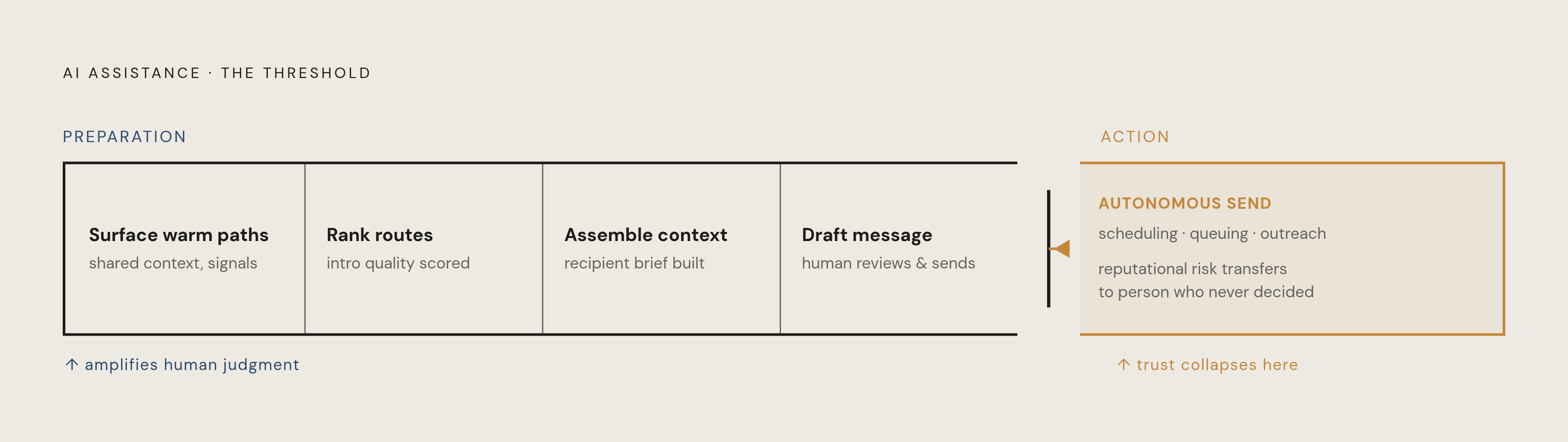
What connects all four of these is that they amplify a person's judgment. Preparation is high-value and low-risk. The moment you cross into autonomous action, a warm path and an automated one start looking identical from the outside, and that's the problem worth sitting with. Rolo lives on the preparation side of that line. It connects to the systems where relationship data already sits, surfaces warm paths, drafts outreach, and stops. Nothing goes out until a person chooses to send it.
What breaks when AI crosses from drafting into acting
The failure mode here is social and reputational, and those are much harder to walk back than a bug in production code.
Picture an AI system sending an introduction request on someone's behalf without them reviewing it first. The recipient has no way of knowing whether the sender actually meant to send this, actually knows the other party well enough to vouch for them, or actually believes the two should meet. The message might read fine. It might even sound indistinguishable from something the professional would have written by hand, yet automated sending has already stripped out the one thing that made the whole exercise worth anything: intentionality.
The cost doesn't stop at that single interaction. The person whose name is on the introduction just spent social capital on an action they never consciously took. If the fit is wrong, if the timing is bad, if the recipient feels imposed on, that person absorbs the reputational hit without ever making the call that led to it. Liable for a decision they didn't make. It's a strange spot to put someone in.
There's a documented risk in AI agent design generally that maps onto this directly. Give an autonomous agent write or send permissions, then add a vague tool description, a misread instruction, or a prompt-injection attack, and it can take actions the user never sanctioned. In most software contexts, that's an embarrassing bug you patch and move past. Relationship contexts don't recover the same way. A poorly timed or misaddressed introduction can damage something that took years to build, and there's no patch for that.
Consider two executive assistants. One drafts every email for their principal but never hits send without sign-off. The other acts independently and occasionally gets it wrong. The first is worth more, even at the cost of speed, because the principal never has to wonder what went out under their name without their knowledge. One bad autonomous action erases the goodwill built by a hundred good automated ones; that asymmetry is close to the whole argument for keeping a human at the send button.
The institutional dimension: why firms need collective relationship visibility without pooling private context
Zoom out from the individual to the firm, and a related but different problem shows up.
Relationship data inside most organizations is abundant and almost entirely invisible. It lives in individual inboxes, individual calendars, individual message threads, none of it connected to anything else. When a senior partner leaves, the network they spent a decade building, who they know, how well, what was actually discussed, usually walks out the door with them. Nobody else had visibility into it while they were there, so nobody can pick it back up once they're gone.
That cost isn't trivial. Firms routinely miss warm paths sitting somewhere inside their own collective network, simply because no single person can see across the whole thing. Surveys of financial institution leaders point to data silos as a real barrier to competitive advantage, a structural drag on how deals actually get sourced in practice.
The instinct might be to pool everything, one shared database where all the email and calendar data lives together, fully visible to the whole firm. That solves one problem by creating a bigger one. Nobody wants their private client relationships, their candid notes, their sensitive negotiation history sitting somewhere every colleague can browse.
The better architecture threads that needle. Surface the existence of a warm path and who holds it, without exposing the private content underneath it. Someone should be able to see that a colleague at their firm has a strong connection to a target company, full stop, without seeing the actual email exchanges that built that connection. A permissioned relationship graph makes the institutional network collectively queryable while individual context stays under individual control. Rolo is built around this exact principle: firm-wide relationship signals become visible across the organization, while the private substance behind each relationship stays with whoever owns it.
Why the governance layer must sit between AI recommendations and any action taken
Put the individual concern next to the institutional one, and you land on a single structural requirement: something has to sit between whatever the AI recommends and whatever actually happens next.
The operating principle in well-designed AI systems generally is that AI speeds up the work, but a governance layer controls the decision. Nothing goes live until a human has reviewed it. Applied to relationship tools specifically, this means nothing gets sent, no introduction gets made, no contact gets added to an outreach sequence, without an explicit human action triggering it.
This is a trust architecture requirement, and the asymmetry underneath it makes the case on its own. The upside of shaving a few seconds off a send is marginal at best. The downside of one unauthorized outreach landing on the wrong person at the wrong moment can be a relationship that never comes back.
Regulation is tightening around this too. GDPR breach volumes have climbed, regulators have turned more attention toward AI systems and cross-border data transfers, and financial institutions now operate under resilience and third-party risk frameworks that expect documented, auditable controls rather than vague assurances. Security certifications, encryption at rest, the standard checklist items, those are table stakes now, not differentiators. The real question underneath all of it is whether the architecture is built so the AI cannot act on relationship data without a human saying yes first. That's a much higher bar than "is it secure," and it's the one that actually matters. Enterprise buyers in high-trust environments, investors, founders, business development people whose entire job runs on relationship capital, tend to gravitate toward tools that make that authorization step explicit and checkable, rather than tools that bury it in a settings menu and call it optional.
How the human-in-the-loop constraint is implemented in practice, not just in principle
Saying "a human stays in the loop" is the easy part. Building it so it's actually true at every decision point in the workflow is the real work.
At the surfacing stage, the AI presents a ranked list of warm paths with supporting context attached, and the professional picks which ones to pursue. It doesn't initiate contact with anyone on that list; it just makes the list legible.
At the drafting stage, the AI writes a message in the user's own voice and style, but that message sits there until a human reads it, edits it if needed, and sends it themselves. No queuing, no autonomous send scheduled for later.
At the context stage, the AI pulls together whatever background matters before a meeting and hands it to the person. What they do with it, how they use it, whether they mention it at all, that's entirely up to them. The AI never pushes that information toward the other party directly.
Meeting prep is a good concrete case of this working the way it should. Before sitting down with an investor or a prospective partner, an assistant can pull together funding history, recent news, a summary of the last conversation, and hand all of it to the human walking into the room. The human decides how to use it, or whether to use it at all.
Sentiment and communication pattern analysis works the same way. If an AI notices a recurring theme across a string of investor emails, say rising concern about runway, or the same question about a specific metric coming up again and again, it flags the pattern to the professional. The person decides whether to respond, and how.
Here's a fair test for any tool making these claims: can you, as the buyer, identify every point where the AI could take an action that reaches another person, before you've even signed up? If the answer is fuzzy, or buried three pages into documentation nobody reads, the governance layer is probably thinner than advertised. This tracks with what's actually happening in adoption inside high-trust professional environments. The number of firms willing to pilot an AI tool runs well ahead of the number willing to run it in full production, and that gap reflects exactly this kind of scrutiny. People are checking, carefully, what the tool will and won't do without asking first.
What to look for when evaluating AI relationship tools against these constraints
So if you're sitting across the table from a vendor, what should you actually be asking? Nearly everything claims to use AI at this point, so that question alone won't get you far. The narrower, more useful question is where, specifically, the human stays in control.
A few things worth putting directly to any vendor. Can the tool send, schedule, or queue an outreach message without an explicit action from the user at the moment of send? What happens to the private email and calendar content it touches: is it stored, trained on, visible to other users on the platform? How does the permissioning model separate what the whole firm can see collectively from what stays private to one person? Is the authorization step auditable, meaning could a compliance officer verify, after the fact, that nothing went out without review? And what does the system do when an instruction is ambiguous, does it pause and ask, or guess and proceed?
The tools that hold up against this standard tend to share a design instinct. They connect to the systems where relationship data already lives, email, calendar, LinkedIn, messaging threads, rather than asking a professional to re-enter everything into a new database from scratch. Rolo takes this approach, on the logic that the relationship data worth surfacing already exists somewhere; the job is connecting to it, not recreating it. This is also part of what separates purpose-built relationship intelligence platforms from general-purpose CRMs. A CRM organizes around pipeline stages and contact fields, while a relationship intelligence tool organizes around warm paths and context, a different design problem entirely.
The instinct to treat AI's purpose as removing human effort from the loop wherever possible holds up fine in plenty of domains, but it inverts here. The professionals who get the most out of these tools aren't the ones handing off the most decisions to AI. They're the ones using it to see their own network with more clarity than they could manage alone, then applying their own judgment about when to act on what they're seeing, how to approach it, whether it's worth approaching at all. That judgment is the entire reason the technology has any value in the first place.