Relationship Intelligence Platform Evaluation Criteria for Investment Firms
Investment firms evaluating relationship intelligence platforms need a different scorecard than the one built for sales teams, because the thing being protected and the thing being activated are not the same. Generic buyer's guides skip all four, because they were never built with investment work in mind. Relationship Intelligence Platform Evaluation Criteria for Investment Firms.
Evaluation criteria for investment firms versus generic buyers
Most of the widely cited relationship intelligence buyer's guides, the ones built by vendors like RevenueGrid or Boomerang and referenced across the category, frame their criteria around what makes a sales rep productive: stakeholder mapping, deal engagement signals, pipeline health. That's a sound way to judge a tool meant to help an account executive move a deal through a funnel. It is the wrong lens entirely for a fund evaluating a platform meant to manage relationships with founders, limited partners, co-investors, and portfolio company executives, because a fund's "deal" is not a purchase order, it's a relationship governed by disclosure rules and trust dynamics that have no sales-org equivalent.
Three structural differences explain why the generic checklist breaks down. First, the network itself is the product. A sales team's contact graph supports revenue; a fund's contact graph is the fund's edge, the thing LPs are underwriting when they commit capital. Second, the sensitivity of what's stored is categorically higher: an LP's identity and commitment size, the terms of a live deal, a founder's board-level disclosures, none of that has a clean analog in a sales pipeline, where the worst-case leak is a discount rate. Third, the finish line looks different. A sales tool measures success at a closed deal. In investment work, the meaningful conversion event is a warm introduction that earns a first meeting, and everything upstream of that (who knows whom, how well, and how recently) has to be modeled differently than a sales funnel models pipeline stages.
There's also a timing argument for why this evaluation matters more now than it did two years ago. Gartner projects that 40% of enterprise applications will carry task-specific AI agents by the end of 2026, up from under 5% a year earlier. Firms picking a relationship intelligence platform today aren't just picking a dashboard, they're picking the data layer that will feed an agent making decisions on their behalf within a year or two. Get the data foundation wrong now, and the agent inherits that mistake at scale.
What makes warm introductions structurally valuable in investment dealmaking
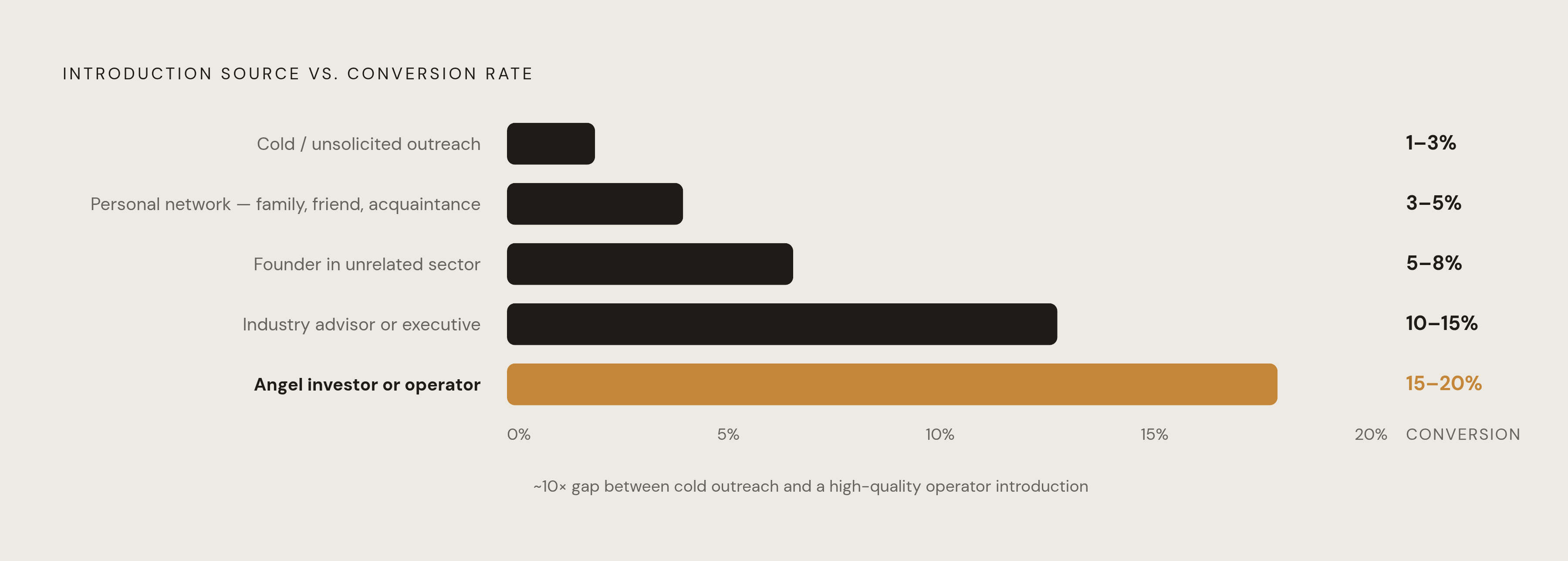
The numbers behind warm introductions are stark. Cold, unsolicited outreach to an investor converts at somewhere between 1% and 3% https://canvena-invest.com/pages/blog/en/08_warm_introductions.html. An introduction from an angel investor or an operator with real deal experience converts at 15% to 20%, roughly an order of magnitude better https://www.spectup.com/resource-hub/investor-warm-introductions. The gradient in between tells its own story: an industry advisor or executive with domain credibility converts at 10% to 15%, a founder in an unrelated sector with unverified connection quality converts at 5% to 8%, and a personal network contact, family, a friend, a casual acquaintance, converts at just 3% to 5%, barely ahead of cold outreach https://www.spectup.com/resource-hub/investor-warm-introductions.
Why does the introducer's identity matter that much? It isn't about warmth for its own sake, or some social nicety investors extend to people they like. It's a substitution mechanism. Early-stage companies don't have the financial track record that would let an investor model them the way a public-markets analyst models a mature company, so the investor substitutes social proof for financial proof. The introducer's own reputation becomes collateral for the pitch. An operator who has actually done deals carries more weight than a friend of a friend, because the operator has something to lose if the intro turns out to be a waste of time.
That mechanism, though, carries a real cost, and the piece would be dishonest to leave it out. Del Johnson at Backstage Capital has argued that warm-intro dependency entrenches exclusion, since the people best positioned to make high-converting introductions tend to look, sound, and come from the same places as the investors already inside the network. So the warm-intro system, for all its efficiency, has a built-in tendency to keep drawing from the same well.
That doesn't argue against relationship intelligence as a category. It argues for a specific kind of relationship intelligence, one that widens the graph rather than just deepening the same one a firm already has. A platform that only ever resurfaces the ten paths a partner already knew about isn't adding much https://www.hks.harvard.edu/centers/wappp/research/past/venture-capital-entrepreneurship. The real test, when evaluating any of these tools, is whether it's expanding the set of accessible warm paths, pulling in adjacent networks a firm doesn't already lean on, or whether it's just making the well-worn paths easier to walk.
The institutional network most firms already own but cannot see
The median private equity firm captures only around 18% of relevant deal flow in its own target markets https://www.gritt.io/blog/venture-capital-deal-sourcing. That's not a market-scarcity problem, there's no shortage of deals out there, it's a visibility problem. It just can't see most of it.
Where does that invisible reach actually live? In email threads between a partner and a founder that never made it into any CRM. In calendar history showing a partner has met quarterly with a co-investor for three years, a relationship no one else at the firm knows exists. In a board member's personal relationship with a prospect's CFO, the platform must surface the signal that a strong connection exists without exposing the underlying communication content. And in the most acute case: a departing GP whose entire relationship graph, years of built trust, walks out the door with them on the last day, taking the firm's access with it.
Gartner estimates that 70% to 80% of enterprise knowledge is tacit, never written down anywhere retrievable https://atlan.com/know/data-for-ai/institutional-knowledge-loss/. Investment firms aren't an exception to that pattern; if anything, given how relationship-dependent the work is, they may be a sharper example of it. Most of what a fund actually knows about who's connected to whom sits in someone's head or someone's inbox, not in a system anyone else can query. Forrester's research on knowledge workers backs this from a related angle: 79% report their own teams operate in silos, and workers lose roughly 12 hours a week just manually gathering data that a connected system should have surfaced automatically https://www.empaxis.com/blog/data-silos-problematic.
The cost compounds when people leave. Without a system that captures relationship context independently of any one person's inbox, a firm becomes dependent on a handful of individuals as walking, talking routers of institutional memory. Those people carry an unreasonable load, they burn out, and when they exit, the knowledge exits with them, because there was never anywhere else for it to live.
Criterion one: data source breadth and how platforms differ on it
The category's history explains a lot about why breadth matters now. Between roughly 2018 and 2024, relationship intelligence was a single-source business: nearly every major platform was built around one signal and stayed there. That framing is the single most useful thing to understand about the current landscape, because it explains why so many tools, even well-regarded ones, still show only a sliver of a firm's actual network.
Introhive built its business on partner email and calendar data, and has found real traction inside professional services, serving dozens of the top law and accounting firms with cross-practice referral tracking. Affinity took the same email-and-calendar signal and pointed it at venture and private equity firms, growth equity shops, M&A advisors, and family offices, becoming one of the default tools in the category. UserGems built around a narrower but useful signal: tracking when a known champion changes jobs and shows up at a new target account. LeadDelta works off individual and team LinkedIn networks through its Workspaces product, aimed at sales teams, founders, recruiters, and staffing agencies. Common Room aggregates community and product usage signals and attributes them back to real people, a fit for product-led SaaS and developer-tool companies. And RelSci, now under Altrata, works from a curated external database mapping board members, executives, and donors, serving investment banks, wealth managers, and nonprofit fundraising teams.
Each of those tools does one thing well. None of them, on its own, covers what an investment firm actually needs, because a fund's relevant network doesn't live in one signal, it's split across internal email, external databases, LinkedIn, and portfolio relationships all at once.
A newer group of platforms is trying to close that gap by pulling from more than one source at a time. Centralize pulls from CRM records, email, calendar, and call recordings together, building AI-generated account maps that show relationship overlap across a deal team, with activation still partial. Connect The Dots works from two pillars, a firm's internal team network plus the extended personal networks of everyone on that team, and scores connectors by trust level. Vieu also works from two pillars, internal team data plus external enrichment, and uses that for account planning and suggested introductions, though a rep still has to act on the suggestion. Boomerang claims the widest net of the group, four pillars: team, customers, board members and advisors and investors, and partners, combined with what it describes as an end-to-end warm-intro process.
For an investment firm specifically, "breadth" needs to mean four things at once. Email and calendar data captures the organic relationship history a firm has already built without anyone deliberately logging it. LinkedIn adds a surface-level connection map, useful for a first pass but shallow on how deep any given relationship actually runs. External databases like RelSci, BoardEx, or Harmonic extend reach past a firm's own graph entirely, surfacing targets nobody at the firm has met yet; Harmonic's own valuation is a decent proxy for how much the market has come to value early-stage sourcing intelligence as its own category. Portfolio and co-investor networks, the connections a fund has through the companies and partners it already backs, remain the most underused warm path in both private equity and venture, largely because so few systems are built to surface them at all. Single-source examples, from S5 Boomerang buyer's guide, are carried exactly as sourced.
Criterion two: privacy architecture and why investment firms face a higher standard
The regulatory floor is rising for everyone. GDPR breach notifications climbed 22% year over year, reaching a rate of roughly 443 incidents, and regulators are increasingly turning their attention to AI systems specifically and to cross-border data transfers. That's the baseline every company handling personal data has to clear now. Investment firms need to clear something higher.
Why? Because the categories of information a fund stores carry a different weight than what sits in a sales CRM. LP identity and the size of an LP's commitment can be material non-public information. Deal terms mid-process cannot be visible firm-wide without creating exactly the kind of information barrier problems that compliance teams exist to prevent. A founder's board-level disclosures, shared in confidence, cannot be visible to a deal partner elsewhere in the firm who happens to be chasing a competing investment in the same space.
Layering AI into that picture compounds the exposure. A relationship intelligence platform that trains a recommendation engine on unfiltered inbox content is exactly the kind of system that produces incidents like that.
So the platform has to resolve a real tension, not paper over it. The whole point of the tool is that the firm's aggregate network should be queryable across the team, that's the value proposition. But a junior analyst cannot be able to open a partner's email thread with an LP just because the analyst has a login. The way through is architectural: the system needs to surface the signal, something like "Partner X has a strong connection to the CFO at Target Co," without exposing the underlying email or call content that signal was derived from. That's a genuinely hard design problem, and it's one most platforms built for sales teams have never had to solve, because data sensitivity in investment work is categorically higher (LP identity, deal terms, and portfolio conversations are material non-public in ways that a sales pipeline is not). The AI exposure risk shows that 62% of enterprises have experienced AI-related data exposure incidents, most stemming from inadequate input controls or unclear data handling policies, according to.ai.
Criterion three: activation depth and the difference between surfacing a path and running the introduction
The category splits cleanly along a second axis in 2026, separate from data breadth: does the platform just show a path, or does it help walk it? Most vendors stop at discovery. A smaller group attempts partial or, in one documented case, end-to-end activation.
"Activation" carries a different weight in a sales context than it does in an investment one. In sales, activation usually means the platform drafts the outreach message, routes it to whichever rep owns the account, and fires off automated follow-up sequences without much human review at each step. In investment work, that same word has to mean something more careful: identifying the warm path, drafting the ask in the connector's own voice, flagging the right moment to actually make the ask, and then routing the whole thing for a human to approve, never sending anything autonomously. That last clause carries real weight. It's the entire difference between the two models.
Mapped against that spectrum, Introhive, LeadDelta, and RelSci are at the low end: they surface a path and leave execution entirely to the user. Affinity, Centralize, Connect The Dots, Vieu, and UserGems occupy a partial-activation middle ground, drafting outreach content but leaving the actual routing and sending as a manual step. Boomerang is the one platform in this set claiming a fully end-to-end motion, drafting, routing, following up, and closing the loop without a manual handoff at each stage. That model has real value, but it was built for SaaS and B2B sales contexts, where the cost of a slightly mistimed automated follow-up is low. Whether "closes the loop automatically" fits an investment firm's trust requirements is a question each firm has to answer for itself, not one a vendor's feature list answers for them.
Worth noting, too, that not every relevant platform fits neatly onto the discovery-to-activation spectrum, because some solve an adjacent problem. 4Degrees, for instance, offers a natural-language assistant that answers questions about CRM data and a document-intelligence feature that drafts deal records from uploaded files, positioning itself as a lighter-weight alternative for deal-driven VC and PE teams. The platforms on the activation spectrum, from S5, are carried as sourced.
Criterion four: human-in-the-loop controls and why autonomous agents are the wrong model for relationship-driven dealmaking
Every criterion covered so far points toward the same conclusion: relationship-driven dealmaking runs on trust that a human has to keep vouching for, at every step, all the way through. Automate that step away and the conversion advantage that made the warm introduction pursuing in the first place starts to erode, because the recipient can often tell, one way or another, when the outreach wasn't actually written or vetted by the person whose name is on it.
By the end of 2026, 40% of enterprise applications are projected to include task-specific AI agents, up from under 5% a year earlier, meaning investment firms evaluating platforms today are choosing the data layer that will feed those autonomous agents https://nektar.ai/top-10-relationship-intelligence-tools/. A platform that treats "human-in-the-loop" as a checkbox rather than an architectural commitment is building toward a future where an agent might draft and send an introduction to an LP with no partner ever reading it first. That's not a hypothetical risk so much as a design choice some vendors are already making, whether they advertise it that way or not.
None of this argues against automation broadly, and it would be a mistake to read it that way. Drafting in a connector's voice, surfacing the right moment to make an ask, flagging a relationship that's gone cold and might be worth reviving, all of that is exactly where AI adds real value, precisely because it removes grunt work without removing judgment. The line is narrower and more specific than "AI good" or "AI bad": the system can suggest, draft, and rank, but a person who actually knows the relationship has to be the one who decides whether the message goes out, and in what form. For an investment firm, that's the same trust-substitution mechanism from the second section, playing out one layer further upstream. It's the same trust-substitution mechanism from the second section, playing out one layer further upstream: an investor trusts an introducer because that person has something on the line. According to Zenit Data, 20% of deal team total time is spent researching suitable targets (Zenit Data, https://www.gritt.io/blog/venture-capital-deal-sourcing). According to IDC Market Research, companies lose 20–30% of annual revenue due to data and operational inefficiencies (IDC Market Research, https://carta.com/blog/siloed-data-portfolio-monitoring/). Poor data access and quality can cost organizations 15% in potential annual losses (carta.com, https://carta.com/blog/siloed-data-portfolio-monitoring/). The average financial services firm operates 23–35 different technology systems (vantagepoint.io, https://vantagepoint.io/blog/sf/state-of-crm-financial-services-2026-trends). Industry estimates from nektar.ai put actual customer interactions manually captured in CRM systems at only 20–30% (https://nektar.ai/top-10-relationship-intelligence-tools/). Nektar.ai reports that 70–80% of customer interactions remain invisible in CRM systems and are not manually logged (https://nektar.ai/top-10-relationship-intelligence-tools/). According to Gartner, 5% of enterprise applications included task-specific AI agents a year earlier than 2026 (Gartner, https://nektar.ai/top-10-relationship-intelligence-tools/). Nektar.ai reports that 45% of organizations say their CRM data is not prepared for AI use at all (https://nektar.ai/top-10-relationship-intelligence-tools/). There are 22 Series A+ funded companies in the Relationship Intelligence sector, according to Tracxn (https://tracxn.com/d/trending-business-models/startups-in-relationship-intelligence/__QXTkXzOVnZmCo2mY8O1RLcfboE46UTXyFTXUtIVHMPE). Warm introductions and referrals convert at a rate of 15 to 25 percent, according to Launch Leads (https://salesmotion.io/blog/relationship-intelligence).