AI-Assisted Deal Team Onboarding to Inherited Relationship Graphs
AI can surface relationship patterns new deal team members wouldn't discover alone.
When a new deal team member joins a private equity firm in 2026, what they're missing on day one is not sector knowledge or modeling skill PwC Global Private Equity Trends. It's the accumulated relationship history the firm has built over years of emails, meetings, and quiet introductions, and until recently there was no good way to hand that history over quickly. That gap matters more now than five years ago, because the deal market has narrowed into something closer to a scarcity contest EY US Private Equity Industry Insights.
Read that pair of numbers together and the market looks less like a slowdown and more like a filtering process. H1 2026 deal volume dropped 34% even as average deal size rose close to fourfold compared to H1 2025, PwC reports, meaning capital concentrated hard into fewer, higher-conviction bets PwC Private Equity Deals Outlook PwC Global Private Equity Trends / PitchBook. Specialist funds, built around a narrow sector thesis and the relationships that come with it, pulled in 70.6% of all capital raised in 2026 year to date, well above the five-year average of 65.4%, according to PitchBook data cited by EY EY US Private Equity Industry Insights. A sector-specific network used to be a sourcing edge. Now it's a fundraising one too.
Layer the growing backlog of aging, unsold portfolio companies on top of that and the pressure sharpens further. PitchBook counted 32,979 portfolio companies sitting on sponsors' books globally as of March 2026, and 34% of those had been held for more than five years, up from 28% just a year prior PwC Private Equity Deals Outlook PwC Global Private Equity Trends / PitchBook. Fewer exits clearing the pipeline means more capital chasing the deals that do come to market, and less patience for firms still sourcing the way they did a decade ago. WTW Intelligence has pointed to what the firms adapting well are actually doing: building relationships with target companies before those companies formally come to market, and proactively working new channels instead of waiting for banks to run a process. The answer to scarcity is better-informed, earlier-formed relationships, deployed with more precision than the next fund at the table.
That raises an obvious question for anyone building or joining a deal team right now. If proprietary relationships are the scarce resource, what happens to a firm's sourcing edge every time someone new joins and has to start from zero? The rest of this piece works through that question: why so much of deal flow depends on warm paths, where the firm's accumulated relationship memory actually sits, and what it takes to make that memory usable by someone who wasn't there when it was built.
How much of the deal flows through warm relationships
Start with the headline figure, because it sets the scale of what's at stake. An HBR survey of 900 venture investors, cited by Affinity, found that close to 70% of deals trace back to a connection somewhere in the investor's network Harvard Business Review / Affinity. Separate research from Gasimo puts the figure for VC deal origination at roughly 58% through professional networks, co-investor referrals, or portfolio company introductions, against only about 10% from unsolicited cold inbound Gasimo Deal Sourcing Insights. The exact percentage moves depending on who's measuring and how, but the shape of the finding doesn't: cold outreach is a minority sport, and warm paths carry the deal flow that actually converts.
The premium attached to a warm introduction is not subtle either. Why does a warm path carry that much weight? The mechanism is trust transfer — a genuine shortcut through the attention bottleneck every investor faces.
One might expect firms to respond to a tightening market by simply doing more outreach, and many have tried. It hasn't worked. Affinity's data shows 51% of PE firms saw their introduction output fall 46% between 2024 and 2025, even as they increased email volume by 20% over the same period. More volume, fewer introductions — about as clean a signal as exists that cold, volume-based prospecting is structurally declining as a sourcing method, not just having an off year.
The counterargument deserves attention before leaning too hard on warm networks as a cure-all. Del Johnson's critique, published on Medium, points out that network-based sourcing can just as easily concentrate competition on the same over-networked, insider-visible deals that every other well-connected fund can also see. A relationship graph that only ever points a new hire toward the most obvious, first-degree contacts is replicating the crowd. The implication for any AI layer built on top of a firm's relationship data is that its value depends on surfacing non-obvious second- and third-degree paths, the founder two hops away that nobody at the firm has actively pursued yet, not just confirming what everyone already half-knows Harvard Business Review / Affinity Gasimo Deal Sourcing Insights.
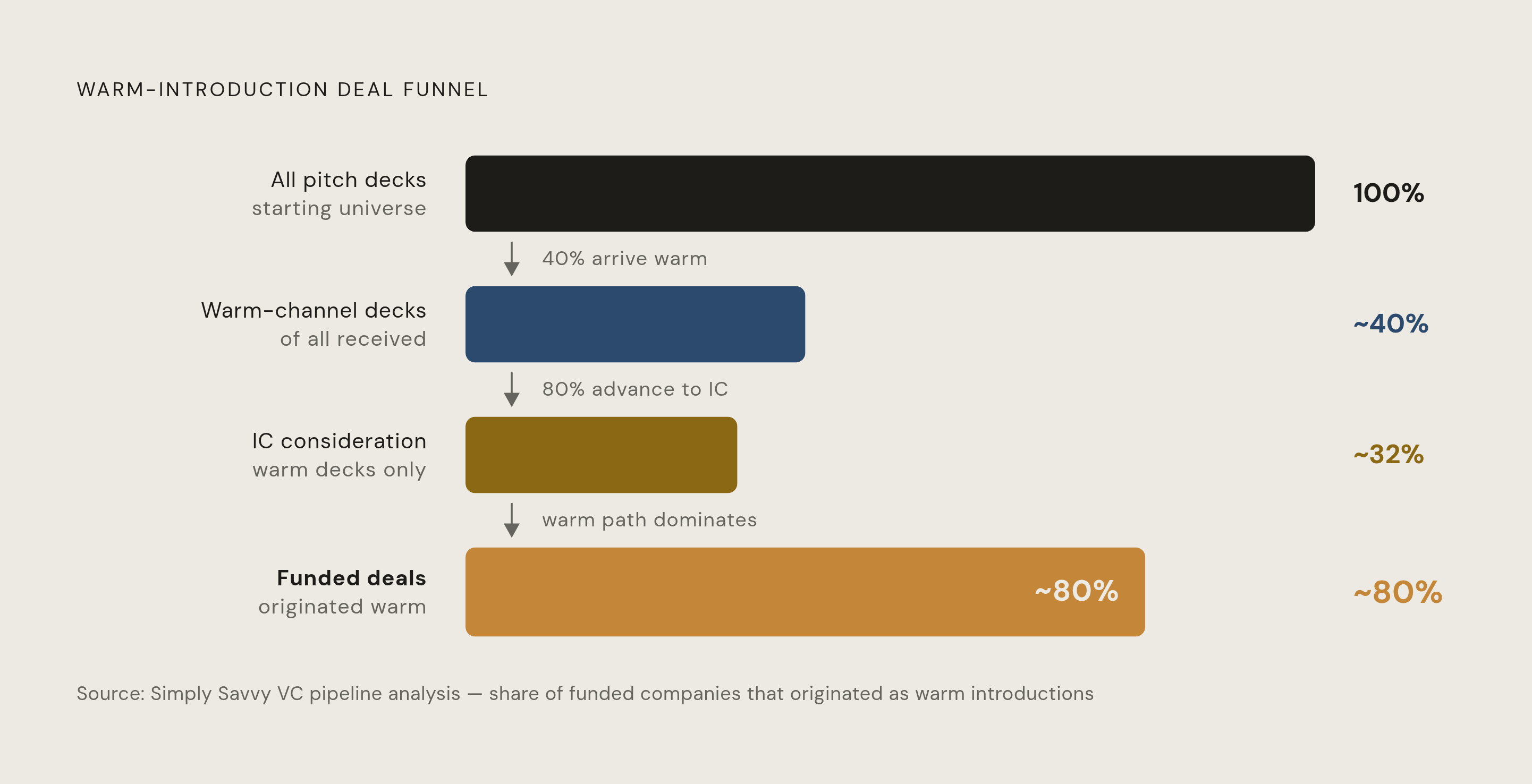
Put the two numbers together, though, and the onboarding stakes come into focus Harvard Business Review / Affinity Gasimo Deal Sourcing Insights. If most funded deals trace back to a warm introduction, and a new hire starts with no visibility into the relationships the firm has already built, that's not a knowledge gap that ramps up with time on the job Simply Savvy. It's closer to a permissions problem: the information exists, the new hire just can't see it. The warm introduction premium is real and measurable: startups entering through pre-existing relationships see a 2.1× benefit, with ~40% of initial pitch decks arriving through warm channels, 80% of those advancing to investment committee consideration, and ~80% of ultimately funded companies having originated as warm introductions, according to Simply Savvy VC pipeline analysis (Simply Savvy, Deloitte / Rework).
Where the firm's accumulated relationship context lives
So where does that relationship history actually sit? Mostly nowhere coherent. It's scattered across individual email inboxes, a handful of spreadsheets someone keeps meaning to consolidate, personal notes taken in meetings, and a CRM that some team members update religiously and others touch twice a year. No single system reflects what the firm, collectively, actually knows about its own network. That's the silo, and it's less a technology failure than an organizational habit that predates any CRM the firm has bought.
That silo raises a practical cost, quietly visible in how a warm introduction sitting in one partner's inbox could unlock a deal a different partner has been chasing cold for months — and neither would ever know it, because the connection never left the original inbox. Worse, whatever data does make it into a shared system decays fast. Affinity's research on CRM data hygiene puts B2B contact decay at 22.5% a year or more, with some estimates running as high as 30% to 70% annually, meaning a firm leaning on last year's contact list could be working from records where up to two-thirds are simply wrong Harvard Business Review / Affinity Gasimo Deal Sourcing Insights.
Turnover turns this from an inconvenience into the sharpest version of the challenge. Most PE firms lean heavily on individual team members' personal knowledge and contacts, and per Meridian, when a VP leaves, that relationship history walks out the door with them unless someone had already captured it systematically. Arvya's framing offers a useful gut check: if it takes a new team member more than a few hours to get oriented on an active deal, that's a sign of an institutional memory problem, not a training problem. Contrast that with the version that works. When the relevant history sits in a centralized system, the associate who inherits a departed VP's coverage can pull up every prior conversation and outstanding action item, and the deal keeps moving instead of stalling while someone tries to reconstruct what was already known.
The problem compounds with growth, not against it. As a firm adds headcount, scales AUM, and layers on new strategies, the spreadsheets and manual processes that used to just barely work stop working, and per Meridian, senior professionals end up spending real hours on coordination and data cleanup instead of the relationship-building that's actually supposed to be their job. And there's a cruel irony built into any CRM that depends on manual entry to stay current: it's always slightly out of date, and it tends to be least reliable at exactly the moment someone needs it most, when a new hire is scrambling for context on a live deal.
None of this means the data doesn't exist. It's there, in the emails, the calendars, the meeting notes nobody formally filed. The firm has a relationship history; the problem is that the history is invisible to anyone who wasn't personally in the room when it was built.
How a relationship graph helps a new hire get useful answers from AI on day one
A relationship graph, in the technical sense, is a structured map of who at the firm knows whom, how well, through what history of contact, and by what path an introduction could realistically travel. It's not a contact list. A contact list tells you a name and an email address. A relationship graph tells you the strength of the connection, when it was last active, and which of several possible paths gets a message to the right person with the most credibility attached.
They map professional connections across the whole firm rather than one partner's personal network, which is the only way a junior team member ever sees paths senior people have built. They score connection strength off actual interaction data, frequency and recency of real contact, rather than a self-reported field someone typed in once and never updated. And they can path-find beyond the obvious first-degree contact, tracing second- and third-degree routes a human scanning their own inbox would never think to look for.
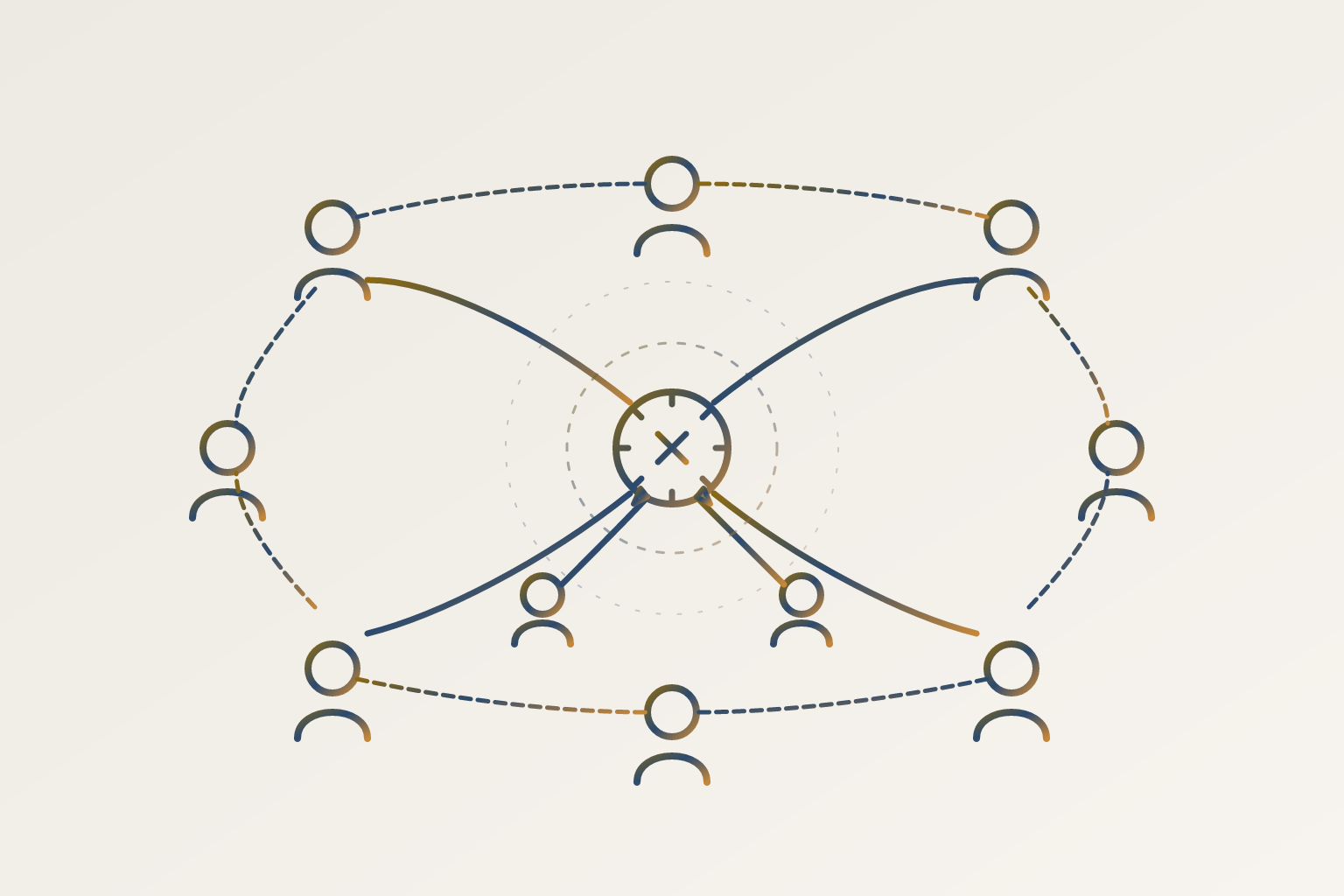
Automatic capture underneath it is what makes any of that work. The firm's most valuable relationships already exist inside team inboxes and calendars; an AI layer that reads that data automatically and turns it into structured relationship intelligence builds something a manually maintained system simply can't replicate, because manual entry always lags behind reality. Affinity's own data on this is specific: within 24 hours of turning sync on, a firm gets visibility into its collective relationship graph, no data entry required. That's the mechanic that actually solves the challenge laid out in the prior section. Instead of walking into a meeting and hoping someone in the room happens to remember the firm's history with a particular founder, the new hire can query it directly: who has spoken to this person, when, what was discussed, and who currently holds the warmest path in.
What doesn't change, and shouldn't, is judgment. The graph can surface a path. It can't tell a new hire whether activating that relationship right now is the smart move, and it should never be given the authority to send anything on its own. AI drafts, AI recommends, a person decides. That's not a limitation bolted on for optics; it's the correct design for an industry built on trust that took years to accumulate one interaction at a time.
Making relationship data useful across a whole team while keeping individual conversation context appropriately private and permissioned isn't a nice-to-have feature. In an industry where confidentiality carries real compliance weight, it's closer to a load-bearing architectural requirement. Per the best platforms in 2026, a relationship intelligence layer must do three things well.
How the tools that do this work: the relationship-intelligence and deal-CRM landscape in mid-2026
The market here splits into genuinely different jobs, and it's important to be precise about which tool solves which one rather than treating them as interchangeable.
In the relationship-driven pipeline and CRM category, Affinity offers automated relationship strength scoring pulled from email and calendar data, with the firm's network mapped automatically rather than manually Harvard Business Review / Affinity Gasimo Deal Sourcing Insights. Pricing is quote-only, reported starting around $2,000 or more per user annually with an approximately $20,000 annual minimum that pushes effective per-user cost up meaningfully for smaller teams Gasimo Deal Sourcing Insights Affinity. The firm added 71 new private equity clients in the six months before mid-2026, pushing its PE customer count past 330, per the Rework guide updated that July, and it reports firm-wide deployment, including data migration, email and calendar sync, onboarding, and workflow setup, completed in under 60 days Gasimo Deal Sourcing Insights Affinity.
Intapp DealCloud takes a different approach: it's a full deal-lifecycle system of record, with AI-assisted deal notes, tagging, and reporting spanning the entire process from sourcing through close. 4Degrees is a more accessible tier, scoring relationship strength, mapping shared connections, and keeping records current, reported around $250 per user monthly, positioned toward emerging managers and mid-market deal teams.
A separate, adjacent category covers company discovery rather than relationship intelligence proper, and it's easy to conflate the two Harvard Business Review / Affinity Gasimo Deal Sourcing Insights. Grata and SourceScrub both do AI-native sourcing across private companies, and as of mid-2026 both sit under Datasite, following its 2025 acquisition of Grata and its August 2025 acquisition of SourceScrub, combining human-verified data with AI-native search. Datasite then acquired BlueFlame AI that same August, adding an agentic deal workspace on top of its existing Diligence data room product, per Rework's July 2026 reporting. That's one vendor now holding sourcing, diligence workspace, and virtual data room infrastructure across a meaningful share of PE deal flow, and that deserves watching regardless of where a given firm's tooling budget goes Affinity.
Consolidation elsewhere points the same direction. Carta's March 2026 acquisition of ListAlpha, per Meridian, signals that AI-native CRM for private markets has become a category the larger platforms actively want exposure to, with the market drifting toward vendors who can pair fund administration with relationship intelligence in one stack. Whichever tool a firm evaluates, the criteria that actually separate them come down to automatic capture without manual entry, visibility across the whole firm rather than one user's silo, path-finding into second- and third-degree contacts, and a permissioning architecture that keeps sensitive context appropriately restricted. On that last point, the industry isn't treating security as a differentiator anymore, it's the price of entry: Deloitte's 2025 GenAI in M&A Survey, cited by Rework, found 86% of corporate and PE leaders had already integrated generative AI into M&A workflows, 65% within the prior year, while 67% named data security as their top concern with adoption Deloitte 2025 GenAI in M&A Survey / Rework. This is the relationship-driven pipeline and CRM category.
The agentic frontier: where the human must stay in the loop during multi-step AI orchestration of inherited context
The next layer past relationship mapping is agentic orchestration, AI systems that chain several steps together without a human prompting each one. Meridian describes the emerging version of this: an agent screens a CIM, enriches the company's profile, maps out the competitive landscape, drafts an initial investment memo, and schedules an introductory call by routing through the firm's own relationship graph, end to end. Due diligence work offers a useful parallel for how much time this kind of compression saves. Teams using AI to synthesize findings across expert transcript libraries report time reductions over 70% on document-heavy work, per Meridian, and the underlying pattern, AI collapsing the time it takes a person to get up to speed, appears consistently whether the workflow is sourcing or diligence Harvard Business Review / Affinity.
Adoption at this point isn't really in question. That Deloitte figure, 86% of PE leaders already using GenAI somewhere in their M&A workflow, has shifted the live focus from whether to adopt toward where, specifically, it compounds a team's actual capacity Deloitte 2025 GenAI in M&A Survey / Rework.
But agentic capability at the sourcing and outreach layer runs into a limit worth taking seriously rather than engineering around. Autonomous outreach, a message sent on a firm's behalf without a human choosing to send it, breaks the exact trust-transfer mechanism that makes a warm introduction valuable in the first place. If the recipient later learns, or even suspects, that no person actually decided to reach out to them, the message stops functioning as a warm introduction and starts reading as a well-disguised cold one. The control principle holds regardless of how capable the underlying model gets: AI can surface the path and draft the message, but a person decides to walk that path and hits send. That's not a temporary constraint waiting on better technology. It's the correct design for an industry that runs on relationships built one deliberate interaction at a time.
Skepticism about AI's payoff elsewhere in the portfolio matters too, if only for calibration. Bain's GP Outlook for 2026 found 39% of general partners don't expect AI to have any material financial impact on their portfolio companies this year, a reminder that AI's return is far from uniform once it leaves the deal team itself Bain GP Outlook / Rework. Relationship intelligence happens to be one of the workflows where the evidence for return is comparatively strong, which is exactly why it should be separated from broader, murkier AI claims made about the wider portfolio. Directionally, at least, capital is moving that way: Bank of America projects agentic AI spending will hit $155 billion by 2030, roughly three times the consensus estimate, according to figures cited by Meridian, a number that should be read as a projection rather than a settled fact, but a clear signal of where investment is headed nonetheless Gasimo Deal Sourcing Insights Affinity.
What good onboarding to an inherited relationship graph looks like in practice
Most firms start from the same place: the relationship data already exists, scattered across inboxes and half-maintained spreadsheets, and the first real task isn't building a new graph from scratch, it's making the one that already exists visible.
From there, the sequence tends to follow a fairly consistent arc. On day one, automatic sync gets switched on, and within roughly 24 hours the firm's collective relationship graph becomes visible with no manual data entry required to get there Affinity. During the first week, a new hire starts actually querying that graph against live targets: who at the firm has a real path to this founder, this LP, this banker, and when was that connection last active. By the first month, the new hire is drafting warm outreach grounded in genuine relationship history and written in the firm's established voice, not sending cold introductions dressed up to look otherwise.
Judged against the market conditions laid out earlier, concentrated capital, fewer exits, warm paths driving the large majority of funded deals, that sequence looks less like a nice efficiency gain and more like table stakes. A firm's relationship graph was always its most durable asset. What's changed is that it can finally be handed to the next person who needs it, instead of leaving with whoever built it.