Operating Partner Network Activation at Private Equity Firms
PE firms are rediscovering operating partner networks as their lever for outsized returns.
Private equity has run out of easy leverage to make deals work. Debt costs more, and multiples aren't expanding on their own. Bain's 2026 Global PE Report captures the shift in a phrase that ought to unsettle anyone still underwriting deals the old way: "12 is the new 5." A deal that once needed five turns of EBITDA growth to hit target returns now needs something closer to twelve. Most firms answer that math by trying to hire their way out of it. The real asset is already inside the building: the operating partners already on staff, and specifically the relationship networks they carry, which most firms activate only in fragments, if at all.
The numbers on the industry's broader health make the stakes clear. Global PE investment activity rose 37% in 2024 and exits climbed 34%, according to Bain's 2025 Global Private Equity Report, but fundraising fell 23% over the same period. LPs are routing capital toward managers who can prove they create value operationally, a distinct standard from managers who merely describe that capability in a deck. Industry research flags a widening spread between top- and bottom-quartile managers, with operational capability, sector expertise, and proprietary deal sourcing widely cited as key differentiators. The operating partner sits at the center of that shift: a role that used to sit near the org chart's edge is now central to how returns get made, and the 2024 Operating Partners Forum drawing more than 500 senior operating partners is as good a signal as any that the industry has noticed.
What operating partners actually bring to a firm beyond their functional expertise
Ask what an operating partner is, and the functional answer comes easy: a former CFO, a supply chain veteran, a manufacturing executive who now advises portfolio companies on the problems they used to solve for a living. That's real, and it matters, but it's only half the asset. Most firms still evaluate operating partner hires as though it were the whole thing. Firms hire for the résumé and get the network almost by accident, then wonder why they can't find it later.
The other half is relationship capital, built over a career rather than a mandate. Founders who trust them, executives who'll take their call, board members, intermediaries, sector specialists — all accumulated through decades of actually being in the industry rather than advising on it from outside. This second kind of capital is harder to replace than the functional expertise, because it's personal and slow-built. A firm can hire a new supply chain expert in a matter of weeks; it cannot hire someone else's twenty-year relationship with a founder who's about to sell a company.
The industry is already testing what happens when expertise gets systematized rather than left in one person's head. AlixPartners has pointed to operating partners as the natural people to identify and scale AI use cases across a portfolio, and Korn Ferry has tracked the rise of a specialized "AI Operating Partner" role, essentially the same idea in a new outfit: take deep expertise that used to live with one person and make it available across every portfolio company at once. Apollo's Portfolio Performance Solutions model pushes this further. Apollo runs a centralized purchasing intelligence system across more than 40 portfolio companies so operational knowledge from one deal informs the next.
That's the template for expertise. Relationship capital deserves the same discipline and largely hasn't gotten it, because it looks like a softer problem than purchasing data. What can be systematized here is narrower than what Apollo built: the signal that a relationship exists, how strong it is, how recently it was active, separate from the content of a private conversation. That distinction matters more than it sounds like it should, and the sections ahead keep circling back to it.
How operating partner networks actually generate deal flow and portfolio value
Two distinct jobs get done by the same network, and conflating them is where most firms lose the thread. On the sourcing side, an operating partner's relationships surface off-market targets and open a warm path to a founder or intermediary who'd otherwise never take a cold call. On the portfolio side, those same relationships surface talent, customers, suppliers, and specialists for companies already inside the fund.
Cold outreach in a long-cycle, high-stakes deal context converts at a fraction of the rate a warm introduction does, and the deals that actually close often come from repeated touchpoints rather than the first contact. Founders remember who showed up as a genuine resource before asking for anything, and they call those investors first when it's time to sell.
Consider how Blackstone sourced its acquisition of an $18 million EBITDA specialty financing provider: through a Milwaukee-based real estate broker, a connection that existed somewhere in the firm's collective network but required someone to bridge an unlikely gap between a real estate contact and a financing deal. Off-market advantage rarely comes from working harder on the obvious paths; it comes, more often, from reach into non-obvious nodes, the kind of connection nobody would think to search for because it doesn't look like a deal contact.
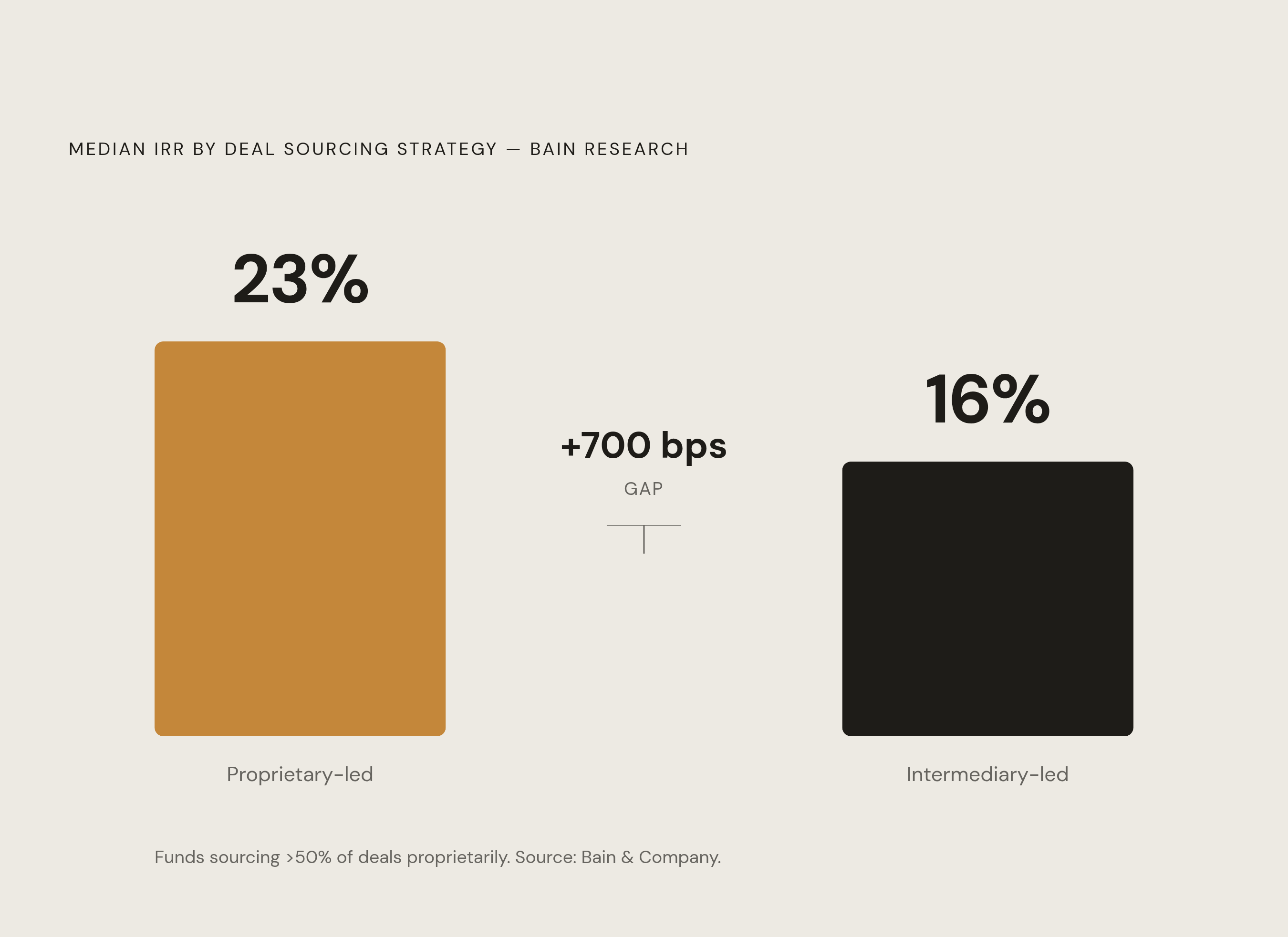
The scale of what's at stake here is not small. Bain's research found that funds sourcing more than half their deal flow proprietarily delivered median IRRs of 23%, versus 16% for funds leaning heavily on intermediaries. That's a 700-basis-point spread, and it's worth sitting with that gap for a second. It doesn't appear by accident, and better financial modeling doesn't explain it. It's the downstream result of relationships getting activated at the right moment by the right person, and operating partner networks are one of the primary mechanisms that produces it.
The portfolio side follows the same logic with a different payoff. When relationship mapping works, it reduces a firm's reliance on retained search, because board-ready operators and functional experts turn out to already exist somewhere inside the firm's collective network. The firm just has to find them, which, as the next section lays out, is precisely what most firms currently can't do.
The structural reason most of that network value goes unused
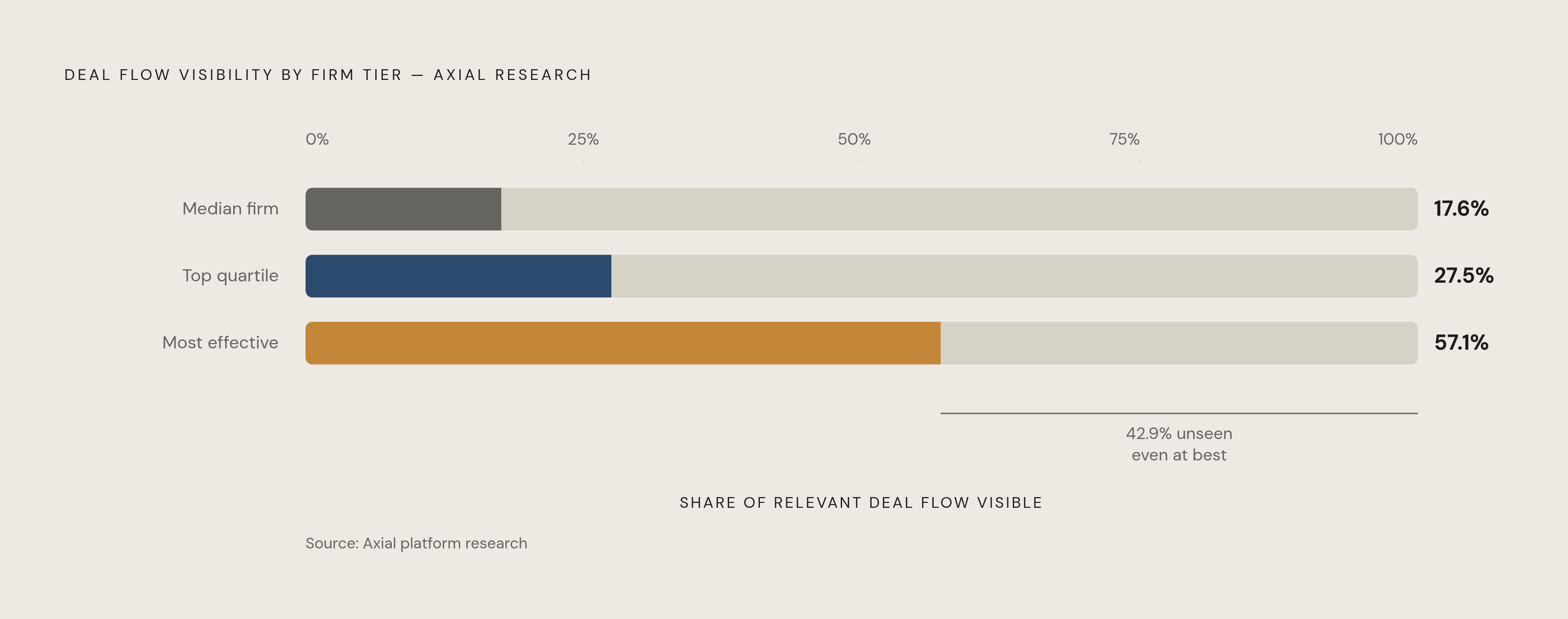
Here's a number worth sitting with. According to Axial's research on deal sourcing, the median PE firm sees just 17.6% of its relevant deal flow. Top-quartile firms reach 27.5%, and even the most effective firms in the market top out around 57.1%. Turn that around: even the best firms in the industry are blind to nearly half the opportunity that's technically within reach.
What explains a gap that large? It isn't a knowledge problem. Most firms, in aggregate across their partners and operating partners, already know a much larger share of the relevant market than any single person could see. The gap is a coordination failure. Operating partner relationships live in individual inboxes, calendars, and heads, and none of that is queryable by anyone else at the firm. When a portfolio company needs a CFO with specific sector depth, or a deal team needs a warm path into a founder's inner circle, the answer may already exist two floors away, but nobody can find it fast enough to matter.
There's a term in the organizational literature for what happens when this goes unaddressed for years: "organizational Alzheimer's," the loss of institutional knowledge that comes with turnover. It's the partnerships, external and internal, that a departing person had built, and the social capital loss is frequently worse than the loss of raw expertise. Social Network Analysis has a term for the people this hits hardest too: "critical nodes," employees who function as bridges between departments or contact groups, whose departure disrupts how information and relationships move inside the firm. In private equity, a departing operating partner is almost always one of these critical nodes.
Add it up and the picture is fairly stark. Each operating partner functions as a self-contained silo, while the firm's collective network, taken as a whole, is larger than any individual sees. And activating any specific piece of it depends on luck (someone happening to remember that someone else knows someone), or on expensive redundancy: retained search fees, intermediary costs, the price of not knowing what's already sitting inside the building.
Why the standard fix — a shared CRM — doesn't solve the problem
The obvious answer is a shared CRM. Get everyone logging their contacts in one system, and the visibility problem solves itself, or so the theory goes. In practice it doesn't, and the CRM fix deserves to be ruled out explicitly rather than treated as a reasonable option that just hasn't been tried hard enough.
Most funds today manage relationships across a patchwork: email inboxes, spreadsheets, calendar apps, and CRM systems built for high-volume, transactional B2B sales cycles. A CRM built for sales reps logging fifty calls a day is poorly suited to a business where the calls that matter happen four times a year and carry a decade of context behind them.
Even a well-chosen CRM runs into a second wall: it requires manual upkeep, and operating partners who are actually active in the market don't have the bandwidth to log every meaningful interaction as it happens. Worse, the relationships that matter most (the ones with the most history and the most trust behind them) tend to be the least likely to get logged, precisely because they're the ones an operating partner treats as personal rather than administrative.
Underneath the workflow problem sits a trust problem. Asking an operating partner to enter relationship context into a firm-wide system means asking them to hand over something that was never theirs to give away. The relationship belongs to the operating partner, built through years of personal rapport, and the content of a private conversation should never get exposed broadly just because a firm wants better visibility. BDO's 2025 Private Equity Survey, which polled 435 fund managers and operating partners, found 41% prioritizing dry powder for new platform investments. Firms are putting capital to work, and administrative data hygiene projects that operating partners resent from day one lose out for budget and attention almost every time.
So the fix a CRM offers falls short, and no amount of mandatory-field enforcement changes that. What needs to move across the firm is a narrower, more permissible layer: the signal that a relationship exists, some sense of its strength, and how recently it was active. That's an architectural distinction, and it points toward a different category of tool entirely.
What systematic network activation looks like in practice at a PE firm
Start from the foundation. A relationship intelligence layer connects the systems where professional relationships already live, meaning email, calendar, LinkedIn, messaging tools, and turns that scattered history into something a firm can actually query: who knows whom, how recently, how strongly. Relationship strength scoring lets a deal team or a portfolio support function pick the best warm path available rather than settle for the most convenient contact on hand.
Picture the sourcing case. A deal team is chasing a target company, and relationship intelligence surfaces an existing connection between an operating partner and a key contact at that company — a fact nobody on the deal team would have known to ask about. The result is outreach that starts warm instead of cold, because the connection already existed inside the firm's network.
The portfolio-side case works the same way in reverse. A portfolio company needs a VP of Operations with specific sector experience. Instead of paying a retained search firm to start from zero, the firm's relationship graph surfaces that an operating partner already has a connection to a qualified candidate, sitting inside the collective network the whole time. Due diligence benefits too: relationship intelligence platforms can point to key thought leaders and specialists already inside a firm's network, meaning warmer introductions to the experts who can actually stress-test an investment thesis before a deal closes.
The speed gains, where they've been measured, are not marginal. Affinity reports that MassMutual Ventures discovers and triages opportunities up to five times faster using relationship intelligence tools. Alpha Venture Partners has reported saving 100 hours a week, and TELUS Global Ventures has documented saving 2.5 hours per person per week just from improved data completeness, without even touching sourcing speed. Axial's research on origination staffing found that top-performing firms run dedicated origination teams at a ratio of roughly 0.75 to 1.25 deal sources per generalist investment professional, seeing three to four times more relevant opportunities than peers who don't invest in that structure. That ratio only pays off if there's an infrastructure layer underneath it turning scattered contacts into something searchable. Otherwise more people just means more silos, each one as invisible to the rest of the firm as the last.
Blackstone's internal "Bistro" analytics platform offers a useful parallel, built centrally and deployed across the portfolio to standardize operational data. Relationship intelligence applies that same logic to a different kind of data: the map of who in the firm knows whom, rather than operational metrics.
The privacy and trust architecture that makes firm-wide activation acceptable to operating partners
Any operating partner who bristles at the idea of a firm-wide network system has a legitimate point, worth taking seriously rather than waved off as resistance to change. These relationships were built on personal trust across years, sometimes decades. A founder who confided something to an operating partner over a private dinner did not sign up for that becoming a firm asset that anyone with database access can query.
The resolution is to design around the objection rather than argue past it. A well-built system surfaces that a relationship exists and roughly how strong it is; the content of what was actually said stays private, shared only with the operating partner's permission. That line has to hold, without exception. A permissioned architecture puts the operating partner in control of what's visible to the firm and what stays private, so the collective benefit is the relationship graph itself, the map of who knows whom, separate from the conversation layer sitting underneath it.
There's a related design rule worth stating plainly: AI in this context should draft and recommend, with every outreach reviewed and approved by the operating partner before it goes out. That keeps the relationship exactly where it belongs, in that partner's hands, preserving the judgment that made the relationship valuable in the first place.
None of this works, in an industry built on trust the way private equity is, without treating security and permissioning as the floor rather than a selling point. Enterprise relationship intelligence is as much a compliance question as a technology one. And there's a genuine upside for operating partners buried in all this, worth naming directly: a system that handles the administrative memory of a network, tracking recency, flagging who hasn't been contacted in months, surfacing a relevant trigger like a job change, frees the operating partner to spend limited time on the actual high-judgment work of tending relationships, rather than trying to remember everything themselves.
The current landscape of tools reflects different bets on how to balance this. Affinity, 4Degrees, Intapp DealCloud, Avnir, and Rolo each approach the tradeoff between relationship graph depth, PE-specific workflow, and privacy control a little differently. The scale of relationship and deal management platforms is a useful data point on where institutional adoption stands: according to Affinity AI in Private Equity, Intapp DealCloud serves more than 1,100 clients across private capital, and Intapp's platform has seen broad institutional uptake across private capital and capital markets, which suggests the category has moved well past early experimentation.
How firms can move from ad hoc activation to a repeatable operating partner network program
None of this is about replacing an operating partner's judgment about their own relationships, and any program that tries will fail on contact. The goal is narrower and, frankly, more achievable: give the rest of the firm visibility into the fact that a relationship exists, and build a structured way to request that it be activated when it matters.
A workable program tends to have three layers. An infrastructure layer connects the systems where relationship history already sits (email, calendar, LinkedIn) so signals get captured passively, without anyone manually logging a meeting that happened eight months ago. An intelligence layer scores those relationships by strength, recency, and relevance to whatever the firm needs right now, whether that's a live deal or a portfolio company staffing gap, and surfaces the warm paths on demand. An activation layer defines the actual process: a deal team or portfolio company surfaces a need, the system identifies the strongest available warm path, and the operating partner who owns that relationship reviews and approves the introduction before anything gets sent.
The technology only gets a firm halfway there. What determines whether operating partners actually buy in is the human protocol sitting alongside it: do they understand exactly what's visible to the rest of the firm, how requests will reach them, and that they keep control over every single outreach that goes out under their name? Skip that conversation, and adoption fails no matter how well the tool works. This is the part firms tend to underbuild, because it's harder to spec than the software, and it's usually the actual reason a rollout stalls, not the technology itself.
There's a continuity benefit worth naming too. When an operating partner eventually rotates out or retires, the relationship graph built over years stays queryable by the firm. The connections don't have to walk out the door with them the way they would have otherwise, which is precisely the "organizational Alzheimer's" problem from earlier, addressed at the structural level rather than left to chance.
None of this is worth building unless it can be measured. Firms running a real program can track the share of introductions that originate from warm paths against cold outreach, the time-to-first-meeting on sourcing efforts, and the portion of portfolio support requests resolved through existing network connections rather than a retained search fee. Those numbers are what make a network activation program legible to the rest of the partnership, the ones who need to see the return before they'll back further investment in it.
Circle back to where this started: that 700-basis-point IRR gap between firms with strong proprietary sourcing and firms leaning on intermediaries. That gap closes by making visible, at the exact moment it matters, what the firm already collectively knows and simply couldn't see.