Venture CRM Comparison for Early-Stage Fund Managers
Smart CRM selection for tiny funds hinges on network visibility, not features.
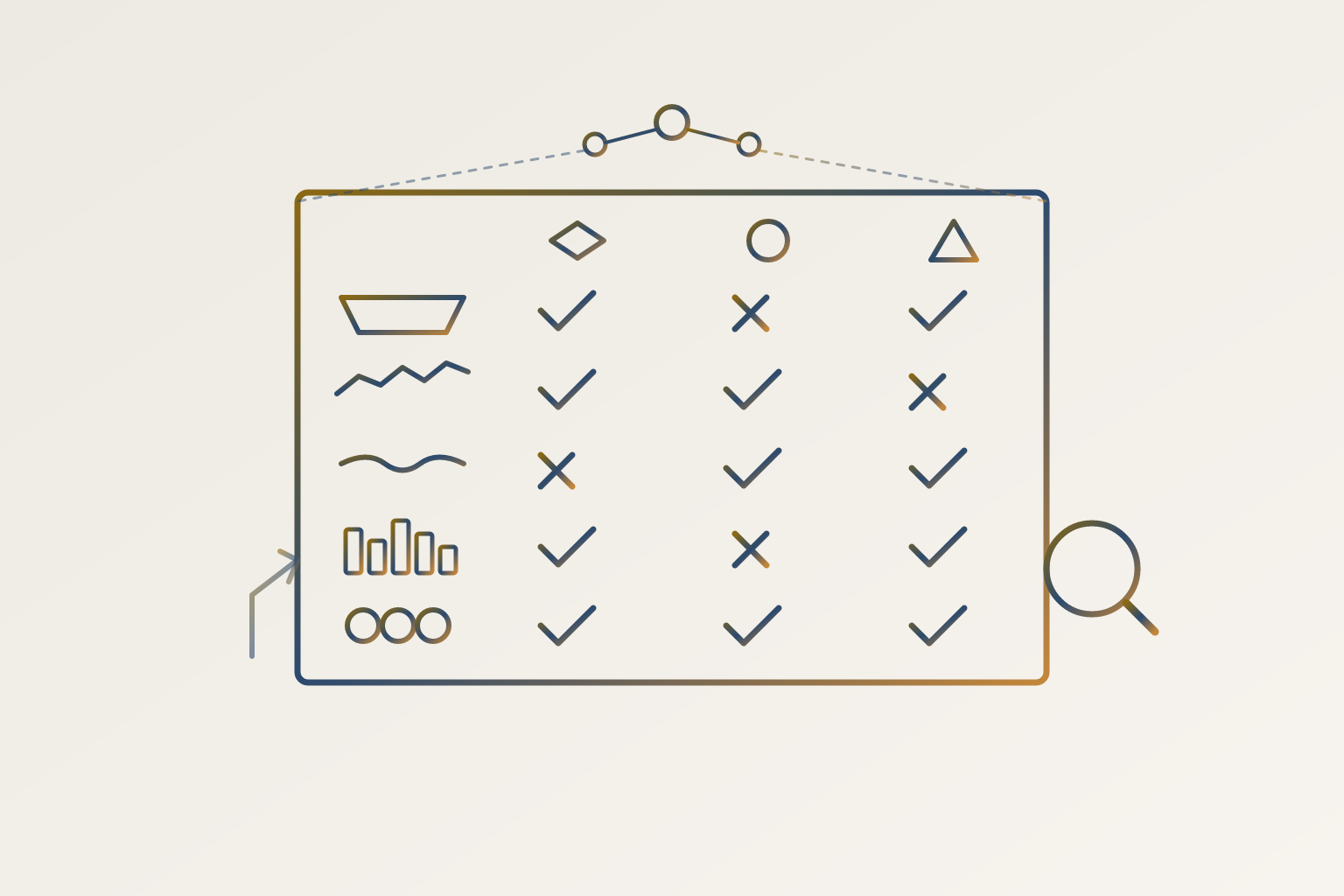
Most venture CRM comparisons rank platforms on feature depth, polish, and integration count, the kind of scorecard that makes sense for a multi-partner firm with an ops team and a hundred active deals. That framework breaks down for a fund with two general partners, a thin closed-deal count, and a network scattered across two inboxes and a stack of LinkedIn messages. This piece looks at the tools actually available to early-stage managers against the constraints that define their stage, rather than the constraints of a firm ten years further along.
The timing matters too. The number of funds in operation grew 76% between 2015 and 2023, and by 2024 just 20 VCs captured 60% of total capital raised. That's a strange environment to compete in: more funds chasing deals, fewer dollars concentrating at the top, and LPs with less patience for managers who can't show a clear edge. A two-person fund isn't just competing for deal flow anymore; it's competing for attention in a field that got both larger and more top-heavy at once. The real question here is which platform gives a small team the relationship visibility and pipeline discipline it needs to survive that competition, ahead of which one simply has the most features. The answer turns on four criteria: automated data capture, network mapping across the whole firm, pipeline flexibility suited to pre-seed and seed stages, and pricing that doesn't assume a fund has already scaled. Get those four right, and the platform choice mostly makes itself; get them wrong, and no amount of integrations fixes it.
What "relationship intelligence" actually means for a two-person fund
Traditional CRM software is a storage problem. Someone enters a contact, logs a meeting note, updates a deal stage, and the system holds onto it until someone looks it up again. The output is only as good as the discipline behind the input, which is exactly why so many CRMs rot: the moment a team gets busy, data entry stops, and six months later the pipeline view is a fossil record of what used to be true.
Relationship intelligence works differently. Instead of waiting for a human to type something in, it reads email threads, calendar invites, LinkedIn connections, and message history passively, then builds a picture of who knows whom, how recently they've spoken, and how strong that connection actually is. No one has to remember to log it, since the system watches the exhaust of normal work and turns it into a graph.
Why does that distinction matter so much at the earliest stage? Because the questions a small fund actually needs answered aren't the kind a spreadsheet can hold. Who on the team has the strongest relationship with the founder of this pre-seed company they're trying to meet? Which LP has a connection to the enterprise buyers a portfolio company is chasing this quarter? Neither question resolves against a contact list, and both require a queryable graph, one that already knows the shape of the network before anyone goes looking for it.
A Harvard Business Review analysis of nearly 900 VCs found that over 70% of all deals originate from a firm's existing network. Sit with that for a second: the deal source most funds spend the most energy trying to build, cold outbound, conference circuits, warm intro requests to strangers, is already secondary to the network they've already got. The practical implication is less about needing a bigger network and more about needing visibility into the one they already have.
For a two-person fund, that visibility problem is structural, not incidental. Each partner has a separate inbox, a separate calendar, a separate decade of contact history, and there is no shared view of what the combined network actually covers. A tool that surfaces that combined picture is worth more, at this stage, than one that tracks which column a deal sits in. Rolo, from Alpha Watch, is one warm-path finder built around exactly this kind of network visibility. Pipeline stages are a management convenience, while the network graph is the asset, and treating it as an afterthought is the single most common mistake a small fund makes when it goes shopping for a CRM.
None of this works if the system demands upkeep. A two-person team has no spare hour to log meeting notes or tag contacts by relationship strength; a system that requires that discipline will either get abandoned within a quarter or go stale exactly when someone needs it most, usually mid-sprint on a hot deal. Automated capture isn't a nice-to-have feature; it's the precondition for the whole category being useful to a team this small.
One caveat worth stating plainly: relationship intelligence should draft and suggest, not act on its own. A system that autonomously sends outreach on a partner's behalf, or exposes one partner's private email context to another without permission, creates a trust problem bigger than the visibility problem it's trying to solve. The architecture around privacy and permissioning matters as much as the underlying feature set. A tool that surfaces "your co-founder Jane has a strong connection to this target" without ever showing the other partner the private thread behind that signal has solved the problem correctly, while a tool that hands over inbox contents wholesale has not, and that distinction is where several products in this category quietly fail.
The four criteria that should drive an early-stage fund's CRM decision
Four things matter here, in roughly this order of weight for a team this size.
Automated, passive data capture comes first because it's not really a differentiator so much as a floor. A platform needs to sync from email and calendar without prompting, and it needs to score relationship recency and frequency on its own. Any CRM that asks a two-person team to manually maintain contact records will be out of date at the exact moment someone needs it, which tends to be the worst possible time: mid-diligence, trying to figure out if anyone on the team already knows this founder.
Network visibility across the whole team is where the real differentiation lives, and it's also where most vendors overstate what they've built. The tool needs a shared relationship graph, one view that shows the combined partner, LP, advisor, and portfolio network together rather than as three disconnected contact lists. It also needs to surface warm paths through second- and third-degree connections, not just first-degree ones. Why does that second-degree layer matter so much? Because the obvious contacts, the people a partner already emails weekly, are usually already exhausted as an introduction source. The value sits one or two steps further out, in the network a partner doesn't think to check because they don't remember they're connected to it. Permissioning belongs here too: the individual content of a partner's inbox should stay private, while the signal of who's connected to whom, and how strongly, should be visible firm-wide. That's a narrow line to walk, and not every product walks it well.
Pipeline flexibility for pre-seed and seed stages is its own criterion because early deals don't move through the clean stage gates that a growth-equity CRM assumes. A tool built around a template of "sourced, screened, term sheet, closed" leaves no room for the murkier early-stage reality of watchlists, informal tracking, and "relationship before raise" monitoring, where a fund spends six months building rapport with a founder before there's even a round to track.
Pricing and adoption fit rounds out the list, and it's the most concrete of the four. Per-seat pricing needs to work for a team of one to five without hitting enterprise minimums designed for a twenty-person firm. Setup shouldn't require a dedicated ops hire, because a two-person fund doesn't have one, and friction has to stay low: a tool nobody opens is strictly worse than a spreadsheet, since at least the spreadsheet gets updated.
Two things are worth flagging as secondary rather than primary. LP relationship management and reporting matter, but mostly once a fund is actively fundraising rather than in the earliest deployment phase. And data security posture, particularly around how a platform handles AI-driven data capture, deserves more attention as it becomes a live concern for regulators and LPs alike. Neither drives the decision the way the first four criteria do, but neither should be ignored either.
How the leading platforms compare against those criteria
This isn't a ranked list, but rather an honest look at where each platform is strong, and where the gaps show up specifically for a team this size.
Affinity has the strongest relationship intelligence in the dedicated VC CRM category, full stop. It captures email and calendar data automatically and builds a network map with connection scoring that's genuinely native to the product, not a feature bolted on after the fact. It's also the most widely adopted platform among established VC and PE firms, which means deep integrations and a large, active user base to draw on. The complication for early-stage managers is straightforward: pricing runs enterprise-oriented, and for a sub-five-person fund that cost is meaningful, while implementation isn't the kind of thing a team sets up in an afternoon. Affinity fits best once a fund has scaled past its earliest phase, has some ops support in place, or is already juggling a large volume of active portfolio relationships. Buying it on day one, before that volume exists, means paying for a network effect the fund hasn't generated yet.
4Degrees shares the relationship intelligence focus, automatically pulling from email and calendar, and it's built specifically with investment teams in mind. Its pipeline management leans into VC-specific workflows and handles warm introduction routing natively, which is a genuine strength. It's also generally positioned as more accessible to smaller teams than Affinity, though pricing is worth checking directly rather than assuming. The gap that matters for a brand-new fund: the network graph depends on the team's own communication history, so a fund that's only a year or two old with a thin email archive gets a thinner graph back.
Attio takes a different approach entirely. It's a data-model-first CRM where users define their own objects, pipelines, and views rather than inheriting someone else's fixed schema. That flexibility appeals to technically comfortable teams that want to build exactly the system they need without paying for six features they'll never touch. But relationship intelligence isn't native here the way it is with Affinity or 4Degrees; Attio reads more as a modern, adaptable pipeline tool than a network-mapping engine. It fits a team with a clear operational point of view and the patience to configure it, though it's a weaker fit for a team that wants relationship intelligence working out of the box on day one.
Folk is lightweight and fast to set up, with a strong LinkedIn integration for pulling in contacts. It suits a solo manager or a very early fund that needs basic organization and simple pipeline tracking without much overhead. What it doesn't do is much relationship intelligence, since network scoring and warm-path surfacing aren't core to what the product does. Folk reads best as a starting point, a tool to use before deal volume and team size justify something more purpose-built.
Decile Hub takes a different angle altogether, built specifically for emerging managers with LP relationship management and fundraising pipeline as the primary use case rather than deal sourcing. The numbers here are notable: among more than 750 monthly active users, daily platform users secured nearly five times more in LP commitments than occasional users, and those with 180 or more days of platform experience secured nearly 45 times more than users in their first two weeks. That's a steep compounding curve, and it suggests the tool rewards sustained, consistent use rather than sporadic check-ins. Decile Hub is stronger on LP management than on deal sourcing or portfolio relationship intelligence, which makes it a serious option for a manager whose most immediate problem is closing a first or second fund rather than building sourcing infrastructure.
One more note, briefly: plenty of first-time managers start on HubSpot or Salesforce out of familiarity, and that's usually a mistake worth naming directly. Both are capable general-purpose CRMs, but neither carries VC-specific relationship intelligence or pipeline logic, and most funds that start there eventually migrate once deal volume reaches a meaningful level. Starting on a purpose-built tool from day one avoids paying that migration cost twice: once in subscription fees for a tool that never fit, and again in the labor of re-entering years of contact history somewhere else.
The network visibility problem that no pipeline tool solves on its own
Here's the structural issue underneath all of this: even a fund that adopts a CRM often hasn't solved its network problem, because CRMs track pipeline stages, not relationship strength across a combined team. Two partners can both be diligent about logging every deal update and still have no shared view of who in their combined network actually knows the founder they're trying to reach.
The cost of that silo shows up in three predictable ways, and none of them are hypothetical for a fund running two separate inboxes. Deal flow gets lost when a founder closes a round with a competing fund while a relevant partner's email sits unanswered, unseen by anyone else on the team. Introduction requests go unfulfilled because no one realizes an LP or a portfolio CEO already has the right connection. And two partners occasionally evaluate the same deal independently, each unaware the other is already three conversations deep with the founder.
Poor data access and quality can cost organizations over 15% of potential value annually. For a fund, that loss doesn't show up as a line item, but rather as a missed deal, a slow introduction that arrives a week after a competing fund's faster one, or an LP relationship managed reactively instead of with any real foresight.
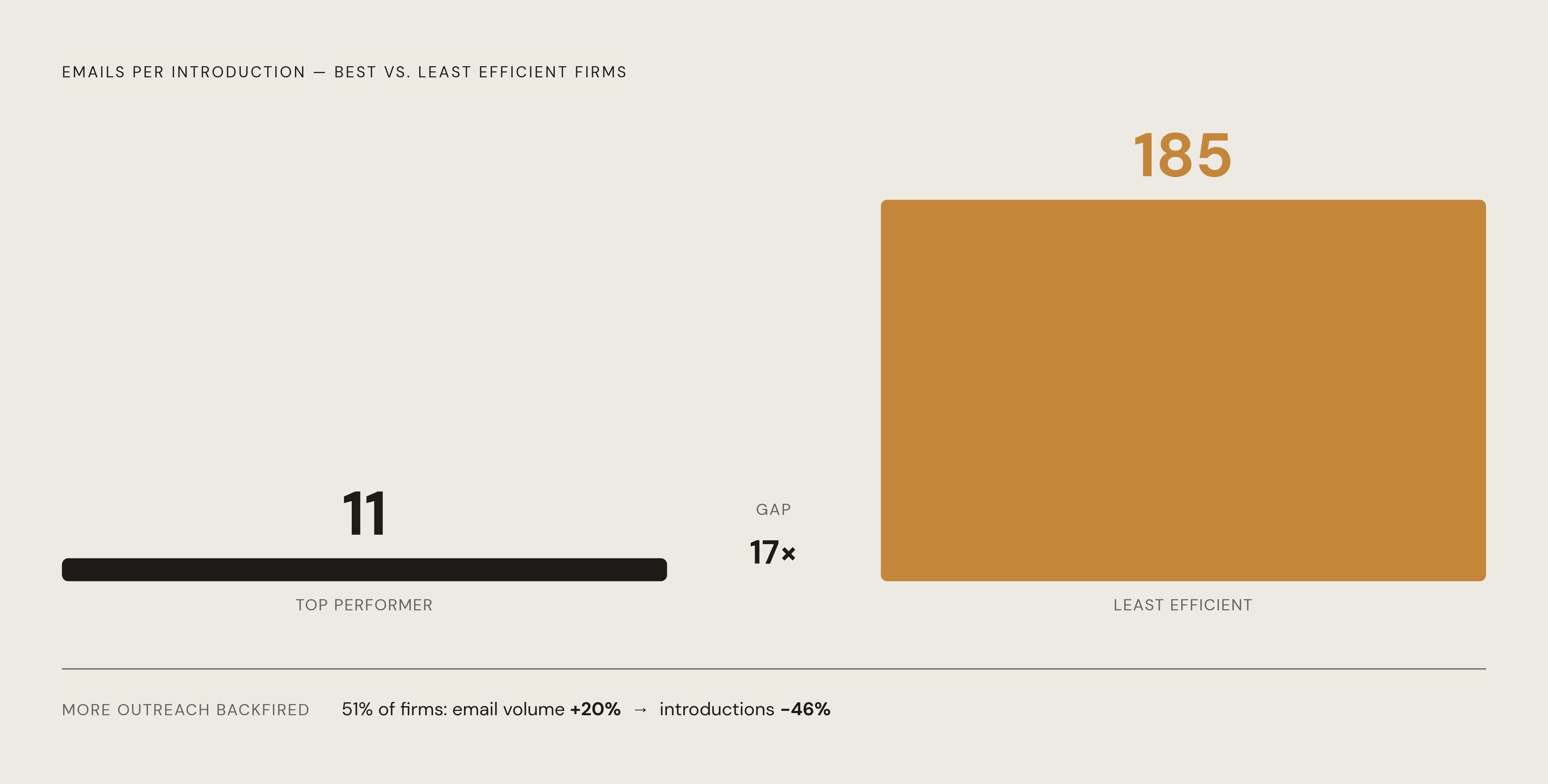
The efficiency gap here is measurable, and it's steep. Research from Affinity on private equity firms found that the most efficient firms generate one introduction for every 11 emails sent, while the least efficient need 185 emails to produce the same result, a 17-times gap between the two. More strikingly, 51% of firms saw their introduction output fall by 46% even while increasing email volume by 20%. More outreach doesn't fix a visibility problem so much as it produces more noise on top of the same blind spot, which is worth sitting with, since the instinct when deal flow slows is almost always to send more emails rather than to ask why the existing network isn't surfacing what it already has.
So what does that mean for tool selection? A fund that picks the technically correct CRM but leaves relationship data trapped in individual inboxes has organized the wrong layer of the problem. The pipeline looks orderly, but the network underneath it is still dark. And the compounding advantage runs the other way too: top-performing firms increased their introductions by 16% year-over-year in 2024 while others lost ground, and the difference wasn't effort or email volume. It was whether the firm could see, at the moment it mattered, who in its own network already had the connection it needed.
Practical guidance for choosing the right tool at each phase of early-stage fund development
The right tool changes as the fund changes, which is a fairly unglamorous thing to say but true regardless.
Phase one, pre-fund or a solo manager building a first close, has a different priority than the phases that follow: LP relationship management and personal network organization matter more than deal pipeline, because there's often no active deal pipeline yet. Decile Hub is a reasonable starting point for an LP-focused manager; Folk works as a lightweight layer for contacts and light pipeline tracking. Worth adding a relationship intelligence layer early even at this stage, because the network graph gets more accurate the longer it's been capturing signal. Waiting until the fund is operational to start means losing months of data the graph could have already built, and that data doesn't backfill itself later.
Phase two, actively deploying a first fund with a team of two to four, is where network visibility becomes the central need. The combined team's network is the deal source at this point, per the earlier data on where deals actually originate, and it stays invisible without a shared relationship graph. Pipeline flexibility matters here too, since pre-seed tracking doesn't look like growth-equity stage gates. Attio or 4Degrees handle the pipeline side well at this size. A dedicated relationship intelligence layer alongside either one helps surface warm paths across the combined network that a pipeline tool alone won't show.
Phase three, scaling toward a second or third fund with five or more team members and an active portfolio, is where the overhead of a heavier platform starts to pay for itself. Deal volume and portfolio support complexity justify it. Affinity becomes the natural fit here: relationship intelligence is native, the network has grown large enough to generate real signal, and there's typically enough operational support to handle implementation properly. This is also the stage where data security and compliance posture stop being a secondary concern and start being table stakes. SOC 2 compliance and clear permissioning architecture aren't differentiators by this point, but baseline expectations from LPs doing their own diligence on the fund's tooling.
A few rules cut across all three phases, and they matter more than any single platform recommendation. If the bottleneck is closing LPs, Decile Hub is the priority. If the bottleneck is deal sourcing and warm introductions, relationship intelligence takes precedence, whether that's Affinity, 4Degrees, or a lighter-weight option depending on stage and budget. And if the bottleneck is simple pipeline organization, without much need for network mapping yet, Attio or Folk cover that ground without asking a two-person team to pay for infrastructure it doesn't need yet.
This is less about finding the platform with the most checkboxes, and a fund that shops that way usually ends up overpaying for features it won't touch for two years, and more about matching the tool to the actual constraint a fund is operating under at that specific moment, since the constraint that matters at a solo first close is rarely the same one that matters two years and a second fund later.