Contact Deduplication and Data Hygiene Across Firm CRM Instances
Duplicate contacts plague investment firms because the problem is structural, not just messy data.
Contact deduplication keeps failing at investment firms because everyone treats it as a data-entry error rather than what it actually is: a structural feature of how relationship data gets created, owned, and used across an organization. The fix people reach for, an automated merge job that runs once and declares the database clean, treats a permanent condition as a temporary mess. That instinct is wrong, and the numbers explain why.
Melissa's State of Enterprise Data Quality 2025 report found 84% of organizations struggle with inaccurate or duplicate data. Validity's 2025 State of CRM Data Management Report puts finer detail on the wound: 76% of CRM users say less than half their organization's data is accurate and complete, and 37% report direct revenue loss tied to it. Poor data quality costs U.S. businesses enormous sums in aggregate, with individual organizations absorbing losses that compound across operations, compliance, and customer experience. Validity also found that 62% of sales reps' selling time gets lost to validating and correcting contact information; for every 13 hours spent actually selling, employees spend roughly 13 hours hunting for information. That is half a workforce's time evaporating into a problem nobody has diagnosed correctly, and if the damage shows up this consistently across so many different organizations, the cause cannot be careless staff. The cause is structural, and the fix has to be structural too, addressing the conditions that keep regenerating duplicates rather than sweeping them away once.
How duplicates are actually created, and why the trigger is almost always human
Duplicate records rarely come from a system glitch or an integration bug. They come from a person staring at a search bar, deciding it is faster to create a new record than to find the existing one. That decision happens under time pressure, inside interfaces that were not built for speed, when search results are slow, ambiguous, or simply absent. Multiply that decision across a firm with dozens of employees making it dozens of times a week, and the duplicate count stops looking like an anomaly. It becomes an inevitability, baked into how people are asked to work.
The deeper cause sits upstream of the individual choice. There is no single source of truth, so defaulting to creation rather than lookup becomes the rational move, not the lazy one. Why search a system that might not have what someone needs, when typing a new entry takes ten seconds?
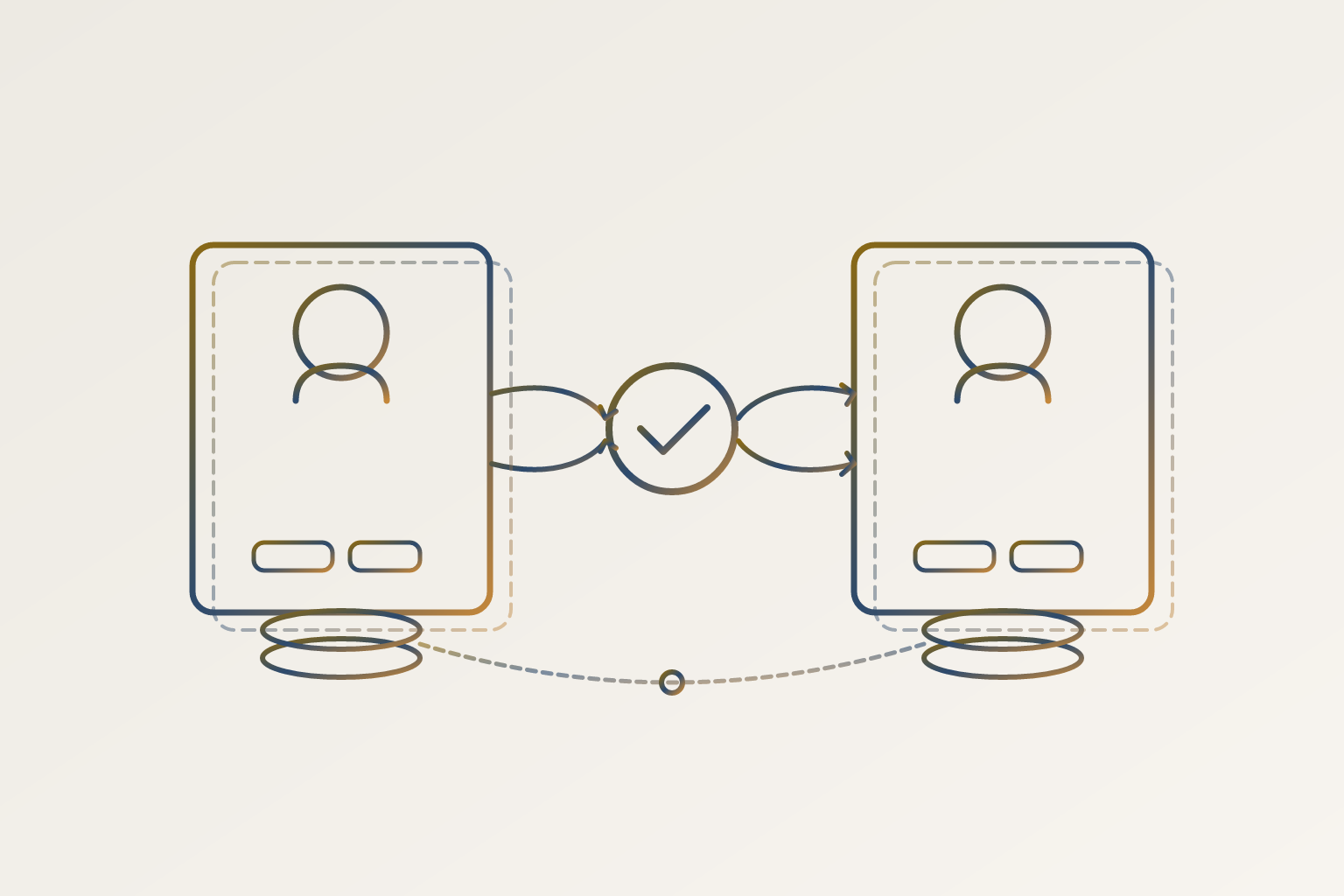
Multi-instance firms make this worse by design, not by accident. When a deal team and an investor relations team run separate CRM instances, and both happen to interact with the same person, the firm ends up with two records that are each entirely correct. A general partner might be tracking a founder as a portfolio prospect in one system, while IR is tracking that same person as a prospective LP in another. Neither record is wrong. Both are true, from the vantage point of whoever owns them, and no deduplication rule will flag that as an error because nothing about it looks like an error. It looks like two teams doing their jobs, which is exactly what makes it so hard to catch.
The downstream cost is where this becomes tangible: two reps unknowingly working the same account, marketing sending the same email twice to the same inbox, pipeline dashboards inflated by phantom records that are really just the same contact counted twice. None of this shows up as a technical failure in any system log. It shows up as wasted outreach, duplicated effort, and numbers that quietly lie to whoever is reading them.
Why one-time deduplication runs decay almost immediately
The standard response to this mess is a deduplication sprint: run the tool, merge the flagged records, call the database clean, move on. That approach works for about as long as it takes the same conditions that created the duplicates to start creating them again. Manual entry didn't stop, multi-team ownership didn't stop, and disconnected systems didn't stop. So the duplicates come back, usually at close to the same rate they left.
Relationship data adds a second decay mechanism that most enterprise data doesn't have to contend with: people change jobs, change titles, change email addresses, and none of that shows up automatically in a CRM record. A merge that was accurate the day it happened can be stale within months, not because anyone made an error, but because the underlying person moved on and nobody updated the record to match.
Industry surveys have consistently found that data silos rank among the top concerns for organizations, and that the underlying fragmentation problem has persisted despite more sophisticated tooling. Sit with that for a second: deduplication tooling has gotten more sophisticated, and the underlying fragmentation problem has gotten worse anyway. The tooling was never the bottleneck, and treating it as the bottleneck is the mistake most firms keep making.
Investment firms carry a version of this that is uniquely punishing. When a partner leaves, the relationship graph they built over years, deal conversations, warm introductions, board relationships, tends to leave with them unless someone systematically captured it while they were still there. No amount of post-departure cleanup recovers a network that lived in one person's inbox and one person's memory. The cleanup metaphor fails here because it assumes a finished state exists somewhere, a point at which the data is done being messy. Relationship data has no such point, and firms that keep budgeting for one keep getting surprised when it doesn't arrive.
What makes relationship data different from other enterprise data
A product SKU has one owner and one correct value, and the same is true of an invoice. A relationship between two people does not work that way. It is owned, simultaneously and legitimately, by both people in it, and it is stored in both of their inboxes, their calendars, their memory of what was actually said in the meeting.
Consider what a single contact might look like across a firm with three teams touching that person. To one partner, the contact is a warm lead worth a follow-up call. To the IR team, the same person is an LP prospect being cultivated for the next fund close. To a third team, that person is a former portfolio founder whose exit created goodwill worth preserving. All three descriptions are accurate. None of them is complete on its own, and no single record can hold all three without someone deciding whose context takes priority.
Relationship strength also decays with time in a way that most enterprise data does not. A contact who represented a strong, warm path two years ago may be cold today, but the CRM record still shows the old last-contact date sitting there, looking current, telling nobody that the relationship has gone quiet.
No deduplication algorithm trained on name, email address, and company name resolves any of this. Field matching can tell software that two records probably describe the same person, but it cannot tell software which team's context should survive the merge, and it cannot merge two records without losing information that mattered to at least one side. There is also a structural cost buried in the merge itself: the value of a contact is not just who they are, it is who they are connected to, and a naive merge can sever paths that were only implicit in each record's separate connection history. This is precisely why relationship data calls for a graph model rather than a record model, with hygiene understood as graph maintenance rather than record cleanup.
The multi-instance problem specific to investment firms
Investment firms don't stumble into running parallel CRM instances. They build that structure on purpose. Deal teams track opportunities, IR tracks LP relationships, and portfolio monitoring often lives in a third platform or, more often than anyone would like to admit, a spreadsheet somebody maintains manually. Each instance is correct within its own domain. The fragmentation isn't a configuration mistake; it is what the org chart produces, and no amount of better software fixes an org chart problem on its own.
The result is a set of information silos that force manual workarounds the moment anyone needs a view that spans more than one team. Who at the firm actually knows this LP? Has anyone here already spoken to this founder? Is this contact currently in diligence with a competing fund? Those questions get answered, if they get answered at all, by someone sending a Slack message and hoping a colleague remembers.
Private equity deal activity has faced renewed competitive pressure, with firms competing more intensely for quality assets and the relationships that surface them earliest. Firms winning the best deals tend to be the ones identifying opportunities earliest and maintaining stronger LP relationships through operational discipline, both of which erode the moment relationship data is scattered across systems that don't talk to each other. On the venture side, the fundraising environment sharpens the stakes further: VC funds raised $66.1 billion across 537 funds in 2025, a figure that signals a meaningfully tighter fundraising environment. In a tighter market like that, a warm LP introduction carries more competitive weight than it did when capital was abundant, which makes relationship visibility across a firm a deal-quality question, not an IT ticket.
The practical cost shows up in specific, avoidable scenarios: two partners independently courting the same LP without either one knowing the other is doing it, a junior analyst passing on a deal because nobody told them a senior partner already had a warm path in, an introduction offered to an outside party when the firm had the connection sitting internally the whole time. Every one of those is a lost advantage that existed somewhere in the firm's collective memory and simply never surfaced when it mattered.
Where AI-powered deduplication tools genuinely help and where they stop
The tools have gotten better, and it would be a mistake to pretend otherwise. Fuzzy matching, probabilistic scoring, and machine-learning-trained entity resolution now catch variants that rule-based systems used to miss entirely: nicknames, maiden names, a company that renamed itself after an acquisition. That is real progress, and it matters.
AI-powered integrations that auto-capture email and calendar activity attack the problem closer to its source. If a system logs an interaction automatically the moment it happens, nobody has to manually create a record for it later, which means fewer opportunities for a duplicate to appear in the first place, which is the gap tools like Alpha Watch, a warm-path finder that queries a firm's existing network data rather than asking teams to consolidate their CRMs, are built around. Affinity's approach illustrates the mechanism: once email and calendar sync is turned on, the platform builds a relationship graph automatically within roughly a day, surfacing who at the firm knows whom and how strong that connection is, without anyone typing a new contact record by hand. That reduces duplication at its origin point, ahead of any cleanup after the fact.
Intapp DealCloud takes a different route toward the same multi-instance problem, building deal and relationship management specifically for capital markets workflows. The platform serves more than 1,100 clients across mid-market and mega-fund private equity firms, and its cloud annual recurring revenue surpassed $400 million in the first quarter of fiscal year 2026, which says something about how broadly firms are willing to invest in this layer of infrastructure. Some tools approach the problem from a different angle still, connecting to the systems where relationships already live rather than asking a firm to consolidate or replace existing CRM instances, and building a queryable relationship layer across them without forcing a data migration.
What none of these tools fully resolves is the contextual conflict described earlier: the same contact meaning something different to different teams. An algorithm can flag with high confidence that two records describe the same human being, but deciding whose relationship context should govern once those records get merged is a judgment call, not a matching problem, and no amount of model sophistication substitutes for a policy and a person willing to make one.
The governance and policy decisions that determine whether deduplication holds
Somebody has to own the answer to a deceptively simple question: who owns a contact record when three different people at the firm all have a real relationship with that same person? Skip this decision, and every merge becomes contested, and every cleanup effort reverts within a quarter. This is the part firms skip most often, and it is the part that matters most.
The ownership policies that tend to hold up in investment firms mirror the relationship itself rather than assigning ownership permanently. The partner with the most recent, most substantive interaction acts as the de facto owner, with everyone else holding read access. Ownership shifts as the relationship shifts, rather than staying fixed to whoever created the record first.
Merge authority is its own decision, and there's no clean answer here. Centralize it with a data steward reviewing every proposed merge, and approvals become a bottleneck. Distribute merge authority to any team member, and consistency suffers because everyone applies slightly different judgment. Firms have to pick a failure mode and manage around it, since no option avoids failure entirely. Given the choice, distributed authority with a lightweight audit trail tends to fail less expensively than a centralized bottleneck; a slow merge queue costs deals in a way a slightly inconsistent one usually doesn't.
Firms also need a working definition of "duplicate" that fits their own structure. Two records describing the same person are a duplicate, full stop. But two records describing the same person in genuinely different relationship contexts (an LP record and a portfolio founder record for one individual) may not be a duplicate at all. That might be a case for linking the records together rather than merging them into one, and treating every match as mergeable is exactly the error that erases context nobody meant to lose.
Prevention remains the cheapest form of deduplication available: define what fields are required before a record can be created, standardize name and company formatting, and require a lookup search before any new record gets saved. And partner departures need a pre-agreed protocol, not an improvised scramble after the fact. The departing partner's relationship history should transfer into the firm's institutional graph as a matter of policy, not get chased down after they've already left.
Permissioned access across a shared relationship graph
The resistance many firms feel toward sharing relationship data firm-wide is not paranoia. Relationship data at an investment firm can carry LP identities, deal terms, counterparty sensitivities, and conversations that constitute material non-public information. Treating that resistance as an obstacle to route around misses why it exists in the first place.
But here is the tension that has to get resolved: a unified relationship graph only creates value if people across the firm can actually query it. Permission it too tightly, and the firm has rebuilt the exact silo problem it was trying to solve, just with a different name on it.
The way through is to separate the graph's structure from its access controls. The graph itself can stay unified at the infrastructure level, meaning the connective paths between people still exist and can be traversed, while access to specific nodes within that graph gets permissioned by role and by fund.
A zero-trust design fits naturally here: any AI agent or internal tool querying the relationship graph should verify identity and role before it can pull data, and those permissions ought to reflect a person's current context rather than whatever access got assigned to them on their first day. Role-based access control is the floor. The more sophisticated version is relationship-level access, where a junior analyst can see that a warm path exists between a senior partner and a target company, without being able to open the email thread that path is built on.
The principle worth holding onto through all of this: personal relationship context, the specific conversations, the private judgment calls, should stay private even as the institutional signal (who knows whom, which introduction paths exist, how strong a given connection actually is) gets made useful across the whole firm collectively. For firms operating in regulated environments, this functions closer to a compliance requirement than a nice-to-have feature tier, and it is a prerequisite for trusting any AI tool that touches relationship data at all.
Treating relationship hygiene as a continuous graph maintenance practice
Once governance and permissioning are settled, the remaining question is what ongoing hygiene looks like day to day, because it should not resemble a project with a start date and an end date. Hygiene, understood correctly, is a cadence, closer to financial reporting than to office renovation. Nobody declares quarterly earnings "finished" and moves on to something else, and nobody should declare a relationship graph finished either.
A working cadence has a few recognizable pieces. Automated signals can flag records with no interaction inside a defined window, contacts whose email has started bouncing, or records where a company affiliation appears to have changed, detectable through an email domain shift or a LinkedIn update. Triggered reviews make sense around forcing events: a partner leaving, a fund closing, a portfolio company getting acquired. Those moments are natural checkpoints for reconciling relationship data, rather than waiting for a scheduled cleanup that may or may not happen. Quarterly graph audits, focused specifically on the highest-value clusters (the top LPs, the most active deal sources, the key connectors), catch staleness and merge candidates where they matter most, rather than trying to scrub an entire database at once. And intake discipline remains the cheapest lever available: enforcing a lookup-before-create habit at the point of entry, with a minimum required field set before any record saves, stops a meaningful share of duplicates before they ever exist.
There's a competitive argument underneath all of this, worth stating directly. Top-performing venture firms made measurably more introductions than their peers in 2024, and as deal flow slowed industry-wide, the firms leaning into networks they already had outperformed those still waiting on fresh inbound. A clean, current relationship graph is what makes an existing network actually accessible at the exact moment someone needs to pull a warm path out of it. Affinity's 2025 Investment Benchmark Report found that 64% of investors now use AI to speed up company research, and the firms getting real value out of that AI investment are the ones whose underlying relationship data is accurate enough to query and trust. The AI-in-CRM market itself is projected to grow from $11.04 billion in 2025 to $15.06 billion in 2026, a 36.4% compound annual growth rate, which signals plenty of firms are willing to spend on this infrastructure. The return on that spending, though, scales directly with how clean the relationship data underneath it actually is; a fast, well-marketed AI tool pointed at a messy graph just produces confident wrong answers faster.
Firms that treat this as ongoing graph maintenance, rather than a periodic cleanup exercise, end up with a compounding advantage: a network that gets more queryable, more complete, and more current the longer it runs. Everyone else gets to rediscover the same mess on a semi-regular schedule, clean it up, and watch it decay again, right on cue.