AI Summarization of Long Email Threads for Relationship Context
AI thread summaries reveal relationship shifts that flat summaries miss entirely.

AI thread summarization saves time reading email. That's the pitch, and it's true as far as it goes, but the more interesting thing it does, when it works, is reconstruct the relationship buried inside the thread: the shifting tone, the ask nobody answered, the exact moment a warm conversation went cold. For investors, founders, and dealmakers, recovering that context is often the difference between a re-engagement that lands and one that reads as tone-deaf. This piece looks at what these tools actually do well, where they still fall apart, and what it would take to use them as something closer to relationship memory than inbox cleanup.
Most professionals in high-stakes industries don't struggle with too much email so much as they lose the thread of a relationship across dozens of exchanges spread over months, sometimes years. Inbox triage is a volume problem: how do I get through 150 emails before lunch. Relationship context is a signal problem: who said what, in what tone, and where did we leave things. Those aren't the same problem, and treating them as if they were is roughly why so many AI summarization tools stop short of where the real value sits.
Think about what happens when a conversation goes quiet for three months and a partner wants to pick it back up. The information about what was promised, what was sensitive, what posture the other side left with, it's all still there somewhere in the thread. Nobody forgot it. It's just scattered across fifteen messages that nobody has time to reread. That's the specific failure this piece cares about.
What AI summarization actually does to a long thread — and where it still falls short
Modern large language model summarizers do more than compress text into a paragraph. A well-prompted model pulls out four distinct layers from a thread pretty reliably: a short overview of the situation, decisions that got made, action items with names attached, and questions still hanging open. That's a real step up from what came before.
The old rule-based systems worked off crude heuristics, prioritizing the most recent message or the longest one, and they were too blunt to catch anything resembling a narrative arc. What actually changed the equation is context window size. Models like GPT-4o and Claude 3.5 Sonnet can hold an entire long thread in a single pass now, so the summarizer isn't skimming the last reply and guessing backward. It's reading the whole conversation, start to finish.
So where does it still break? Two places. References to "the thing we discussed on the call," or an attachment that never made it into the thread, trip the model up; it either skips the reference or fills in a plausible-sounding guess that isn't grounded in anything real. The second gap matters more: factual content gets handled fine, relational dynamics don't. A summary might correctly note "the counterparty requested revised terms," and that sentence is true. What it misses is that the tone of the email signaled the relationship was one bad exchange away from falling apart.
Emotional register flattens almost every time. Someone writes "I'm really disappointed and considering whether to continue," and it comes out the other side as "customer requested a change." The facts survive. The relationship doesn't.
Microsoft pushing thread summarization into mainstream Outlook signals how quickly this becomes table stakes
Microsoft is rolling Outlook thread summarization out beyond full Copilot license holders, with general availability targeted for late 2025. Sit with that for a second, because it means Microsoft now treats this as a commodity feature, built into the base product instead of gated behind an expensive tier.
The competitive logic isn't complicated. If Microsoft doesn't build basic summarization into Office directly, a dozen third-party vendors sell the same capability as a bolt-on, and the market gets the feature anyway, just through a different door. The feature spreads regardless of what any one company decides, because the demand for it doesn't care who supplies it.
What does that mean for the person actually using it? Within a year or two, the interesting question won't be whether you have access to thread summarization. Everyone will. It'll be whether you're using it to recover real signal or just skimming a flattened bullet list and calling it done. The Copilot architecture also pulls in Teams conversations and SharePoint documents alongside email, and that breadth matters more than it sounds like it should. A summary built only from an email chain misses whatever happened on a call or in a shared doc. One that sees across all three paints a materially fuller picture, especially in deal environments where several stakeholders are talking past each other in different tools.
But commoditization cuts a specific way here. If everyone has access to the same summarization layer, and that layer flattens relational nuance identically for every user, the advantage shifts to whoever has a process that goes one layer deeper than the default. Table stakes reward the base case and don't do much for the professional who actually needs the edge.
Why the relationship layer inside a thread is the part that actually drives deal outcomes
Warm introductions close at dramatically higher rates than cold, competitive processes. That's close to conventional wisdom in venture and private equity circles at this point. The mechanism is borrowed trust: the introducer's credibility transfers, at least partially, to the person being introduced. But the operational prerequisite, the thing that actually lets someone activate that trust, is knowing the relationship well enough, through tools like Rolo or similar network intelligence layers, to reference it credibly instead of gesturing at it vaguely.
Affinity's 2025 research found 64% of VC investors now report using AI to speed up research, up from 55% the year before. Meaningful jump. But research isn't the bottleneck anymore, or at least it isn't the primary one. Sourcing relationships, the actual human network that puts a deal in front of the right person at the right moment, remains the harder constraint, and faster research doesn't fix that on its own.
The relationship lives in the thread more than it lives in the CRM. What a counterparty pushed back on, what a sponsor hinted about their timeline without quite saying it, what got left deliberately vague because neither side wanted to commit yet: none of that shows up in a contact record with a name, a title, and a last-contacted date. Wharton research has also found referred leads carry a retention advantage of roughly 37% over other leads, which suggests the value of a relationship compounds when it's tended carefully across many interactions, not dusted off the moment a deal happens to be ready.
Picture the scenario directly: an investor reaching back out to a founder after six months of silence. Knowing they spoke before isn't worth much on its own. Knowing what posture the founder left with, whether that was enthusiasm, hesitation, or one specific unaddressed concern that quietly killed the momentum, that's what turns a re-engagement from cold and slightly awkward into something that reads as genuinely warm. AI summarization that surfaces that texture, who held which position and how the tone shifted over the thread, does something a generic "here's what was decided" summary can't touch.
The institutional version of the problem: relationship context that disappears when people leave
Zoom out from one relationship and the same problem shows up at the level of an entire firm. When a senior banker retires or a partner leaves, the firm doesn't just lose a person. It loses years of relationship signal that lived entirely inside that person's private inbox: deal discussions, introduction chains, the specific negotiation dynamics that only ever existed in email and nowhere else.
Structurally, that's identical to the individual version of the problem. The information existed. It was never structured, never surfaced to anyone else, and now it's gone along with whoever walked out the door.
Affinity's 2025 deal sourcing data found 50% of dealmakers planned to focus on new deal sourcing, up from 30% the year before. Yet most firms have no systematic way to take inventory of the warm paths already sitting somewhere inside their collective email history. They're hunting for new relationships while sitting on old ones they can't even see.
Legacy CRM systems don't fix this, and it's worth being precise about why not. They were built as systems of record, meant to log that a meeting happened or a call took place, rather than as intelligence layers showing what a relationship actually looks like right now. The silo is structural, not a matter of discipline or bad habits: relationship data lives inside individual inboxes rather than any shared system, so nobody can search it, score it, or act on it collectively. A partner three seats away might be sitting on a warm path to a target company and have no way of knowing it exists.
AI summarization that structures thread-level context into something queryable is the first real step toward treating institutional relationship history as a firm asset the organization owns, rather than a personal artifact that walks out the door with whoever built it.
How the tools that do this well differ from those that only skim the surface
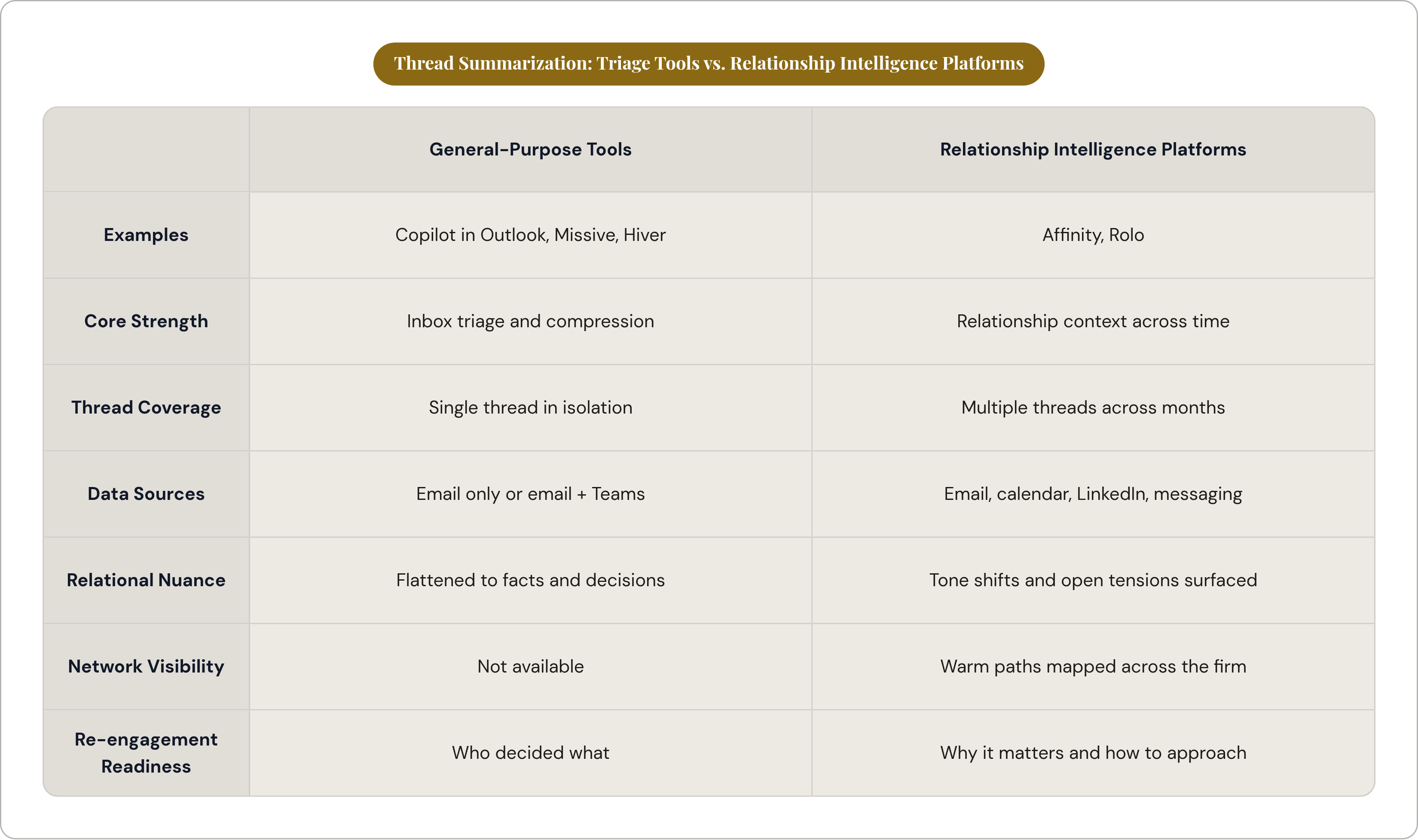
Most tools on the market now share a baseline: thread compression, decision extraction, action items pulled out automatically. Genuinely useful for inbox triage. Not sufficient for relationship intelligence, and the two get conflated more often than they should.
The differentiating capability is understanding who said what to whom, and why it matters, instead of stopping at the factual content and calling the job finished. A few things separate the tools that go deeper.
Context across threads matters more than context within one thread; the real value comes from seeing how a relationship evolved over multiple conversations across months, not summarizing the most recent exchange in isolation. Integration breadth matters too. Tools drawing on calendar data, LinkedIn activity, and messaging context alongside email produce a noticeably richer picture than anything built on email alone. Draft generation paired with the summary is another differentiator worth watching for; responding fast from full context beats reading fast and then staring at a blank reply box. And permissioned access controls matter enormously in a firm setting, because a summary of one partner's relationship thread shouldn't be visible to every other user by default just because the summarization layer exists.
General-purpose tools, Microsoft Copilot inside Outlook, Missive, Hiver, and others, handle the triage layer competently. Relationship-intelligence platforms built specifically for this problem go a step further, connecting thread summaries to a broader network graph, so the output captures not just what was said but who the warm path actually runs through. Rolo sits in that category: it connects email, calendar, LinkedIn, and messaging into one relationship memory layer, so thread-level context surfaces alongside network signals, who at the firm already knows this counterparty, how recently, how warmly, without exposing the private content of one person's inbox to the whole team.
The practical test cuts through most of the marketing noise fairly quickly. Can someone who wasn't on the original thread read the summary and come away with enough to re-engage the counterparty credibly? Or do they just get a bullet list of what was decided, with none of the texture that would let them sound like they actually know this person?
The data privacy requirements that make or break deployment in regulated environments
Data privacy is a leading concern for organizations rolling out AI tools, and in private equity, venture capital, banking, and law, the bar for what counts as adequate protection sits considerably higher than in most industries. That's not excess caution. It reflects what's actually in the data.
Here's the specific risk with email summarization in these environments: the input is often among the most sensitive material a firm holds, deal correspondence, LP communications, live negotiation threads, and any ambiguity about how a vendor's model processes, stores, or trains on that data is disqualifying before the conversation even reaches features. Affinity's 2025 research found 76% of VC investors report using AI to automate daily tasks, up from 62% the year prior, and that adoption curve is outrunning a lot of firms' governance frameworks. Tools are getting adopted faster than the policies meant to govern them are getting written.
So what should a firm check before signing anything? Where is the summary actually generated, and does the provider store or train on the input data passing through it? Can the system enforce access controls per user or per mailbox, so relationship context doesn't leak across the firm to people who have no business seeing it? Can the firm produce an audit log tracing what the model processed and when? And does the vendor actually disclose how the summary was produced, rather than handing over the output and calling the process a black box?
The regulatory backdrop is tightening while adoption accelerates, which is its own kind of pressure. The EU AI Act came into full force in August 2025. California's AB 2013 takes effect January 1, 2026. Firms putting AI on top of sensitive correspondence need to know where their vendors stand against these frameworks now, before deployment, not after a regulator asks the question for them.
The design principle underneath all of this is that individual relationship context has to stay private even while institutional relationship signals get made collectively useful. Permissioned sharing rather than broadcast access. Sounds like a small distinction on paper. In practice, it's most of the ballgame.
Making thread summarization work as relationship memory in practice
Here's the mindset shift that actually matters: use summarization before re-engaging, not just after receiving something new. Pulling context ahead of a call or a piece of outreach is where the tool earns its keep. Reading a summary of something that already happened is nice enough, but it's not where the leverage sits.
What does that look like day to day? Pull the last three to five threads with a counterparty before reaching out again. Look specifically for what was left open, what posture the counterparty held in their last message, and any commitment made but never followed up on. Then draft outreach that actually acknowledges where the relationship stands, not a generic reintroduction that could have been sent to anyone.
For teams and firms, the practice worth building is structuring thread summaries into shared relationship records whenever a deal or introduction hits a meaningful milestone. Treat it as institutional memory that survives whoever leaves the firm next, rather than CRM data entry that nobody enjoys doing and most people skip anyway.
One principle worth holding onto: AI should draft and surface. The professional who's actually read the summary and understands the relational context is the one who decides what to say and when to say it. That judgment doesn't get automated away, and honestly, it shouldn't.
Where does the value actually compound? Over time, a firm that systematically recovers thread-level relationship context ends up with a searchable picture of its entire network: who knows whom, how each relationship evolved, where warm paths already exist that no single partner could ever see alone. The firms building that infrastructure now save people reading time today, and they build an institutional memory that most competitors are still losing, one departure and one abandoned inbox at a time.