Differential Privacy Applications in Professional Contact Graphs
Differential privacy can protect relationship data.
If you know a venture investor's calendar entry from three years ago, naming a specific board meeting with a specific portfolio company, you have enough to reconstruct a relationship most people would assume stays private. Professional contact graphs built from firm email, calendar, CRM, and meeting records hold exactly this kind of latent value, but any statistics pulled from them can be worked backward to reveal whose relationships they describe. That reversal is the problem this piece maps, along with the question of whether differential privacy can actually solve it for graph-shaped data rather than just the tables it was first built for.
Why professional contact graphs create a re-identification problem
If you strip the names off a spreadsheet, the rows mostly stay rows. But combine edge structure with even thin node attributes (a title, an office location, a deal sector), and an adversary has enough to work backward from pattern to person.
This is not a new worry invented for the age of CRM platforms and relationship-intelligence software. In a 2009 paper for the IEEE Symposium on Security and Privacy, Narayanan and Shmatikov showed that social graphs could be de-anonymized even after names and identifiers had been stripped out, simply by matching structural patterns against outside information an attacker already had. That result still stands as the clearest demonstration that scrubbing a graph of labels does not scrub it of identity.
For a professional contact graph specifically, the threat is not abstract. The graph does the remaining work for them, because professional networks cluster: people who meet with the same partner tend to know each other too, and that clustering is precisely the signal that lets an outsider fill in gaps.
Graph neural networks raise the stakes further. A firm publishing "we have strong coverage in fintech" as a single summary statistic may be disclosing more about specific relationships than that sentence appears to contain.
What makes this different from a conventional data-release problem is structural. Anonymization built for spreadsheets was never built to survive contact with a network.
What differential privacy guarantees for graph data
Differential privacy answers a narrower, more precise question than "is this data anonymous." It asks whether the output of some computation would look meaningfully different if any single person's data were removed from the input. If the answer is no, that person's presence, relationships, and attributes cannot be reliably inferred from what gets published, no matter what an adversary already knows going in.
Calibrated noise is the mechanism behind that guarantee. How much noise gets added is governed by a parameter usually written as epsilon, which is best understood as a dial rather than a formula: turn it down and privacy protection gets stronger but the output gets noisier and less precise; turn it up and the output sharpens but the protection weakens.
What keeps DP ahead of anonymization and aggregation as a practical standard is that its guarantee holds up against an adversary who already knows almost everything except the one fact being protected. DP's guarantee does not depend on what the adversary does not know.
So DP does not drop cleanly onto graph data the way it drops onto a table of transactions. Graphs do not, and that ambiguity is where the next layer of difficulty starts.
Edge-level versus node-level protection in graph DP
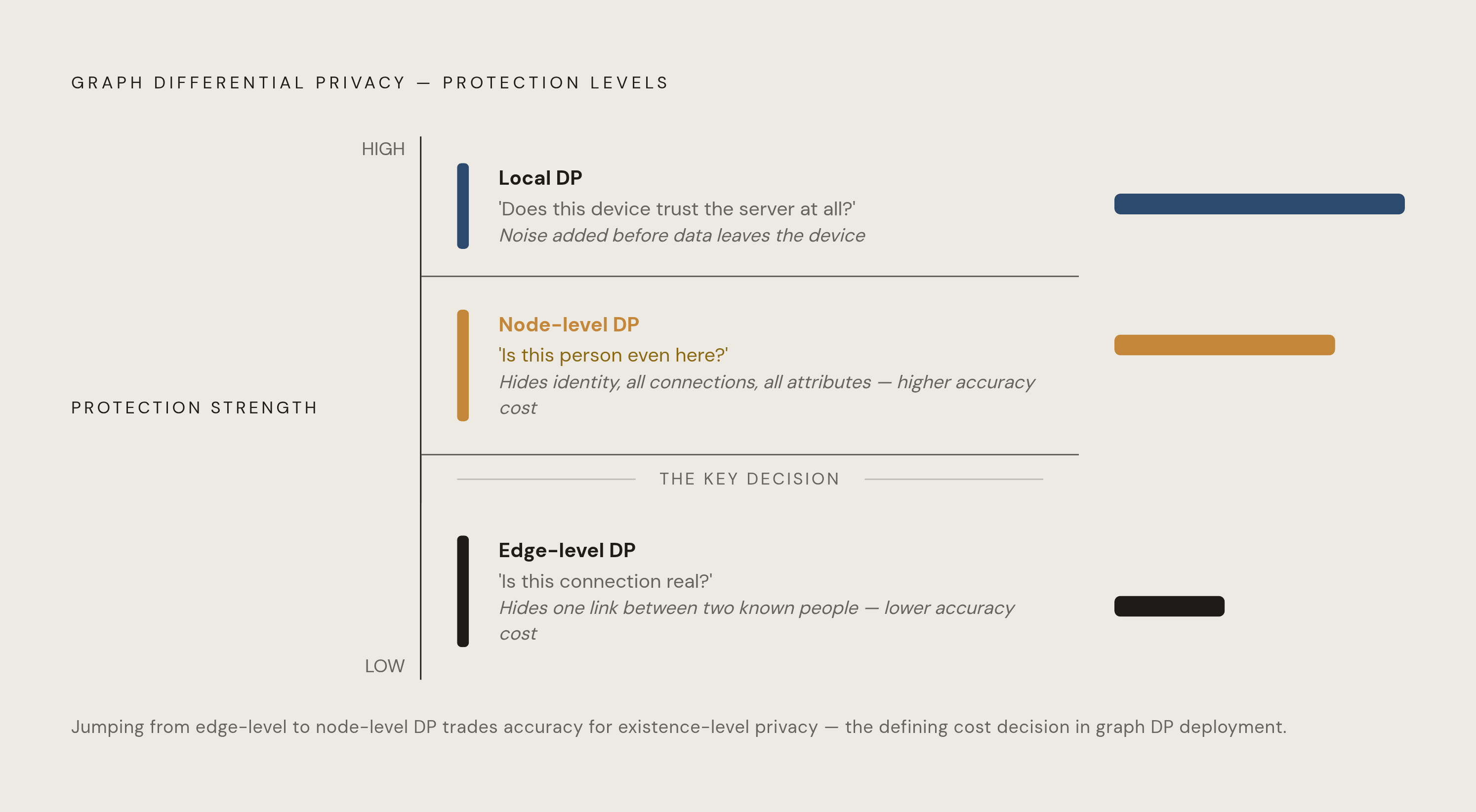
Before a firm can apply DP to a contact graph, someone has to decide what, exactly, is being protected, and that decision has no equivalent in tabular data. These are not two flavors of the same guarantee. They produce very different levels of protection and very different costs in accuracy.
Edge-level DP conceals whether a specific relationship exists between two known people. Edge-level protection is built for exactly that question: the identities of both parties are already known or assumed, and what stays hidden is the connection between them.
Node-level DP is a stronger and harder guarantee. For a professional contact graph, that is often more sensitive, because a person's mere participation in a firm's relationship map can itself be confidential information, regardless of who they happen to know.
Research is still catching up to that cost. A 2025 framework called N2E, built by Hu, Ding, and Dong at Nanyang Technological University, proposes a way to reduce node-level DP problems to edge-level DP problems, letting existing edge-DP mechanisms be reused rather than rebuilt from scratch for the harder node case. N2E introduces a distance-preserving clipping mechanism and what its authors describe as the first node-DP mechanism for approximating maximum degree, and reports meaningful error reductions on tasks like edge counting and degree distribution estimation compared to earlier approaches. This is progress on a frontier that a firm cannot yet simply install as a settled method.
For a firm deciding how to apply this in practice, the two levels map onto two different institutional needs. So a firm needs node-level DP when it cannot even reveal whose relationship data was included in an analysis in the first place.
A further variant pushes the trust boundary even closer to the individual. With local differential privacy, noise gets added before data ever leaves a person's own device or account, so no central system, not even the firm's own servers, ever sees the unprotected relationship data. For firms where employees should not have to expose their contact history even to an internal platform, that architectural distinction matters as much as the choice between edge and node level.
Choosing a protection level is only half the problem, though. Once that choice is made, the noise required to deliver on it has to land somewhere in the graph, and it does not land evenly.
How DP noise degrades relationship signals
Noise calibrated for privacy does not spread across a network the way rain spreads across a field. It pools in specific places, and those places tend to be exactly the parts of a professional graph a firm cares most about discovering: junior staff, regional offices, specialists in emerging sectors, and contacts that were only recently added.
Sensitivity is the mechanism behind that pattern. DP noise is calibrated to how much a single record could possibly change the output, and in a graph that sensitivity tends to scale with node degree.
Fioretto, Sen, and Ziani, writing for AISTATS 2025, show this is not a hypothetical concern but a measurable one: DP techniques distribute privacy-induced bias unevenly across different populations within a network, producing a real fairness problem in who gets accurate output and who does not.
The picture is not uniformly bleak, though, and that matters for how practitioners should actually weigh this risk. Work from 2026 finds that for some analytics tasks, the noise added for privacy is small next to other sources of error such as sampling variation and model misspecification, so data curators can still deliver genuinely useful insight while protecting privacy, and you should not assume DP noise is automatically the dominant source of inaccuracy in every case.
What follows from both findings together is a testing obligation, not a verdict against DP. So you need to test where, specifically, utility loss is sharpest in a given graph before you lean on DP output to drive relationship decisions. One might ask: if a vendor cannot point to where its own system degrades, has it actually tested it against real structure, or only against an average?
Dynamic professional graphs introduce a second privacy problem: accumulating privacy cost across updates
Everything discussed so far treats the graph as if it sat still long enough to analyze once. Professional contact graphs do not sit still. New meetings get logged daily, email threads open and close, and the relationship map a firm holds today is already slightly different from the one it held yesterday. In a DP system, every update that touches a historical edge again adds to the cumulative privacy cost paid against that edge, so a graph that looked well-protected at a single moment can end up over-exposed after enough repeated inference cycles.
Why does this happen? Standard DP accounting is built around the assumption of a fixed dataset analyzed once. Dynamic graphs break that assumption outright, because model updates keep re-touching the same edges over and over, and the privacy loss accumulates with every additional pass.
One response to this comes from PriDyG, which pairs a graph neural network branch, learning from structure under edge-level DP, with a separate branch that reasons from node text attributes alone using a language model and incurs no additional edge-level privacy cost. PriDyG is best read as one principled example of how to keep privacy cost from accumulating across updates.
This remains an open research question rather than solved engineering. Firms running DP on a live, continuously updated contact graph, whether that means re-ranking contacts daily or scoring relationship warmth on every new email, should treat cumulative privacy accounting as a core design requirement from the start, not something bolted on after a system already ships. A system that looks compliant on its first day of operation can look very different after a full quarter of continuous updates.
Even with noise calibrated and privacy cost tracked across updates, a firm must still find a way to let a team benefit from collective relationship knowledge without handing any one person's private contacts to everyone else.
The architectural principle that makes collective relationship intelligence compatible with individual privacy
Most relationship systems built before DP became practical conflated two things that are actually separable: a person's private relationship context (who they know, in what setting, with what history) and the institutional signal that context produces (this target company has a warm path into it somewhere inside the firm). Only the second one needs to travel beyond the individual who holds the first.
Without that separation, surfacing something as simple as "we have a warm path to Company X" necessarily reveals whose relationship that path runs through, which creates a real compliance problem in any regulated environment and gives individual partners a direct incentive not to contribute their contact data to a shared system in the first place.
DP gives a firm a way to compute and share that aggregate signal, a warm path exists, while formally bounding how much any single relationship can contribute to what gets revealed, limiting what anyone downstream can infer about one specific person's connections.
That bound is necessary but not sufficient on its own. The complementary piece is permission-aware architecture: even where DP is applied correctly, the underlying relationship data should stay access-controlled, so an individual can still see their own contacts in full while the broader system only ever surfaces aggregated, privacy-protected signals at the firm level. Rolo applies a comparable principle to relationship data specifically, letting individual users retain full visibility into their own contacts while the system surfaces only firm-level signals, rather than raw connection data, to the wider team, an architecture that treats DP's mathematical bound and access control as two parts of one design, not substitutes for each other.
Any such system should be able to answer "does our firm have a warm path to this target company?" without answering the follow-up question of whose private email thread that path runs through. DP supplies the formal, mathematical bound on what can be inferred; permissioned architecture supplies the access control on what can be seen directly. A system needs both, because one without the other leaves either a mathematical gap or an institutional trust gap.
Verifying DP outputs from a professional contact graph system
A vendor's claim to use differential privacy is only as solid as three things: how specifically its privacy definition is stated, how honestly its utility trade-offs are described, and how firm its permission controls actually are. A DP claim on a professional contact graph system is only as trustworthy as the specificity of its privacy definition, the honesty of its utility characterization, and the firmness of its permission controls, and most vendor implementations leave at least one of these underspecified.
Check which level of DP is actually applied.
The second thing to check is what epsilon value is in use, and over what scope. Ask how cumulative privacy cost gets tracked across repeated updates.
The third thing to check is where utility degrades in this specific graph. Fioretto and coauthors' 2025 findings establish that degradation concentrates in sparse subgraphs, so a vendor should be able to point to where in a firm's own network accuracy loss runs highest, rather than offering a single aggregate accuracy figure that averages dense, well-connected regions together with thin, peripheral ones.
The fourth thing to check is whether the system acts on its own or only recommends. A relationship intelligence system that drafts outreach, routes introductions, or enriches CRM records autonomously is held to a higher bar than one that surfaces signals for a human to act on, and the D'Silva, Nepal, and Kanhere systematization paper explicitly identifies misleading protection claims as a practitioner risk.
The fifth thing to check is what compliance certifications actually exist, and what they actually cover. SOC 2 Type II, for instance, covers access controls, but it does not require disclosure of whether agent-initiated writes require human confirmation before they take effect, so practitioners in regulated environments should treat certifications as a baseline. A certification is a reasonable floor to require. It is not a substitute for asking, in plain terms, what the system does when it is wrong.
Sources
- SoK: Practical Aspects of Releasing Differentially Private Graphs | Proceedings of the ACM Asia Conference on Computer and Communications Security
- N2E: A General Framework to Reduce Node-Differential Privacy to Edge-Differential Privacy for Graph Analytics
- SoK: Practical Aspects of Releasing Differentially Private Graphs
- Practical and Accurate Local Edge Differentially Private Graph Algorithms
- Differentially Private Graph Data Release: Inefficiencies & Unfairness
- PriDyG: Privacy-preserving Dynamic Graph Inference with LLM-GNN Collaboration