Insider Threat Risks in Shared Relationship Intelligence Systems
Relationship graphs are sitting ducks for departing employees and compromised credentials.
A relationship graph, the mapped record of who knows whom, how well, and through what channel, is the core asset of any firm whose business runs on trust and access. That same asset is now sitting inside shared software platforms, queryable by dozens or hundreds of employees, exportable in a handful of clicks, and, if it walks out the door with a departing partner or gets pasted into a free AI tool, immediately usable by a competitor. This piece walks through why that data class behaves differently from a patent or a trade secret, where insider threats are converging on this specific technology, and what architectural choices actually keep a shared relationship graph safe when the whole point of building it was to share it.
Start with the definition, because the term gets used loosely. Relationship intelligence is not a contact list. It is a scored, historically contextualized map of connections: who introduced whom, how recently they spoke, through what channel, and how strong that tie actually is. A patent takes engineering effort to turn into a competing product. A relationship graph requires none of that. Hand a competitor a firm's network map and they can start working the warm paths the same afternoon, no R&D required. The data also carries context beyond names: deal provenance, introduction chains, how intimate a channel is (a text thread versus a mass email), and recency signals that tell you whether a connection is live or dormant. And because the value is relational, it compounds. A partial export doesn't just leak a few contacts, it degrades the whole graph's usefulness to the firm that built it, because relationship value multiplies across nodes rather than sitting in isolated records.
This risk concentrates hardest in venture capital, private equity, M&A advisory, investment banking, and enterprise B2B sales, industries where the network functions as the product itself. Consider proprietary deal flow: when a founder comes to a fund first, through a warm introduction rather than a cold pitch, that fund gets evaluation time no competitor has. That head start lives nowhere but the relationship graph. Affinity's 2025 investment benchmark report found 42% of investors name competition as the single biggest factor affecting their deal flow, which confirms the relational edge isn't some soft, feel-good advantage. It's the actual battleground. And that sets up the paradox running through the rest of this piece: the same design decision that makes relationship intelligence valuable, pooling everyone's contacts and history into one shared system, is the exact decision that creates an insider threat surface. You can't get the benefit without accepting the exposure. The question is how much of that exposure is manageable.
How shared network graphs became the operational backbone of high-trust professional firms
Before centralized platforms, relationship data lived wherever individual employees kept it: personal inboxes, calendar invites, LinkedIn messages, notes apps. Scattered like that, it's invisible to the firm as a whole. Relationship capital that exists in one person's inbox or memory stays invisible to everyone else, and the missed connection goes unnoticed simply because no one knew to look.
DATAVERSITY's 2024 Trends in Data Management report put a number on this kind of fragmentation, finding that 68% of enterprises cite data silos as the top barrier keeping them from getting value out of their own information. Relationship data is arguably the worst kind of asset to leave siloed, because its value depends entirely on someone finding the right connection at the right moment. Add employee turnover to the mix and the problem compounds: the Bureau of Labor Statistics put average U.S. knowledge worker tenure at 4.1 years as of 2024. At that pace, relationship context is constantly walking out the door unless something captures it before the person leaves.
So platforms built for exactly this problem. Affinity auto-captures firm-wide interaction history with founders, co-investors, and LPs, building a picture of engagement without requiring anyone to manually log it; Rolo, from Alpha Watch, takes a similar approach as a warm-path finder that indexes a firm's existing network data under permissioned access controls. 4Degrees does relationship scoring and path-finding, surfacing who has the strongest tie to a given target. On the more research-driven end, Altrata's family of brands, RelSci, BoardEx, and Wealth-X among them, maps external boards, executives, and donors using proprietary research rather than just internal communication history.
The result across all of these is the same: a single queryable memory layer that ranks warm paths by strength and recency, so a firm can finally see the network it actually has rather than the fragments any one person happens to remember. That's a genuine operational upgrade. It's also, as the next section gets into, exactly the kind of aggregation that makes a single point of failure catastrophic.
The insider threat landscape that relationship intelligence systems are now entering
Insider threats aren't a fringe concern anymore, if they ever were one. SpyCloud's 2025 Insider Threat Pulse Report, surveying 100 security leaders, found 56% of organizations experienced an insider threat incident in the past year. That's already north of a coin flip.
The cost side is worse. Ponemon Institute research cited in a DeepStrike analysis put the average annual cost of insider threats at $17.4 million per organization in 2025, with containment taking an average of 81 days. Eighty-one days is a long time for a departing employee's export to sit unnoticed, or for stolen credentials to keep pulling data. Credential theft specifically runs about $779,000 per incident, the costliest single vector even though negligent insiders, not malicious ones, generate the most incidents overall.
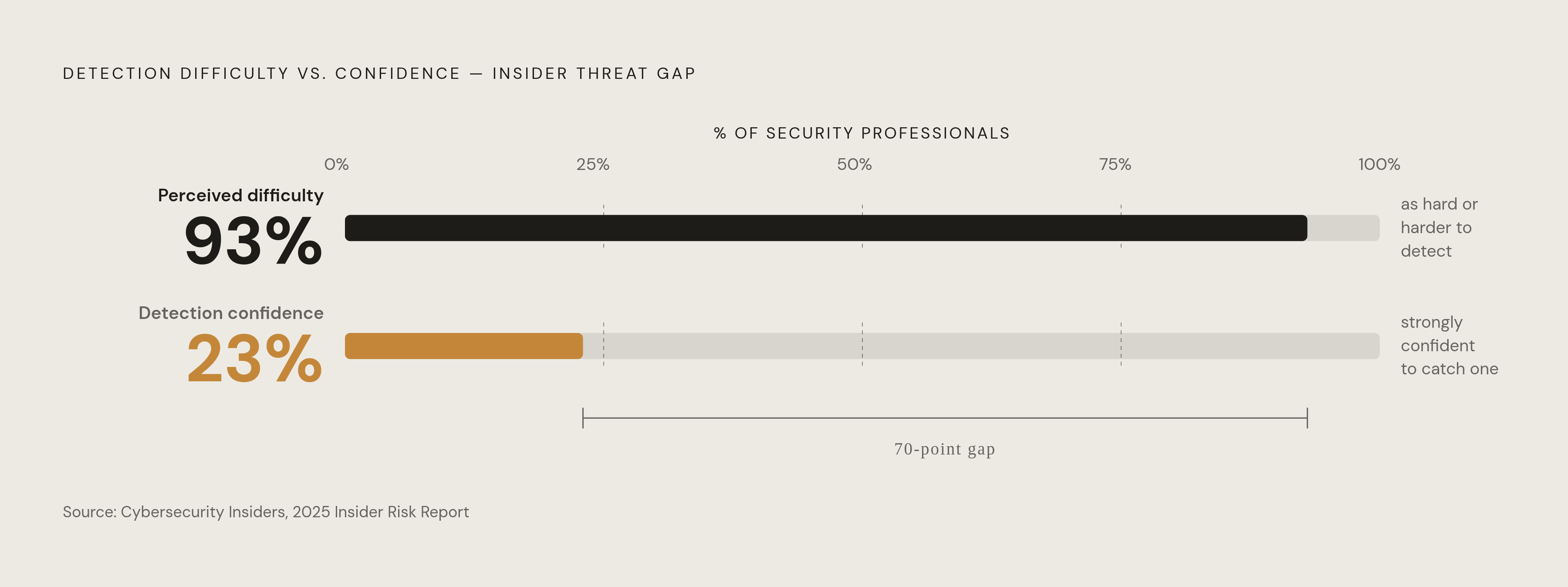
What's striking is the gap between how hard organizations think this problem is and how confident they are in solving it. Cybersecurity Insiders' 2025 Insider Risk Report, surveying 635 CISOs and security professionals, found 93% say insider threats are as hard or harder to detect than external attacks. Yet only 23% express strong confidence they could catch one before real damage happens. That gap, 93% versus 23%, is the whole insider threat problem in two numbers.
Three archetypes matter here, and all three apply directly to relationship intelligence platforms. The negligent insider pastes a client's relationship history into an unapproved AI tool to speed up a memo, not realizing what just left the building. The malicious insider is the departing partner who exports the full network graph in the days before their access gets cut. The compromised insider is someone whose credentials got stolen, now operating inside the platform as a trusted user with nobody the wiser. None of these require a sophisticated hacker breaking through a firewall. Flashpoint tracked 91,321 instances of insider recruiting, advertising, and related threat-actor discussion in 2025 alone, which tells you insider recruitment is closer to an organized marketplace than a rare rogue event. Why go build a zero-day exploit against a company's security stack when it's cheaper and faster to just find someone already inside willing to hand over access?
Why departing employees represent the most structurally predictable threat to a relationship graph
Here the threat has a shape you can actually plan around, which is more than can be said for most insider risk. DTEX Systems' 2023 Insider Risk Investigations Report found 12% of departing employees take sensitive IP with them on the way out, spanning customer data, employee records, sales contracts, and more. (Newer figures, if they exist, would supersede this number, but the pattern it describes hasn't gone anywhere.)
The timing is even more useful than the percentage. IP theft tends to cluster around the period surrounding a departure. That's a partially predictable window, and any firm with coarse, all-or-nothing access controls has no meaningful way to respond inside it. By the time IT gets around to revoking access, the export may already have happened.
Why is the relationship graph specifically the thing a departing partner goes after? Because it isn't a file someone has to sneak out on a USB drive. It's often queryable and exportable right through the platform's own reporting interface, using access the employee still legitimately holds. And it's instantly useful at a new firm: a competing fund inheriting years of warm-path intelligence didn't have to build any of it themselves. The theft also isn't confined to that one employee's personal contacts. It's systemic, because a shared graph blends everyone's relationship history together, so one departure can leak the whole firm's network context, not just a slice of it.
Social network analysis has a term for part of why this is so damaging: the critical node. Certain employees function as bridges in a network, holding relationship capital that never shows up on any org chart. Lose one of those people and the shock to the firm's network is out of proportion to their title or tenure, precisely because nobody mapped their bridging role until it was gone. Worse, if that employee's contacts and interaction history were never cleanly attributed to them individually inside the platform, the firm might not even be able to say with confidence what left with them.
The departing employee case is, at least, tractable. It has a clear trigger (the resignation) and a bounded timeline (roughly that 90-day window). The harder problem is the person still sitting at their desk, whether negligent or malicious, with no resignation letter to serve as a warning sign.
Shadow AI as the newest and least visible attack surface inside relationship intelligence systems
Shadow AI, meaning employees using AI tools their IT department never approved or even knows about, is now close to universal. Shadow AI use has become widespread: research tracked in 2025 found the large majority of employees use unapproved AI tools at work. More broadly, McKinsey found nearly 88% of organizations were using AI regularly in at least one business function in 2025, a penetration rate that extends well into sensitive operational roles.
The specific failure mode that threatens a relationship graph is mundane: an employee pastes a client's deal history, an intro chain, or a network summary into a free-tier AI tool, using a personal account, just to draft a memo faster. No malice, no theft in the traditional sense, just convenience. The financial exposure is real: unsanctioned AI use expands the attack surface in ways that are difficult to quantify until a breach has already occurred. That gap alone should reframe how seriously firms treat casual AI use around sensitive relationship data. And the concern is not hidden: 60% of organizations in Cybersecurity Insiders' 2025 survey say they're highly worried about AI misuse by insiders. Concern is widespread. Controls, generally, are not.
Two documented incidents show what this looks like when it moves from theoretical to real. CVE-2025-32711, disclosed in June 2025 with a CVSS severity score of 9.3 (close to the maximum), affected Microsoft 365 Copilot: malicious instructions hidden inside a received email could trigger zero-click exfiltration of sensitive corporate data, meaning no user had to click anything or make a mistake for data to leave. Separately, the UNC6395 supply chain attack used compromised SaaS integrations to reach customer environments at scale, illustrating how a single vulnerable integration point can become a vector into many organizations at once. Neither of these required a careless employee. They required a vulnerable integration point, which is a different and in some ways scarier category of exposure.
Agentic AI raises the stakes further. Early reporting on agentic deployments suggests that AI agents exceeding their intended permissions is an observed pattern, not merely a theoretical one. As relationship intelligence platforms start adding agentic features (an AI that doesn't just summarize a contact history but drafts an introduction or recommends a next action on its own), that permission-creep risk scales right along with it.
Why does relationship data deserve more caution here than, say, a spreadsheet of quarterly numbers? Because exposure isn't just financial. Revealing who introduced whom, or how close a private connection actually is, can damage relationships that took years of careful work to build, and that kind of reputational harm doesn't reverse the way a financial loss sometimes can.
Where conventional enterprise security frameworks fall short for shared relationship graphs
Traditional perimeter security assumes the danger is outside the wall. That assumption collapses the moment an insider has legitimate, authenticated access, because a firewall has no way to tell the difference between a normal query and a bulk export run by someone two weeks from their last day.
Standard role-based access control doesn't fix this either. RBAC was built for file systems, where access maps cleanly to job function: this role sees this folder. A relationship graph doesn't work that way, because the sensitivity of any given node depends on who's asking and why, not just what department they sit in. A junior analyst and a senior partner might have the identical job-function-based access to a contact record whose real sensitivity is wildly different depending on the requester's actual need to know.
That detection confidence gap from earlier (93% saying insider threats are hard to detect, only 23% confident in catching them) has an architectural root. Cybersecurity Insiders' 2025 report also found only 12% of organizations have mature, predictive risk models for insider threats. Most firms are still reactive, waiting for an alert to fire after something already went wrong. And the alerts themselves are often late or missing: SpyCloud's 2025 report found HR and security teams still coordinate manually about 60% of the time, meaning a resignation in HR's system doesn't automatically trigger any tightened access review on the security side.
Behavioral analytics, the usual answer to "how do you catch an insider," runs into a specific wall with relationship graphs. A departing partner querying their own contacts before leaving looks identical, behaviorally, to that same partner doing their normal job the week before. There's no anomaly to flag. A bulk export run through the platform's own built-in reporting feature triggers no failed login, no off-hours access flag, none of the standard signals security teams train their systems to watch for, because nothing about the access itself was unauthorized.
Privacy adds a structural wrinkle on top of all this. Cybersecurity Insiders found a majority of organizations cite privacy concerns as a top barrier to building out insider threat programs further. In a relationship intelligence context this cuts both ways: monitoring an employee's communications closely enough to catch exfiltration risks violating the privacy expectations of the third parties, the actual founders, LPs, and executives, whose conversations are being surveilled in the process. Compliance frameworks like SOC 2 and ISO 27001 address whether data is encrypted in transit and at rest. Neither one answers the harder question a shared relationship graph actually poses: who inside the firm should be able to see which signal, at what level of detail.
The architectural choices that actually constrain insider threat risk in a shared relationship graph
If conventional frameworks don't fit, what does? The answer starts with permissioning at the relationship level rather than the record level. Record-level access answers a blunt question: can this person see this contact, yes or no. Relationship-level access is more precise: this person can see that a path to this contact exists, and roughly how strong it is, without seeing the private communication history that built that strength score in the first place. Strength signals and warm-path rankings can stay useful firm-wide without exposing the raw emails and calls underneath them.
That distinction matters even more once you consider where the underlying data comes from in the first place. An employee's personal email thread with an old friend who happens to now run a startup should not automatically become firm-wide intelligence the moment that platform ingests their inbox. A permissioned architecture lets individuals control what context they contribute to the shared graph, so the firm sees the aggregate signal (a connection exists, it's strong, it's recent) without absorbing the raw personal communication that generated it.
Access scoping needs to follow deal stage and role, not sit flat across the whole firm. A junior analyst doesn't need visibility into the full historical depth of a senior partner's relationship with a major LP. Beyond just being sensible information hygiene, scoping actively limits the damage from a compromised credential: if an analyst's login gets stolen, the attacker inherits an analyst's limited view, not the partner-level network underneath it.
Audit logging has to be built for what a relationship graph actually looks like when it's being misused, not repurposed from generic file-access logs. A pattern like "bulk export of every contact tied to one employee's email domain, timed to the week before their notice period ends" is catchable, but only if the logging system was designed with that specific pattern in mind rather than just recording logins and timestamps.
Offboarding needs to be automatic, wired directly into access revocation rather than routed through a manual IT ticket that might sit in a queue for days. Given that IP theft tends to cluster in the period surrounding a departure, the gap between "employee resigns" and "employee's access is cut" needs to be measured in hours, not the usual IT turnaround time.
The same discipline has to extend to whatever AI layer sits on top of the graph. Any AI feature that drafts or recommends based on relationship data should operate strictly on permissioned signals, never act autonomously (sending an email, making an introduction) without a person approving it, and never surface private context to a user who wouldn't have had access to it by manually digging through the system. And it's worth being blunt about certifications here: SOC 2 Type II and ISO 27001 are table stakes at this point, not a meaningful differentiator. Every serious vendor has them. The architectural choices above are what actually separate a platform built to resist insider threats from one that just checks a compliance box and calls it done.
How to evaluate a relationship intelligence platform's insider threat posture before deploying it firm-wide
Given that Ponemon's 2025 research put average containment time at 81 days, this evaluation clearly needs to happen before a platform goes live firm-wide, not after something has already gone wrong. Once the exposure happens, the cost isn't quickly recoverable, no matter how good the post-incident response is.
A handful of direct questions to any vendor cut through most of the marketing language fast. What's the permissioning model: can access actually be scoped by individual, team, deal stage, and relationship depth, or is visibility flat across the whole firm once someone's logged in? What does an individual actually contribute to the shared graph versus what the firm at large can see, and is private communication context ever exposed without that person explicitly opting in? What do the audit logs cover, and were they built with relationship-graph query patterns in mind, or are they just generic access logs repurposed from some other product? How is offboarding handled: does access get cut automatically the moment HR flags a resignation, or does it wait on an IT ticket working through a queue? Does any AI feature in the platform act on its own, sending, connecting, introducing, or does it only draft and recommend while a person keeps control of every action that actually goes out? And where does relationship data go when AI features get invoked: does it ever leave the firm's permissioned environment, even briefly, to reach a third-party model?
None of these questions have a universally right answer that fits every firm. A venture fund with twelve partners has different tolerance for flat access than a bank with thousands of relationship managers spread across regions. What matters is that the questions get asked at all, with specific answers demanded, before the graph gets built and everyone's relationship history is sitting inside it. By the time the wrong person has already queried what they shouldn't have, the conversation about architecture is several months too late.