Email Bounce Rates as a CRM Health Signal
Stale contact records break email deliverability and derail deals before anyone notices.

A hard bounce on a named contact is rarely about email deliverability. It is a signal that a relationship has gone dark somewhere inside a firm's CRM, and almost nobody notices until the bounce report forces the issue.
Email Bounce Rates as a Measure of Contact Data Health
Most professionals who watch a bounce rate climb reach for the obvious fix: check the subject line, check the sending domain, check whether the email landed in spam. That instinct treats the bounce as a campaign problem, something to patch before the next send goes out. But a bounce on a named contact in a CRM is really evidence that a person left a job, a domain got retired, or an organization restructured, and nobody inside the firm has updated the record to reflect it. The email failed because the relationship it represented had already changed.
The distinction between a hard bounce and a soft bounce matters here, not as a technical footnote but as the starting point for reading bounce data correctly. A hard bounce is a permanent failure: the address no longer exists, or the domain behind it is dead. Internet service providers treat this as a sign that the sender is working from a poorly maintained list. A soft bounce is temporary: a full inbox, a brief server outage, a momentary block that clears on its own. DeBounce's 2026 guide on bounce rate benchmarks makes the operational point directly: firms should never manage the blended total alone, and should split hard from soft every time a report runs, because a combined number that looks fine can hide a hard bounce rate that has already crossed into dangerous territory. That split is what turns a deliverability number into something diagnostic. Once hard bounces are isolated, each one is no longer a line in a campaign report but a dated, verifiable fact about a specific relationship: this contact, at this address, is gone.
Contact Data Decay and the Relationship Graph
Contact data does not decay in dramatic bursts. It erodes steadily, in the background, at a pace fast enough that a database left untouched for even a year or two loses a real share of its valid addresses purely through ordinary turnover, people changing jobs, companies changing domains, titles changing hands. No single event causes this. It is simply what happens when humans keep moving and records do not move with them.
That decay is not spread evenly across a contact database, either. Business email addresses tend to decay faster than job titles or phone numbers, because a person's professional email is retired the moment they leave a company, often within days of their last day. Oddly enough, executives and senior decision-makers turn over somewhat less often than the broader workforce, but when they do move, the consequences for a firm's deal pipeline are disproportionate: these are the contacts whose relationships carry the most weight, and losing track of one of them costs more than losing track of ten junior contacts combined.
The compounding effect means a CRM that nobody re-verifies on a regular basis is not sitting still, preserved. Every quarter it passes without verification, it grows a little less accurate, and nothing inside the system flags that slippage until an email bounces and reveals the visible edge of decay that has been accumulating quietly for months.
Why the steepest decay maps onto high-stakes relationship environments
Bounce rates vary a good deal by industry, and the variation is not random noise. It tracks directly with how fast an industry's contacts change jobs and how much of its email infrastructure runs through shared, catch-all domains rather than individual verified addresses. If most contacts in a B2B industry hold business email addresses tied to a single employer, address decay moves faster, because employment changes turn into dead inboxes right away.
What stands out is which sectors land at the top of that exposure list: financial services, real estate, and technology consistently show some of the steepest bounce exposure. These are the fields where deals get sourced through relationships first and cold outreach second, where a warm introduction from a trusted contact can move a transaction forward faster than any amount of paid marketing. That is precisely why decay in these sectors costs more than decay elsewhere. In a low-stakes consumer marketing list, a stale contact record just means you wasted an email. But inside a financial services or real estate firm's CRM, a stale contact record severs a link in the exact chain of relationships the firm depends on to find its next deal.
The threshold at which a rising bounce rate starts doing institutional damage
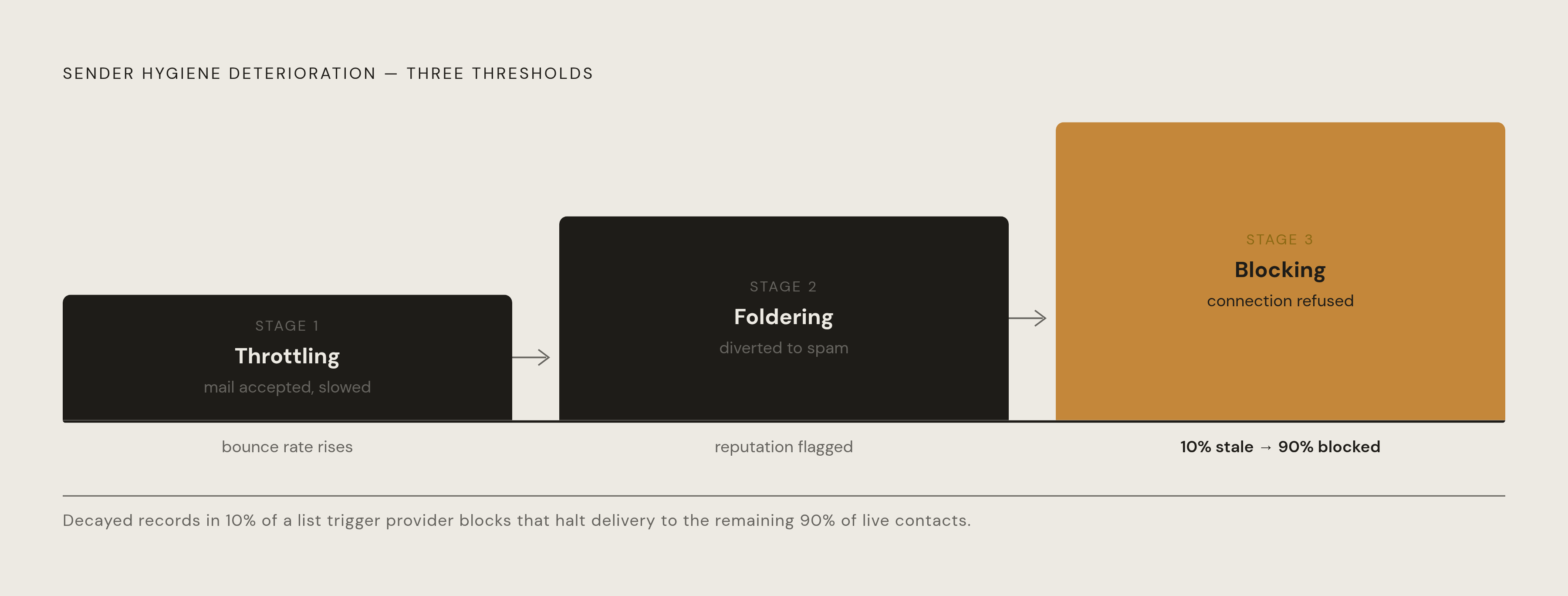
A bounce rate does not become a problem gradually, in a straight line. It crosses thresholds, and past each one, the consequences stop being about the single contact that bounced and start touching every message the firm sends afterward. Tomba's 2026 benchmark guide lays out the progression mailbox providers follow once hygiene starts slipping: first throttling, where mail still gets accepted but more slowly; then foldering, where messages start skipping the inbox and landing in spam instead; then blocking, where the provider stops accepting connections from the sender altogether. This sequence does not happen overnight. It compounds over weeks of accumulating poor hygiene, until a meaningful share of a firm's legitimate outreach simply stops arriving anywhere.
By the time a bounce rate is visibly bad enough to notice, the institutional damage already cuts in both directions: the sender reputation damage caused by it is already bleeding into outreach aimed at contacts whose addresses are completely valid. A firm's stale data, in other words, starts punishing its live relationships too. If ten percent of a contact list has decayed, it can drag down deliverability for the ninety percent that still works. DeBounce's 2026 guide frames the stakes from Google's side: bounce hygiene is not a cleanup task a sender can defer. It sits alongside authentication, unsubscribe compliance, and low spam complaint rates as one of the conditions a sender must meet to keep earning good inbox placement at all. Once a firm crosses that threshold, the cost is no longer confined to the contacts who bounced. It spreads to every relationship the firm is trying to maintain through email.
The Cost of Decayed Contact Data
The costs of decayed contact data rarely appear as a line item labeled "deliverability. They show up as deals that stalled, revenue initiatives that got delayed, and AI tools that quietly misfire because the data feeding them was already out of date before anyone pressed send. Firms report delayed revenue-generating initiatives and lost deals as the primary costs tied to CRM data decay, not penalties on email performance. That ordering matters: the deliverability problem that eventually appears in a bounce report is downstream of a data problem that had already cost the business money before a single email went out.
The AI dimension makes this worse, not better. Most of the CRM data across firms is simply not ready for the AI tools now being layered on top of it, even though most organizations have already started deploying those tools anyway. When an AI-powered outreach or scoring system runs on stale data, the failures are specific and avoidable: it emails people who left their roles months earlier, it ranks accounts by firmographic details that no longer reflect reality, and it drafts personalization that references a prior fiscal year's initiatives as though they were current. None of that is a flaw in the AI model. It is a direct consequence of feeding a live system a dead dataset.
And the silo effect compounds both costs further inside multi-team firms. When relationship data sits fragmented across individuals, inboxes, and disconnected systems, one person's stale contact record stays invisible to every colleague who might otherwise have a live path to that same person. The institutional cost of a bounced email from a senior partner's dormant contact is never just that one failed send. It is the introduction that never got made, because nobody else on the team knew the relationship existed, let alone that it had gone quiet.
Measuring bounce rates as a CRM health signal versus a campaign metric
Reading bounce rates as a relationship-data diagnostic calls for a different measurement habit than the one most firms already run for campaign management. Most firms run the second version instead: they track an aggregate bounce rate across a mailing list to gauge overall list quality at scale. That aggregate view works fine for marketing purposes. It tells almost nothing useful about any single relationship.
The posture a firm needs instead treats a hard bounce on a named contact as a discrete, point-in-time event: a signal that this specific relationship path has gone dark and needs to be verified or rebuilt, independent of whatever the firm's overall bounce rate looks like that month. DeBounce's 2026 guide spells out the mechanics that make this possible: split hard bounces from soft in every report, and classify each one by its SMTP response class, permanent failure versus temporary failure, before deciding whether the problem sits in the list or in the sending infrastructure. That same logic carries over directly when the "list" in question is a CRM full of named professional relationships rather than a marketing database. Each hard bounce deserves to be read individually, not folded into an average.
The frequency of verification matters just as much as the classification does. A contact database checked once, at onboarding, and never touched again will have drifted in a meaningful way within twelve months, given how fast business contact data decays under ordinary turnover. Treating verification as a continuous process rather than a one-time import is what actually converts a bounce rate from a lagging indicator into a leading one. One might argue that continuous re-verification sounds like overhead a busy deal team can't spare. But the alternative, discovering a dead relationship only when an email bounces during an active deal, costs far more than the verification would have.
The warm introduction paths a firm is quietly losing
If your deal flow runs on warm introductions rather than cold outreach, a hard bounce means something sharper than a stale address. It means a node somewhere in the firm's introduction network has gone dark, and the firm found out only by accident. That raises an important question: how many other nodes in that same network have already gone dark without triggering any bounce at all, simply because nobody has emailed them recently enough to find out?
A warm introduction path is only as strong as the contact data behind it. If a system cannot confirm whether a bridging contact's email address still works, it cannot reliably claim that the introduction path through that person still exists, even if the CRM record looks perfectly current on screen. The path can be dead at the infrastructure level while still appearing live in the system of record, and that gap is exactly where a firm's confidence in its own network outruns the network's actual condition.
Not every introduction carries equal weight, either. Introductions that come through portfolio founders, close advisors, or genuine personal connections convert at meaningfully higher rates than introductions sourced any other way. A bounced email to the single highest-value node in that hierarchy is a loss that no volume of cold outreach can replace at anything close to the same cost or speed. Research on weak ties shows that loose acquaintances, not close contacts, are statistically the strongest source of new information and new opportunities. But the further a connection sits from direct, regular contact, the more likely it is that the bridging contact's data has quietly decayed, with no signal reaching the firm that still depends on that path to reach someone further out.
What follows from this is a design requirement, not just an observation. A system that passively stores contact records, however thoroughly, cannot do the job a relationship-driven firm actually needs done. What is needed is a live relationship graph, one that can surface a warm path and confirm that the path is still intact, not merely that it once existed.
Building relationship intelligence infrastructure that treats contact data as a live asset
The right response to all of this is not a more aggressive list-cleaning schedule. Scrubbing a list harder only catches decay after the fact. So the better response is to rebuild the relationship graph itself as something continuously updated and properly permissioned, so that decay signals appear in internal monitoring before they ever reach a bounce report at all.
The architecture that makes this possible connects the systems where professional relationships already live, email, calendar, messaging, and treats recency of interaction as an ongoing signal of relationship health. A contact who has gone quiet for months can be flagged as at-risk before their address ever bounces, rather than discovered only after the fact. Rolo is one example of a platform built around this idea, pulling together email, calendar, LinkedIn, and messaging activity into a single queryable view of a firm's relationships, rather than leaving that context scattered across separate inboxes and personal notes.
Permissioned architecture is the foundation the whole approach depends on, not a nice-to-have feature bolted on afterward. The firms pulling ahead on relationship intelligence tend to be the ones with the most trusted, properly permissioned data, not simply the ones holding the largest volume of contacts, because trust and permissioning are what let AI-assisted tools operate at scale without exposing one team member's private context to another who has no business seeing it. That requirement becomes sharper in firms with multiple teams: a contact sitting siloed in one person's personal inbox or individual CRM login cannot surface the warm path hiding inside a colleague's network, no matter how good that colleague's own data hygiene happens to be. A firm-level relationship graph, one that respects the boundary between personal and institutional data while still making second-degree paths visible across the team, is the structural answer to that silo problem.
The same caution applies to how AI gets layered on top of all this. AI should draft and recommend, not act on its own. The professional stays in control of every message that actually goes out. That is the design principle, not a minor implementation detail, that makes AI-assisted relationship intelligence trustworthy in exactly the high-stakes environments this piece has been describing, where a misjudged introduction or an unauthorized outreach does not just fail quietly. It can damage the very relationship the system was built to protect.