Network Overlap Analysis Across Firm Partners and Principals
Mapping which partners know the same people unlocks deal flow trapped inside individual inboxes.

A firm's most valuable asset does not sit in its CRM or its data room; it sits in the heads and inboxes of individual partners, scattered across years of dinners, cold emails that turned warm, and board seats nobody bothered to log. Network overlap analysis is the practice of mapping where those scattered fragments connect, turning private relationship history into something the whole firm can actually see and use. That distinction, between a network that exists and a network that is visible, is what this piece is about.
A Harvard Business Review analysis of nearly 900 VCs found that over 70% of all deals originate from a firm's existing network. That number should stop you for a second. It means the raw material for most of a firm's pipeline is already sitting inside the firm, not out in the world waiting to be prospected. But "the firm's network" is a fiction if nobody has actually mapped it. In practice, each partner carries a fragment of it around, and those fragments rarely touch. A warm path to a founder might exist through a principal who worked with them at a prior company three years ago, and the managing partner running point on the deal has no idea that connection is sitting one floor away. That is not a reach problem. The firm already knows the person. It is a visibility problem, and it is worth taking seriously as its own category of failure rather than folding it into the general complaint about "sourcing."
What network overlap actually measures and why it's distinct from a contact list
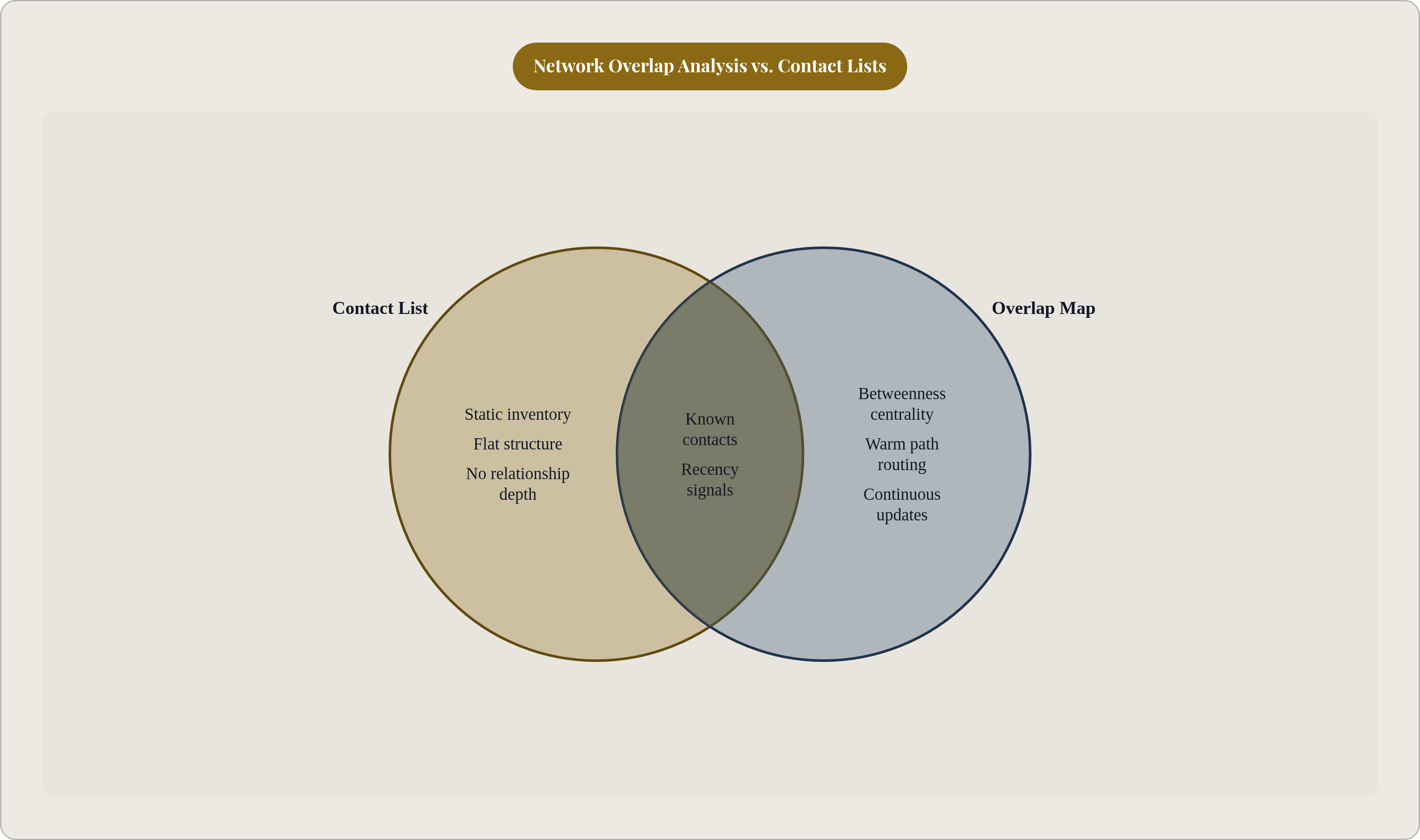
A contact list is flat. It tells you who exists in your orbit, full stop. A network overlap map is a graph, and a graph captures something a list cannot: the relationships between people, not just an inventory of the people themselves.
Overlap analysis tracks a handful of distinct dimensions, and it's worth separating them because they get flattened together in casual conversation. There's the shared connection itself: two partners who both know the same operator or LP, neither aware the other has that tie. There's co-investment history, which is different from a shared contact because it implies an actual working relationship. Two partners who backed the same syndicate carry an implicit trust bond with the same counterparties, and that bond is worth more than a cold LinkedIn connection ever will be. There's recency and depth, which might be the most underrated dimension of all: a contact who exchanged emails with a partner last week is categorically different from one who went quiet two years ago, even though both would show up identically on a static contact list. And there's alumni and institutional overlap. Shared educational or employer backgrounds create a kind of latent credibility that shows up in the data; Garfinkel et al. (2024) documented how shared educational backgrounds actually influence investment decisions and outcomes, which suggests this isn't just a soft, feel-good signal but something with measurable weight.
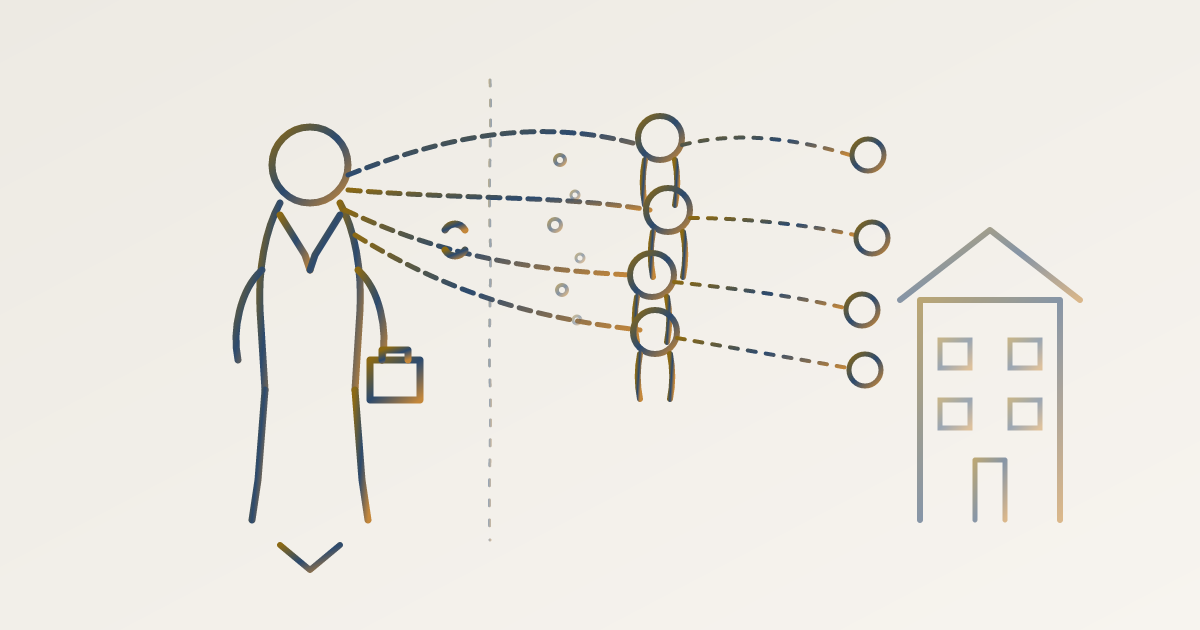
The formal concept underneath a lot of this is betweenness centrality, a term borrowed from network science that measures how much a given person sits between otherwise disconnected clusters. Academic work on VC networks uses it to identify who can act as an intermediary between investors who have no direct relationship to each other. Here's the practical version: a junior principal who happens to sit between two senior partners' otherwise disconnected networks might be the single most valuable connector at the firm, and nobody would know it without a map showing the gap they're bridging. Overlap analysis isn't answering "who do we know?" It's answering a sharper question: who can we reach, through whom, and how warm is that path right now?
What the academic research on VC network position actually shows
The research on network position in venture capital is fairly unambiguous, and it's worth walking through because it establishes why any of this matters beyond intuition. A 2025 paper in a peer-reviewed journal found that central VC firms achieve superior performance because they get better access to deal flow and can provide more value-added services to their portfolio companies. That's not a surprising finding on its face, but it's worth pausing on the mechanism: centrality doesn't just mean "knows more people." It means seeing deals earlier and getting pulled into competitive syndicates more often, because the firm sits inside the flow of information rather than downstream of it.
A 2023 study went a layer deeper, using something called k-shell decomposition, a method for measuring how deeply embedded a VC firm is in the core of the co-investment network, and found it predicted investment performance better than other popular centrality measures. So it's not just about how many connections a firm has; it's about how embedded those connections are in the network's core versus its periphery.
Then there's a January 2025 paper by Marta Zava that gets specific about how firms actually acquire this influence, identifying three routes. Syndicate, meaning co-investing alongside firms that are already influential. Backing, meaning providing follow-on capital into their portfolio companies. And endorsement, meaning receiving their follow-on funding into your own portfolio companies, which the paper identifies as the most effective of the three. Timing matters here too. Which company connects two VC firms, and when that connection forms, changes how much influence actually transfers between them.
Here's where it gets interesting for this piece specifically: none of this research describes intra-firm overlap. It measures firm-level network position, treating each firm as a single node in a larger graph. It proves, convincingly, that network structure drives performance. But it says nothing about how a firm should organize its own internal relationships to exploit that structure. That gap between "network position matters enormously" and "here's how a firm operationalizes its internal network" is exactly the space overlap analysis fills.
The GP bottleneck: how individual ownership of relationships creates a structural drag on the firm
Here's a pattern that shows up at nearly every firm, regardless of size or strategy: the general partners hold the largest, most valuable networks, and they are also, by a wide margin, the busiest people in the building. That combination creates a bottleneck. Every time someone junior needs to activate a relationship that belongs to a partner, they're waiting on that partner's attention, memory, and willingness to make an introduction.
A central mandate of any serious network operation is converting each individual's network into a collective, transparent asset. Most firms have no systematic way of doing this. The consequences show up in small, recurring ways that add up to something large. A principal researching a target company has no way of knowing that a managing partner had dinner with the founder's former CFO six months earlier. A VP sourcing a new round doesn't realize two partners are both close with the same Series A lead, and that one of them already passed on the deal quietly. Outreach gets duplicated across the firm, or worse, two people reach the same contact with contradictory messages.
Forrester Consulting found that 79% of knowledge workers report their teams are siloed, and as a result they spend 12 hours a week manually gathering data they should already have access to. In a deal context, that's 12 hours of relationship archaeology, digging through old emails and asking around the office, when a proper overlap map would surface the answer instantly. There's a human cost buried in here too. When one person becomes the informal bridge connecting siloed networks, that person burns out faster than everyone else, and when they eventually leave the firm, the institutional knowledge leaves with them. Nobody wrote it down because there was never a system built to write it down in.
This isn't a people problem. It would be easy to frame it that way, to say partners should communicate better or principals should ask more questions. But the underlying issue is architectural: there is no visibility layer connecting these fragments, so the fragments stay disconnected no matter how well-intentioned everyone is.
How relationship data decays and what that means for overlap maps built on stale inputs
Contact data in deal sourcing and portfolio databases decays substantially every year. Sit with that number for a second: nearly a third of a firm's relationship data goes stale within a year if nobody actively maintains it.
What decays, specifically? Job titles change. People move firms. Portfolio companies get acquired or shut down. Co-investors shift strategy and stop doing the kind of deals they used to do. The node, meaning the person or company, still exists in whatever system the firm uses. But the edge, the actual live relationship connecting that node to the firm, has changed or gone dormant, and the system rarely catches up.
This matters enormously for overlap analysis, because a warm path built on stale data isn't just useless, it's actively counterproductive. An introduction based on an outdated relationship creates friction rather than credibility; the target of the intro can tell something's off, and the partner making the ask looks like they haven't kept up with their own network. So a one-time audit, the kind of spreadsheet exercise a firm might run once a year during an offsite, has a short half-life. Within months, a meaningful chunk of what it captured is already wrong.
The overlap map needs to update continuously, which raises a practical question: update from what? This is where the email and calendar data most firms already generate becomes the obvious input. Every meeting that gets scheduled, every reply that comes back, every thread that gets forwarded to a colleague is a signal about which edges in the graph are still live and which have gone cold. Firms already produce this signal constantly; the question is whether anything is set up to read it. Overlap mapping, done properly, isn't a project with a start and end date. It's a system, and that system needs to be fed continuously by the channels where relationships are actually lived out day to day.
The efficiency gap between firms that surface warm paths and those that don't
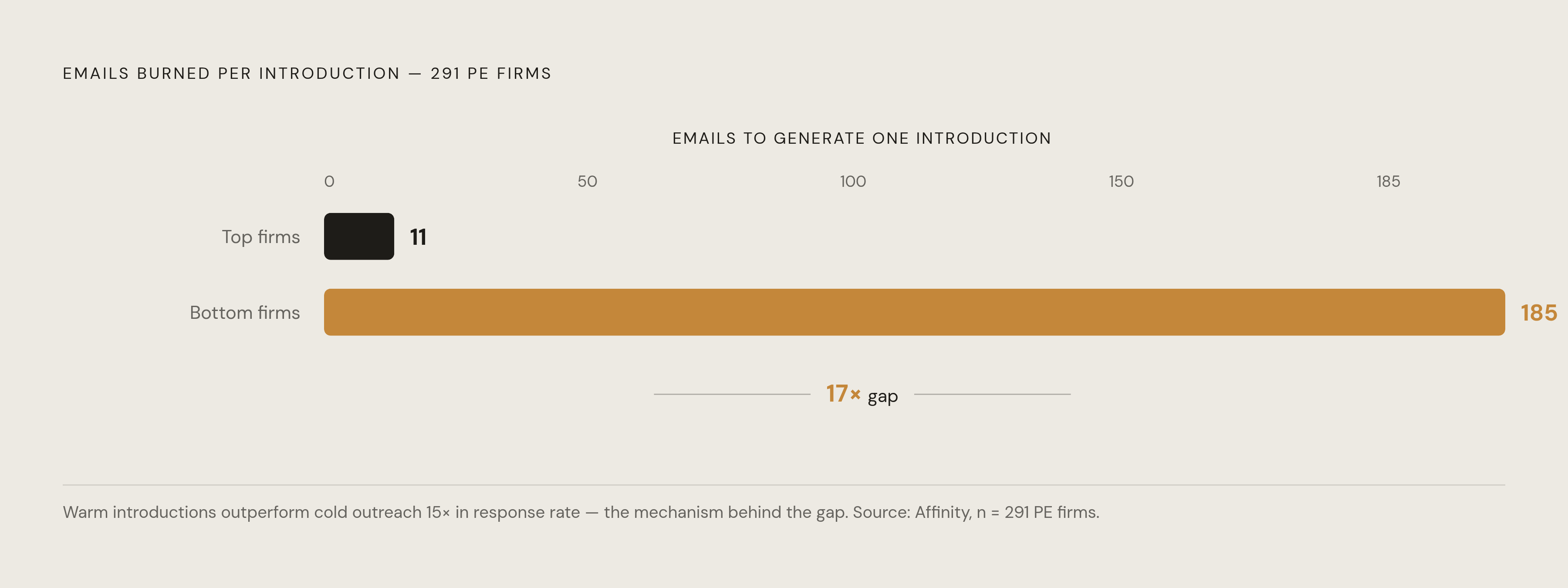
Affinity's analysis of 291 PE firms over two years surfaced a gap large enough to reframe how anyone should think about outreach efficiency. The most efficient firms in the sample generated one introduction for every 11 emails sent. The least efficient firms needed 185 emails to produce that same single introduction. That's a 17x gap between the top and bottom of the distribution, and it's worth asking what actually explains it.
It is tempting to assume the gap comes down to network size, that the efficient firms simply know more people. But that's probably not the real driver. The gap is much more plausibly explained by routing: how well a firm can direct its outreach through the warmest path already available to it, rather than defaulting to a cold email because nobody realized a warm path existed. Warm introductions outperform cold outreach by 15x in response rates, which is a staggering multiple when you actually think about what it means for a firm competing on speed. And algorithms designed to surface the warmest available path of introduction have been shown to increase the odds of winning a competitive deal by up to 25%.
There's a data point from 2024 that crystallizes this well. Top-performing firms ended the year with 16% more introductions year-over-year, while simultaneously adding 4% fewer new contacts. Read that pairing carefully: they made more introductions with a smaller universe of contacts to draw from. That's direct evidence the highest performers are going deeper into relationships they already have, not wider into relationships they don't.
This lands at an interesting moment. 50% of dealmakers named new deal sourcing as their top priority heading into 2025, up from 30% the year before. So the competitive pressure to source more deals is intensifying right when cold outreach is proving to be the least efficient way to do it. Firms that have already mapped their internal overlap are positioned to meet that pressure with warm paths. Firms that haven't are stuck competing on raw volume, sending more emails to get the same result.
The mechanics of running a network overlap analysis across a firm's principals
So how does a firm actually build one of these maps? It starts with establishing the inputs to the relationship graph itself. Email history matters most, since it shows who has corresponded with whom, how recently, and how often. Calendar data carries even higher signal in some ways, because a scheduled meeting indicates a relationship strong enough to justify someone's actual time, which is a scarcer resource than an email reply. LinkedIn and other external databases fill in structural context: degree connections, board memberships, prior employers. And CRM records help too, with the caveat that manually maintained CRMs run straight into the 31% annual decay problem already discussed.
From there, the firm needs to define which overlap dimensions actually matter given its thesis. Co-investor overlap asks which VCs both Partner A and Partner B have backed deals alongside. Founder and operator overlap identifies which executives multiple partners know, and which individuals sit at the intersection of the most clusters, making them unusually valuable connectors. LP overlap is often undercounted, but shared limited partners represent real relationship capital. Alumni overlap picks up shared institutional or educational history, the kind of latent trust Garfinkel's research already suggested carries measurable weight.
Once those dimensions are mapped, paths need to be ranked by warmth, not mere existence. A shared connection isn't automatically a warm path; recency, depth, and directionality all matter. Two partners might share a contact that neither has actually spoken to in two years, and that's a dormant edge, not an active one, no matter how impressive it looks on a graph. Ranking should weight how recently the interaction happened, how frequent it's been, and whether the relationship runs both ways or only one.
Then comes a step firms tend to underestimate: surfacing the path without exposing private context that was never meant to be shared. The firm-wide graph should be able to show that Partner A has a strong relationship with a target company's CFO. It does not need to show the actual content of what they emailed each other about. Permissioned architecture, meaning a clear design for what enters the shared graph versus what stays private, has to be a requirement from day one, not something bolted on after someone complains.
Finally, the path gets activated through outreach that actually uses the context the map surfaced. The whole point of building this in the first place is enabling the right ask: who should be the one making the introduction, what context do they need going in, and what exactly is being asked for. Generic, templated outreach defeats the entire purpose. It erases the warmth that made the path worth using in the first place.
What relationship intelligence platforms do — and where they differ in their approach to overlap
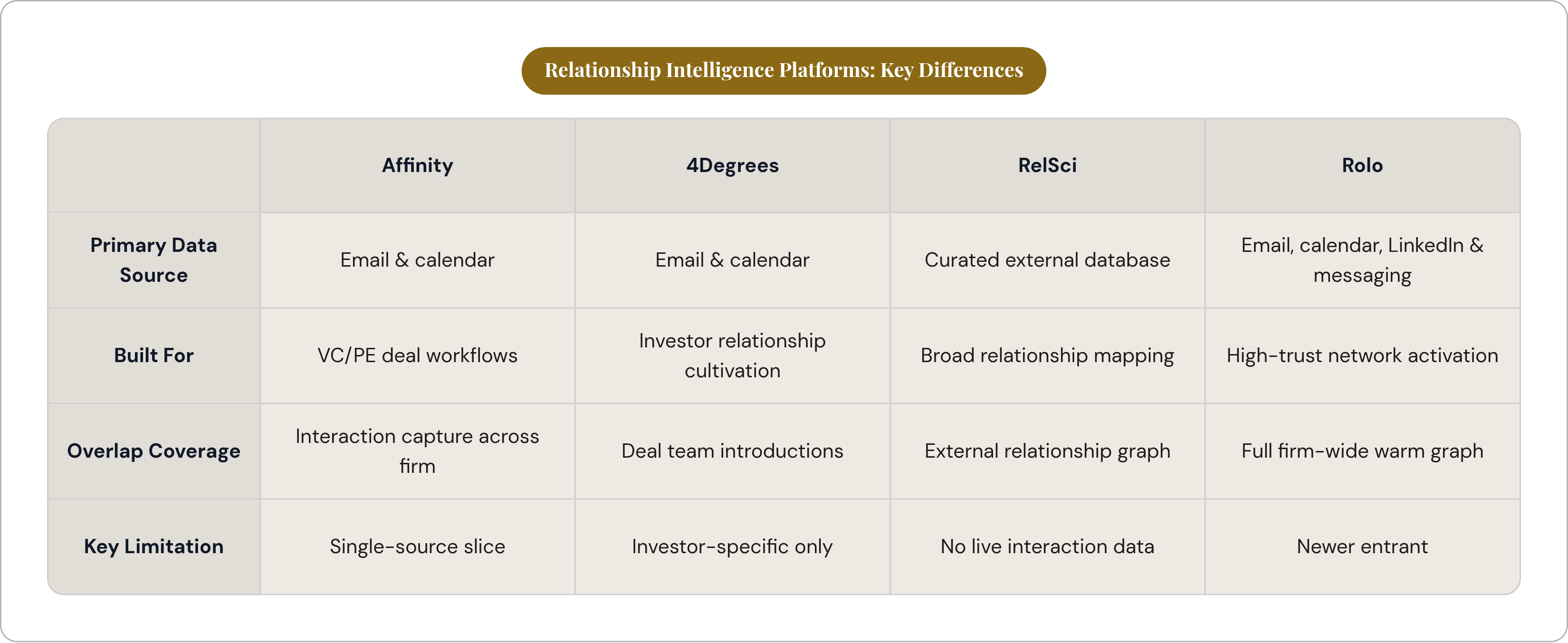
A distinct category of software has grown up around this exact problem: relationship intelligence platforms, built to automate the capture, enrichment, and surfacing of relationship paths across a firm's communication data. These are meaningfully different from a traditional CRM, which depends on someone remembering to type information in by hand.
The generation of tools that emerged roughly between 2018 and 2024 tended to build around a single data source, and it's worth naming how that shaped what each one could actually see. Affinity and Introhive built around email and calendar. RelSci built around a curated external database of relationships. Sales Navigator built around LinkedIn's graph. Each revealed one slice of the overall relationship picture, which was genuinely useful, but none of them captured the whole thing, because the whole thing lives across multiple channels at once.
The next generation of platforms is trying to compete on two fronts simultaneously: structuring the full warm graph across every type of connector a firm has, meaning team members, customers, board members, and partners, and running the actual warm-intro motion end to end instead of stopping at "here's a path that exists, good luck." Affinity remains the incumbent inside VC and PE, automatically capturing every interaction a firm has with founders, co-investors, LPs, and operators, with CRM functionality purpose-built for deal-sourcing workflows; MassMutual Ventures surfaced 67,000 contacts and 43,000 organizations within 60 days of implementing it, which gives some sense of how much relationship data sits invisible inside a firm before anyone bothers to look. 4Degrees was built by former investors and focuses on the investor-specific workflow of cultivating relationships and surfacing introductions inside deal teams.
Rolo, from Alpha Watch, takes a somewhat different angle: it connects the systems where professional relationships already live, meaning email, calendar, LinkedIn, and messaging, and turns that scattered history into a single, queryable graph across the whole firm. It surfaces warm paths and ranks them by relevance and recency, and it drafts outreach in the actual voice of the person sending it, without sending anything autonomously. That last detail matters, because it was built specifically for high-trust environments where private context has to stay private even as the fact that a relationship exists becomes useful to the wider firm. It's designed for the investor trying to source a deal, the founder who needs a warm path into a target OEM, or the BD operator who knows, somewhere in the back of their mind, that the right introduction exists inside the firm but has no way to actually locate it.
The differentiating question worth asking of any platform in this category is fairly simple: does it just tell you a path exists, or does it help you actually use it, and can it do that without exposing the private correspondence that made the relationship worth having in the first place? 64% of investors already use AI to speed up company research, and 92% use AI somewhere in their workflow. The question facing firms today isn't whether to adopt tools like these. It's which approach to the underlying graph actually serves the overlap problem rather than just adding another dashboard nobody checks.
Privacy and permissioning: why overlap mapping only works if people trust the system
The resistance partners feel toward this whole idea is real, and it's legitimate. Asking a senior partner to make decades of contact history queryable by the rest of the firm is asking them to hand over something they spent years, sometimes an entire career, building relationship by relationship.
Underneath that resistance sits a specific, well-founded fear: that a junior team member will reach out to a close, carefully maintained relationship without the right context and damage something the partner worked hard to build. That fear shouldn't be dismissed or argued away. It should be designed around.
The design answer separates institutional signal from private context. The firm can know that Partner A has a strong relationship with a target company's CFO without anyone else seeing the actual content of their email exchanges. Permissioning has to sit with the individual, meaning each partner controls what enters the shared graph and at what level of detail gets exposed. And critically, any action built on top of the map, meaning an actual outreach or introduction, requires a human being to approve it. The system's job is to recommend a path and draft the ask; it is not the system's job to send anything on its own.
That structure is what makes overlap mapping viable at all. Without it, you're not building a relationship intelligence system, you're building a surveillance layer that partners will quietly route around, keeping their best relationships out of the graph entirely. And a map with the best relationships missing isn't really a map. It's a partial picture dressed up to look complete, which might be worse than having no map at all, because at least then everyone knows what they don't know.