LinkedIn Integration Limitations in Professional CRM Workflows
LinkedIn's API deliberately blocks CRM access to protect its premium product.

LinkedIn's API is built to keep the professional graph it owns out of reach of the CRM tools that would make it useful for relationship work. This piece maps what that architecture permits, what it refuses, why the refusal is permanent rather than a bug awaiting a fix, and where firms can build relationship intelligence instead, using data they already control.
LinkedIn's API: what it permits and refuses in 2026
LinkedIn is the dominant professional graph, but the API that governs access to that graph is built to exclude the vast majority of developers and CRM builders from the data that would make it useful as relationship infrastructure. The restriction starts at the message layer. Unapproved developers cannot send direct messages through the API, reading message history through the Compliance API remains closed even to most developers who have already cleared LinkedIn's partner approval process, and the official API blocks unapproved developers from profile data and connections data as well.
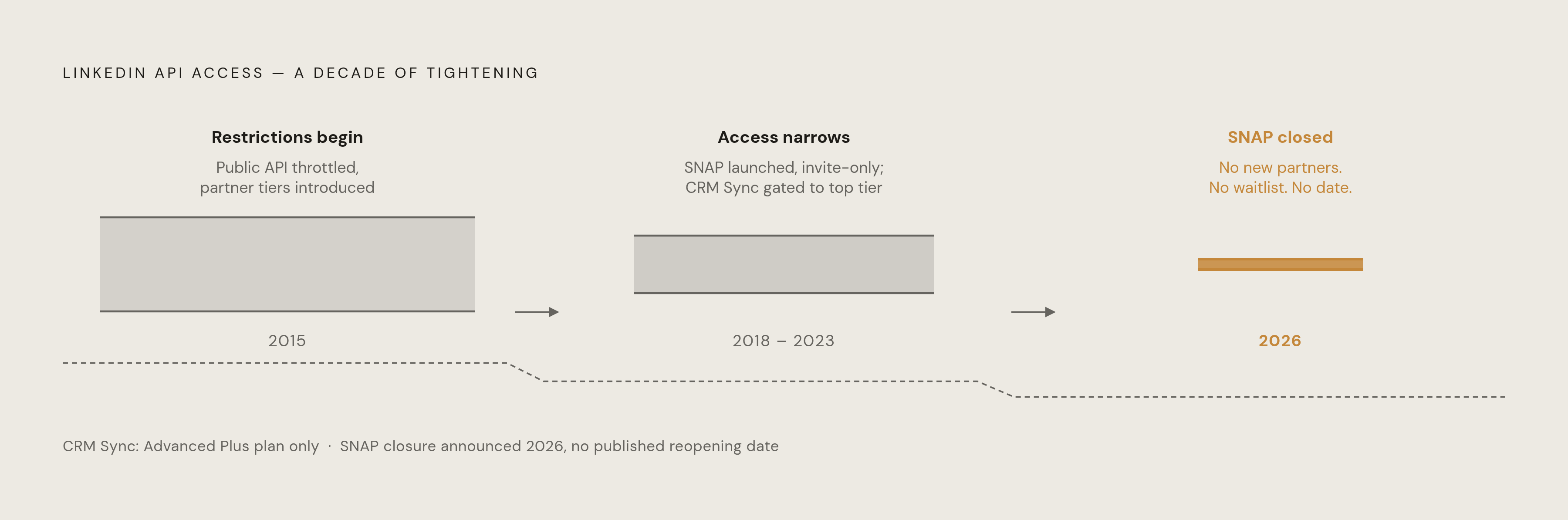
The Sales Navigator API, known as SNAP, enables profile matching and lead data at scale and would be the natural route around this. As of 2026, SNAP has stopped accepting new partners entirely, with no waitlist and no published date for when onboarding might resume. Even where access is granted, the rate limits attached to it undercut any attempt to operate at professional scale: limits vary by endpoint and tier, and the Community Management API's Development tier caps out at 100 calls per member per day, while higher application-level limits elsewhere still fall short of what a firm managing hundreds or thousands of contacts would need.
Then there is the use-case restriction, which closes off the remaining angle. LinkedIn's Marketing API Terms, along with the program-specific terms attached to them, explicitly prohibit using the API for marketing or sales prospecting, a category that includes identifying leads, enhancing CRM records, or building audience lists. A firm that wanted to use LinkedIn data to enrich its own contact database would be operating outside the terms it agreed to by building on the platform at all.
The wall is sharpest in profile lookup. Retrieving another member's profile requires a Person ID, and LinkedIn's own documentation states that this ID is "available only via certain limited access APIs and subject to member privacy settings," returning nothing for any member who has restricted their Off-LinkedIn Visibility. The endpoint exists on paper. The data behind it does not, for a meaningful share of the people a firm would want to look up. That gap between what is documented and what is retrievable is the clearest evidence that the wall is deliberate rather than incidental.
Why LinkedIn built the wall
The restrictions just described are a monetization and ecosystem-control strategy, and recognizing that tells a firm whether to wait for LinkedIn to loosen its grip or to build around it permanently. Blocking third-party CRM integrations creates a specific kind of pressure: anyone who wants programmatic access to relationship data is pushed toward Sales Navigator, LinkedIn's own premium product, as the only sanctioned path.
This is not a new posture. LinkedIn has tightened API access progressively since 2015, and each round of tightening has lined up with an expansion of what Sales Navigator offers. The direction of travel has been consistent for over a decade, which is the strongest reason to treat the current state not as a temporary inconvenience but as the latest point on a line that keeps moving the same direction.
Even the official escape hatch reflects this logic. Sales Navigator's CRM Sync, the sanctioned way to connect LinkedIn data to an external system, is available only on the top-tier Advanced Plus plan, putting it out of reach for most firms that would want it. LinkedIn frames its restrictions as user-data protection, and that framing carries real legal and reputational weight. But the privacy rationale and the commercial incentive both point the same direction: there is no version of opening the API that satisfies one goal without threatening the other, because wider access to connection data would undercut Sales Navigator's value proposition regardless of how carefully it was gated.
One might argue LinkedIn is leaving money on the table. It could open the API and charge for it directly, capturing revenue from developers while still enabling the integrations firms want. LinkedIn has had years to make that move and has chosen not to; the CRM Sync pricing structure shows a preference for bundling data access inside its own premium subscription rather than selling that access as a standalone product. The incentive to preserve the wall outweighs the incentive to monetize passage through it. The 2026 closure of SNAP to new partners, without any published timeline for reopening, reads as confirmation that this cycle of tightening is not finished.
Where exactly the wall breaks professional CRM workflows
The consequences of this architecture are not minor friction. They sever the specific data flows that relationship-driven CRM depends on most: network traversal, communication history, and connection-graph visibility across a team.
Start with traversal. Mapping a firm's own network programmatically requires reading connections, and reading a member's profile requires a Person ID that is unobtainable wherever Off-LinkedIn Visibility has been restricted. Firms cannot reliably chart even their first-degree connections through automated means, which rules out any systematic attempt to surface second- or third-degree paths, the paths that most often contain the warm introduction a deal actually needs.
Communication is a separate failure. LinkedIn messages and email live in two systems with no authorized bridge between them, and professionals consistently point to this specific gap, the inability to see LinkedIn messages alongside email in one CRM view, as a dealbreaker for the tools they evaluate.
LinkedIn itself does not help close this gap from the inside. There is no native way to add notes to a profile, tag or categorize a connection, or log a meeting against a contact, and because the API prohibits using LinkedIn data for CRM enrichment, no third-party tool can build that functionality through sanctioned means either. The feature set a CRM user expects by default simply does not exist on the platform that holds the most relationship data in the first place.
The team-level version of the problem is sharper still. Connection data cannot be pooled across a firm's members, so each professional's network stays siloed inside their own account. Picture a BD operator who needs to confirm whether anyone at the firm has a credible path into a target company before an outreach email goes out cold. The warm path may exist somewhere inside the firm's collective network. There is no authorized way to query for it, so it stays invisible exactly when it would matter most. Off-market deal sourcing breaks precisely at this point: the relationship exists, but no system LinkedIn permits can surface it.
Even where a firm manually copies LinkedIn data into its CRM to work around the gap, the records decay almost immediately. Most member profile data is subject to a 24-hour storage limit under the Marketing API's developer policy, which makes any kind of automated refresh impossible. What gets saved becomes a historical snapshot rather than a living record, stale the moment it is captured.
The net effect is fragmentation. Firms end up maintaining separate systems, a CRM for contact records, a LinkedIn session for connection data, email threads for interaction history, none of which talk to each other, producing a relationship picture that is always incomplete at the moment it matters. Some firms try to patch this with unofficial integrations built on browser automation or scraping. Those approaches violate LinkedIn's terms of service and carry real account-restriction risk, because LinkedIn actively enforces against them through behavioral analysis and browser fingerprinting. The workaround is as fragile as the wall it is trying to get around, maybe more so, because it adds the risk of losing account access entirely on top of the original data gap.
Why warm-path relationship data is worth solving for
Whether any of this is worth solving at all is itself a fair challenge before going further. Would a firm be better off accepting the wall and working within it? The answer turns on what warm introductions actually do, which is not a marginal improvement over cold outreach but a different order of outcome entirely.
Cold email reply rates have collapsed below 3% according to industry tracking, and that gap from warm-path performance is not incremental but structural, because it reflects how professional trust actually operates, not a difference in message quality or timing. Connection-graph visibility also changes timing, not just outcome: a firm that can see its network clearly may identify a high-priority target months before that target's founder starts talking to investors at all, and knowing in advance whether anyone in the portfolio or LP base already has a relationship with the founding team lets the first conversation open warm instead of cold. Firms that have closed this visibility gap report measurable sourcing gains, more deals reviewed, broader coverage of early-stage rounds, and those gains compound, because every new relationship added to the graph creates more paths to the next opportunity.
That raises an obvious objection. If LinkedIn's wall is as permanent as the previous two sections argue, isn't the entire case for warm-path data moot, since the infrastructure to access it reliably doesn't exist? The objection is correct about LinkedIn specifically. That is exactly the point at which the argument needs to shift, from trying to access LinkedIn's graph to building relationship intelligence on data a firm already owns outright.
Where relationship data lives when LinkedIn won't release it
The data LinkedIn withholds is not missing from a firm's environment. It already exists, recorded in granular detail, inside the communication systems the firm fully controls, and the case for building there is structural: the firm owns this data outright and no API wall governs it.
Every email sent, every meeting invitation accepted or declined, every calendar event logged is a timestamped record of how strong a relationship is, how recently it was touched, and what context surrounds it. Taken together, these signals form a more accurate picture of how warm a connection actually is than a static first-degree link on LinkedIn, which tells a firm only that a connection was made at some point, not whether it still means anything. LinkedIn profile data pulled through the API has to be deleted within 24 hours under the platform's terms.
None of this requires new data collection. The systems involved, email, calendar, LinkedIn accessed manually, messaging apps, are the same ones professionals already use every working day. The actual gap is integration and queryability: the data exists but sits disconnected across tools that were never built to reference each other.
This is the institutional pattern of disconnected systems. A typical firm's relationship data is spread across a CRM holding contact records, email threads holding interaction history, a calendar holding meeting cadence, and LinkedIn holding connection visibility, with none of these systems joined to any other. Organizations repeatedly name data silos as one of the main barriers to their CRM delivering what they expected from it. In investor relations specifically, the dysfunction is structural rather than incidental: IR teams work across disconnected sources, CRM, ownership analytics platforms, roadshow spreadsheets, email threads, with no single system able to answer a basic question like who actually engaged versus who was invited and never responded.
Manual upkeep does not solve this, because no professional has the time or the discipline to log every interaction consistently. A CRM that depends on human logging will always carry gaps, and those gaps tend to open widest at the exact moment a deal or an introduction turns time-sensitive. The team-departure risk compounds this further: when someone leaves a firm, the relationships they built, who they knew, how well, through what path, leave with them unless the communication history that recorded those relationships has already been captured at the institutional level rather than left inside one person's inbox.
What relationship intelligence built on owned data can do
A relationship intelligence layer built on email, calendar, and communication history can do precisely what LinkedIn's API wall is built to prevent: traverse a firm's collective network to surface warm paths, rank connections by how recent and relevant they are, and preserve relationship context when the person who built it leaves, all without needing LinkedIn's cooperation or exposing anyone's private messages.
Determining whether anyone across a firm has a credible introduction path to a target company requires pooling connection data across the whole team, something LinkedIn prohibits doing programmatically. Email and calendar history across that same team already encodes the answer, because every meeting and every exchange between a colleague and a potential path to the target is sitting in records the firm already owns. A relationship graph built from that history can surface second- and third-degree paths that no single team member would see by checking their own LinkedIn account.
This is a relationship intelligence layer that treats email and calendar activity as the primary signal for how warm a connection really is and how recently it has been touched. Ranking by recency and relevance works the same way. A first-degree LinkedIn connection could carry the same static weight in a traditional CRM as a contact a partner exchanged emails with last week. A system built on communication history can tell those two apart, surfacing the contact that is actually warm right now rather than the one that merely exists somewhere in a network.
None of this requires LinkedIn's permission, because none of it depends on LinkedIn's data in the first place. It depends on the records a firm has been generating all along, in systems it already controls, waiting for a layer that can finally make them queryable as what they have been the entire time: the real record of the firm's relationships.