Forwardable Blurb Mechanics in Professional Introduction Chains
A well-crafted blurb removes friction from the connector, making introductions actually happen.
A warm path to the right person is not the same thing as an introduction. Between the two sits a short piece of text, usually two or three paragraphs, that most people treat as an afterthought and that actually determines whether the whole effort pays off. Warm introductions carry weight because the request arrives through someone the recipient already trusts. The connector's reputation screens the deal before a single word of pitch gets read. The blurb only earns that screening power if it gives the connector something worth staking their reputation on. A vague or half-finished blurb forces the connector to either rewrite it themselves, at a cost of time and attention they rarely have, or quietly let the request sit. The number of introductions that die this way, not from a lack of goodwill but from a missing or clumsy draft, is the real subject of this piece.
Why the connector's friction level determines whether the introduction happens at all
The single factor that predicts whether a connector forwards a blurb has less to do with how much they like the person asking and more to do with how much work the forward requires of them. Connectors are busy people spending social capital on someone else's behalf, and any message that demands interpretation, editing, or additional context-gathering gets deprioritized, then forgotten. The most common reason an introduction never materializes is a connector who meant to send something, intended to write a few lines to frame it, and never found the ten free minutes to do so.
A blurb built correctly removes that burden. It works on three levels at once: it makes a strong impression for the person asking, it gives the connector enough confidence to hit forward without hesitation, and it reinforces to the recipient that this particular connector sends high-quality introductions worth opening. That third effect matters because connectors who send sloppy introductions pay a reputational cost with the people they introduce to, which makes them warier about doing it the next time.
There is also a softer corollary built into the ask itself. Give the connector a graceful way to decline, make it easy to say no, and avoid creating pressure around the request. A reluctant connector who feels obligated will send a half-hearted introduction, and that half-heartedness strips away the credibility that made the warm path valuable. The practical test for whether a blurb is actually finished is simple: if the connector cannot forward it without editing a single word, it is not ready. Everything the next section covers follows from that test.
The four structural elements that make a blurb forwardable
A forwardable blurb has four parts, and each one does a specific job for a specific reader, whether that is the connector deciding whether to send it or the recipient deciding whether to respond.
The first element is name and role, stated in the opening line so the recipient never has to guess who is being introduced. This should be written in the third person. That point deserves a moment of clarification, because advice on self-written outreach often warns against writing about yourself in the third person, and that warning is correct for a blurb a founder sends directly under their own name. A forwardable blurb is different: it is drafted by the requester but voiced as the connector, since the connector is the one who will actually hit send. Third person is the only form that lets the connector forward the message without rewriting pronouns or restructuring sentences, which is exactly the kind of friction the previous section flagged as fatal.
The second element is company or context, compressed into a single sentence. Keeping it to one sentence forces discipline, since anything longer starts to read like a press release. That sentence also has to be written for the specific recipient rather than recycled across every introduction a requester sends out. A company description aimed at a growth-stage investor evaluating a funding round should emphasize different things than the same company described to a potential enterprise customer evaluating a vendor, or an OEM partner evaluating a supplier. A blurb that reads like it could have been sent to twenty different people with the names swapped signals low effort, and recipients notice. Specificity is what tells the reader someone did the work of thinking about them in particular.
The third element, and the one most blurbs get wrong or skip outright, is a sentence explaining why this introduction matters to the recipient specifically. This is the hardest part to write because it requires the requester to do analytical work most people skip: connecting their own situation to the recipient's actual interests or priorities, rather than simply listing facts and hoping the recipient draws the connection unprompted. A weak version states what the requester has built and leaves the relevance to be inferred. A working version names the connection outright: thesis fit for an investor, a specific portfolio overlap, or a timing reason the conversation makes sense now. A useful check: if the sentence could be dropped unchanged into a blurb sent to a completely different recipient, it has not done its job.
The fourth element is the ask, and it needs to be concrete. "I'd love to connect" asks nothing and gets nothing in return. A specific ask, such as a twenty-minute call or a reply if there's interest, respects the recipient's time by telling them exactly what saying yes would commit them to. Pairing that specificity with low-pressure language, something like "I'll let you two take it from here," gives the recipient an easy on-ramp. Clarity and low pressure do complementary jobs: one tells the recipient what is being asked, the other tells them they are free to decline.
Why skipping the double opt-in sequence burns the connector
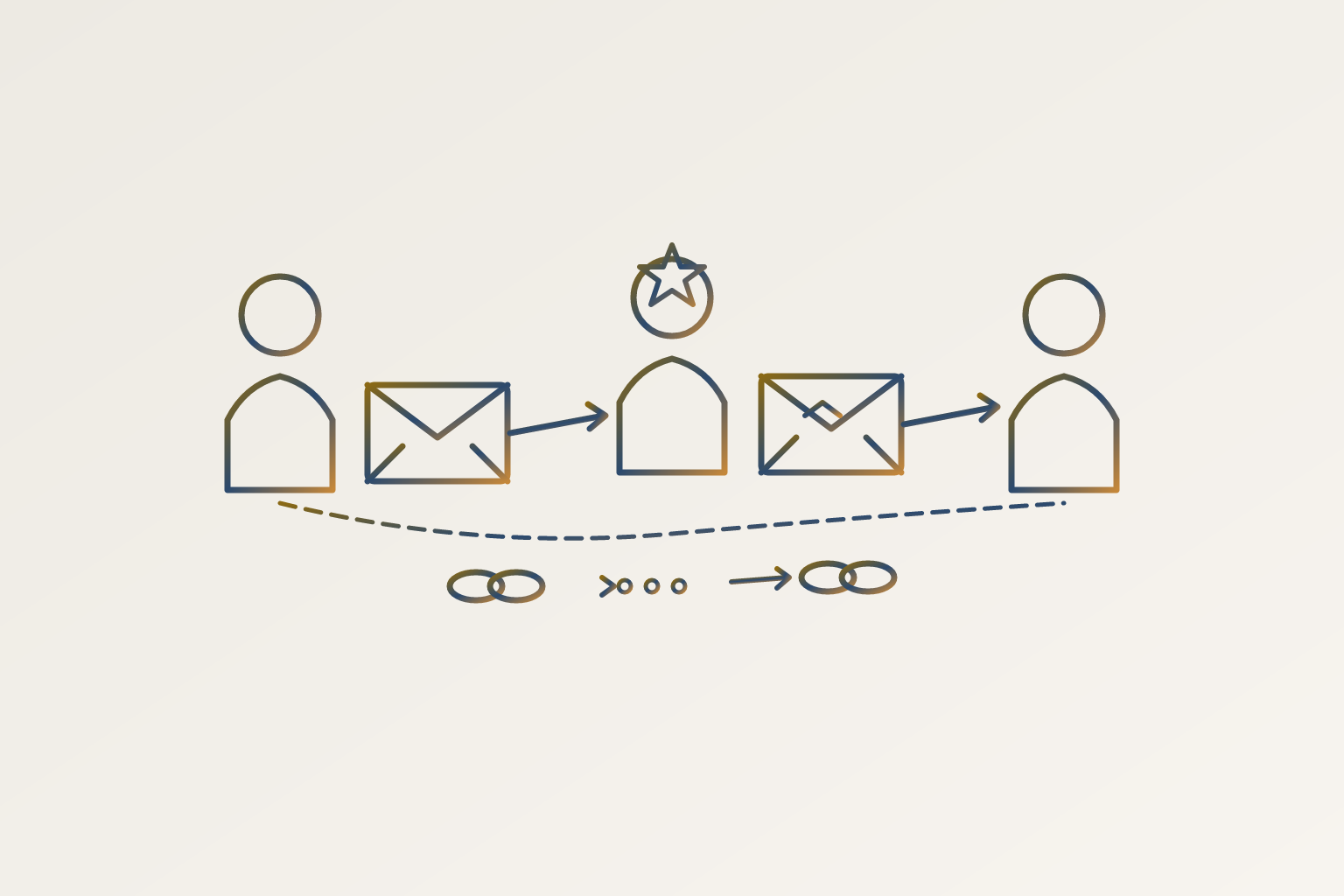
A perfectly built blurb can still fail if it gets deployed at the wrong moment in the chain, and the moment that gets skipped most often under time pressure is the opt-in step. The correct sequence runs in four parts. The requester hands the connector the blurb. The connector sends a short, separate note to the target asking whether they would be open to an introduction. Once the target confirms interest, the connector forwards the blurb itself. The requester then takes the conversation from there. Skipping the check-in and asking a connector to "just send it" puts the connector in the position of forwarding an unsolicited pitch to someone who never agreed to receive one, and that costs the connector goodwill with the very person they're introducing.
That two-step sequence protects three relationships at once. The requester's first impression lands on ground where the recipient already expects and wants it. The connector's reputation gets spent only on contacts who actually asked for the introduction, not burned on someone who resents being pulled into an unwanted conversation. And the recipient's time is never consumed by something they had no say in. None of that works if the requester hands over only one message. The practical fix is to prepare two distinct pieces of text: a brief note the connector can use to check for interest, and the full forwardable blurb to send once that interest is confirmed.
Time pressure is the usual excuse for collapsing these two steps into one. A deal is moving fast, a window feels like it is closing, and asking a connector to do two things instead of one feels like an avoidable delay, even though the extra step is what prevents wasted effort later. But collapsing the steps does not actually save time if it produces a dead introduction. It just moves the delay to later, often without anyone measuring the cost of the attempt that fizzled. Following up with the connector after the introduction, not just to say it happened but to report how the conversation actually went, closes the loop in a way that makes that same connector willing to help again. That willingness is not guaranteed. It depends on how genuine the connector's investment in the outcome was to begin with, and the mechanics of the blurb alone cannot make up for its absence.
Why the connector's conviction determines whether the blurb carries signal
A technically flawless blurb sent through the wrong connector will still produce a weak introduction, because the format only works when the underlying relationship carries genuine conviction. Not every path to a target is equally valuable, even when each one technically counts as "warm." Paths to a target fall into a rough hierarchy of value. An existing investor or backer who already has money riding on the requester sits at the top, because their credibility is staked on real financial exposure. Below that sits a portfolio founder the target has already written checks to, someone whose judgment the target has tested before. Below that are advisors or customers with direct working history. At the bottom sit second-degree LinkedIn connections, where the relationship is often closer to a shared network than an actual working bond.
Seniority is a weaker predictor of connector strength than depth of relationship. A senior engineer who has shipped a product alongside the requester for eighteen months carries more credibility as an introducer than a VP met once at a conference and connected with over LinkedIn the following week, even though the VP's title looks more impressive on paper. The recipient evaluates whether the connector's vouching means anything, which depends on whether the connector actually knows what they are vouching for.
Two groups should be avoided as connectors regardless of how well-crafted the blurb is. Investors who have already passed on the opportunity carry that negative signal with them even if they're willing to forward the message, since the recipient can often sense a halfhearted endorsement. And anyone who would not recognize the requester's face in person is not a warm connector in any meaningful sense. A tenuous acquaintance forwarding a polished blurb is, functionally, a cold email that took an extra step to arrive.
No amount of craft in the four structural elements compensates for routing the message through someone without genuine conviction. That does not argue against building systems to find connectors. It argues for building systems that surface the right connector, the one with the strongest actual relationship to the target, instead of defaulting to whoever happens to be easiest to reach. Judgment about relationship depth remains irreducible. The question is whether an organization can actually see enough of its own network to exercise that judgment well.
Why most firms cannot see the warm paths that already exist inside their own networks
Everything so far has addressed the blurb at the level of one requester, one connector, one target. Scale that up to a firm with dozens or hundreds of practitioners. The limiting constraint on warm introductions becomes the firm's inability to see which paths already exist across its own collective relationships.
No single practitioner holds more than a fraction of an organization's relationship graph. A partner may have sat through three meetings with a target company's CFO the previous year. An associate on a different team might already be connected through a shared portfolio company board seat. A business development operator might sense, correctly, that the right introduction exists somewhere inside the firm, without being able to locate whose relationship it actually is. Each of these people is sitting on a piece of the answer, and none of them can see the whole picture.
Traditional CRM systems were supposed to solve exactly this problem, and in practice they tend to make it worse. Complex interfaces, heavy manual data entry requirements, and thin training lead employees to work around the system. The predictable result is duplicate records, outdated contacts, and fragmented data scattered across tools that were never built to talk to each other. A CRM that depends on manual upkeep will always be behind the actual state of the relationships it is meant to track, and a stale contact record is arguably worse than having no record at all, because it creates false confidence in a path that may no longer be real. A partner who believes a contact is warm because the CRM says so, when that contact left the company eighteen months ago, is worse off than a partner who knows to go check.
The institutional consequence is a firm that is data-rich and insight-poor at the exact moment it matters most: when a time-sensitive sourcing question needs an answer measured in hours, not days. The relationships exist. The history is there, scattered across inboxes, calendars, and the memories of people who may be on a different floor or a different continent. What's missing is the ability to surface any of it fast enough to matter.
What relationship intelligence looks like when it is built for this specific problem
A relationship intelligence platform designed for this exact problem has one job: make the firm's existing network visible and actionable at the moment someone needs an introduction, without pretending to replace the judgment the earlier sections established as essential. That means reconstructing the relationship graph from the data a firm already generates, emails, meeting history, calendar patterns, rather than relying on anyone to manually log a contact after the fact. It means surfacing not just that a path to a target exists, but which path is strongest, using something closer to the hierarchy described earlier: an investor with money at stake ranks above a second-degree LinkedIn contact, and the system should reflect that distinction rather than treat every connection as interchangeable.
It also means helping with the mechanical layer this article has spent most of its length on: drafting a first version of the blurb in the requester's voice, structured around the four elements, name and role, context, relevance, and ask, so that a human still reviews and sharpens it rather than sending a machine-generated draft untouched. The system's real contribution is speed and visibility, not persuasion. The judgment about whether a connector's conviction is genuine, whether the timing is right, whether the ask is pitched correctly for this particular recipient, stays with the people doing the asking. What changes is how long it takes them to find out the path was there.